
Scott’s ascendency is an example of the rising influence of the SFA, which is now a major player at the nexus of history, culture, and progress.
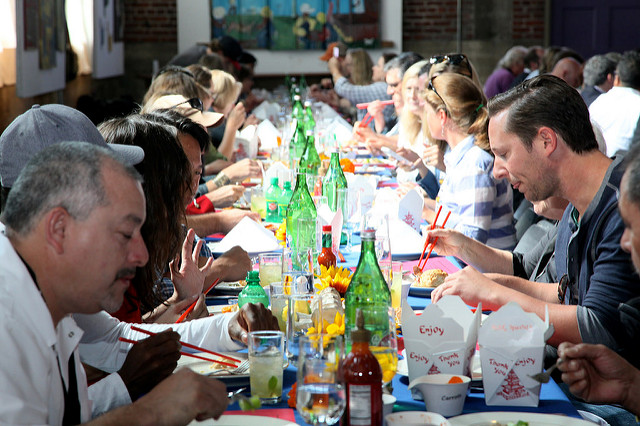
Although food may seem central to SFA work, it’s really more of an entry point for contemplation, exploration, and discourse. People flock to SFA to learn from experts, and also from each other through casual conversations over cocktails or lunch.
They look forward to getting the newest edition of Gravy, SFA’s quarterly award winning journal, and listening to the latest episode of the podcast, also called Gravy. They watch the short films and documentaries SFA commissions, and attend oral history and film workshops hosted by SFA. When a fellow member publishes a book, they organize or attend author signing parties. When an SFA member restaurant hosts a fundraiser event, they drive for hours or book plane tickets to attend and show their support.
Intense social bonding happens at SFA events, when busy restaurateurs, farmers, writers, and academics, who normally have a hard time peeling away from day jobs, carve out a few days to spend with peers. They share insights and tips, support each other through struggles, and celebrate triumphs.
Active members trust each other so much that they invite people they may have only met a few times to sleep in their spare bedrooms when they’re out of town.
Members will open up to a stranger introduced by an SFA leader and share personal stories about painful family dynamics, failed business ventures, and the impacts of racism. They do this with complete faith that if SFA trusts this new person, then they should, too.
In a conversation about career trajectories, members often name a handful of close SFA friends who have had an impact on their business.
Often they join fellow SFA members at food and wine festivals or SFA events, and they drop in for visits with SFA friends when they travel across the region and nation. They go out of their way to stay in touch with each other, texting about something funny or asking advice. A tight web of influence and trust connects members.
“They’re like summer camps for grown-ups,” Angie Mosier, who owns an Atlanta food styling and photography company called Placemat Productions, says of SFA events. “People you’ve known for so long, people you love, and you’re so excited to see them. It’s the best kind of fellowship.”
The community extends far beyond events.
“We’re mostly head down and working; the restaurant business is all-consuming,” said Pardis Stitt of Birmingham, who along with her husband, Frank Stitt, owns Highlands Bar & Grill and sister restaurants Chez Fonfon, Bottega, and Bottega Café. “So many of my adult friendships are because of SFA. Writers, chefs, people we would never meet or see otherwise.”
That kind of fidelity is rare among nonprofits. Supporters of a community food bank, the Southern Poverty Law Center, or local chapters of organizations such as Habitat for Humanity don’t usually know each other so intimately or have such weighty professional influence on each other.
SFA has created intense loyalty to the organization, which impacts its financial success and stability. SFA now counts 1,875 souls as members and reaches a much broader audience through social media: 44,000 Facebook followers, 45,000 Instagram followers, 35,000 Twitter followers, and 47,000 unique monthly website visitors. The annual budget is $1.4 million excluding events, which are designed to roughly break even.
Only 5% of the budget comes from membership dues. Philanthropy funds the organization. The largest single source is an auction, hosted each January by Blackberry Farm, that yields $200,000 or more each year. One donor has made two $1 million gifts to SFA operations, and another has made a $1.25 million contribution. More than 20 donors have made gifts in the $25,000 to $100,0000 range, and gifts in this range have consistently gotten larger and more frequent over time. SFA operations are largely underwritten by donations from companies including Billy Reid, Lodge Manufacturing, Royal Cup Coffee, and McIlhenny Company, the maker of Tabasco®.
At SFA’s core is scholarship and an academic grounding that underpins all of its work. All work is richly researched and contains historical context, and oral histories and documentary films capture the circumstances of the subject’s upbringing and family history, plus the corresponding political, economic, cultural, and social climates that defined an era.
Although it could publish its books through any house, SFA leaders choose to publish through an academic press in partnership with the University of Georgia. Every part of its programming is original and deeply considered, and events are populated with thinkers and scholars from across many academic disciplines who try to make their material engaging even when the audience might not be fond of footnotes. Even meals are planned so that they are contextually appropriate.
SFA is an institute of the Center for the Study of Southern Culture at the University of Mississippi. It is housed in the central rotunda at Barnard Observatory, not far from the Circle where a deadly 1962 riot erupted in protest of the admission of the first AfricanAmerican student.
The University benefits from a symbiotic relationship with SFA in which academic rigor, cachet, and media attention flow both ways. The school manages finances, human resources, healthcare, and retirement benefits for SFA staff. To give back, and to drive foodways scholarship, SFA has endowed two faculty positions. One of those professors, Catarina Passidomo, received a Fulbright US Scholar award in 2018 to travel to Peru to teach and conduct research on post-colonial Peruvian foodways and how cuisine helped establish a nation-brand. SFA funds two Nathalie Dupree Graduate Fellows, and by 2020 SFA will endow a senior leadership position in its own organization.
“Think of the great programs that bring attention to the university, and pound for pound SFA is a tremendous bargain,” said Justin Nystrom, an associate professor of history at Loyola University in New Orleans, Director of the Center for the Study of New Orleans, and SFA member and contributor. “SFA raises its own money and brings all this really positive attention to the university. It’s hard to quantify it, but you know it’s there. There is enormous return on investment on what they’re doing.”
With its professionally produced and academically-focused content, one could mistake SFA for a digital media company that happens to be a nonprofit.
Managing Editor Sara Camp Milam directs SFA content creation, with assistance from a team of contract writers, editors, designers, and other contributors. SFA’s lead oral historian Annemarie Anderson manages a team of contract oral historians who are paid well for their work.
SFA media products cover many genres. The Gravy podcast has been downloaded more than 2.4 million times as of August 2018. The professionally designed, edited and produced Gravy publication typically runs 70-plus pages of essays, poetry, personal opinion, journalism, and occasional recipes. The James Beard Foundation named Gravy, the collective print and podcast forms, publication of the year in 2015.
SFA has gathered nearly 1,000 oral histories over the years, and, has produced 125 documentary films. SFA films have screened on PBS across the nation, and at film festivals such as the Nashville Film Festival, the Sidewalk Film Festival in Birmingham, and Indie Grits in Columbia, South Carolina.
SFA media is so well produced that Marcie Cohen Ferris often incorporates it into her curriculum at the University of North Carolina at Chapel Hill, where she taught in the American Studies department before retiring in 2018. SFA encourages use of its materials and while many academic producers charge usage fees, SFA grants free classroom usage and distributes all content digitally at no cost.
“I am constantly pulling up and showing SFA content in class. It supports my scholarship and my teaching,” said Ferris, author of The Edible South. “Everything resonates because it’s excellent, well produced, well designed. Students, if they look at it and think it’s a lame website or bad technology or bad film quality, they tune out. The quality of everything is really good.”
SFA compensates those writers, directors, and producers well. The organization also invests in future contributors through writing workshops, oral history workshops, film workshops, and graduate student symposia.
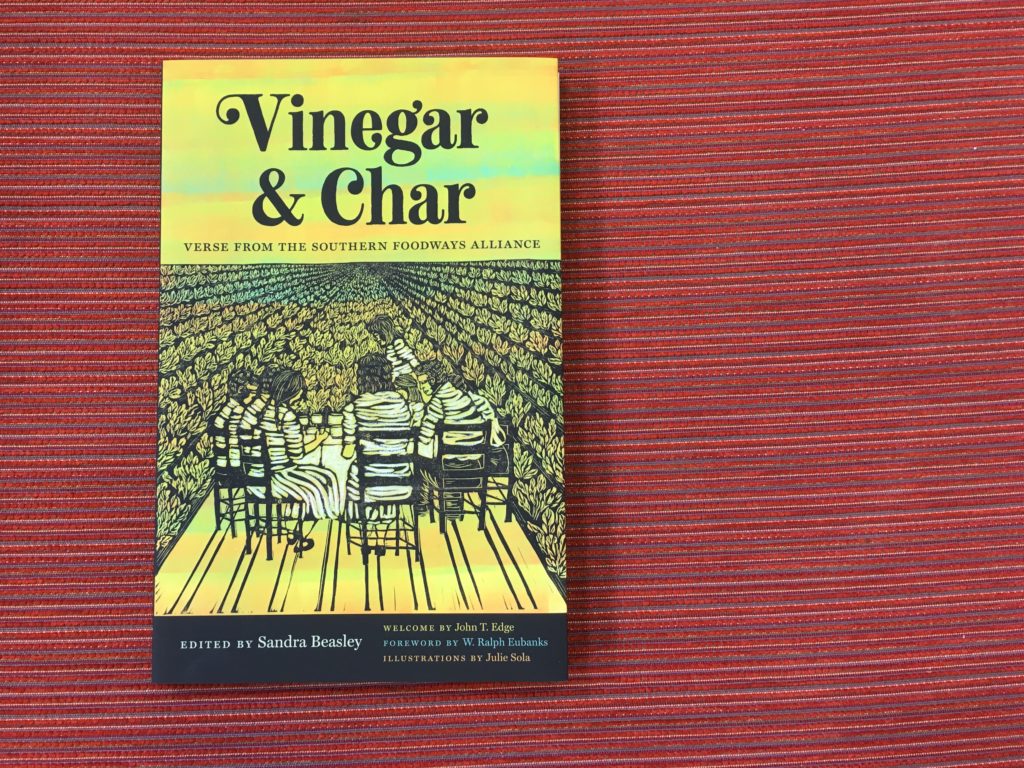
The 2018 releases of SFA’s book series with the University of Georgia Press included Catfish Dream by Julian Rankin about African-American catfish farmer and processer Ed Scott’s fight for his family farm and racial justice and Mississippi Delta, and Creole Italian by Loyola’s Nystrom, about how Sicilian immigrants shaped New Orleans food culture. A book of poetry titled Vinegar & Char, edited by Sandra Beasley, debuted in the fall of 2018, showing the breadth and range of what Southern foodways means. This sort of work is a defining difference for the SFA. How many other food-focused nonprofits publish books of poetry?
SFA hosts dozens of events each year including the Fall Symposium, which was founded in 1998, a year before SFA itself came into existence. In 2012, when the theme was barbecue, the event sold out less than a minute after ticket sales were announced. Two years later, when the theme was race relations, the Fall Symposium sold out in less than 30 seconds. To meet the demand, SFA added a Winter Symposium and has increased the size of the Summer Symposium.
The SFA’s biggest impact is arguably the exposure it generates for the often unknown or little-known cooks, restaurateurs, farmers, and artisans featured in SFA podcast episodes, films, oral histories, journal articles, and at events. Careers and businesses often flourish after attention from SFA.
That impact extends to the writers, historians, and archivists who gather and produce material for the SFA. Rosalind Bentley, a journalist at the Atlanta Journal-Constitution and a SFA contributor and member, recently completed a Master of Fine Arts in narrative nonfiction from the University of Georgia, where Edge was her mentor. In 2017, she reported and produced a Gravy podcast and wrote a companion print Gravy article about her great aunt Lucille Burton, a Civil Rights movement activist who fed and housed young men and women at her home in Albany, Georgia. Bentley says the joy and fulfillment that came from that project, coupled with support from Edge and other SFA colleagues, encouraged her to advance plans to write a book and reach new audiences.
“When you’re doing the work you should be doing, there’s nothing better,” Bentley said.
Media coverage of barbecue pitmaster Sam Jones has more than tripled since an SFA commissioned a short film about him debuted in 2014, from about 20 media mentions per year to more than 70 each of the past two years, Factiva data show. Through August of 2018, Sam Jones has already accrued 68 stories, meaning media attention is on track to double for the year.
The momentum has helped drive traffic to his new restaurant, where sales were up by double digits in the first half of the year.
“There would be no Sam Jones BBQ without SFA,” Jones said. “I would still be the guy making your sandwich and slaw, but I wouldn’t be doing it at the Charleston Wine and Food Festival or Big Apple or any of these other places without SFA.”
SFA directed an oral history project in 2010 on Atlanta’s diverse Buford Highway corridor, a 30- mile stretch of restaurants and stores run by immigrants from Mexico, Korea, China, El Salvador, and other nations. That same year SFA staged a Summer Symposium on Buford Highway, and the theme of its Fall Symposium was The Global South. Since then, media coverage of Buford Highway restaurants has more than doubled from about 40 articles to more than 100 in each 2017 and the first eight months of 2018, according to Factiva.