
Too Many Tales Spoil the Broth High-end diners have had their fill of narrative.
by John Kessler
illustrations by Delphine Lee

The restaurant Next in Chicago switches up its menu every few months to tell a new, themed story.
The Hollywood menu riffed on movie titles; the World’s Fair menu served elevated treats and snacks. I’m not sure where the Paris menu 1906 went with its premise. I Googled “Paris 1906” and discovered it was the time and place of Jewish military officer Alfred Dreyfus’ exoneration, more than a decade after he was wrongly convicted of treason. Perhaps they served Manischewitz.
I went to Next for the first time recently to try a Julia Child tribute menu, and it was fun. My friend and I had our picture taken in front of a mock-up of her iconic pegboard-walled kitchen, paged through a booklet designed to evoke her two-volume classic Mastering the Art of French Cooking, and sat down to a meal where each course was served with a lengthy recitation about the life and times of Mrs. Child.
The centerpiece course, boeuf bourguignon, was quite the production. Servers set the table with a small device designed to look like a cathode-ray tube TV playing an episode of The French Chef, as well as a cast iron pot perched over a live flame. Inside was a hunk of beef and some aromatic herbs and vegetables. Our server brought a cruet of red wine to pour atop and suggest the fragrant beginning stages of simmering stew. Alas, the pot had gotten too hot. Flames leapt, the wine vaporized into an opaque cloud, and a frisson of panic swept through the room.
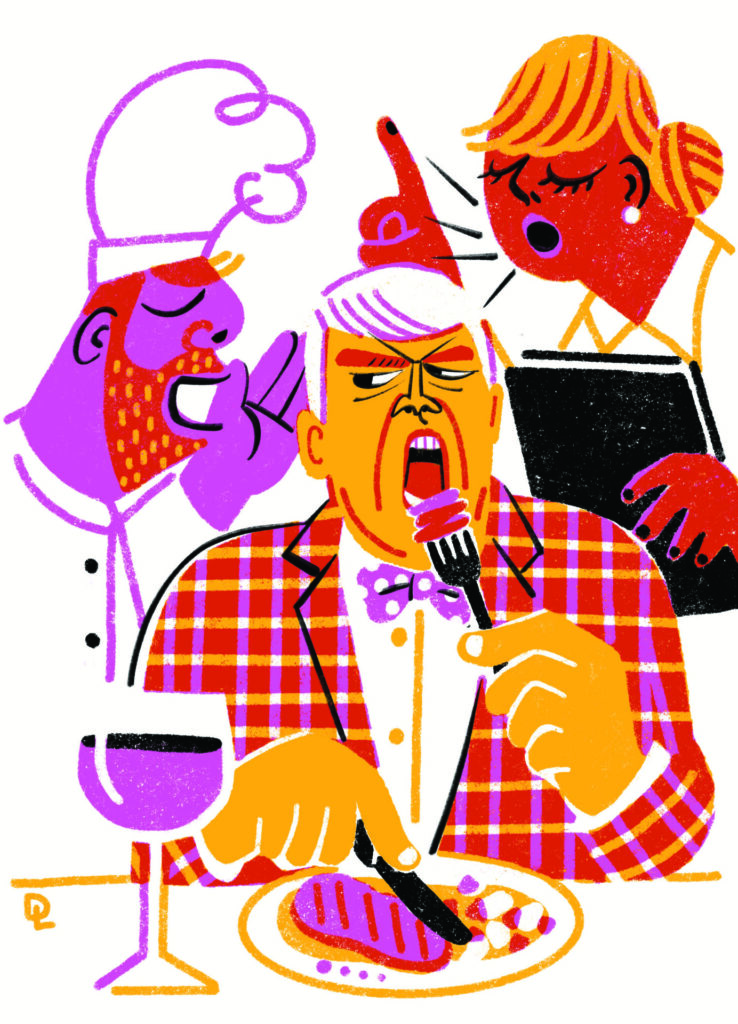
Somewhere amid this excitement was the food: a braised short rib sharing a bowl with rawish baby carrots. It was tasty enough, but nothing like that classic recipe I knew so well. It wasn’t boeuf bourguignon.
This may be an extreme example, but it points to a development in dining I’ve been noticing for the better part of the last two decades: Restaurants have become all about the stories they tell. A fine meal has become something told, not something served.
Restaurants have always had stories. Immigrant families generations ago opened diners in Savannah and tea rooms in Atlanta and passed them along to their kids. More recent immigrants bring a world of flavors to roadside fueling stations or food trucks set up in parking lots. The characters in the story may change, but the beats are the same: perseverance, resilience, grandma. Chain restaurants tell you stories, too. Try walking through the gift shop of a Cracker Barrel and not remembering an actual country store.
But what I’m talking about is narrative, an urge on the part of restaurateurs to tell you all the whats, wheres, whens, whys, and hows of each morsel of food before you can even take a bite.
This impulse is particularly true at the most expensive restaurants. Have you ever gone to the best-reviewed special-occasion place in town to have a meal where each dish is described in excruciating detail? This happened to me just the other day at Schwa, an excellent tasting menu restaurant in Chicago where the chefs personally deliver a dozen two-bite yumbos. Over the din of Siouxsie and the Banshees, you will hear about alllllllll the ingredients in every dot of sauce, or at least catch a few words. I fathomed something about “strawberry kosho” on the teeny slivers of Wagyu beef, and as a food nerd who lived in Japan, I got the reference. Did anyone else?
Over the din of Siouxsie and the Banshees, you will hear about alllllllll the ingredients in every dot of sauce, or at least catch a few words.
These recitations have a term: spieling. In many restaurants today, it isn’t just about the cooking, but also about the inspiration. During my daughter’s brief career as a server in a tasting-menu restaurant, she often came over to practice spieling the dozen or so courses she had to memorize. One, which included a trail of escargot roe, hearkened to the chef’s childhood exploring the woods behind his grandparent’s summer cottage. Dad, should I use the word ‘traipsed’? One dish contained four small bites to pick up and eat with your fingers. But it would allegedly express differently depending on the order of consumption, so she described it as “choose your own adventure.”
More often, it’s not up to you to pick up your fork with any sense of adventure at all but to follow precise instructions: Tip your dish back into your mouth like an oyster. Cut straight down to capture some of each layer.
You also must listen to the inspiration for each dish, because chefs are not only cooking for you but also exploring their identities on the plate. They’re telling you who they are, bite by bite. A dish may be inspired by the snack Chef’s mom served after school, or a trip Chef took to Mumbai, or Flamin’ Hot Cheetos, or all three.
Wine service has also fallen prey to overwrought narrative. In a way, it is a reaction to a changing viticultural world, where maverick vintners are throwing out the orthodoxy to bring livelier, more expressive, and more naturally processed bottles to the table. Sommeliers are excited, and they want you to be, too—so you hear about the background of the winemaker, the terroir, the abundant natural yeasts, the earthenware amphorae, the whole-cluster fermentation, and the badass distributor who dubbed it “killer juice.” Sometimes, a somm’s spiel can be like a museum audio guide so insistent that you can barely process the art on the wall.
Put this all together, and today’s experiential dining reveals its algorithmic nature: It has been curated for you like an Instagram ad. The restaurant tells you what to think, what flavors to identify, and even how to use utensils to transport food to your mouth before you’ve taken one bite or—weird word in context, I know—assumed any agency.
The dogged storytelling in restaurants seems to be an American thing—or, at least, it seemed that way to me after spending two glorious weeks in Spain. There, I was rarely told anything about my meal other than “here it is.”
 Getaria, a fishing village on the Bay of Biscay between San Sebastián and Bilbao, had several restaurants that served fish grilled outdoors on braziers set up by their front doors, then brought into the kitchen to be plated with sauce and garnishes. What a pleasure it was to eat meaty hake throats and whole grilled turbot at different restaurants and then compare them. I got curious about how this style of restaurant came to be and learned the story: Fishermen used to grill their meals on the boat, unload the rest of their catch, then head into town to drink at bars. These bars began setting up braziers out front as an enticement for the anglers to grill and eat dinner at the bar, stay longer, and drink more. Soon, the locals wanted in on the action.
Stories can be charming and an important part of appreciating your meal, but only if they’re not spooned right into your mouth. They work best when they’re the start of a relationship.
My favorite new restaurant in Chicago, Warlord, doesn’t take reservations or offer an online menu and rarely ventures onto social media platforms, other than to post job listings. One such post, showing the flaming hearth, assured applicants that manning the grill would likely be hell. The arresting food at Warlord, often an oddly cut hunk of meat or fish with a simple roasted vegetable and a sauce, presented with nothing more than a “here you go,” pulls you in. You taste your way into the layers of flavor unlocked by dry aging, the smoky heat of the grill hitting flesh and bone, and the depth charge of the sauce.
When I interviewed the trio of chefs about the restaurant’s name, they spoke haltingly about overcoming personal demons and past struggles but avoided oversharing. I began to understand this restaurant’s story on a more emotional level; it’s about taming the fire but also watching, rapt, as it burns.
The chefs at Warlord understand the true art and craft of the story, that basic tenet that writing teachers and editors repeat ad infinitum, as a mantra: Show, don’t tell. I’m not sure any of us really want to first encounter a dish with the words, “This is chef’s play on…” We spend grandly on restaurant meals because we want the pleasure of eating to crash over us like a warm, delicious wave. We want our own senses to tell us what’s going on in a dish, and then, if we’re curious, we can ask more.
That Julia Child menu at Next was a diverting Disneyland ride of a meal. I just wish they had paid tribute to the grande dame the best way possible, by following her recipe for boeuf bourguignon. How I would’ve loved to taste it again.
John Kessler is a journeyman food and dining writer. The Atlanta Journal-Constitution restaurant critic for eighteen years, he currently reviews restaurants for Chicago Magazine.
SIGN UP FOR THE DIGEST TO RECEIVE GRAVY IN YOUR INBOX.