
My Brother’s Fried Bologna Sandwiches I cherish those days when we fed one another.
by LaToya Faulk
Illustrations by Lindsey Bailey
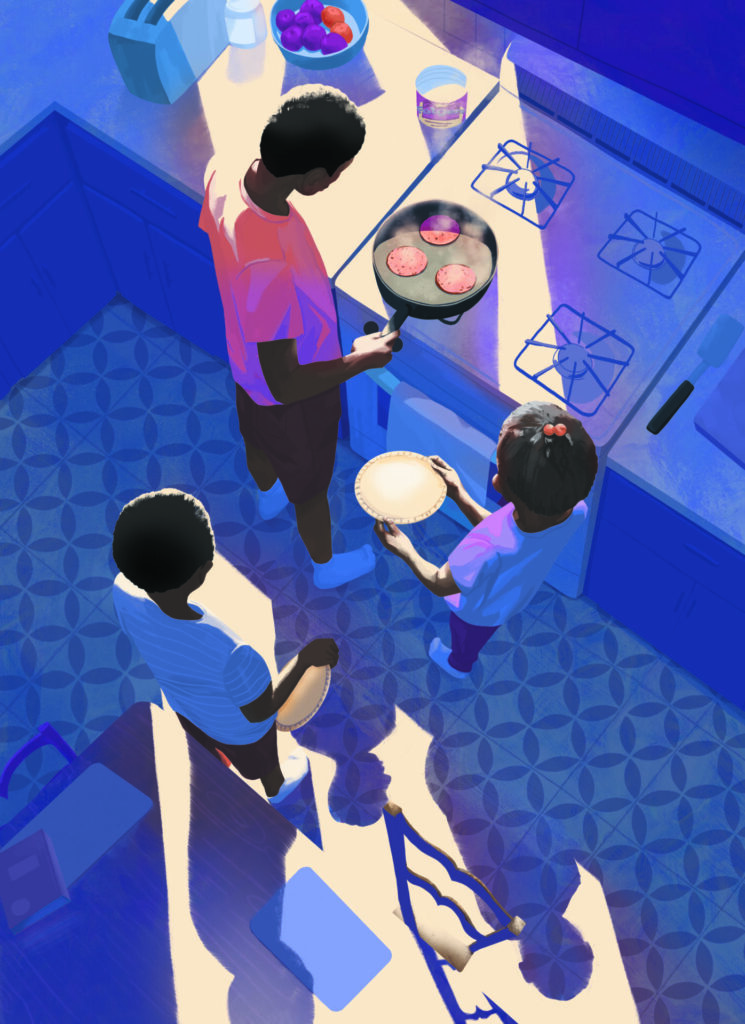
On early afternoons, after long, cumbersome school days, and often on Saturdays too, as the sun played peek-a-boo between withered curtains, we could hear the crack and sizzle of bologna.
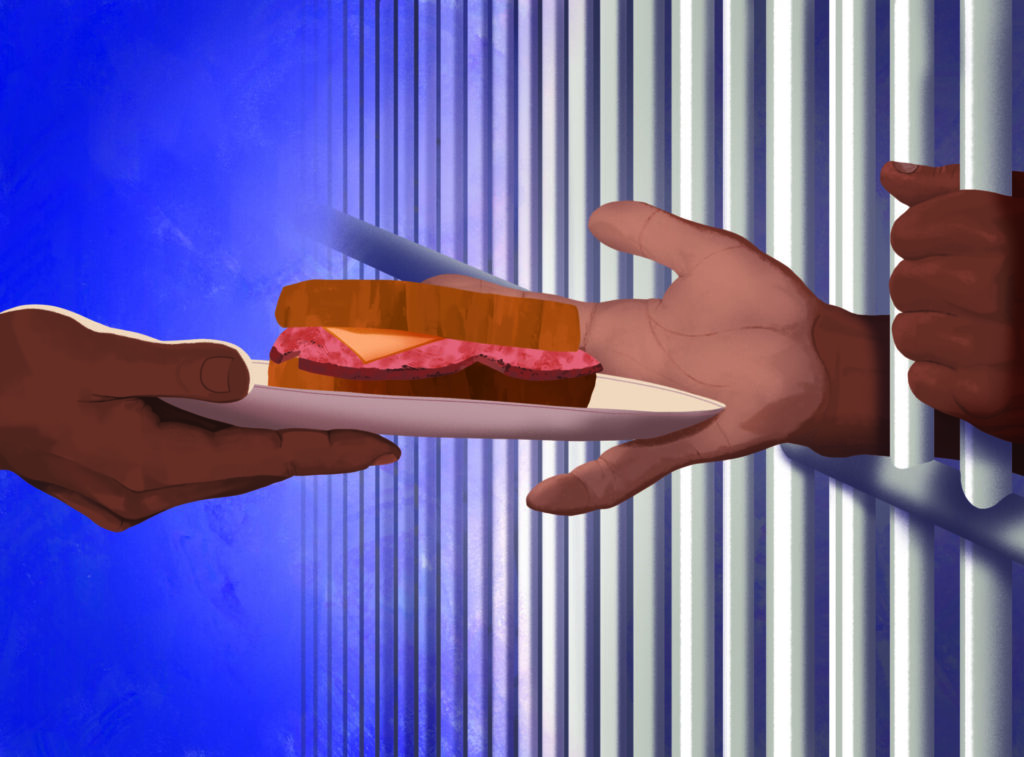
In the cast-iron skillet, it became crisp and glossy while whirling in butter, Crisco, or the reused lard from the Folgers coffee can our grandma left on the counter, just inches from the gas stove. If we were lucky and food stamp coupons served us well for the month, there would be loaves of white bread, lettuce, tomatoes, caramelized onions, mustard, Vlasic pickles, and mayo—or the fried meat naked on our breakfast plates with scrambled eggs and buttered toast. Though we all knew how to use the stove as ever-hungry teenagers, nobody in the house cooked or made fried bologna sandwiches like the oldest of us: my brother Ben. He might add spicy Doritos or half-soggy potato chips drenched in Frank’s RedHot to our fried bologna sandwiches. Sometimes, he’d fry the slices of bread in butter and sugar until they were crust-golden, the syrupy, burnt aroma devouring the entire house. Other times, he would make a roux from the Crisco drippings and soak the sandwich in the salty, dark-brown sauce. Ben wasn’t stingy with his ghetto concoctions, as he called them. He shared. Asked you to try some as he held the paper plate toward you like he was handing off a treasured gift, and he giggled. In fact, he giggled his way through our amused reactions, as if our plentiful savoring meant he did a thing. And so we crowned him the God of Hood Comestibles.
We chewed those fried bologna sandwiches up. The bread became paste stuck to the roofs of our mouths. We tongued the inner linings of our gums and sucked our teeth in pleasure and relief. Our plates empty, we questioned who would hand-wash the skillet and put the condiments and bologna back into the refrigerator. A game of rock, paper, scissors was usually how we delegated grunt work.
Long after we ate our fried bologna, the oily smell lingered. It traveled into the living room, past the foyer, and into the four back bedrooms, where it soured as the hours turned. Sometimes it followed us outside onto the front porch, sticking to our clothes.
“Fat Boy!” said Marcel, our half-Black, half-Mexican neighbor from across the street. Ben retorted by holding his flappy gut with both hands and doing a little belly-front shimmy. In those days, ’round the corner and down the street and across the way, boys gathered on the side of the house under the black gum tree. They smoked weed and talked all kinds of shit out of the direct purview of Grandma and other adults. That tree has since been cut down, but I remember how it had given the best summer-shaded breeze and fall orange leaves.
Though I had very few friends—still do—when the ones I did have visited, Ben flirted, shooting his shot. “Girl, you so fine.” And when his affections went unrequited, he surrendered. “Okay, ignore me all you want with your fine ass. You still fine, though.”
My other brother Johnny chuckled, the youngest of us calling the oldest out. “Ole lame ass.”
“Ya mama,” spat Ben in defense, and the two laughed. Though Ben struggled with school and ended up in educational special-needs programs, he made his true talents known every time he took over Grandma’s reign in the kitchen.
It wasn’t until college that I learned bologna was made from a blend of meats, a recycled junkyard of cows, pigs, and chickens. I was sitting at the campus cafeteria, homesick and nostalgic, yearning for time spent with my brothers and fried bologna sandwiches. I shared these pinings with some new acquaintances whose faces I can no longer bring to focus. What I do remember is how ashamed their rebukes of the lunchmeat made me feel. I was a first-generation college student who often felt indifferent and unprepared as I walked around the Michigan State campus, eyes glued to the concrete, listening to the bells clang from Beaumont Tower, trying to get through math equations and hours crafting papers on Oedipus Rex and the Communist Manifesto.
I often think back to a time before Ben covered most of his body with tattoos, before Johnny fathered a cadre of children with different mothers. I consider our lives before the highs and lows of higher learning and dreams of suburban life left me disillusioned, when I believed I could discharge our birthed wreckages and reinvent our history from scratch. Now in my forties, when upward mobility gives way to deep feelings of displacement, I cherish those days when we fed one another and our grandma’s kitchen and backyard brought out the best of what our Great Migration Alabama-to-Michigan family held together.
We had a childhood rich with backyard barbecues and a kitchen filled mostly of food retrieved with our own hands from Grandma’s garden. We divvied out ice cream buckets of table scraps to fenced-in dogs linked to heavy metal chains and elatedly gritted our teeth at our uncles who watched Grandma turn the kitchen corner and allowed sips of their beer. “Put some hair on your chest,” they’d say, even to the girls in the family. Those same uncles’ tyrannical, inebriated outbursts were always handled gently, with diplomacy, and without the involvement of police.
Right before the changing tides of our lives altered the distances between my brothers and me, I asked Ben why he was always making fried bologna sandwiches. “Sis, don’t you know? Fried bologna is the poor man’s steak,” he said.
“The poor man’s steak,” I repeated.
I thought this was so poetic, ethereal—but more than anything, I was amused by his prideful analogy of our class station and the emulsified meat. Were we ourselves a kind of cured, finely ground, mystery cold cut?
Long before this industrial lunch meat reached the table of our Black household, immigrants were credited for the food fad. Bologna—also spelled baloney—is derived from the pork sausage mortadella, which originated in Bologna, Italy. High in nitrates and popular in the South, with a history of use in soup kitchens and prisons, bologna was an economical second-rate meat among American meatpackers and became poor people’s delightful class burden. Even today, that jingle about B-O-L-O-G-N-A holds great emotion among my childhood memories.
In middle and high school, I hadn’t felt the weight of our poverty the way my brothers had. I was too busy escaping in my mind, moving around in The Real World, Ally McBeal, and Terry McMillan’s novel Waiting to Exhale. When I did occasionally awaken from that luminous fictional slumber, it was to visit various juvenile detention centers and courtrooms with Grandma and my Aunt Andrell (who had a driver’s license). It seemed both my brothers graduated from detention centers to county jail to prisons.
Michigan State, the first panoptic institution of my choosing, had me questioning all the inner workings of my youth—and of our very existence. I will never forget being set up on a date by two well-meaning friends with a White guy with Appalachian roots who worked in the dorm cafeteria. We discussed our backgrounds, our families. I told him about my two brothers, both serving sentences for felonies. “I did the same stupid, idiotic stuff growing up,” the tall, lanky, White guy said as he lay on my carpeted dorm-room floor, his palmed hand holding up his face. “I just never got locked up for it.”
He proceeded to share all the troubles he had gotten himself into as a teenager: setting a basement on fire, shooting another boy in the face with a BB gun, cursing out his mother and taking money from her purse when she tried to mandate a curfew, stealing a box of Fruit Roll-Ups from a grocery store, taking his father’s whiskey from an old shed, and countless fights with other neighboring boys. When the night ended and the White guy tried to kiss me goodnight, I jolted back, my neck swirled like the hook on a coat hanger, and I gave him one of those back-patting Christian hugs learned from the bourgie women at the cult-like prosperity church I was attending at the time.
There was a part of me that despised all I had come from and wanted desperately to mobilize myself toward a more appetizing future free from drug addiction, parental abandonment, recidivistic prison sentences, and traumatic family secrets. Then there was the other part of me that couldn’t get comfortable with the idea that for one group of boys, their mischief and mayhem was simply typical adolescent growing pains, and for another it was a forfeiture of freedoms, the risk of losing mental faculties, and being placed in a precarious fiscal state of constant pleas for commissary—or even worse: a premature funeral.
Then July 2, 2015, happened—to Ben, and to all of us, and to the family of a twenty-four-year-old man named Jamie Hines. That month, Grandma kept receiving calls from an unrecognized Indiana number, and she finally wrote it down from the caller ID and asked me to figure out whether it involved Ben’s whereabouts. I dialed the number. It was the Wabash Valley Correctional Facility in Carlisle, Indiana, and a desk clerk answered. It was unlike Ben to not contact us for days, and we were given a prison ID number and offense code to gain entry into understanding his plight. After a litany of transfers and holds, the flood gates opened. A sixty-year sentence. Manslaughter.
“What?” said Grandma; her face turned to stone. Her eyes went wet and dim behind her cataract glasses.
“I can’t believe it,” I said. “Get the — out of here.”
Uncle Derome sighed heavily but seemed unsurprised. Grandma said nothing else; she just walked into the kitchen and began whispering prayers. In the weeks that followed, I searched for answers. What happened? How could this be?
I became a low-budget detective, calling friends on Ben’s Facebook page. He lived in a house just outside of Indianapolis with other KFC employees. He’d left Saginaw, Michigan, for Indianapolis with a cousin who had promised employment opportunities outside of Michigan after struggling to find even menial work with prior felony convictions. The Indiana cousin did help Ben with employment and room and board, but allegedly within months he kicked him out of the house for fear an affair had ensued with a girlfriend. Unable to secure an apartment lease on his own, Ben moved in with Hines. The girlfriend Ben was dating turned out to be the sister of the man he was accused of killing, and this woman was also pregnant with his baby. “I’m just lost right now. My family ain’t having me keep this baby.” She told me this over the phone that summer when I reached out. I didn’t know what to tell her, so I listened, as I sat in a residential advisor dorm room on the campus of Wayne State University and allowed her to vomit out the anguish—though I wish now I had recorded the conversation.
Sixty years. Sixty. “That’s pretty much a slow death sentence,” I said to my little brother.
“Man, I mean, pretty fucking much,” Johnny said.
Was it self-defense? I knew Ben was remorseful. An argument over money and respect gone all the way left. I didn’t know what to think. I knew, between the many accounts of July 2, 2015, the truth of what really happened was siloed, caught in the mouths of strangers and new enemies. We could not save my brother from their rebuke, nor could we convince the fearful and silent who corroborated the self-defense claims to talk to court authorities, and my brother’s own fury was weighted. I hurt for the family who lost a brother and son and father and friend. I hurt for the former girlfriend who had entrusted me with her pain, and I hurt for the baby who would not come to be. I hurt for my brother and our family, because this also felt like a burial of sorts.
I sat in my disappointment for years, not returning my brother’s collect calls, and in that split-self Frantz Fanon and W. E. B. Du Bois way, I thought of the Black-on-Black crime complaints by conservatives who dismissed urban areas as criminal wastelands without reckoning the manic psychological conditions of poverty. Behind the dismay and chaos, I thought about our childhoods: our mother’s addiction and mental illness, a father who himself was in and out of prison for home invasions and marijuana possession, and I thought about the enticements of Saginaw streets and the round-faced hustlers and dealers with their juicy-mouthed promises of wealth and power dripping with condescension. I thought of the incarcerated or dead Black men from home whose faces sometimes appeared on billboards, and those living risky lives in unpromising neighborhoods—and on the college campuses where I studied or taught, when I could outwit my own disguises and imagine greater promises, I glowed with ecstatic joy whenever a Black man, having seemingly defied the odds, crossed my path.
My senior year of high school, when I didn’t know who else to talk to, Ben was the first to find out I had lost my virginity. “I see now, me and you gon’ have to talk about the birds and the bees,” he said, as we stood outside in front of the house. The blue, starless night worked like a pinky promise, framing our alliance.
In graduate school, I’d ridded myself of straight, permed hair, having devoured Black writers who assured a trust in the divinity of our kinky hair and large noses and wide lips. When I returned home baldheaded (my first big chop), Ben was the first to tell me I was beautiful.

A couple of years ago, I thought of Ben as I fingered through the colorful pages of the 2023 cookbook Goon with the Spoon by the California rappers Snoop Dogg and E-40 and came across a recipe for fried bologna. I was working at Off Square Books in Oxford, Mississippi. By then, Ben had already served nearly eight years of his sentence. It all came back to me. Sundays after church with crackers, RedHot, and cans of Vienna sausages hand-fed into our toddler mouths. The hog’s head cheese Grandma pulled from the container as if it were a slice of bread. And those days in the kitchen after school and on weekends when the house went quiet except for Ben’s laughter and the skillet crackling and sizzling with scorched bologna. I have wished life turned out differently for my brothers. That maybe, had the laws of providence tilted more toward the talents of impoverished neighborhood boys, Ben would be a chef at a hotel bistro or a manager at a fast-casual chain restaurant. Maybe he’d even be the owner of his own cookout joint, where the popularity of his fried bologna sandwiches would bring recognition—or simply the provisions to secure a home that no one could rightfully dislodge him from just because it suited them.
I purchased that Goon with the Spoon cookbook. It sits on my kitchen counter. I opened it recently after answering a call from Ben, who was hurting for commissary. I assured him I had it covered, and I did. In the cookbook, Snoop Dogg claims to have replaced the American cheese on his fried bologna sandwiches with Gouda, now that he has obtained The Jeffersons economic flight out of Long Beach. My twelve-year-old daughter came over to the dinette and asked what I was doing.
I could show better than tell, so I set out that afternoon to Kroger for bologna and bread and potato chips. As the meat sizzled in a buttered, nonstick, non-PFOA pan, I told my daughter all about Ben: how he was a magician in the kitchen and made the best fried bologna sandwiches. I told her about Walcott Street, corner stores and penny candy, and backyards filled most summers with family, card playing, laughter, and the smell of grilled meats and sour, yeasty beer. Our home in Mississippi grew smoky and lacquered with the smell of that cured meat. My daughter, who loves cooking and has hinted at a career in the culinary arts, was just a toddler when my brother was sentenced. She glowed with eager skepticism as she took hold of a slice of fried bologna. “It’s gummy, sort of tastes like bacon,” she finally said. “I like it.”
The next morning, the gamey, charcoaled smell of fried bologna greeted me at the kitchen alley, and I watched as my daughter placed slices in her lunch box. “I’m going to share this with my friends at school.” When I returned from school drop-off and the smell remained trapped in my home, I didn’t open the windows or turn on the ceiling fans. I just sat on my living room sofa breathing it in, accepting the ways it had taken hold, stayed, and remained with me, unabandoned.
LaToya Faulk teaches composition and rhetoric at the University of Mississippi, where she also earned her MFA in fiction.
SIGN UP FOR THE DIGEST TO RECEIVE GRAVY IN YOUR INBOX.