
Belonging on the Line Many Latino Americans—myself included—have found community in restaurant work. What happens now?
by Valentina Abril
Illustrations by Julia Kuo
When I introduce myself, I often say, “Hi, my name is Val, short for Valentina—like the hot sauce.”
Valentina is a brand of hot sauce from Mexico, tangy and slightly spicy. It’s perfect over eggs, burritos, and even fruit on a hot summer’s day; palatable to most; and a staple at any reputable Mexican establishment in Texas, the state where I’ve lived more than half my life. Hot sauces are foundational to the food pyramid in Texas. As an adult, finding part of my identity in an inherently Mexican product felt like a small but meaningful sign of the progress I’d made in unraveling the internalized racism I carried from the moment I became an immigrant. Growing up in Bogotá, Colombia, I was privileged enough to learn English from a young age. Even so, when I first arrived in Houston in 2003, at the age of eleven, my English was far from adequate. I called the movie theater “the cinema” and lacked the vocabulary for very important things, such as “sleepovers” and “friendship bracelets.”
 Our move to the United States was born of necessity. My sister needed medical treatment available to our family at Texas Children’s Hospital, so I changed my “hola” to “hello” and didn’t dare go back. In our early years in Texas, the conversations I overheard from the grown-ups around me sent the message: We are different from the other Latino people here. Remember, we came here “legally,” and we are definitely not ever meant to be confused with Mexicans. At the time, the Latino population in the United States was approaching 40 million residents, about two-thirds of whom were of Mexican origin.
Anti-Mexican sentiments weren’t new then and have continued to fester and flare. Texas’s identity has been in flux from the moment it declared (and soon won) independence from Mexico in 1836. It was a short-lived republic before becoming part of the United States in 1845. The term “illegal” became widely used roughly a century ago, when the United States established the border patrol. Those without citizenship often faced economic and discriminatory hardships. The same ideology and interracial conflict are still with us.
When my family relocated to Houston, policies born out of the fallout from 9/11 shaped the world I was now a part of. The newly formed Department of Homeland Security (which now houses Immigrant Customs Enforcement, or ICE) intensified the anti-
immigrant tension I felt in my classroom and out in public. I heard slurs muttered when people would speak Spanish in line at the grocery store, or a disdainful look was cast upon anyone with a last name or a face that wasn’t similar to theirs.
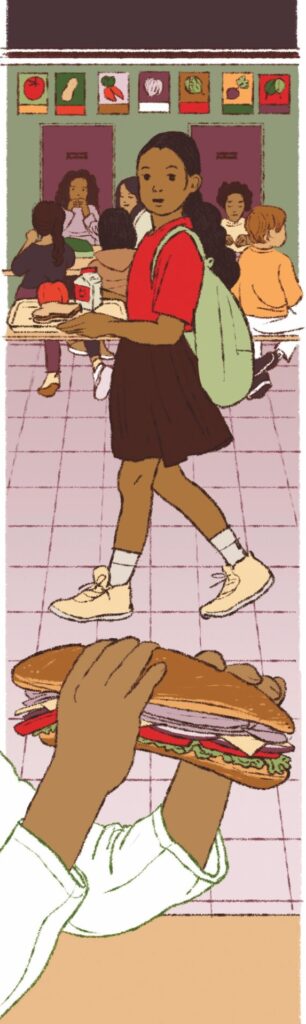
Even though I heard Spanish from my classmates in an English as a Second Language (ESL) class held in a trailer outside the main school building, I never spoke Spanish back to them. For me, refusing to speak Spanish was just one way in which I distanced myself from my roots as an act of survival, even if that was just surviving the fifth grade. I tried as fast as possible to lose my accent, tested out of ESL, and refused to be friends with anyone who had brown-colored skin resembling mine. It wasn’t hard to do, seeing as the harshest judgment I felt wasn’t from my white classmates but from other Latino students. They thought my accent was strange and couldn’t understand why I thought they were having dessert for lunch. (“Torta,” which refers to a sandwich in Mexico, is the word for “cake” in Colombia.) Like most eleven-year-old girls, I yearned for community and belonging, and more so, being new in this country, I longed for acceptance. I eventually found friends and a sense of community-—but not within the Latino culture that is such an integral part of Houston’s identity. Most of my school friends were white.
My family moved to the Dallas metroplex as I was starting high school. Four years later, I easily transitioned to a life in my small college town of Denton, Texas. There, I quickly found that the best way to make money while studying for my “Politics of Language” class was to work at a restaurant. Waiting tables and bartending at independently owned restaurants were my gateways into the service industry, with its tight-knit communities forged by hard, shared work. I fell in love—maybe it was Stockholm syndrome or perhaps it was capitalism, because my bank account had never seen so much action—and I fell hard. The community I built around foodservice carried me through periods of depression and reignited my passion for food. Most importantly, it began cracking open the safe where my Latina identity lay.
Across the United States, approximately one in four restaurant line cooks is Hispanic, having emigrated from Spain, Mexico, the Caribbean, Central America, or South America. In Texas, the vast majority come from Central America. Beyond demographics, a well-acknowledged tension exists between front-of-house and back-of-house workers, rooted in pay disparities and the different demands of their roles. As a professional people-pleaser and novice bartender, I was on a mission to befriend the kitchen crew. Life is so much easier when you have alliances.
This meant that I had to speak Spanish again and build relationships with people who I had actively distanced myself from for years. The tables had turned, and my core values began to shift. To thrive in these jobs and to find belonging in these communities, I needed to embrace the very side of me I hadn’t tapped into in over a decade. Still, change didn’t happen overnight. There were many Mexican cultural nuances I didn’t understand, and even though we spoke the same language, sometimes things got lost in different dialects. But unlike my misunderstandings when I was a kid, everyone was much more responsive when one of us asked for a straw and three different words came out of our respective mouths, depending on who was asking for it. To this day, none of us can agree on whether it is called a “popote,” a “pajilla,” or, as I have always called it, a “pitillo.” More instances like these became the norm, such as when people learned that I was from Colombia, they would often call me “parce,” a nickname Colombians use for a friend, or they would be more gracious with my mistakes because we shared a mother tongue.
Waiting tables and bartending at independently owned restaurants were my gateways into the service industry, with its tight-knit communities forged by hard, shared work.
A few years after earning my degree, I moved to Denver to pursue a community organizing role with a social justice organization. In September 2020, I was furloughed along with a third of Americans working in the nonprofit sector. With family in back Houston, a reluctant return made sense. During the years I’d been away, Houston had changed, and thankfully, so had I. With many nonprofits in a hiring freeze, I jumped back into the arms of my first love: the service industry. Even amid the pandemic’s financial effects, Houston maintained its growth, both physically and culturally. Texas, in its Lone Star way, was one of the first to begin re-opening restaurants (even if it was just at 25 percent capacity) on May 1, and by the time I got there in September, they were able to operate at 75 percent. With more than 13,000 restaurants before the pandemic, the city had become a food destination for many and a buffet for me to pick from as my new form of employment.
As I stepped back into my front-of-house role as a bartender in a small Italian restaurant in Houston’s trendy Heights neighborhood, I was scared that ghosts of discrimination past would surround me. I was unsure if my slight otherness—being Latina but not Mexican—would alienate me once more, like it did when I first arrived. I don’t know whether it was a mutual understanding among everyone as we re-emerged into the world after lockdown, or whether my perspective had changed. But those ghosts never came back to haunt me; instead, I found a community with Guatemalan, Salvadorian, Honduran, and mostly Mexican coworkers. Those borders only mattered during the Conacaf Champions Cup, and cheers or groans emanated from the kitchen on nights that the soccer games coincided with service.
I have spent the last five years walking into restaurant kitchens, and whether it was a small New American independent restaurant or a corporate, nationally owned brand, I have been endlessly fed by the prep ladies in the morning with their pan dulce and café de olla actually made in a kitchen pot. I love walking from the front-of-house, with our perfectly curated guest playlist, to the back-of-house, where you don’t know if the next song will be a heart-wrenching ranchera or an explicit-yet-catchy reggaeton song. I have learned, to my father’s disappointment, that Spanglish is very much a language of its own. I’ll sometimes hear the bussers say they’re going to “setapear” a table, meaning they are “setting it up.”
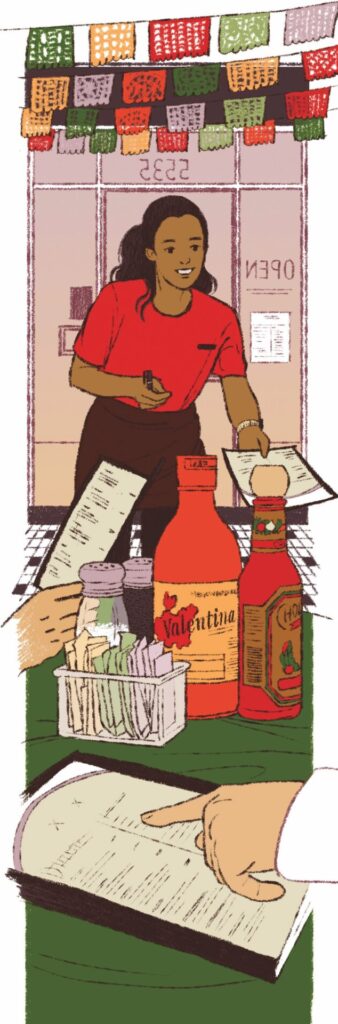 One of my Mexican coworkers asked how I could possibly like spicy food, seeing as Colombian food is anything but spicy. I proudly said, “Well, I grew up here—I feel as if I’m half Mexican,” and he concurred that I most definitely was. Seeing as part of my identity felt tied to the Mexican American experience, I could not help but feel a sense of despair as I would hear many of my undocumented co-workers’ stories of immigration and lack of agency in their lives as we would be closing the restaurant for the night.
In a conversation I had with Janett, a friend who co-owns an acclaimed Mexican restaurant in Houston and requested her name be changed for this story, she shared her experience growing up as a Mexican American in Houston and remembered the magic of her childhood holidays in Mexico. This intangible feeling is what she wanted to showcase in her restaurant. Her family first arrived in the United States in the 1960s, when her grandfather came to work under the Bracero program. Like earlier initiatives, this program relied on Mexican workers to fill US agricultural labor shortages during World War II. In 1954, that changed. President Eisenhower’s deportation initiative, odiously named “Operation Wetback,” was a direct response to the Bracero program that had begun just a decade before. About 4.6 million Mexican workers entered the United States as braceros, and thousands of others were illegally hired to meet the demands of war. But as American soldiers returned home, this labor was no longer needed. In the span of a year, one million Mexican workers were deported.
As I talked to various service-industry colleagues about their immigration experiences, this fraught and complex history gave language and context to a paradox I witnessed while working in restaurants: Latino labor is always essential and yet always expendable. History has demonstrated they are often among the first groups to be scapegoated when the economy starts to downturn or when a president wants to gain favor with a disenfranchised populace. During the Great Depression, many Mexican workers were blamed by the federal government for the lack of jobs available, and to divert the public’s attention from the economic crash, President Hoover called for a deportation program to be instituted. From 1929 to 1935, over 400,000 people were sent back to Mexico, including American citizens of Mexican descent. In a way, President Trump’s 2025 deportation initiatives are falling in line with this American practice. The history of the back-and-forth from one side of the border to the other continues to repeat itself.
I focus so much on Mexican migration because, even though there are many Central and South Americans living in the United States, it is Mexican culture that has rooted itself throughout most of the Southwest, especially in Texas. They are the ones who are most often persecuted and discriminated against, but somehow there never seems to be a border wall when it comes to enjoying and profiting from Mexican labor and culture.
In Houston, being Chicano (an American with Mexican ancestry) is something to be extremely proud of. This community has carved out spaces beyond the East side of the city, which has historically been a predominantly Latin neighborhood. They have made their mark by being involved in politics, hosting cultural festivals, and enriching the city with more than 2,000 Mexican restaurants. When I tried to align myself with them outside of my restaurant community, my otherness stood out. Some Chicanos saw me celebrating their holidays or coming to community celebrations as cultural appropriation. What’s interesting, as Janett explained to me, is that often, recently immigrated Mexicans think of Chicanos as not Mexican enough. Chicanos might not speak Spanish and can be generationally removed two or three times from Mexico, so that to those who have just arrived, Chicanos are Mexican in name alone. Some people are lucky enough to return to Mexico and tap back into their ancestral culture, but for the undocumented population, that’s not a choice.
As I did when I was a child, many immigrants choose assimilation as a survival skill. At the same time, they also want to ensure that the connection to their home countries is not lost. That balance is hard to maintain. For Rolándo, a chef I met while working in a Houston restaurant who also requested his name be changed here, this has proven to be the biggest challenge. Unlike Janett, Rolándo is unable to return to Mexico. He has been in Houston for twenty years, and when I asked him about his identity, he replied in Spanish that at that time, he didn’t know. He said that he thinks that when everyone first gets here, they feel the warmth from their home. But as time passes, people start to forget, and they begin adopting a new way of living, a new way of eating. He said, “We are in a country where we have to adopt the American system.” It is this American system that, according to Rolándo, provides the opportunity for immigrants to own homes, have well-paying jobs, raise their children in safe areas, and begin to build wealth. But all of it is fragile for those who are undocumented.
The day after the 2024 presidential election, I felt a new atmosphere of fear and caution at work. When ICE raids began in Houston, we heard about them through hushed conversations in the back-of-house and from the bussers and other support staff in the front-of-house, as if speaking about them too loudly would make an agent suddenly appear. Although I moved away from Houston in the fall of 2025, I return often enough to still call it home. So far, many of my Houston restaurant friends have told me that most raids still don’t occur in restaurants themselves, but ICE has abducted many undocumented immigrants throughout the city in other ways. I remember fearing for the lives of those I love, knowing every day could be the last I see of them. Every time someone was sick, I would always ask a manager about them. Are they okay? Do they need help? I feared the answer might be that I would never see them again.
In our conversation, Rolándo reminisced about his early days working at a steakhouse ten years ago. He called the time prior to this administration “the times before.” He said that they would often bring a twelve-pack of beer to drink after work, and even the managers would sometimes have a drink. He chuckled as he said that sometimes, police officers would look out for them and interact in a friendly manner. There was less fear then.
Things have changed now. I think back to how many of my Latino coworkers would stick to themselves and go straight home from work in the last year. For those few who chose to continue living their lives without concern for this new deportation initiative, the decision came at a price. Rolándo said he used to be a nonbeliever when it came to ICE abducting people. But then it happened to one of his employees, and suddenly he was jolted into reality.

For many immigrant workers, this is the fear. They came here to build something bigger and better than their country of origin could provide, and it is now at risk of being taken away. Many cannot enjoy the lives they have built, and simply work to live and pay taxes that fund services they often cannot partake in. As of 2024, Latino workers make up 28 percent of the labor in American restaurants, and I’ve heard that some Houston-based restaurant owners have begun to form contingency plans in case of an ICE raid. It sounds exaggerated, but the conversations I’ve had with fellow industry workers in regards to those new procedures remind me of the ones I’ve read in history books about people hiding European Jews during World War II.
Some business owners who are undocumented may be active in immigration advocacy by hosting fundraisers or speaking out on social media, but many operate quietly to protect themselves and their employees, as public attention to their status can carry significant risks for owners and staff alike. Rolándo arrived in this country without permission, so that would make him “illegal” to ICE. He knows that if he were to be taken, it would put a terrible strain on his family, so he keeps his head down and just works, hoping this passes over and his immigration issue is solved. Even with this fear and lack of mobility within the city, he said he feels indebted to this country. He explained that America has given him so much that Mexico couldn’t, but at the same time, he had to give up his family, culture, and food to be here. To make the American Dream work, he had to give up his dream of Mexico.
When I first sat with Rolándo, I asked him what his favorite food was, and he said “chiles rellenos.” Very quickly, he added, “pero mole tambien”—but mole too. Mole is considered to originate in Puebla, the city Rolándo left twenty years ago, so, of course, he had to say he also loved mole. The next time I saw him, I brought him a mole and a peanut butter cookie from Janett’s restaurant, which combines American flavors with traditional Mexican recipes so well that it has won multiple awards in the few years since opening. Rolándo couldn’t stop talking about how this cookie tasted like Puebla and Houston, all in one. The flavors and ingredients that had for centuries crossed geographical borders as people migrated from Mexico and back are finally being brought back together.
The way in which Mexican cooking is showing up in cities like Houston is not just a portal back to Mexico. It demonstrates the hope that immigrants have of continuing to build lives here, of being able to travel back and forth to the places they once called home, and the realization that I can still belong in Texas by claiming a hot sauce as my own. In the kitchens of Houston, mole and peanut butter coexist. That cookie tastes like a dream of belonging that refuses to choose one side of the border.
Valentina Abril is a Texas-raised and New York–based writer with a background in the service industry. Her work explores how food and history shape community and identity. This is her first story for Gravy.
SIGN UP FOR THE DIGEST TO RECEIVE GRAVY IN YOUR INBOX.