
To-Go, or Not To-Go? That is the question for restaurant owners balancing food waste and container costs.
by Hanna Raskin
Illustrations by Natalie Nelson
An enormous amount of what restaurants purchase is ephemeral. Only a real lunkhead of a general manager would order tomatoes, mayonnaise, and sandwich bread with the hopes of having the ingredients on hand next year.
But considering the cost of to-go containers, the family behind SaBaiDee Cafe in Murfreesboro, Tennessee, was galled by how quickly they went out the door. While the women understood why dine-in customers wouldn’t want to surrender their uneaten Lao sausage and fresh tapioca noodles, they also knew they’d have to raise prices if every patron left the restaurant with a dollar’s worth of the lidded, dishwasher-safe trays the owners considered best suited for their handiwork.
So, on October 21, 2024, SaBaiDee announced a 6 percent surcharge on meals that ended with boxing up leftovers.
“Customers are more than welcome to bring your own to-go containers!” the SaBaiDee crew enthused in an Instagram post. “We’re happy to help reduce waste and keep costs down while serving you the meals you love.”
Tellingly, the message didn’t generate an outpouring of support from followers often inclined to respond to SaBaiDee’s posts with raised-hands and fire emojis.
“We had mixed reviews,” general manager Kaylin Chanthara admitted. Explaining the policy to each table was a pain, and very few patrons had gotten the social media message that they could sidestep the fee by showing up with, say, a Rubbermaid TakeAlong. (“I definitely saw those,” Chanthara said when asked which containers were favored by compliant customers.) Within one month, SaBaiDee rescinded its doggy-bag tax.
For Chanthara’s aunt, SaBaiDee’s resident purchaser, the short-lived surcharge was purely a financial calculation. But as the restaurant’s Instagram reference to food waste suggests, the disposition of what remains on a plate is one of the most vexing conundrums facing hospitality today, with each possible solution introducing a host of new problems.
How might a restaurant try to chip away at the 170 million metric tons of food waste the EPA attributes to the United States annually, a source of carbon dioxide emissions roughly equivalent to forty-two coal-fired power plants? Should it serve up Styrofoam, a petroleum-based material? Or is it better to distribute reusable containers, which customers might wash at home with lots of water (not good) or return to the restaurant by car (even worse)?
What all those strategies have in common is the assumption that customers want to keep their scraps. But that’s not the case in much of the world—and wasn’t true in the United States until 1980. (It’s the rare cultural phenomenon that can be pegged to a calendar year, but a Pittsburgh Post-Gazette columnist was barking up the right tree when she declared on December 24, 1980, that the year should be remembered as “the year of the doggy bag.”)
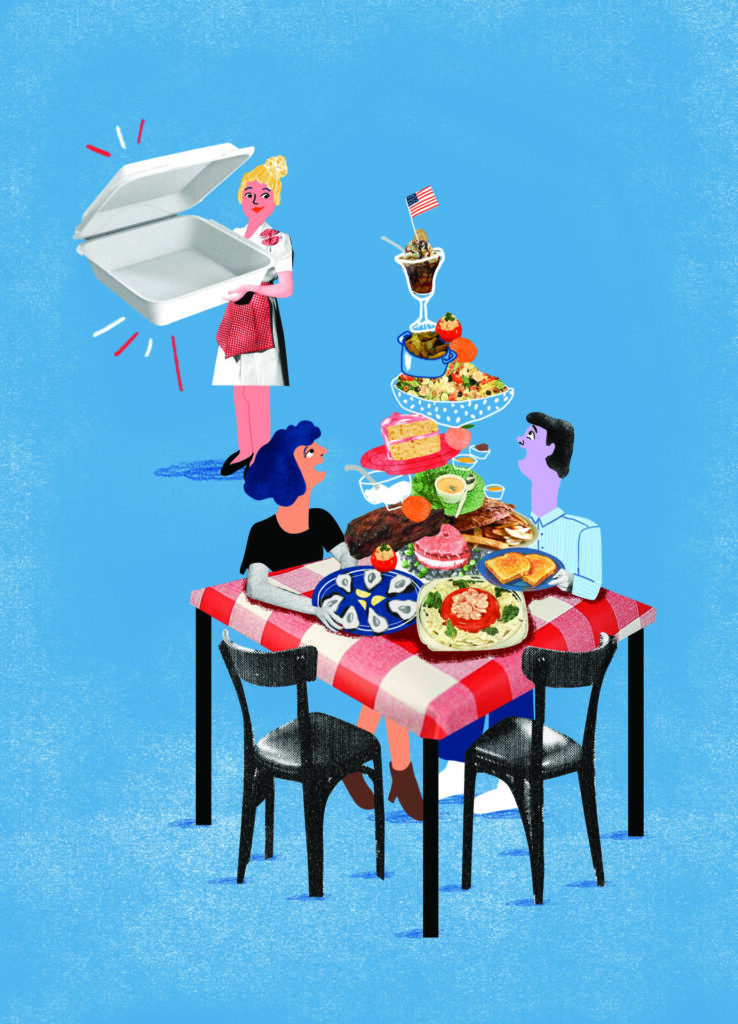
Although the transformation tracks back to double-digit inflation, it also represents a shift in how Americans thought about restaurants and what their money bought there. Prior to 1980, diners understood their orders as part of an experience to which they were granted time-limited access: They’d no sooner claim ownership of pizza slices still in the pan than they’d try to bring home their seats from the theater.
Then, suddenly, they decided they couldn’t afford to merely rent their meals. Gnawed T-bones, excavated baked potatoes, and torn dinner rolls were swept into takeaway boxes.
Amid a veritable flock of foil pheasants packed with duck breast remnants, high-end restaurant professionals may have felt the power differential tilt toward the newly possessive customer as their role subtly shifted from host to steward. After all, when’s the last time you asked a friend throwing a dinner party to pack up everything he cleared from the table so you could enjoy it the next day?
“This doesn’t go on in our restaurant,” Paul Kovi, co-owner of Four Seasons in New York City, was quoted as saying in a syndicated 1980 feature headlined “Doggy Bags are ‘In.’” The scandalized restaurateur continued, “I find the idea offensive. I don’t want to talk about it!”
An online legend holds that doggy bags got their name and start from a World War II–era campaign to make up for the scarcity of canned dog food with bones salvaged from restaurant plates. Yet if there was a wartime effort aimed at the small fraction of pet-owning Americans who ate out nightly, I couldn’t turn up any trace of it in digitial federal archives.
Even Pennsylvania Rep. Chester H. Gross—who in 1943 earned the nickname ‘Lick-the-Platter-Clean’ for an anti–food waste tirade sparked by a tour of Washington restaurants—never suggested that defeated diners should ask for a bag. “Lick the platter clean is the patriotic thing to do, and 90 percent of people will cooperate,” the famously skinny pol said. “The rest will be ashamed.”
The disposition of what remains on a plate is one of the most vexing conundrums facing hospitality today, with each possible solution introducing a host of new problems.
One of the earliest references to the custom appeared in The Carlisle (Kentucky) Mercury, which in 1957 published a short item about Akron, Ohio, restaurants which “now provide their customers with a ‘Doggy Bag’ on request. A ‘Doggy Bag’ is a greaseproof paper sack into which the odds and ends of a steak or what have you may be taken home…Do they all own dogs or is it lunch for the next day?”
For the next two decades, customers asking for doggy bags despite not owning dogs was one of the most reliable punchlines in hospitality. Even though all involved agreed their contents were fit for human consumption, societal norms held that eating from a doggy bag was tantamount to spooning tuna from a cat-food can. In a 1980 column reflecting on how doggy bags had become commonplace, Jim Fox of The St. Louis Post-Dispatch described children outing the family dog as imaginary when their parents requested boxed leftovers at a restaurant.
Some early doggy-bag enthusiasts weren’t thinking of Fido—fictional or otherwise—when they took restaurant food home. A 1963 Biddie and Bert cartoon captured the typical scenario, with an aproned Biddie leaning over the stove. “I certainly enjoyed eating out last night, dear—even if it did strain the budget,” she calls to her husband, who is lounging in an easy chair.
“Yes, sir,” Bert confirms. “That was a beautiful piece of roast beef. Speaking of food—what are we having tonight, baby doll?”
“Doggy bag.”
In 1975, The New Emily Post’s Etiquette helped pave the way for doggy bag acceptance by branding them as sensible. Post had previously ruled the practice was “degrading,” but with concerns about world hunger mounting, her etiquette guide reconsidered its stance.
To mark the revolution in American manners, The Asheville Times polled local restaurateurs, one of whom estimated only 2 percent of local diners asked for their leftovers. But women—who in many households remained wholly responsible for meal preparation, even though close to half of them had jobs outside the home by that time—were chief among them. A manager at the Village Square Restaurant confided, “On one occasion, I had a woman ask for a doggy bag to take home the rest of her chef salad.”
Somehow, the nation’s hang-ups about restaurant leftovers vanished when food prices spiked.
As The News and Advance in Lynchburg, Virginia, explained in a major doggy bag feature on January 28, 1981, “In 1970, an eight-ounce steak cost approximately $3.20. Today, an eight-ounce steak is $8.95.” A local restaurant manager told the paper, “At the price of beef, we feel that the customer should be able to take it with him.”
In fact, restaurateurs felt so strongly on that score that they started coaching their servers to offer leftovers to customers, often in logoed bags that made the former taboo seem fashionable. like hell it’s yours gigi: these steak bones are from tosi’s restaurant, read one bag printed in 1980.
According to Jack Nassar of To Go Packaging in Houston, the cutesy container fad lasted only as long as it took doggy bags to reach the mainstream. By the mid-1980s, when one-quarter of American households owned a microwave, those fancy boxes were mostly forgotten. “We tell customers, you can buy a label with your name and stick it on there yourself,” Nassar said.
Elsewhere, though, economic considerations don’t always come first. Across Europe and Asia, taking home restaurant leftovers is so suspect that nonprofits such as Japan’s Doggy Bag Committee have devised an app, contests, and slogans such as “You can enjoy your meal twice!” to encourage the environmentally sensitive habit of bringing restaurant leftovers home. In France, a group has rebranded doggy bags as “gourmet bags,” which are supposed to indicate the holder is too discerning to trash deliciousness.
Still, a 2018 New Zealand study found only 5 percent of diners would dare take home uneaten food.
Five percent! That number struck me as nutso, considering the lengths I went to as a restaurant critic to pretend I wanted my unfinished dishes boxed up, even though I already had my next four or five meals planned out. The fake take was crucial to protect my servers’ feelings and to avert a table visit from a manager wanting to know if the food didn’t meet my expectations. (To be clear, I reviewed restaurants anonymously; I’ve been in the same uncomfortable situation many times when traveling.)
Prior to 1980, restaurant diners would no sooner claim ownership of pizza slices still in the pan than they'd try to bring home their seats from the theater.
Consequently, I started my conversation with Erica van Herpen, an associate professor of marketing and consumer behavior at Wageningen University in the Netherlands, by relaying my shock that doggy bags aren’t culturally acceptable around the world.
“I was equally surprised to learn there are places where it is culturally acceptable, so that shows how deeply ingrained this is,” said van Herpen, who in 2021 was the lead investigator on a study exploring how to get doggy bags into Dutch hands in order to reduce food waste.
Van Herpen’s research suggests shame is what stops most diners from requesting a doggy bag.
“You feel embarrassed,” she explained. “People might think you’re cheap. People might think that you need it. You worry about what the restaurant would think [since] some owners might be concerned: Are people good at heating it up, or will they mess it up and blame the restaurant? And it’s an extra effort, so you feel like it’s a hassle.”
That’s a whole lot of objections to overcome. But van Herpen’s team found that if diners are given a choice between two kinds of bags—a tactic she picked up when parenting young children—they’re more likely to tote their residual food home.
So, problem solved? Time to start feeling better about restaurant food waste?
“I’m not entirely sure anymore,” the one-time doggy-bag champion sighed. “Plastic is getting into everything, and into people’s bodies, so I’m not sure greenhouse gas is the only thing to worry about.”
At this point in my reporting, I hadn’t yet encountered Chester “Lick-the-Platter-Clean” Gross, but the congressman would have been proud of me. I tried to wrap up our chat by suggesting the only fix was for diners to eat what they’re served.
Well, not exactly, van Herpen corrected me. She very politely reminded me of the American obesity epidemic, to which doggy bags might be a contributing factor. So much for that solution.
Reckoning with economics and the health of the Earth (and those who live on it), I ended up drawing the same conclusion that Chanthara and her family reached in Murfreesboro. Namely, the ongoing game of matching restaurant customers to predetermined portion sizes is nearly unwinnable.
No wonder SaBaiDee’s fans held their emoji applause.
Hanna Raskin is a Gravy columnist and the publisher of The Food Section newsletter, which just won its first National Magazine Award.
SIGN UP FOR THE DIGEST TO RECEIVE GRAVY IN YOUR INBOX.