
Sticky Rice with Mung Beans and Biscuits with Gravy For a Vietnamese refugee finding his way in the South, the notion of home expands meal by meal.
illustrations by Yuki Murayama

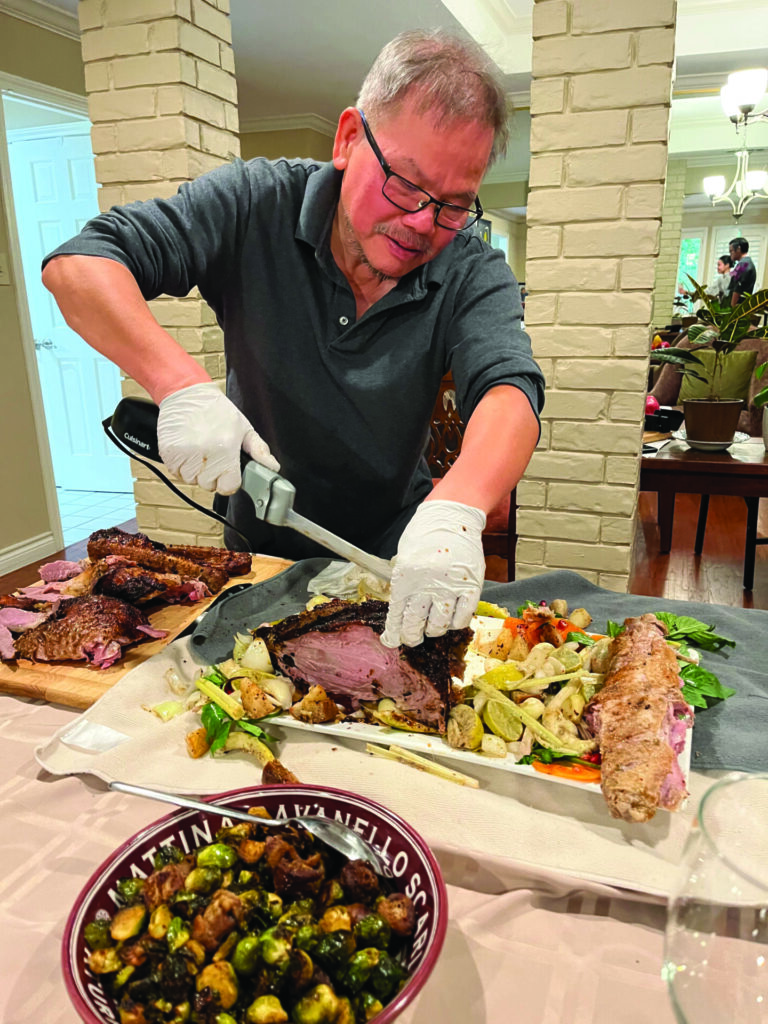
My family gathered around the dining room table just before sunset and sank into the high-backed, cushioned chairs, ready for the journey ahead: Thanksgiving dinner in my parents’ home in Arlington, Texas, in November 2022. A whole roasted goose; a bright salad of marinated kale, persimmon, and red peppers; roasted honey-balsamic carrots; goose fat–coated air-fried Brussels sprouts; and lemon-pepper asparagus crowded the table. Serving bowls cradled mashed sweet potatoes and two types of sticky rice, which my father had made himself: one with toasted peanuts and the other with green mung beans.
When we were a few bites in, my dad mentioned that the last time he’d had his mom’s sticky rice with mung beans was when he was eleven years old and half a world away in Đà Lạt, Vietnam. This was in 1967, and his country was at war. Eight years later, my father, Trấn Văn Thành, fled with thousands of others when Saigon fell to the communist party on April 30, 1975. Because the United States supported South Vietnam during the war, the fall promised retribution against those who remained and who refused to embrace communism.
With his older brother’s sandals on his feet and little in his hands, he boarded one of the many ships that some 800,000 refugees used to escape from Saigon to ostensibly safer places like Singapore, Malaysia, and Thailand. My father and the wave of refugees became known as “boat people.” Thousands who weren’t fortunate enough to board ships attempted the crossing on rickety boats. Many of them drowned or died at sea. Those who survived often encountered more dire and complicated futures in overcrowded refugee camps once they reached their destinations.
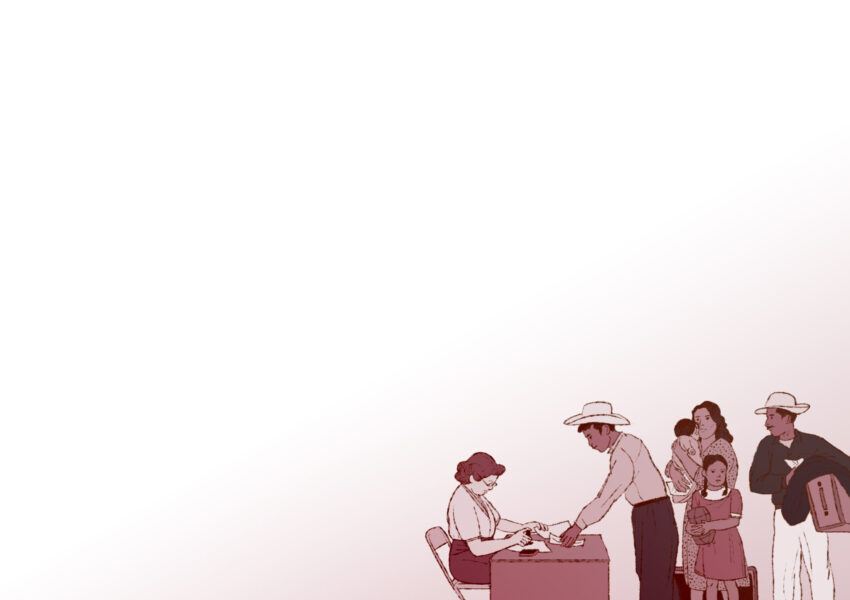
My father traveled for about two weeks, from Saigon to the Philippines to Guam and finally to the United States, where he arrived in mid-May 1975. He was transferred to Fort Chaffee in Arkansas, an Army base that by then was serving as a refugee camp. President Gerald Ford’s Indochina Migration and Refugee Act of 1975 made way for nearly 130,000 Vietnamese, Laotian, and Cambodian people to start new lives in this country.
In Fort Chaffee, my dad and over 50,000 other refugees were provided with food, shelter, and medical care as they waited to get matched with sponsors in other cities. In the meantime, my father began his new life on a base at the southern edge of the Ozarks. And that meant adjusting to Southern food.
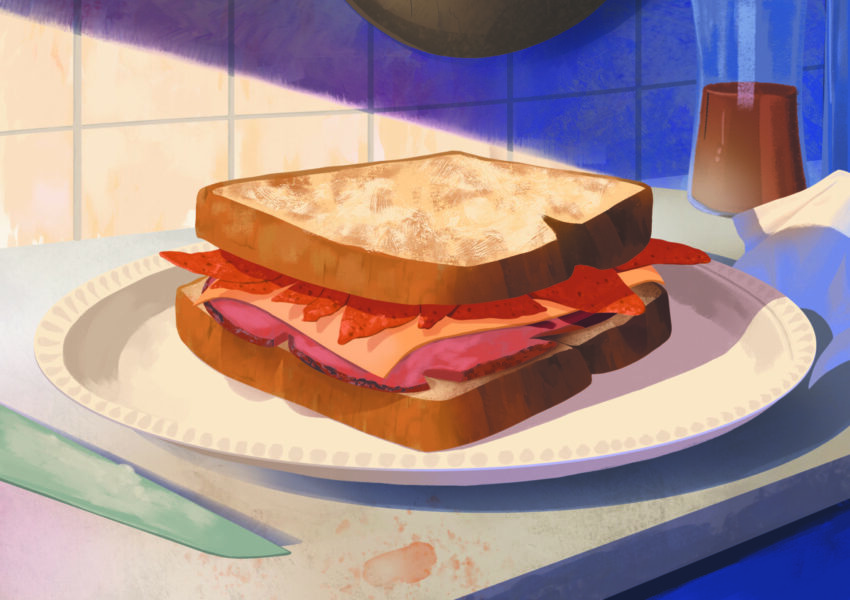
Over the next four months, my dad spent his time wandering around Fort Chaffee—the refugees housed there were not allowed to leave the premises. He started his day with breakfast: a buffet that included scrambled eggs, corned-beef hash, and hash browns. Then more wandering, sometimes with friends; maybe an English language class. Then lunch, also a buffet, typically featuring fried chicken or Spam and rice. After lunch, it was time to settle in for a nap before even more wandering. Then came dinner, usually another buffet with similar offerings to lunch. But the menu changed on Fridays. Apparently, the refugee camp administrators were under the impression that all Vietnamese people are Catholic. Every Friday, the mess hall served what my dad recalls as egregiously smelly canned fish. Most refugees, including him, dreaded those meals.
During his second month in the camp, my dad applied for sponsorship so he could leave the base. He was paired with a twentysomething couple named Joe and Chris Jacob in Ocean Springs, Mississippi. He was on his way to becoming a Southerner.
On the table in front of him was not the corned beef and scrambled eggs of Fort Chaffee, but a fruit that was both unfamiliar and familiar...This was his first encounter with a grapefruit. He had no idea how to eat it.
The morning after he arrived, he sat down for breakfast with the Jacobs. On the table in front of him was not the corned beef and scrambled eggs of Fort Chaffee, but a fruit that was both unfamiliar and familiar: It looked like a large orange, with an off-yellow rind and pink pulp. This was his first encounter with a grapefruit.He had no idea how to eat it. Anh Joe and Chị Chris (anh and chị translate to “older brother” and “older sister”) showed him how to scoop out the meat of the fruit. Tangy and sweet, it tasted like nothing he had ever eaten.
Joe and Chris were vegetarian. They mainly prepared meals of beans and rice with cheese (something my dad still makes to this day) or dishes from Frances Moore Lappé’s Diet for a Small Planet, a bestselling 1971 cookbook that promoted the environmental benefits of eating non-animal proteins. My dad, on the other hand, was a true carnivore. Growing up, he had eaten meat almost weekly, when his mother would slaughter pigs to sell at the market in his hometown. Luckily, once a week, Joe and Chris took my dad out to a local cafeteria-style restaurant that served Southern staples like fried chicken and pork chops. He remembers filling his tray with every meat except hamburgers—he wasn’t interested in the bun.
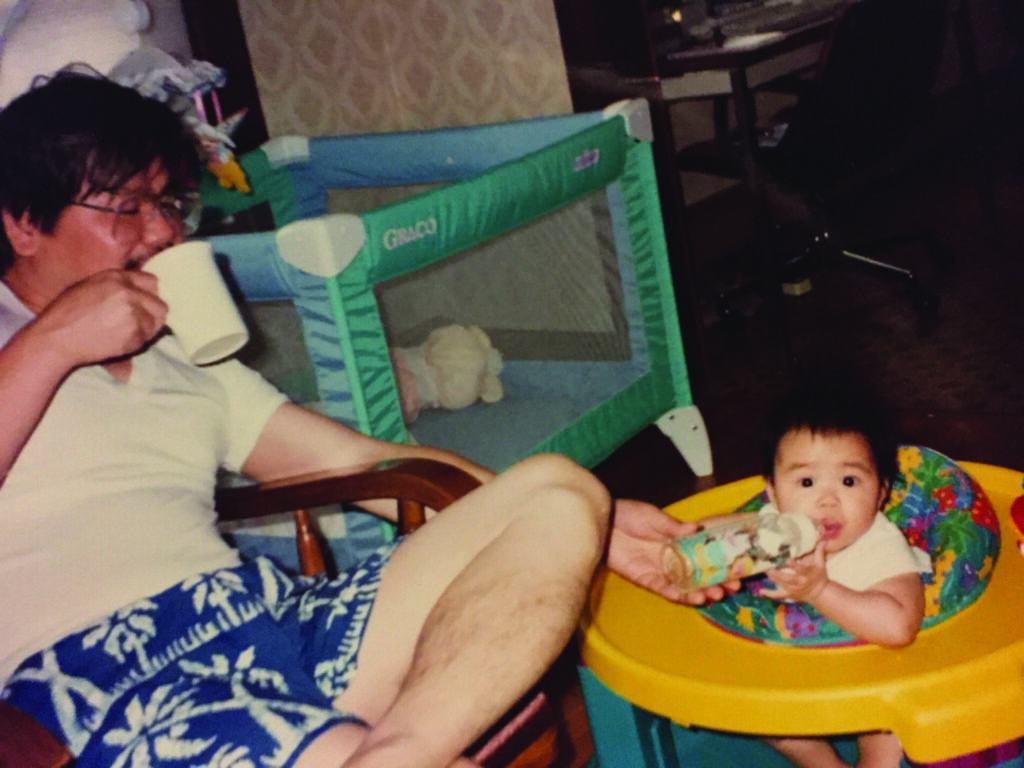
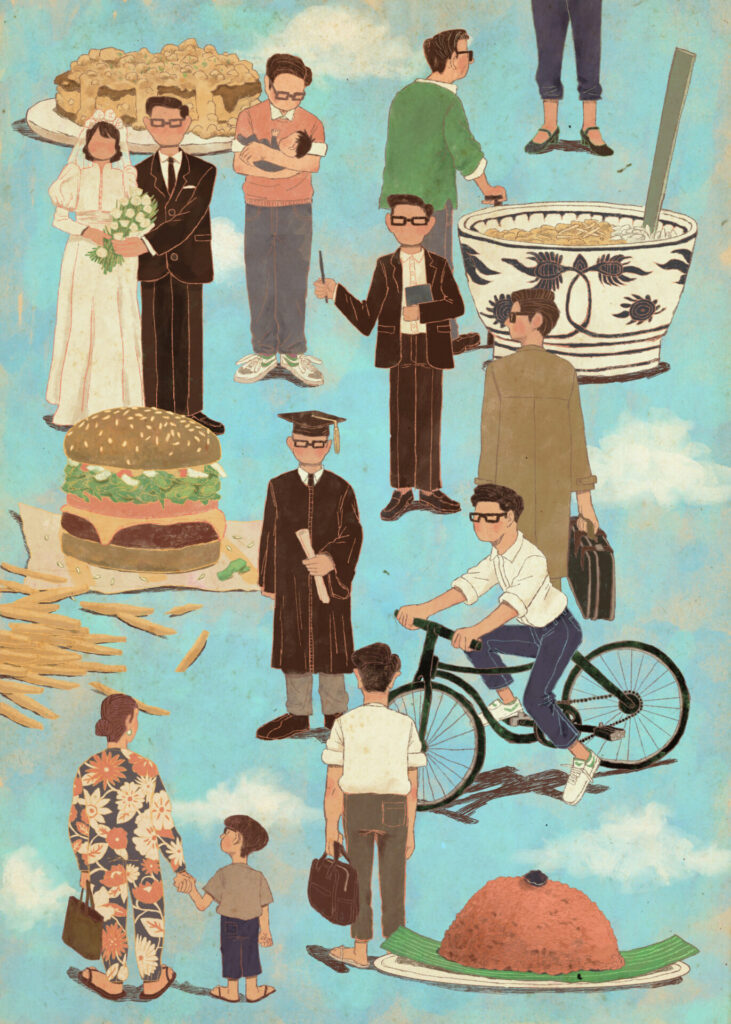
One morning, his sponsors were out of town, and he wanted to try something new: to order a meal on his own without help from anyone. He biked to the local burger joint next to the Piggly Wiggly, mustering up all his courage on the ride. After parking the bike, he walked in and ordered the Number One. They gave him his first-ever American hamburger. It was as though he’d forgone those cafeteria burgers for this very American moment: a smashed and griddled beef patty, iceberg lettuce, and slice of tomato, dressed in ketchup, mustard, and mayo. He still remembers the happiness he felt that day. At the time, there were less than a handful of Vietnamese refugees like him in Ocean Springs, but after that Number One burger, he felt confident being on his own and ordering his own food in English.
He eventually racked up more firsts: first job, first day at school, first Thanksgiving and Christmas. For Thanksgiving, he and Anh Joe headed to New Orleans to Chị Chris’s family’s home. In New Orleans, he discovered the magic of jambalaya and gumbo, but also a nascent Vietnamese community of refugees like him. Many of them were brought to the area in 1975 by Catholic Charities after the fall of Saigon. It was the same organization that helped my dad resettle in Ocean Springs. Over the next thirty years, this small community in New Orleans grew to about 14,000 Vietnamese people. They would go on to change not only the demographics of the city, but also its culinary landscape. With both Vietnam and New Orleans’ historical ties to France, this might have been expected. Traditional Vietnamese flavors and ingredients like lemongrass, ginger, Thai chilies, and garlic paste were interwoven with Cajun foodways to create a new American cuisine: Viet-Cajun, famously found in crawfish boils today. This Southern expression, a blend of his home country and his new home, became a family favorite in our own seafood boils.
Four months after that Thanksgiving, my dad moved out of his host family’s home and into a trailer in Ocean Springs—the first home of his own in the South. Eventually, he moved to Texas, where he earned a bachelor’s degree in sociology and later a PhD in social work at the University of Texas at Arlington. Between those degrees, he returned to Mississippi to get his master’s in social work at Jackson State University. While he worked on his degree in Jackson, he also took a job with a program that offered social services to Vietnamese, Cambodian, and Laotian refugee children. From the “white house” (a nickname for the shared men’s home he lived in while working and studying) to Jackson State’s school cafeteria, cooks at this historically Black university introduced him to much of the Southern fare he came to love: grits, biscuits and gravy, collard and turnip greens, cornbread, and catfish.
Though my dad went on to live in Michigan, Massachusetts, and California, he spent his formative first American decade in the Southern part of the country: Arkansas, Mississippi, Texas, and Kentucky. The biscuits and gravy and collard greens he came to love are foods he treats himself to whenever he can find them on a restaurant menu or hotel breakfast buffet. Recently, I asked him if he ever felt like he was really in the South during those early years. Did he understand the region’s history? Its way of life? He said that, at the time, he didn’t have a sense of what “the South” meant or felt like in comparison to the rest of the United States. He was so focused on surviving—having a roof over his head, a job to pay the bills, and enough to eat—that his surroundings could’ve been a black box. All he knew was that it could never, and would never, compare to Vietnam.
My dad went on to spend his career in academia and social work. But he is also an accomplished poet, recognized in Vietnamese communities here and abroad. His work, which he writes in Vietnamese and often translates to English, is filled with memories of his past: his mother, father, and siblings; and the village and farm he called home, where he found happiness “…waking up in the morning waking/Hearing the crowing of the roosters/And wondering whether or not I am dreaming.” Surrounded by coffee and banana trees, this is where his family shared meals filled with roasted yams, bowls of rice, and ripe yellow bananas. Though he built a social circle of fellow Vietnamese refugees wherever he lived, nowhere in the United States could ever come close to the land of his birth. And yet, with each plate of collards or bowl of gumbo, he adapted to the foodways of his new home.
When he finally had a family of his own, he made sure to bring the South to the dinner table, even if it was fast food. I grew up in the Northeast and Southern California eating home cooked, traditional Vietnamese staples, but on some occasions, we gorged on buckets of Kentucky Fried Chicken, orders of red beans and rice from Popeye’s and my dad’s own version of dirty rice, which is essentially Vietnamese-style fried rice enriched with bacon, turkey drippings, mushrooms, and green onions—a nod to his momentous Thanksgiving dinner in New Orleans with Anh Joe.
Though he built a social circle of fellow Vietnamese refugees wherever he lived, nowhere in the United States could ever come close to home.
I celebrated Thanksgiving 2023 not in Arlington but with my fiancé’s family in Charlotte, North Carolina. It turned out that Anh Joe had moved to North Carolina, and I had the opportunity to meet him for the first time. Following a flurry of text exchanges between my dad, Anh Joe, and me, I found myself spending the next day with my fiancé, his brother, and Anh Joe.
In a five-hour whirlwind, I hopped on a tiny, four-seater plane with my fiancé and his brother, who flew us 125 miles northeast to Burlington, North Carolina. Joe lives in nearby Saxapahaw, a tiny rural community, where he owns a company that offers canoe and kayak tours on the Haw River. He gave us a tour of his office and took us to the Saxapahaw General Store for dinner. Though macaroni and cheese and red beans and rice were on the menu, I had a veggie plate that wasn’t remotely Southern: roasted Brussels sprouts, risotto, and asparagus. As we ate, I asked Joe about his time with my dad. Joe didn’t remember much from those six months. There was, of course, a language barrier. But what remained indelible, he said, were my dad’s kindness, warmth, and fortitude.
My parents told me that for their own Thanksgiving dinner in Arlington last year, they made duck three ways: smoked duck, a Vietnamese duck salad, and Vietnamese duck and bamboo noodle soup. Dad loves to cook, and his phở, bún măng vịt, and thịt heo kho are some of my favorites. Sometimes, he binges YouTube videos to learn how to make Vietnamese dishes lost to him when he fled communism. Other dishes he learns on his own through trial, error, and will. Then there are special ones he makes from memory, including his mom’s sticky rice with mung beans, which he grew up watching her prepare. When he’s not cooking, he enjoys taking our family out to dinner for Texas brisket, ribs, fried chicken, and collard greens. Southern and Vietnamese cuisines usually don’t make an appearance together at my family’s dinner table. But over the decades, my dad has rooted himself in both. He is bound to both places. And whether at our dinner table over pho, or at a Texas barbecue joint over brisket, he shares the stories of the places that made him.
My Happiness
by Tràn Thu Miên
My happiness is being able to return to the old village
And seeing my parents again.
My happiness is waking up in the morning
Hearing the crowing of the roosters
And wondering whether or not I am dreaming?
My happiness is the ripened yellow bananas
That my mother has saved for me with her loving tears
For years, she has looked over the dusty road every day
Waiting for and dreaming of the return of her exiled son
The day I finally come home, she cries, full of happy tears
My happiness is holding my mother’s hand
Walking shoulder to shoulder to the village church every day
And hearing the villagers saying to her
“Your son has finally come home from a far away land to visit old neighbors.”
My happiness is listening to the wind
Blowing over the banana leaves in the garden.
My happiness is seeing my older sister
Crying happily while preparing my homecoming dinner.
My happiness is hearing my dad asking me
If the moon in my land of exile is as bright as the moon in our old village/
And I spend all night hearing him tell me
The stories of our family since I left
And the night passes quickly like the crowing of the roosters.
My happiness is looking at the coffee trees
Blooming with their white flowers in the backyard
Of my old house.
My younger sister is now a married woman
Looking into her eyes, I ask, “Are you happy seeing me again?”
She smiles, holding the sleeves of her torn shirt and nodding shyly
“Your coming home makes me happy.”
My happiness turns sour knowing my baby brother
Has nothing to dream for in his future.
My happiness is to share a roasted yam
With my nieces and nephews.
My happiness is eating dinners
My mother prepares with vegetables
She gathers from her garden.
My happiness is saying the evening prayers
With my mother at the end of a peaceful day.
My happiness will overflow in my exiled heart
For many years.
Click here to access a version of this poem in Vietnamese.
Minh-Y Tran is the director of business development at Robb Report and Art Media. She is also an MA candidate in food studies at New York University and volunteers as an associate board member and high school mentor with Apex for Youth.