
Meditation at Staplehouse Moonlighting as a food runner at a storied Atlanta restaurant taught me the meaning of hospitality.
by Gregory Emilio
photos by Bita Honarvar

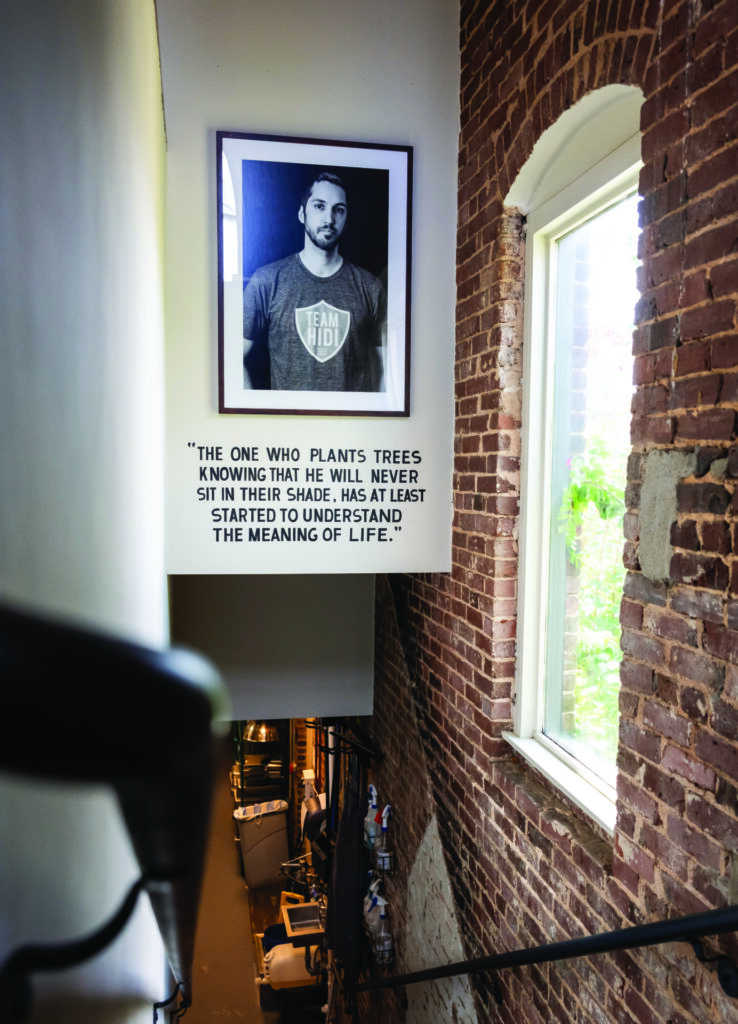
I began each shift by staring into the dead chef’s portrait.
He’s in his mid-thirties in the photo, handsome and lean, wearing a grey T-shirt and sporting a scruffy beard. There’s a darkness lurking behind his eyes. A weariness. It’s not surprising to learn that the photograph was taken just a few months before his death. Below him, a quote in rigid capitalized script, from the Indian poet and philosopher Rabindranath Tagore:
the one who plants trees
knowing that he will never
sit in their shade, has at least
started to understand
the meaning of life.
I worked at Staplehouse for six months, from April to September of 2022. I like to use the cheeky verb moonlighting because this was in addition to my other job as a lecturer of English at Kennesaw State University, some twenty-five miles north of Atlanta. That year, I’d opted out of teaching summer classes and needed a short-term gig. Having worked for over a decade in bars and restaurants, covering every position from dishwasher to short-order cook to lead bartender, the hospitality industry is never far from my mind. Plus, I was feeling a bit burned out from my first year as a full-time faculty member, and I thought a little restaurant work would be a nice change of pace. I’d been a fan of Staplehouse since the days of its peak tasting-menu buzz—in 2016, Bon Appétit named it the Best New Restaurant in America—through its mid-pandemic reopening as a market and counter-service restaurant. A friend from Chrome Yellow, the coffee shop down the block from Staplehouse, said they were hiring. I sent an email.
When it isn’t overcast or raining, the kitchen at Staplehouse is flooded with natural light. The building is over one hundred years old, and from the kitchen floor to the ceiling, it’s a good thirty feet. Light filters down from what used to be boardinghouse bedroom windows. More light streams through a big rolling glass garage door facing the garden. I’d worked in many dank, dimly lit kitchens, so the abundance of light was one of the first things I noticed. The wall above the door from the kitchen to the dish pit bears one of the dead chef’s maxims: “Anything long-lasting or worthwhile takes time and complete surrender.”
You may already know the story, so I’ll keep it brief. Staplehouse was the dream of Atlanta chef Ryan Hidinger and his wife, Jennifer Hidinger. They’d been saving up for a brick-and-mortar for years by hosting Sunday-night pop-up dinners in their home. In 2012, as they started to get within reach of the real thing, Hidinger, at age thirty-five, was diagnosed with stage IV gallbladder cancer. The doctors estimated he had about six months to live. In a stunning feat of community solidarity and Atlanta love, Team Hidi, a charity event set up to help cover his medical expenses, raised over $275,000. After Hidinger’s treatment costs were cleared, there was money left over to start The Giving Kitchen, a nonprofit dedicated to helping restaurant workers sidelined by medical emergencies and other crises. The organization was able to secure the turn-of-the-century brick building for Staplehouse, the long-fermenting dream of a restaurant that would be run by Hidinger’s good friend Ryan Smith; Hidinger’s sister, Kara; and his wife, Jen. Ryan Hidinger died in 2014, just over a year after his diagnosis. In 2015, Staplehouse finally opened.
Four years later, Jen had decided to leave the restaurant to work full-time at the Giving Kitchen. Ryan Smith and Kara Hidinger, by then married with two young daughters, bought Staplehouse outright from the nonprofit in 2020.
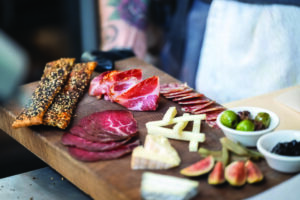
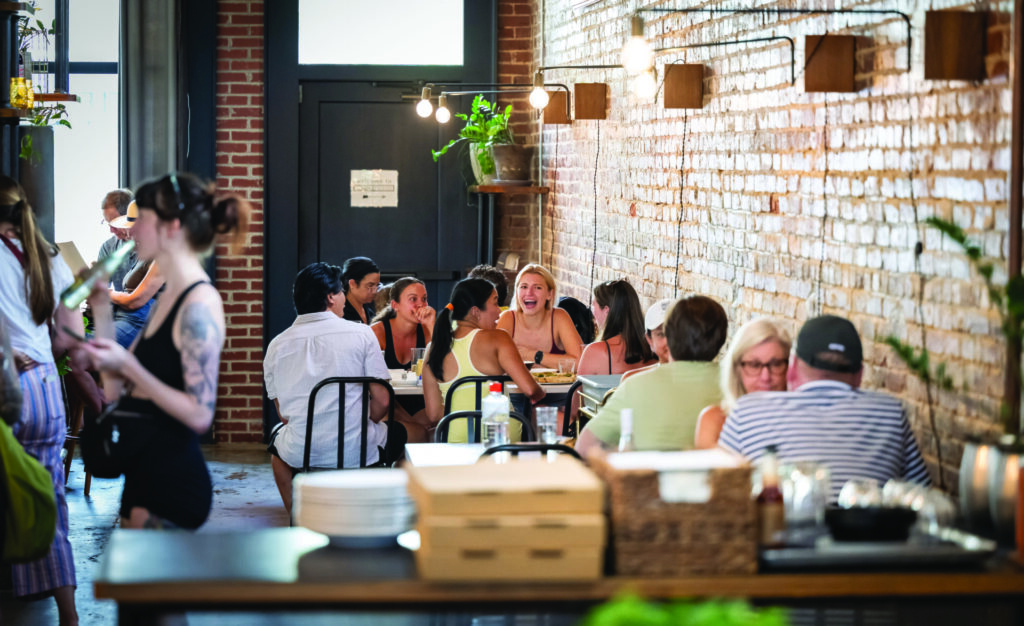
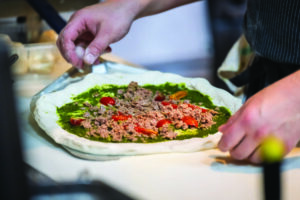
By the time I was working there, Staplehouse had made a pivot from Atlanta fine-dining darling to gourmet market. It sold natural wine, homemade charcuterie and specialty condiments (pâté, fermented hot sauces), and a limited menu consisting mostly of sandwiches and produce-forward sides. My responsibilities in this hybrid iteration largely entailed running food, bussing tables, taking orders at the register, and pouring wine.
In addition to guest-facing tasks, a typical day would include a lot of retail and stocking minutiae, things I’d never had to do so much of before in a restaurant. I stamped to-go bags with a Staplehouse logo (John Candy as the Walley World security guard in National Lampoon’s Vacation), bottled our array of funky condiments (burnt ends XO sauce, chili crisp, salsa macha), and bagged “everything” crackers and fresh pasta. Tearing perfect rectangles of butcher paper to neatly swaddle grinders was an oddly pleasurable task for the type A in me. Then there was the familiar refrain of polishing a never-ending wave of silverware, plates, and glasses—even pinch-hitting as dishwasher when Satchel called off. One of the most memorable and mysterious chores was sweeping up the fine silica dust that flaked off the old building’s brick walls during the night, gathering into crumbs on the concrete floor by morning. It was as if time itself were chewing on the place when we weren’t looking.
At the end of the night, I’d clean the bathrooms, mop, and squeegee the kitchen floors. I’d heave trash bags into dumpsters. I’d walk over twenty-five thousand steps in an eight-hour shift, up and down many flights of stairs, bearing heavy loads. I’d head home ripe with the hallmark musk of professional kitchens, a motley aroma of smoked meat, sweat, and sani buckets. My feet and lower back would ache, softened as they were by my mostly sedentary career in academia. At thirty-five, the same age Ryan Hidinger was at the time of his diagnosis, it was anything but a glamorous gig.
“This place is just…dreamy,” a woman named Eve said to me the day of her last shift at Staplehouse. She was moving on to an office job, and I was her replacement. The kitchen was awash with light as we polished plates beside each other. I believed what she said then, and over two years later, I still do. Before I started teaching full-time, I had been the lead bartender at Bellina Alimentari, an Atlanta wine bar and Italian restaurant, and then worked for a brief stint reviving the bar program of its Israeli-themed sister restaurant, Aziza, during the pandemic. These were positions of some rank and importance. I was a scratch bartender and had a decent talent for creating original cocktails. Sometimes I’m tempted to say I was an “award-winning” bartender, but getting bronze at the High Museum’s third annual cocktail competition, Highball, probably doesn’t justify that title.
 I do have another honorific that I waver between wearing proudly and keeping quiet about, depending on who I’m around. I earned my PhD in English from Georgia State University in 2020, which, during my stint at Staplehouse, probably made me one of the most overeducated food runners in the business. On the one hand, working at Staplehouse was a refreshing break from teaching as many as 150 students a semester; on the other, it revived my longstanding identity crisis, the hard split between hospitality and academia. After undergrad, I wavered between pursuing a culinary degree from Le Cordon Bleu or an MFA in poetry. I chose writing, but restaurants continued to tug at me; perhaps they always will. Though I love my students, some days, when boredom overwhelms them and they go blank while I’m trying to explain the real-world application of rhetorical analysis, or the enduring significance of Sappho or Oedipus Rex, I wish I were shaking cocktails or talking about natural wine with discerning guests. Then again, running food and bussing tables for eight hours often made me long to be back in the classroom.
But what I really want to talk about—what I came to the page to consider—is hospitality: not only as an industry, but as a spiritual mode of being, something as deep as marrow in the bone. I keep thinking about the character Eumaeus from Homer’s Odyssey. Eumaeus was a swineherd and one of Odysseus’s most faithful servants. When Odysseus finally makes it home after his decade of wandering (not to mention sleeping with several goddesses along the way), Athena disguises him as an old beggar. He shows up at the door of Eumaeus’ shack. No questions asked, the swineherd takes in this no-name vagrant and gives him the blanket from his own bed. He then cooks him dinner—suckling pig!—and the two drink cup after cup of the swineherd’s wine. Only after all this does Eumaeus ask Odysseus who he is and where he’s from.
The episode with Eumaeus epitomizes the ancient Greek concept of xenia—the divinely codified ritual of hospitality for strangers, an act so important that it was presided over by none other than Zeus. Eumaeus, whom I called a servant before, but who is more precisely a slave, tells his very master disguised as a vagrant, “What I have to give is small, but I will give it gladly.” Has there ever been a more concise or soulful definition of hospitality? Isn’t it true that the people with the least to give often give the most? I like to imagine this quote hiding in some nondescript corner of Staplehouse, some small wall space in the dish pit, where no guests will see it.
In Andrew Knowlton’s “Best New Restaurant in America” review of Staplehouse, he summed up his choice thusly:
Let me make one thing clear: Staplehouse didn’t become my restaurant of the year because of its heart-wrenching story. It became my restaurant of the year because of the smart, innovative cooking of Ryan Smith and the warm, welcoming, unwavering hospitality of Kara, Jen, and the entire team. In every way imaginable, it floored me.
A few weeks into my stint at Staplehouse, during the pre-service lineup for a wedding buy-out at the restaurant, Kara quoted Knowlton’s bit about the hospitality from memory. She stressed that even though the restaurant’s format had changed, its hospitality needed to remain unwavering. She wanted us to understand the significance of two people entrusting us with the celebration of their marriage, and our sacred responsibility to honor that trust. It was clear from the conviction in her voice that this was no schtick.
Later that night, as the last guests were filing out, I saw the bride, wiping tears from her eyes, talking to Kara about how much the evening meant to her and her husband, how they had their first date here, how they’d followed the story of Kara’s brother, Ryan, throughout his battle with cancer, and the Giving Kitchen, and the pandemic closure and reopening—the whole Staplehouse saga. And then Kara was crying too, tears of gratitude, and the two of them were laughing and hugging and wiping their eyes.
When we finally finished closing that night, after Kara gave us each a bottle of wine to take home, we stood outside the back door, and she asked us to pause for just a second, to take a deep breath. It was spring in Atlanta, and the clouds from earlier had scoured the night sky clean. Midnight, crystalline, a rare moment of silence on Edgewood Avenue. “How special,” she said, looking up. “Just think of what we did tonight.”
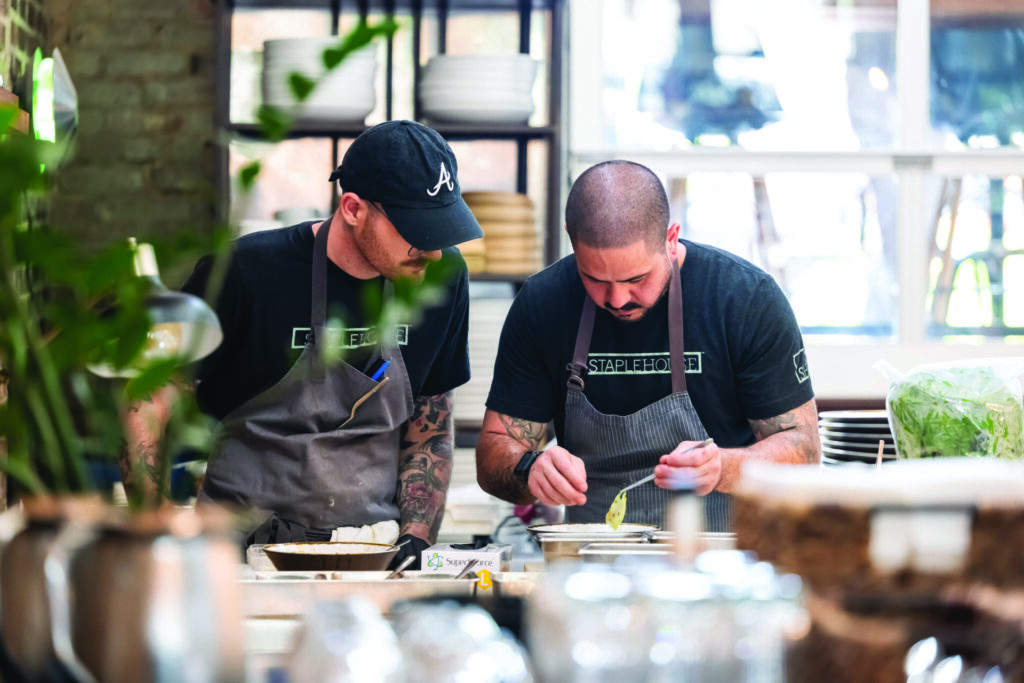
Later that summer, I started doing some work with Staplehouse’s cocktail program, but I still liked manning the expo and running food the best. It kept me in the kitchen, close to what I saw as the real action: cooking. I’d spend hours watching Smith and the team do their thing, perpetually shooting the shit with them, and picking up some techniques and bits of know-how along the way. I learned to shock green onions, sliced on the hardest possible bias, in ice water to make them crisp and frilly. I learned the minuscule dice of a brunoise, the intricacies of a sauce gribiche. Though they remain shrouded in mystery, I began to understand the dark art of making pâtés. I was introduced to new produce like celtuce, condiments like XO sauce, and spice blends like vadouvan. I learned how to rotate a marigold flower between my thumb and index finger while taking scissors to the petals, making them rain down atop any dish that would benefit from a bright, floral pop. (Note: Just about everything benefits from a bright, floral pop.) I took mental notes on how to sharpen my carbon steel knives on a whetstone at home. I was constantly fed scraps by asking the right questions.
“Chef, can you explain what aji dulce are again?”
“How do we make the fennel honeycomb crisp?”
“So what’s the difference between saucisson sec and rosette de Lyon?”
“Yo, can I get another spoon of that grinder tapenade?”
“One more time, chef, the pâté de campagne?”
Plus it was fun to call out orders—sheepishly at first, then with growing confidence and gusto: “Okay, for here I got three grind-dogs, two farm eggs, one noodle add shortie, and to-go one small charcuterie and soft-shell crab.” Every single call-out was followed by a unanimous, synchronized reply, a long drawn out “Yeeessss” from all the cooks. I enjoyed being on my toes during a rush, ready to move. Mostly, I hadn’t had to run my dishes when I was bartending. Now I had to go back to the skills I’d learned at my first restaurant job: how to carry three plates at a time, using the forearm for balance; the quick arithmetic of remembering which plates go to which tables. (We didn’t have seat numbers, thank god.) As the food runner, I was the messenger, and in a place where the food was this good, I brought only the best news. I jogged back from tables, bounding down the stairs, forgetting I was in my mid-thirties, ready to load up and run and say, “Yes, chef!” again and again.
My wife and I celebrated our first year of dating at Staplehouse back in 2018. It seemed just about the coolest, most special place we could go to celebrate one year of being together. Katerina, who is an actress, had been filming all day, and I remember the nervous thrill of picking her up from set and whisking her off to what would be one of the more memorable meals of our lives. She wore a white dress and I was googly-eyed all night, both for her and over the succession of exquisitely composed dishes gracing our table. (I am grinning like an absolute idiot in one picture Katerina took.) We keep that night’s menu on a corkboard among other cherished restaurant memorabilia:
13 September 2018
okra, egg yolk, ribeye, pear, kumquat
gaston chiquet, rosé champagne, france
crab, rau ram, aji dulce, swordfish, papalo, tomato
caraccioli, chardonnay, california
eggplant, edamame, basil
all that you are, the veil, virginia
squash, lobster mushrooms, marigold
la milla, albariño, spain
butternut, sunflower, chicken liver tart, black fig
selbach-oster, riesling, germany
grandma lillian’s potato bread, aged duck, farro, leek
lopez de heredia, rioja, spain
kombucha
buttermilk, rose geranium, almond
château l’ermitage, sauternes, france
caramel miso chocolate
—With Gratitude
I have to admit that all these years later, with the exception of the chicken liver tart’s virtuosic solo, I struggle to remember what the individual dishes tasted like. I know that many of the combinations of ingredients were novel and delightful to me, and that each dish seemed to achieve a sense of resonance, like the struck prongs of a tuning fork. But what I remember most deeply is the cumulative sense of ambience, rhythm, congeniality, and care. Of course, we were influenced by the restaurant’s backstory, its tragedy and eventual triumph. But as Knowlton pointed out, the potent gastronomical magic of that evening wasn’t merely the product of a sad story. Looking back, I’ve come to understand that hospitality, the transcendental kind, the kind that leaves you glowing, the glow rekindling with memory sometimes years down the road, is always greater than the sum of its parts.
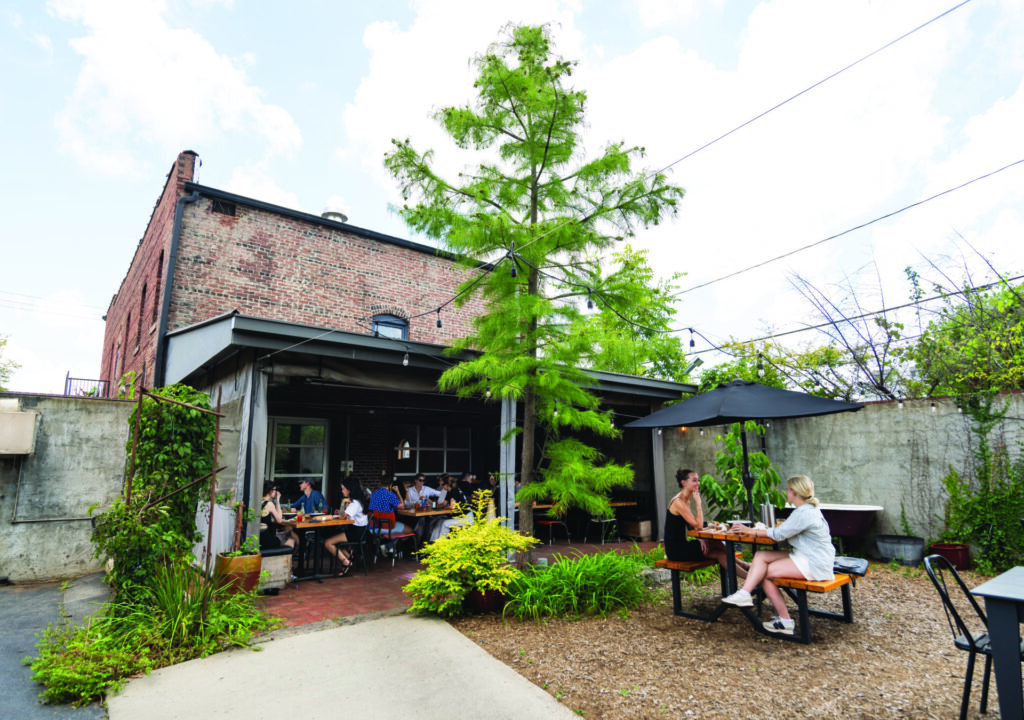
The Staplehouse of 2022 offered a very different dining experience. Guests would place an order, receive a number, and then be invited to walk through the kitchen to find a table in the garden. Many people were flabbergasted by the change. Just about every shift, a guest, waxing poetically about that night they were here four years ago, would ask when (not if) we’d go back to being a “real” restaurant. Sometimes a guest would stare at the menu written on the wall and ask, “So where’s the restaurant?” The answers to these questions were “Probably never,” and, “Ma’am, you’re standing in it.”
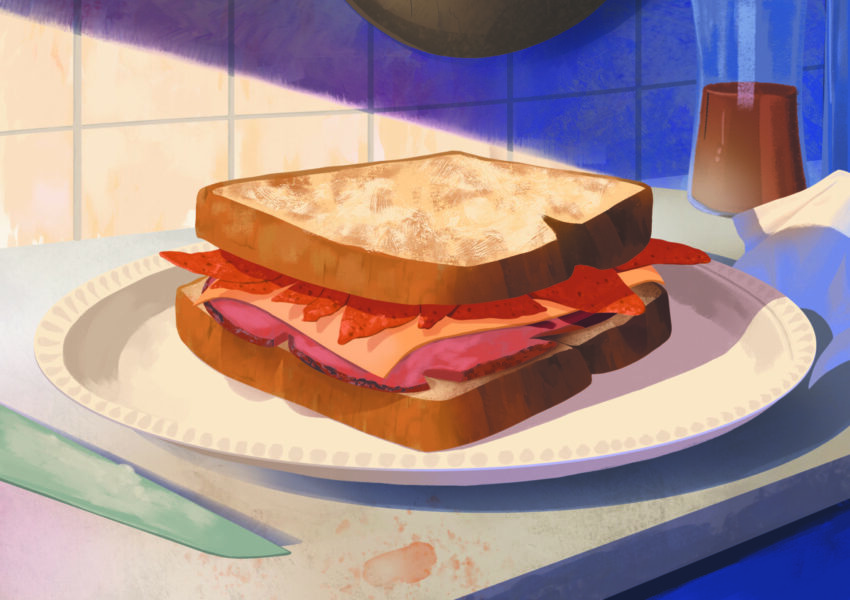
Other guests embraced the shift, many of them explaining that they could not have afforded the tasting menu. To be fair, the food still wasn’t cheap. Twenty dollars is a lot to shell out for a sandwich. But for someone with my tastes and preferences, it was probably the best sandwich money could buy in the city of Atlanta. In their annual awards of 2021, Eater Atlanta gave Staplehouse “Best Pandemic Pivot.” I found the trophy, shaped like a can of soup, unceremoniously tucked among clutter and knickknacks in the office. (A neon-toned print commemorating Bon Appétit’s Best New Restaurant designation was framed beside Smith’s James Beard Award nominations, just outside the office.)
In the last year, Staplehouse has started to revert to its fine-dining roots, serving a five-course, prix-fixe menu on Friday and Saturday nights, while still offering market dishes—grinders, pizzas, noodles, and salads—by day. During my time there, Staplehouse—having made the switch from fine dining to fast casual; surviving Covid-19 only by evolving—felt like ground zero for understanding the hospitality industry in post-pandemic America. Now that it’s combining the best of both worlds—quick lunches and fancy dinners—it remains a fascinating case study in restaurant resiliency, a crucible for hospitality in an ever-changing world.
In The Physiology of Taste: Or Meditations on Transcendental Gastronomy, Jean Anthelme Brillat-Savarin’s 1825 masterpiece on the pleasures of the table, he opens the book with a list of twenty aphorisms. The best known of these, as translated by M.F.K. Fisher, is the fourth: “Tell me what you eat, and I shall tell you what you are.” The ninth follows close behind: “The discovery of a new dish does more for human happiness than the discovery of a star.” For those in the know, the fourteenth is a comic favorite: “A dinner which ends without cheese is like a beautiful woman with only one eye.” It’s the last aphorism, the twentieth, that tops my list: “To invite people to dine with us is to make ourselves responsible for their well-being for as long as they are under our roofs.” A straightforward, concise definition of hospitality, the xenia Eumaeus showed to Odysseus, the ancient contract between host and guest. As long as you are in my home, it is my duty to take care of you. Staplehouse was to me, and to countless others, a house that always felt like home.
Before I knew it, the summer was ending and a new semester loomed on the horizon. One afternoon, a colleague from the English department came in to order some food to go. I knew her by face and by name, but I was fairly certain she wouldn’t recognize me, the new guy in a large department. Despite this, I hid in the back, polishing plates in the dish pit to avoid taking her order, embarrassed (I’m now ashamed to admit) to be doing the kind of job that one of our undergraduate students could easily do.
When the coast was clear, I went back out with my stack of polished plates and talked with my manager about having to phase out in a few weeks before the semester would drown me with its deluge of papers to grade. We talked about it in terms of a hiatus, with the door open for future summer and winter breaks, though I knew that this would likely be the end and was unwilling to say as much. When Kara heard the news, and I said that I’d be back, she replied with a smile and a hug, “Oh, people always say that, but they never do.”
“Nor shall death brag thou wander’st in his shade.”
Thinking of the Tagore adage about trees and future shade under Hidinger’s portrait, this line from Shakespeare’s Sonnet 18 keeps coming back to me. Better known by its first line, “Shall I compare thee to a summer’s day?” the poem is one of the best-known love poems in the English language, and one I love to teach to undergraduates. And here I find some sense of symmetry between teaching and hospitality: Ultimately, they are both acts of service, both attempts to make people feel more at home in the world by welcoming them in. My students, like restaurant patrons, begin as strangers. Over the course of the semester, they become regulars. Instead of serving them something to eat, I try to give them food for thought, ways of seeing that their lives have consequence, and that this consequence is deepened in communion with others.
Sonnet 18 famously concludes, “So long as men can breathe or eyes can see, so long lives this, and this gives life to thee.” Ryan Hidinger wanted to create a restaurant that would outlast him—to plant a tree that would provide shade after death had claimed him. His vision for his restaurant, and his notion of hospitality, in many ways, are downright Shakespearian. A decade after his death, Staplehouse endures.
Saturday, September 3, 2022, was my last shift at Staplehouse. It was a shift much like any other. I arrived at 3 p.m., jogged up to the office to drop off my backpack and get ready. Saddling up my wine key in my back pocket, Sharpie in my shirt pocket, I lingered, as I always did, before Hidinger’s portrait. Looking to the dead is one of the more remarkable things about being alive. Our time is so finite, our lives so infinitesimal, and the prospect of shuffling off what the Bard called “this mortal coil” can’t help but make us wonder how we’ll be remembered. How will we mark the time? How will we scratch the surface deep enough to leave a mark? I wasn’t surprised to learn that Ryan Hidinger had starting writing quite a bit—letters, reflections, aphorisms—during the final year of his life. I imagine he must have wanted to leave some closing remarks, some evidence of having been here. But he also left a vision of a restaurant, an idea of selfless hospitality. I never met him, but after six months at Staplehouse, I felt like I knew him. I felt his presence as a certain kind of lightness in the air. A residue like the silica dust that was constantly sloughing off the brick walls, gathering on the floor, and waiting to be swept up at the start of each shift.
But I still had to clock in. I bounced down the stairs, grabbed a clean kitchen towel from a neatly folded stack, and set about the business of food service. At the register, I reassured people of the grinder’s goodness. I urged true believers toward a slice of the pâté orfoie and told them not to snooze on the alkaline noodles. I chilled bottles of natural wine. I wiped down tables and hauled bus tub after bus tub to the dish pit. I washed and polished round after round of glasses. And of course, I stood attention at the expo, ready to run food, bantering with the cooks between orders. The late-summer, high-afternoon light slowly gave way to evening blues. I brought food to tables like it was gospel. And when people’s eyes lit up, and they began patting their bellies in anticipation, I’d say something like, “Oh yeah,” or “Y’all are doing it right.” And I meant it.
And when I clocked out that night, cut early because it was slow, there wasn’t much fanfare or heartfelt goodbyes, just a round of pounds, a couple hugs, and promises to be back soon. I walked away with my last blessed bottles of wine at cost. I was hungry to be a guest again, with my belief in this way of life deepened. Trusting that hospitality is a ritual we all must work to preserve if we dare to hope for a better world. To have little to give, but to give it gladly. To plant trees knowing—not fearing, but knowing—we will not live to sit in their shade.
Gregory Emilio is the author of the poetry collection Kitchen Apocrypha (Able Muse, 2024). The executive director of the Georgia Writers Association, he lives in Atlanta and teaches at Kennesaw State University.
SIGN UP FOR THE DIGEST TO RECEIVE GRAVY IN YOUR INBOX.