
Kanom Jeeb Built Thai Communities in the American South This soft, supple dumpling holds a sliver of Thai history.
by Ali Domrongchai
Photos by A.M. Stewart
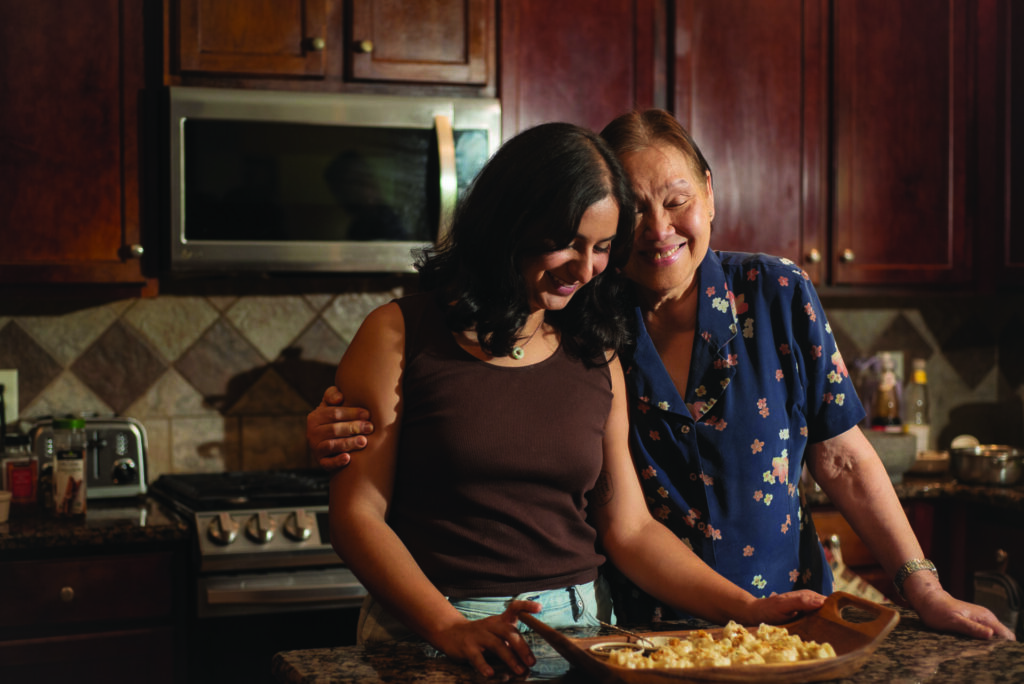
“Ground chicken, shrimp, thin soy sauce, white pepper….” my grandmother murmurs, her voice low, reciting the ingredients from memory in order.
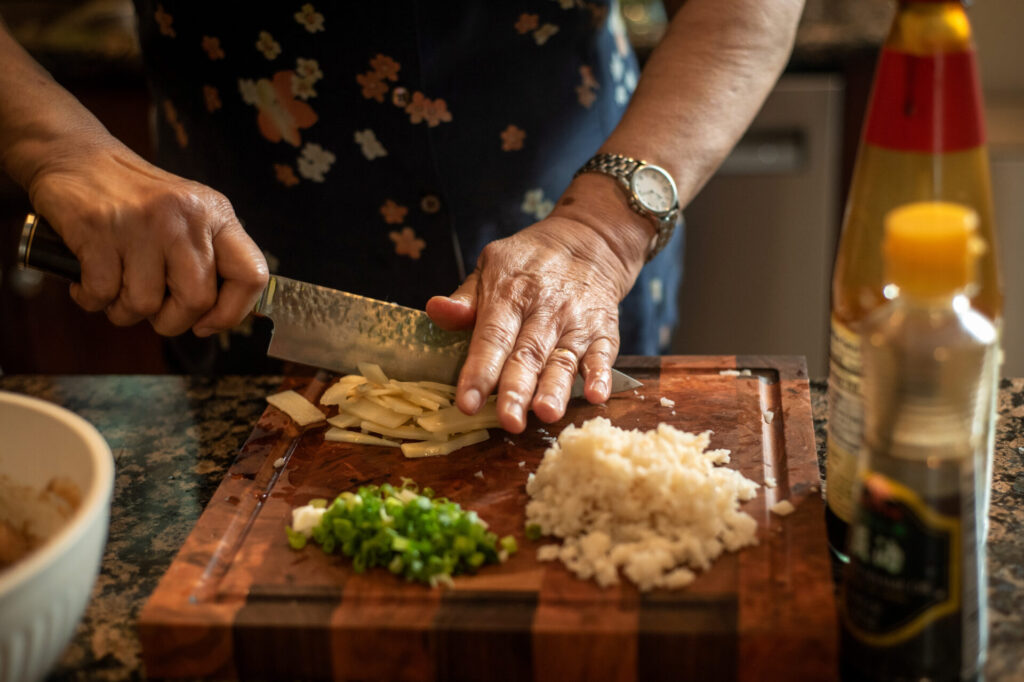
We’re standing side by side in her Boca Raton, Florida, kitchen, making kanom jeeb together. She’s made thousands of them in her lifetime, and we’ve been in this very position, side by side, dozens of times before. She still corrects my grip on the knife as I dice the water chestnuts. She still explains to me why it’s better to use your hands to mix the filling. She still shows me how to scoop the right amount of filling into the center of each thin wonton wrapper, cupping it gently in her palm. She’ll always be my teacher.
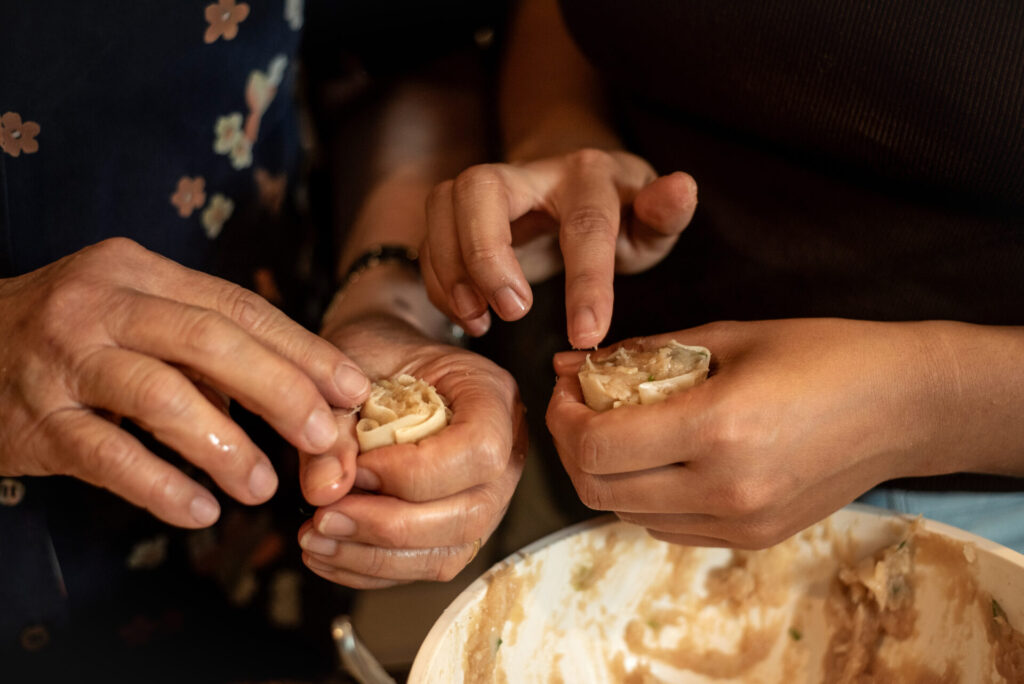
I watch her hands closely, trying to memorize every twitch, flick, and grasp. She doesn’t pause or measure. Just scoops, presses, and gently coaxes each dumpling into shape. Her fingers are slim, knuckles slightly swollen, their movements strong and confident despite the tremble of age. We arrange them in neat rows inside the bamboo steamer, their ruffled edges peeking upward, and the sesame-and-garlic aroma rises before the lid settles in place. We wait. The dumplings are delicate and open-faced and look like baskets, steamed until tender.
These dumplings weren’t part of her childhood in Bangkok. Before there was kanom jeeb, there was shumai. Cantonese in origin, shumai traveled centuries ago to what is now Thailand, when the region was still the Kingdom of Siam. Typically filled with pork or shrimp, shumai is distinct from kanom jeeb, which is often described as more aromatic and slightly sweeter, compared with shumai’s ginger- and scallion-forward flavor. As early as the eighteenth century, Chinese immigrants had a strong presence in Siam. Their influence was foundational to the cultural and culinary landscape of modern Thailand. Most of the beloved noodle dishes of Thai cuisine are Chinese in origin.
The bulk of contemporary Thai cuisine is built on centuries of cultural exchanges like this. In the fifteenth century, Khmer cooks brought curries to Ayutthaya, former Siam’s capital. Fish sauce, which is a pivotal ingredient in Thai cuisine, has origins that date back to the Zhou dynasty of ancient China. Portuguese colonizers introduced chilis in the sixteenth century and blended them with fish sauce and lime, which led to the development of the distinctive flavor profile—a blend of sweet, salty, savory, sour, and spicy—that Thai dishes are known for today.
Over generations, versions of shumai spread across the country and slowly morphed into kanom jeeb—“kanom” means snack, and “jeeb” refers to the pleated folds on the dumpling. Hawkers sold them on street corners, soft and plump, dunked in a salty-sweet-sour sauce and topped with fragrant, crispy fried garlic. By the 1950s, when my grandmother was a child, this was the kind of dumpling that she would eat from street vendors. Not long after that, kanom jeeb began its migration to the American South.
That move started during the Cold War. Geopolitical forces reshaped Southeast Asia, and American military presence in the region introduced many soldiers to Thai cuisine for the first time, sparking fascination and fondness. This newfound affinity, coupled with the postwar tourism boom in the region, led to a surge in American visitors to Thailand. Enamored with Thailand, these tourists returned to the States, bringing their Thai culinary “discoveries” home through cookbooks that continued to feed Americans’ growing fascination with Thai cuisine and culture.
As Americans began visiting Thailand, a parallel movement emerged. Thais, like my grandparents, slowly started immigrating to the United States in pursuit of the ubiquitous American Dream. By the late 1970s, the Thai population in America was growing by the thousands. Early Thai immigrants to the United States arrived mainly on the West Coast, establishing the first Thai Town in Los Angeles. My grandparents settled in Washington, DC, which had its own small Thai community. Around this time, Thai restaurants slowly began to appear throughout America, including in the South. They often served as community spaces for Thai immigrants missing home, just like my grandparents.
Shortly after my father was born, my grandparents left the city for Rockville, Maryland. On the weekends, they’d grill outside on the porch. On rare occasions, other Thai immigrants wandered over, drawn by the familiar smells of gai yang: grilled chicken marinated in dried lemongrass (which they’d stock up on in Thailand), garlic, and cilantro root. Yupin Laopanit was one of the passersby, allured by the smoky-sweet-salty heat coming from their home. She told my family she was the owner of Bangkok Garden in Rockville, and they became fast friends. Laopanit introduced them to their first Thai American community in the States.
My grandparents were regulars at Laopanit’s restaurant. They loved the food, especially the curry, the familiarity, and the community. Over time, they noticed that it wasn’t just Thai people eating there anymore. The crowd was diverse, and that sparked an idea between my grandparents. They were tired of working as a waiter and a hotel cleaner for someone else. My grandmother was a good cook. If so many people enjoyed Thai food, perhaps they could start a restaurant of their own.
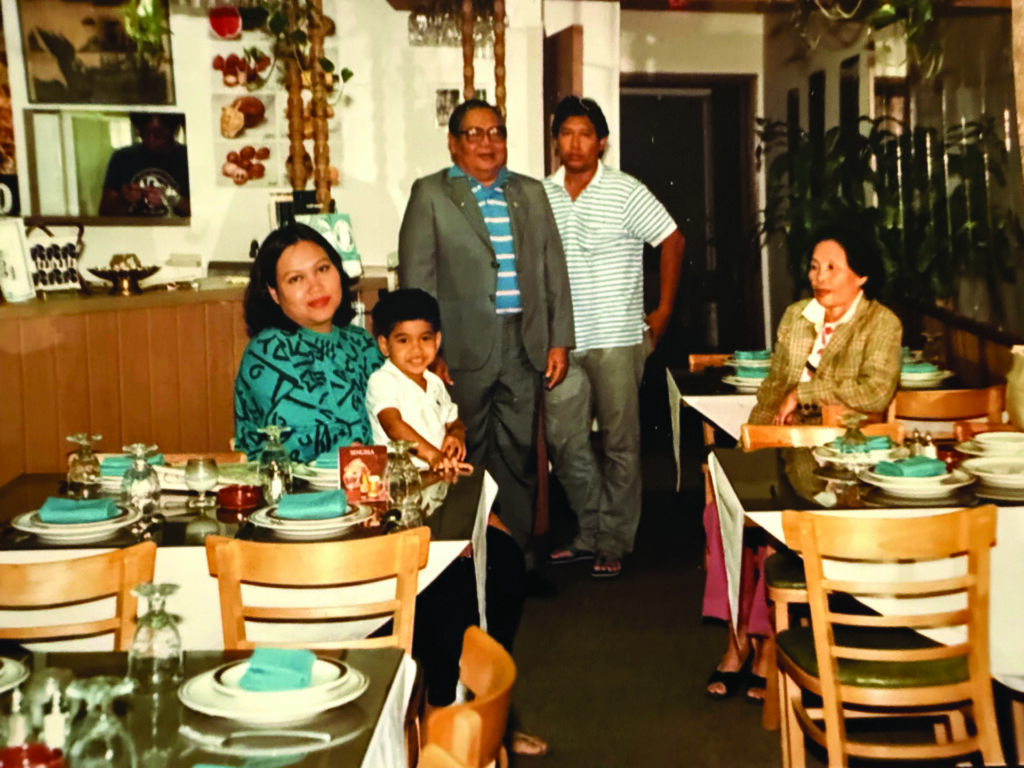
And then in 1985, a couple of Thai family friends who had settled in Boca Raton, Florida, a few years earlier reached out to tell my grandparents that they were selling their restaurant. Siam Gourmet came with all the tables, decorations, and kitchen equipment. This was their chance to build something of their own in this country and become their own bosses. To this day, my grandparents remind me that becoming a business owner is the only way to truly make it in America if you weren’t born here. They put down $12,000 in cash savings from working at hotels and restaurants and paid the rest off in monthly installments. Thy bet on themselves in a place where they had very few connections. My grandma tells me that she’d felt insurmountable loneliness when she first stepped foot in America almost a decade before, but as business owners, they could bring the rest of their family from Bangkok to the States and start building their own community.
To this day, my grandparents remind me that becoming a business owner is the only way to truly make it in America if you weren't born here.
At that time, my grandmother only had a few of her family’s recipes—such as massaman curry, khao mun gai, and satay—in her memory. They were delicious, but she needed a larger repertoire to sustain a full-fledged restaurant. Americans were developing a hunger for the Thai food they experienced abroad. Having a successful restaurant in America meant feeding and satiating the growing customer base of farang—non-Thai—palates. She had no formal training, nor did many other Thai immigrant restaurant owners at the time. Instead, before leaving Rockville, she turned to Laopanit, who guided her through the process of the most popular appetizer at her restaurant. Beyond popular dishes like pad thai, pad see ew, and other Thai staples that many Americans began to associate with Thai food, kanom jeeb stood out as an enduring connection to the culture that so many Thai immigrants left behind.
My grandma doesn’t tell me much about Laopanit. I know that she is the first Thai person that my grandmother met in the States after a year of isolation and loneliness. I know that she encouraged my grandma to move to Florida to open their restaurant. I know that these dumplings we’re making were once hers, that it was Laopanit who her taught each step, from where to buy the wrappers to how to stuff and fold them. Don’t overfill the wrapper or the filling will pour out once in the basket. Heat and taste before steaming. Just as my grandma tells me.
When my grandparents assumed ownership of Siam Gourmet in 1986, my grandmother’s kanom jeeb quickly became a customer favorite. I wonder if part of her winning formula had to do with using ground chicken instead of the more common ground pork. While her choice was a concession to my Muslim grandfather, she noticed that many American customers seemed to prefer chicken anyway. She soon began making kanom jeeb regularly at home as well.
Once mastered the dumplings, she began teaching others. First, her restaurant staff. Then her sisters, who moved to the United States with her support. Then friends. Recipes passed from hand to hand. Never written, always felt. Just as Laopanit had taught her.
She taught them how to season fillings, how to balance salt and sugar, and even how to test the flavor of the dumplings in the microwave for a few seconds before steaming them all to get the flavor just right. Over the years, I’ve seen how this body of knowledge spread through kitchens across the American South, first from Laopanit to my grandmother, and then to other family and friends in Florida.
While there aren’t extensive records detailing how Thai Americans built community through food in the American South, Mark Padoongpatt, a Nevada-based Thai American scholar and author of Flavors of Empire: Food and the Making of Thai America, explains that “Thai social networks were integral to Thai restaurants, which includes a syndicate of Thai restaurateurs who helped other learn how to cook and operate restaurants.” Padoongpatt doesn’t recall seeing kanom jeeb on Thai menus in Los Angeles when he was growing up. Instead, he tells me it was a home dish, one that his mom “still makes to this day.”
Because the first Thai American networks were regional, Laopanit’s choice to add kanom jeeb to her menu set a precedent in the DC area. It shaped which Thai dishes resonated in immigrant communities, and where. And that single menu choice led to a web of other restaurants, including my family’s in Florida, adding it to their menus as well. Yupin Laopanit has since passed away, but her granddaughter Nina Laopanit now runs Bangkok Garden in Rockville. She’s expanded it—and still makes kanom jeeb the way her grandmother taught her, just as my grandmother taught me.
Now, my grandmother is retired. Her sister Thiraporn continues to run the family restaurant, albeit in a different location and with a new name, Peppermint Thai. But the kanom jeeb recipe remains the same.
These dumplings, our dumplings, carry memories of all the hands that previously made them. Through repetition and adaptation, a legacy was built from movement, labor, and care for the success of the broader Thai community. As humble as it is, these tiny folds of dough and savory fillings holds all of that.
They hold a small but important sliver of how Thai communities throughout the South sustained themselves through shared knowledge. These lessons helped seed a network of Thai restaurants across the American South. Laopanit and my grandmother weren’t just teaching people how to make dumplings; they were teaching them how to build a life in America. The dumpling itself isn’t the centerpiece of Thai American identity or cuisine. But the story behind it—one of migration, adaptation, and mutual support—reveals the building blocks of Thai America.
Kanom Jeeb (Thai-Style Chicken & Shrimp Dumplings)
Makes 30 to 35 dumplings
Prep 15 minutes
Cook 10 to 12 minutes
Dumplings
1 pound of ground chicken*
8 to 10 large shrimp (raw) (about 120 grams), thawed if frozen, peeled and deveined
2 tablespoons oyster sauce
2 tablespoons thin soy sauce*
1 tablespoon sesame oil
½ teaspoon ground white pepper
1 teaspoon garlic powder
1 tablespoon granulated white sugar
2 tablespoons cornstarch
½ cup canned water chestnuts, drained and finely diced (from half of an 8-ounce can)
2 scallions, finely chopped (green and white parts)
30 to 35 wonton wrappers, preferably round
Dipping Sauce
2 tablespoons thin soy sauce*
2 tablespoons black or sweet soy sauce*
2 tablespoons distilled white vinegar
1 tablespoon granulated sugar
Garlic Oil
½ cup neutral-flavored oil, such as canola or grapeseed
1 head garlic, cloves peeled and finely chopped
Instructions
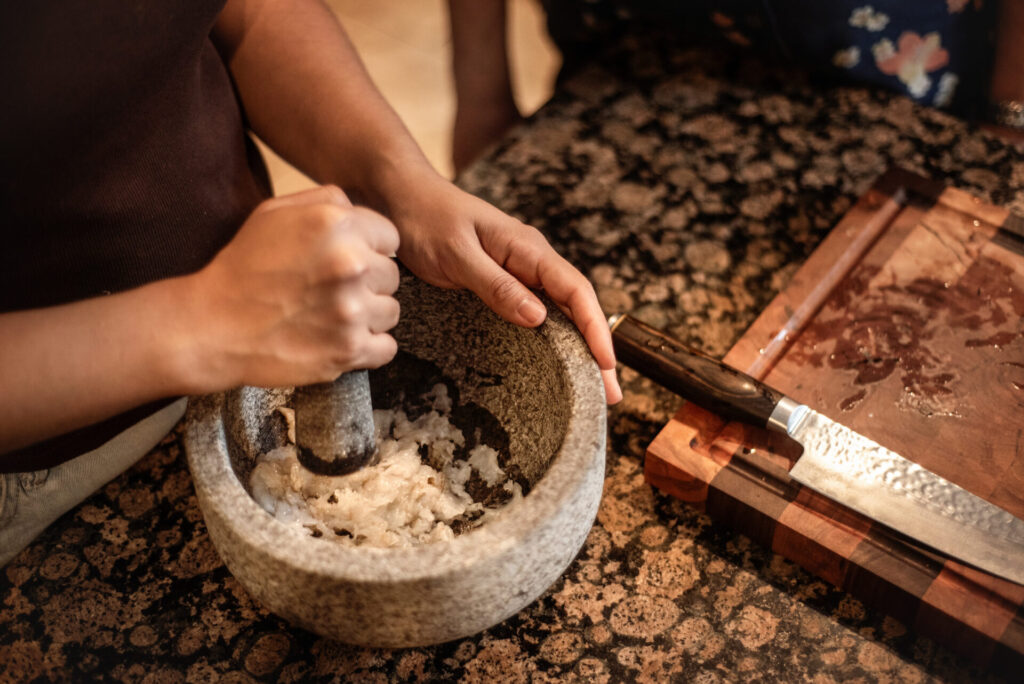
1 In a mortar and pestle or food processor, grind shrimp until it becomes a paste and transfer to a large mixing bowl. Add 1 pound of ground chicken, 2 tablespoons oyster sauce, 2 tablespoons thin soy sauce, 1 tablespoon sesame oil, 1/2 teaspoon ground white pepper, 1 teaspoon garlic powder, 1 tablespoon white sugar, and 2 tablespoons of cornstarch. With your hands, mix to combine (gloves are great for this) until a smooth, thick paste forms.
2 Fold in the 1/2 cup diced water chestnuts and 2 diced scallions with a silicone spatula just until combined; you can heat a little portion of the filling in the microwave for 45 seconds to taste and adjust the seasoning if need be.
3 Assemble the dumplings: Press your thumb and pointer finger together and then tilt your hand so that the circular hole made by your fingers is parallel to the ground. Then, place the wonton wrapper on your hand so that it is resting atop the hole and add a heaping tablespoon (about 20 to 25 grams) of filling in the center. Allow the other fingers to follow to close the wrapper into a cylinder shape. Flatten the bottom of the wrapper and smooth the top with your fingers.
4 In a large pot or metal steamer, bring 8 cups of water to a rolling boil Line the steamer with parchment paper or grease with neutral oil (if using metal) making sure not to cover all the holes so steam can still come up. Steam for 10 to 12 minutes or until cooked through (internal temperature 165° F). If using a multilayered steamer basket, steam multiple dumplings at once otherwise repeat until all dumplings are steamed. Once steamed, removed to a plate.
5 While the dumplings are steaming, make the fried garlic oil: Heat oil in a small saucepan over medium-low heat. Add garlic. Cook, stirring, until the garlic starts to color, about 7 minutes. Remove from heat and let stand, stirring occasionally, until golden brown, about 2 minutes. Transfer to a small bowl and set aside.
6 Make the dipping sauce: Combine thin soy sauce, black soy sauce, white vinegar, and sugar in a small bowl and stir until the sugar is dissolved. Stir in a tablespoon of the garlic oil.
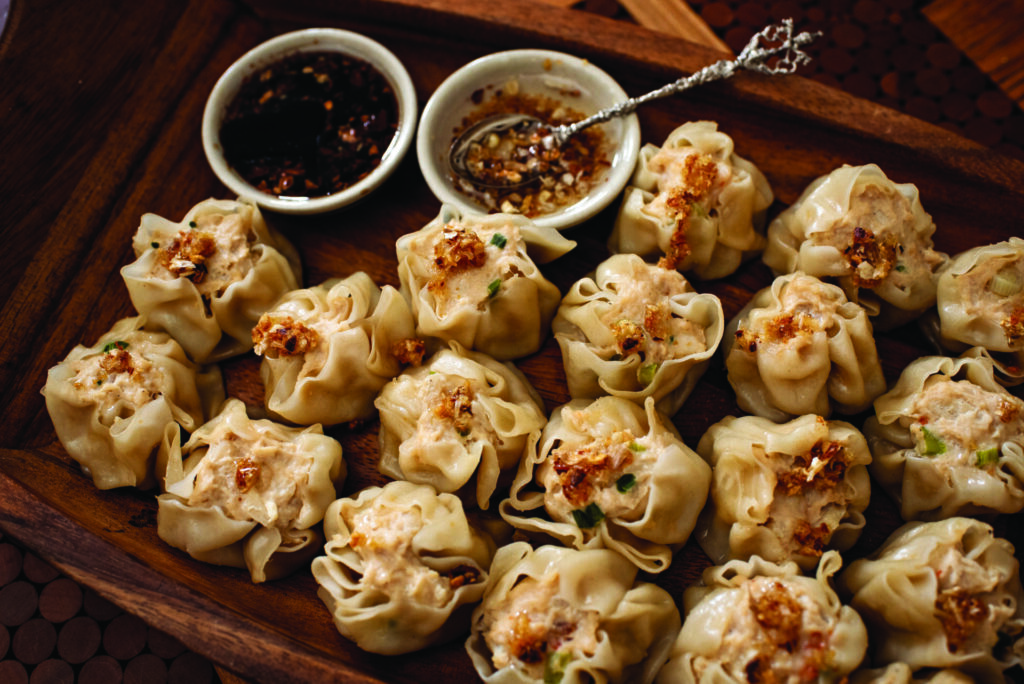
7 Garnish dumplings with fried garlic pieces before serving and serve with small bowls of dipping sauce and garlic oil.
Note: If your wonton wrappers are square, trim them to size by cutting ¼ inch from each corner on the diagonal.
Make-ahead and storage: Filling can be made ahead and refrigerated for up to 24 hours before assembly. If freezing, fill the dumplings ahead of time and freeze raw. Line them on a tray in one layer so they won’t stick together, then once frozen, add to a larger freezer bag and store for up to three months. When ready to cook, steam for 13 to 15 minutes, or until internal temperature reaches 165°F.
*Substitutions: Thin soy sauce can be substituted to a 1:1 ratio of regular soy sauce to water. Ground chicken can be substituted with ground pork or ground beef. Dark soy sauce can be substituted with regular soy sauce and a teaspoon of brown sugar or molasses.
Ali Domrongchai is a Southern-raised, Brooklyn-based food writer and recipe developer. She exclusively eats mangoes from her family’s Florida trees, bare-handed, right over the sink.
SIGN UP FOR THE DIGEST TO RECEIVE GRAVY IN YOUR INBOX.