
“Be Good. I Love You.” Nearly a half-century ago, Patti Myint opened International Market to bring the flavors of her native Thailand to Nashville. Today, her children carry that business forward.
by Mikeie Honda Reiland
Photos by Erica Calhoun
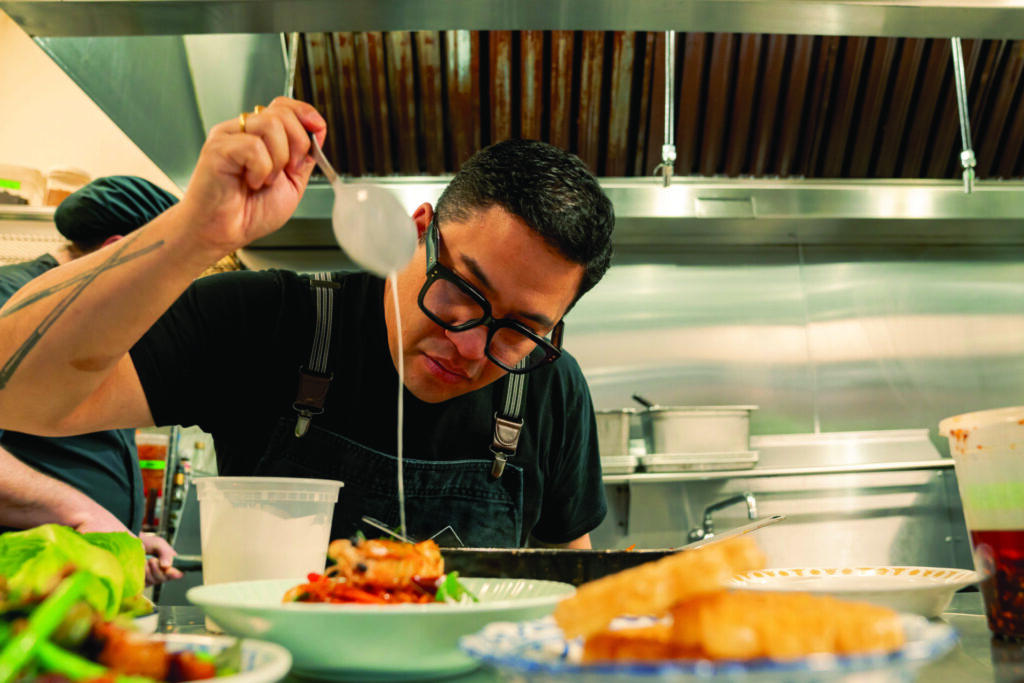
On a Saturday night in Nashville, perched on the stool that his mother once occupied, chef Arnold Myint surveys his family’s restaurant.
In Adidas clogs and Prada glasses, he occasionally leaves the stool to work the expo and call out orders. A few steps away, his younger sister, Anna Myint, handles the phones and the register in a flannel and jeans. They’re nearly a decade apart in age—Arnold is forty-seven and Anna thirty-eight—and haven’t always gotten along, but they’re here now, together.
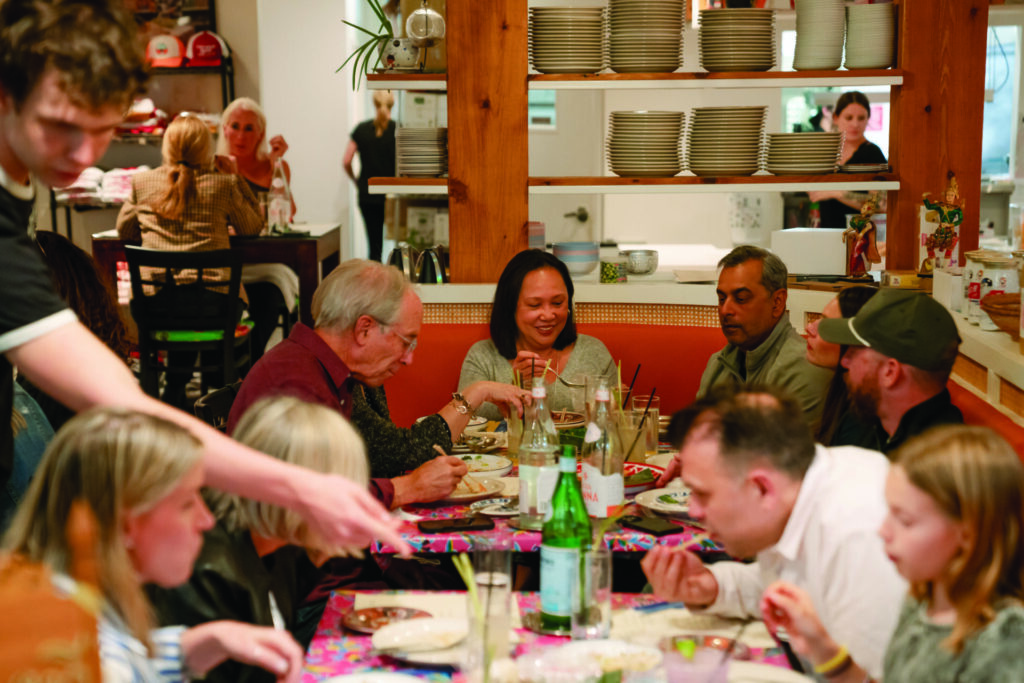
In the dining room, soft pop music purrs beneath hushed conversation. The kitchen smells like fish sauce and sweat. Most of the action takes place at three woks, lined up across the room from a mise en place. If you aren’t used to it, the cloud of spices makes your eyes water. Bearded chefs in beanies and charcoal-colored aprons execute orders, tossing noodles in the woks with tongs. One of them sips a paper cup of coffee from Circle K.
Typical back-of-house chatter fills the room.
Two-top, in new, out first: rice ball! Glass noodle soup! Set: two woks. Three steaks! Half GPs. That’s two all day out first, yo.
“Beyonce’s on a date tonight,” someone says, referencing a regular they’ve nicknamed.
In new, two-top: pad Thai, chicken. Pad krapao with an egg.
One of the cooks eye rolls that last order. “These people are soooo adventurous.”
This feels a little ironic, mostly because at a past version of International Market, this restaurant, Arnold’s mother built an empire on pad thai and pad krapao. But he tends to agree with the sentiment. As a young chef, he found Nashville wanting, so much so that he had to leave.
“The food scene has definitely grown,” Arnold says. “But I always get triggered with why I left before. Like, I put on an exciting menu, but still the safety dishes get purchased more.”
When Arnold fled his hometown for Los Angeles in 2014, he found the validation he hadn’t fully experienced in Nashville. The culinary world confirmed it—Arnold was the creative chef he’d always thought he was. He built a life in California. Then one day in the fall of 2018, his phone buzzed. His sister, Anna, was calling. After that, nothing was the same.
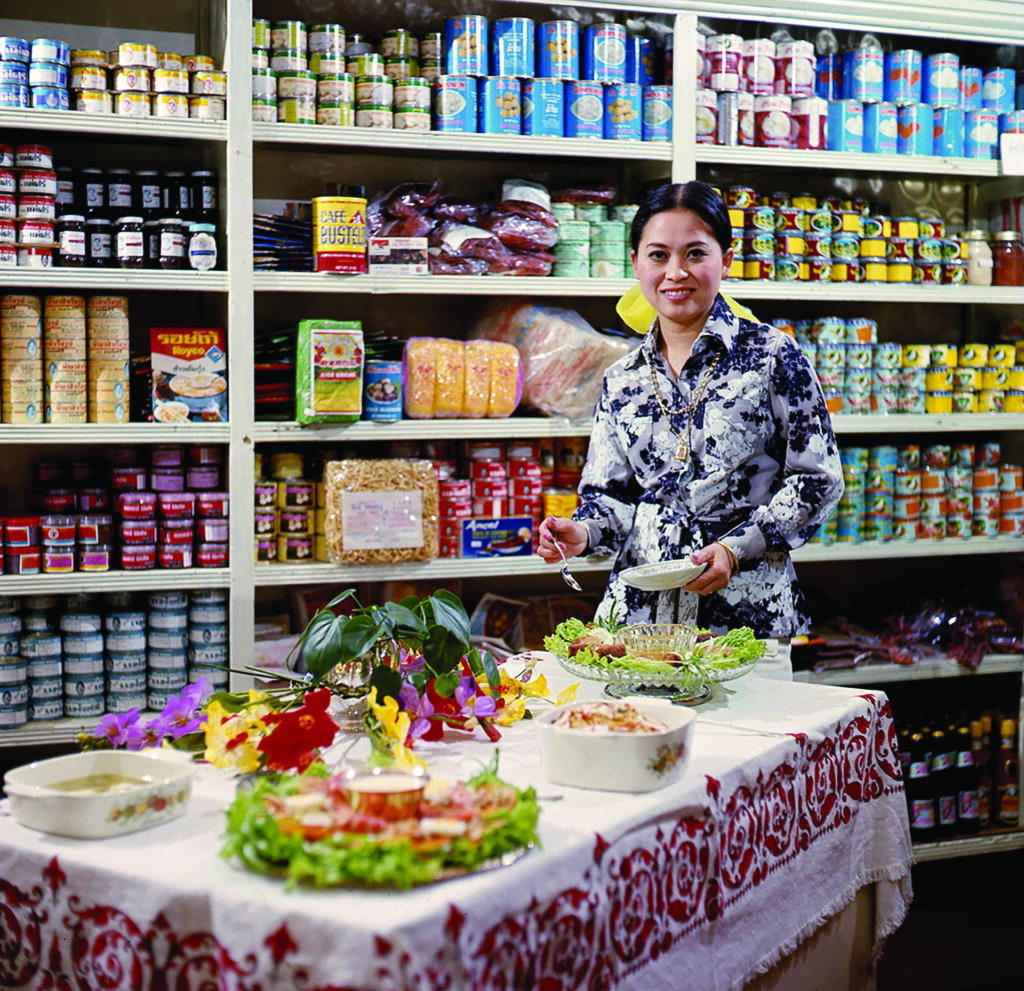
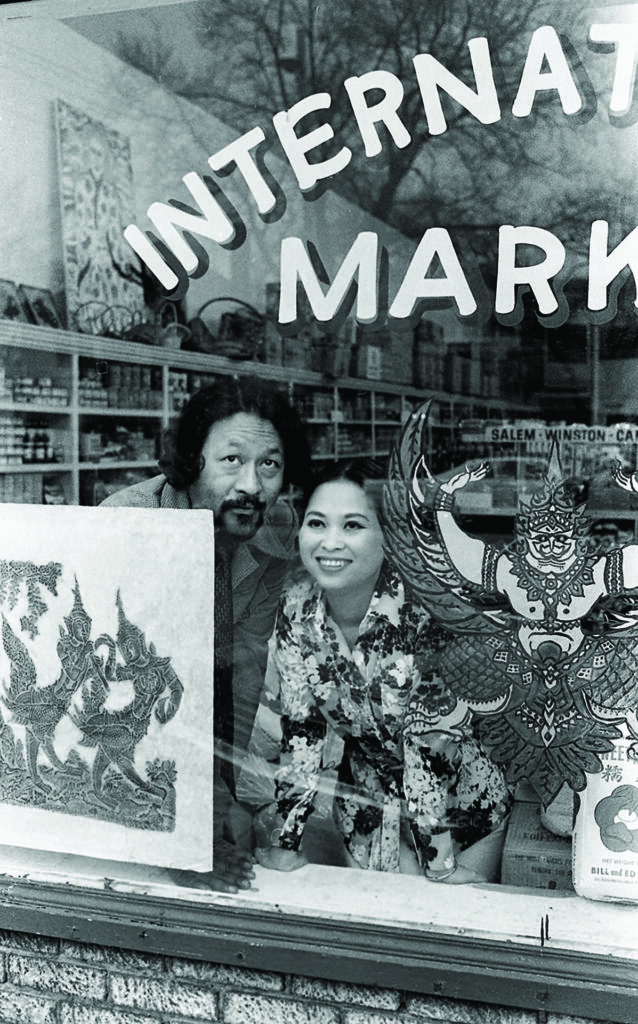
In 1975, Patti Myint—née Prapasri Kopsumbat, a thirty-year-old woman from Thailand—left her house on Linden Avenue and walked north toward downtown Nashville. Along a curved section of Belmont Boulevard, she noticed a boarded-up brick building with a for-sale sign. In a past life, this building had been a small neighborhood grocery store. A hill rose up behind the building, and atop that hill, the campus of then-Belmont College, the alabaster-tinged remnants of an antebellum summer estate, stretched toward the sky. The surrounding neighborhood was desolate, devoid of any restaurants, but Patti could feel the bones of something here.
Patti left Thailand in 1969, settling first in Los Angeles before moving to Nashville. Friends set her up on a blind date with Win Myint (pronounced “mint”), a Burmese immigrant and math professor at Tennessee State University, under the guise of a dinner party. In 1974, Patti gave Win an ultimatum: If he didn’t propose, she was moving back to Thailand. He proposed.
Not one to sit still, Patti began walking their new neighborhood while Win worked. She had worked for her older siblings in Thailand and studied business in Tennessee. As far as she could tell, there was no authentic international market in town—not even a hole-in-the-wall spot where she could find Café Bustelo.
A total lack of international food in Nashville in the mid-1970s might seem impossible. Ditto for the idea that coastal transplants hated the food here. Today, engaged diners nationwide know Nashville as the adopted city of Sean Brock and Maneet Chauhan; the birthplace of hot chicken.
In 1975, neither Brock nor Chauhan was born. Hot chicken had yet to be colonized and disseminated. Nashville was a city of meat-and-threes and TGI Fridays. The food here didn’t diversify until the new millennium when two key things happened: White-tablecloth chefs started to open independent neighborhood restaurants, and international spots began to pop up in strip malls along Nolensville Pike.
In that building on Belmont, Patti saw her chance to create something unique in Nashville: a place to sell ingredients like preserved duck eggs and dried salt cod and to share meals from the part of the world she used to call home.
Patti and Win opened the market first. News of their addition of restaurant service in March 1976 made The Tennessean. Later that year, they closed on the purchase of the building from the YMCA for $22,500. Yet International Market was not an immediate hit. Patti initially served seven dishes on a steam table for thirty-five cents a portion. On the first day, she sold forty dollars’ worth of food.
She offered American Chinese staples like egg rolls and fried rice, thinking these dishes might be more familiar to Southern palates. Over time, she introduced pad thai, pad see ew, and drunken noodles. She sourced many of the ingredients from family living in Chicago so that customers could recreate her dishes at home. Groceries were a key part of the business, lowering food costs and providing additional income.
At the time, the surrounding neighborhood had seen better days. Along Belmont and its arterial side streets, once-stately bungalows and Victorians were chopped up into two or four or six little apartments, where artists and musicians lived for dirt cheap. The blocks behind the restaurant were known as “the Bad Side of Belmont.” Sevier Park, the neighborhood green space, was sometimes called “Needle Park” for the drug deals that supposedly went down there.
For three decades, Kay West was the main food critic for the Nashville Scene, the city’s alt-weekly. West left an editorial job at Penthouse to work in publicity for RCA Records. When she first moved here from New York City in 1981, she felt unmoored. She’d lived in all corners of Manhattan, from Chelsea to the Upper East Side, and in each spot, she found her bodega. Her deli. Her Chinese takeout, her bar. She assumed she’d find those same places in Nashville.
“Food-wise, it was really, really awful,” she says now. “My first night in town, I had to stay at the Hall of Fame Hotel because my place wasn’t ready. The person who checked me in was an Elvis impersonator. I asked about going out to get something to eat. It was a Saturday night. He said, ‘No, you won’t be able to find anything.’”
Elvis was right, pretty much. West ate her first meal in Nashville at an Arby’s that was open late.
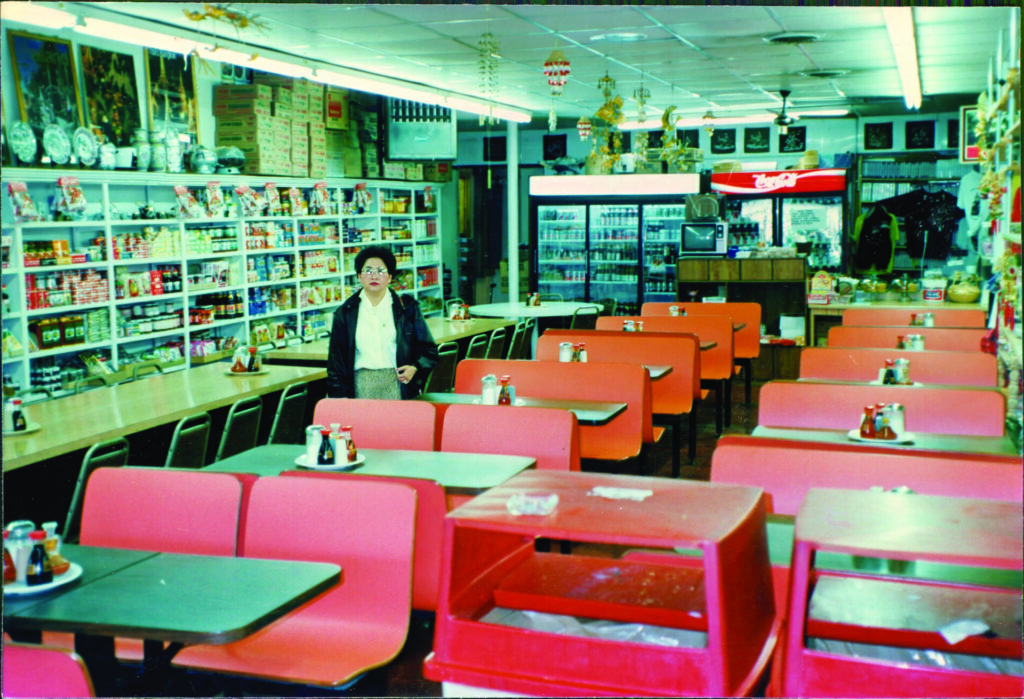
She rented an apartment in Sterling Court on Belmont Boulevard. A fig tree loomed over the corner of the courtyard, and West and her neighbors loved to pick its fruit. A block down the street, West noticed a red storefront. Just down from a Circle K, it was the only eatery nearby. Its name—International Market and Restaurant—piqued her New Yorker sensibilities. She walked inside and saw shelves piled high with items she’d never seen before, but that intrigued her — bamboo shoots, rice vinegars, cooking utensils. She walked around the shelves, past massive bags of rice stacked toward the ceiling in the back of the restaurant, where deep pans of pad Thai, egg rolls, noodle soups, and chicken-on-a-stick awaited her at a steam table.
There’s something here that I can eat, West realized.
A slight woman with high cheekbones was perched on a stool behind the cash register. Red blush, fiery lipstick, icy jewelry. West said hello, but didn’t get to know Patti until years later. She stood just shy of five feet, with fingernails painted the colors of the rainbow. She bounced around the restaurant and stopped at each booth, where she lingered with her customers, all of whom seemed to know her.
West had found something that reminded her of home. She began to stop in regularly. When she collected her purchases and left the restaurant, the woman behind the register usually offered the same parting words.
“Be good. I love you.”
For West and her bohemian friends in the neighborhood, International Market was where they could fill up for five dollars. Pad thai and chicken-on-a-stick were local favorites. When her regulars were broke, Patti fed them for free. She chatted with them as they ate, and their loyalty to her grew fierce. Once Patti knew you, you didn’t necessarily eat from the steam table—you ordered off a hidden menu. If she knew you really well, she’d just bring you what she knew you needed.
Patti made two soups that people swore had medicinal qualities. Her “Cure All,” made with spicy Thai peppers, was what you’d sip to sweat out a hangover. The second was a milder, creamier chicken-and-rice soup, a warm bowl of solace when you had the flu or a cold.
As business improved, Patti and Win bought some buildings that neighbored the restaurant. One day, Patti looked around and her little stretch of Belmont wasn’t so seedy anymore. A coffeehouse with a patio, Bongo Java, popped up across the street in 1993. A sister cafe, Fido, soon opened a few blocks closer to downtown in Hillsboro Village.
Meanwhile, Belmont grew from a little Baptist college into a full-fledged university. The school started to hoover up neighborhood real estate, expanding down the hill and onto the boulevard. They made Patti offers for the land on which International Market sat, but she refused. Instead, she expanded, opening a second restaurant in a building she owned across the street, next to the fig tree.
If you drove your car around this curved stretch of Belmont Boulevard, you might’ve seen Patti Myint wobbling briskly across the street. Kay West recalls several times when, zooming around the bend, she almost hit a jaywalking Patti.
Patti, West said. You don’t own this street.
In response, Patti just giggled. Of course I own this street.
Once, Patti parked across the street from International Market. The Myints owned this lot and an adjacent building and rented them to a bookseller. Patti exited her car and walked into the store to ask a question. She had parked in a normal way, and the lot was empty, but the employee at the register took issue nonetheless.
Get out of the store, she screamed. Go back to your country.
Patti called the bookstore’s owner. She explained that she would be kicking them out. In an instant, she ethered that business. She was, after all, the owner of the street.
In the aughts and 2010s, “the Bad Side of Belmont” began to call itself 12South, a walkable stretch of shopping and dining with a Madewell and the flagship boutique of Draper James, Reese Witherspoon’s clothing line. Needle Park houses a farmers market and pickleball courts. At some point, West’s fig tree disappeared.
“All this growth is going on around [the restaurant], and they’re building over top of her,” West says of those years. “Down her back, and up her butt, and she’s just still there.”
“[International Market] was just something that could be counted on to be there. It was just a magnet. It was a total magnet for a certain segment of Nashville that was curious.”
At this point, as West implies, curiosity made you exceptional in Nashville. Patti’s format—a steam table from which you built your meal—would have been familiar for meat-and-three devotees, yet her flavors were anything but. If you saw yourself as someone who stood apart from Nashville’s monoculture, as a member of the alt scene, International Market called your name.
Eventually, the creatives of Belmont Boulevard, grown-up and able to pay for their food, brought their own kids to International Market. There were items on Patti’s shelves that had probably been there since they lived in those houses divvied up into one-bedroom apartments, houses that had since been razed or restored to their former grandeur and now sold for millions of dollars. Patti fussed over the old heads and their kids.
Patti’s legacy was secure. Her kids, who worked in her restaurant almost as soon as they could count, wanted to create theirs.
Born in 1977, Arnold was plugged into Nashville’s alt scene from a young age. He was gay and Asian, but he never felt like the other because he always had community. He surrounded himself with friends who bought albums at Great Escape, lingered at Café Coco, and danced at Johnny Jackson’s Soul Satisfaction. They were creative, artistic—spiritual descendants of the people who lived in the neighborhood when Kay West moved to Nashville.
Arnold spent most of his teen years figure skating. He was good, so good that he competed at junior nationals. Then he skated on European tours in thirty-three cities—Paris, Madrid, Lisbon. Everyone on tour was in their twenties, and they’d go out together, stumbling back to the hotel and detoxing during their first show in each city. Every stop built up to a bacchanalian group dinner, and Arnold kept a journal of what he ate and drank.
As he felt his twenties start to slide by, Arnold knew he couldn’t skate forever. He also knew that Win and Patti, well-funded thanks to International Market and their real estate earnings, would pay for him to go to culinary school.
He found he had a knack for cooking. French-trained, his career advanced quickly. He competed on Top Chef. He opened a restaurant called Cha Chah, housed in one of his parents’ buildings on Belmont. Cha Chah served tapas, tasting menus, and modern American fare. It opened in 2009, probably a decade too early in Nashville, and closed in 2013. The city was still warming up to baby octopus and duck and chorizo tamales.
He’d opened two successful restaurants in partnership with Patti. But Cha Chah was the first one he’d owned by himself, and its failure hit him personally. As he saw it, Nashville had hurt him. He packed up and moved to Los Angeles, in part to pursue the surrogacy of his daughter.
Anna, born in 1985, followed a more traditional path. She was a cheerleader in high school, worked in the family restaurants in her early twenties, then moved to New York City in July 2009. She worked in fashion but maintained an emotional buffer between herself and the city, eventually returning to her hometown in 2015.
In 2017, Patti finally caved and sold International Market and three adjacent lots to Belmont for an eye-watering $6.5 million. Belmont leased the building back to the Myints for two years, with a leave-by date in 2019.
At the time, Anna was considering an MBA at Vanderbilt. Even after the sale of the original building, the family still owned the building across the street that had once housed Cha Chah. Patti had been preparing Anna to take over, plotting their restaurant’s next era.
You walk in there like the boss, Patti told her daughter as she brought her into the business. Act like the owner. You’re the boss.
Anna was out to lunch in September 2018 when she got the call from George, her father’s at-home caretaker.
Your mom fell, he said, through tears. She hit her head.
Anna left her food and drove toward Saint Thomas Hospital in Midtown. She wasn’t overly concerned, not yet. No need to call Arnold until she knew more. Throughout her childhood, Win had been the sickly one, his zeal for life slowly eroded by Parkinson’s, but Patti was the opposite. She was a force. At seventy-three, she had at least fifteen years left, easy.
Anna beat the ambulance to the hospital. When it finally arrived, lights flashing, she watched paramedics roll her mother’s limp body out on a stretcher and into the emergency room.
Anna felt her sense of certainty start to fade. For the first time, she realized this might not end well. After he examined Patti, the attending doctor pulled Anna into a separate room.
Your mother is probably going to die, he said.
Anna’s world collapsed. Frantic, she started making calls. The first was to her brother. Arnold spent all day in the air and arrived in the hospital that night.
A week later, Patti was gone. Win followed a year later.
When the news leaked, customers wrote notes and left them in bouquets of flowers outside the restaurant. Some notes were sad, some were grateful; all of them expressed love. A bit of rain fell that evening, and a rainbow stretched across the Nashville sky.
At Patti’s memorial service, Anna and Arnold set out a bowl full of little purple bags, each one containing a fortune cookie and a card.
be good, the card said. i love you.
Anna pushed forward on plans she’d made with Patti to reopen International Market in the old Cha Chah building. Some longtime cooks joined her. The final ingredient was her brother, the chef, but returning to Nashville wasn’t so simple for Arnold.
“When Cha Chah closed,” he admits now. “Nashville really kind of staggered my heart. Like, it broke me. And I’m still chasing that sourness in my mind.”
Because of their age gap, Anna and Arnold didn’t grow up together, so they weren’t particularly close as young adults. At first, Arnold struggled to see his sister as a peer, or even a professional. Once, Anna vented to her brother about a fight with a bartender who told her she was going to run the business into the ground.
Of course they don’t think you know what you’re doing, Arnold told her. You’ve never been in restaurants.
This response infuriated Anna. She’d grown up at International Market. She’d worked as a host and server. She had a business degree, and she was hungry to prove people wrong.
Bringing International Market back, Arnold reminded Anna, would be incredibly hard. He’d have to return to the city that he felt had rejected him. And he’d have to spend every day in the building that housed the ghosts of Cha Chah.
I’m not just doing this for me, Anna reminded him. I’m doing this for Nashville. I’m doing this for Mom and Dad. And I’m doing this for you.
Many of the chefs in Arnold’s weight class, the ones with buzzy cookbooks and social media followers in the six figures, had signature brick-and-mortar restaurants. Anna pointed out that re-opening their parents’ restaurant could launch him even further into celebrity chef territory. Arnold bristled at this—You don’t think I’m successful? Still, the prospect was intriguing. He could take his family’s dishes and put his own spin on them, while also mixing in some options that would challenge diners.
“He wasn’t used to his little sister knowing things,” Anna says now. “Being intelligent. Being able to talk back to him, because he’s not used to anyone talking back to him. He has a sharp tongue. His reputation before he left Nashville the first time wasn’t the best, because of his temper. And honestly, he got his temper from both my parents.”
During one bust-up, Arnold told Anna that she didn’t know what he was doing. He’d opened up restaurants before, and he’d seen firsthand the apathy and closed minds that he felt Nashville’s diners wielded like clubs.
Nashville’s different, Anna cut him off. People spend money now.
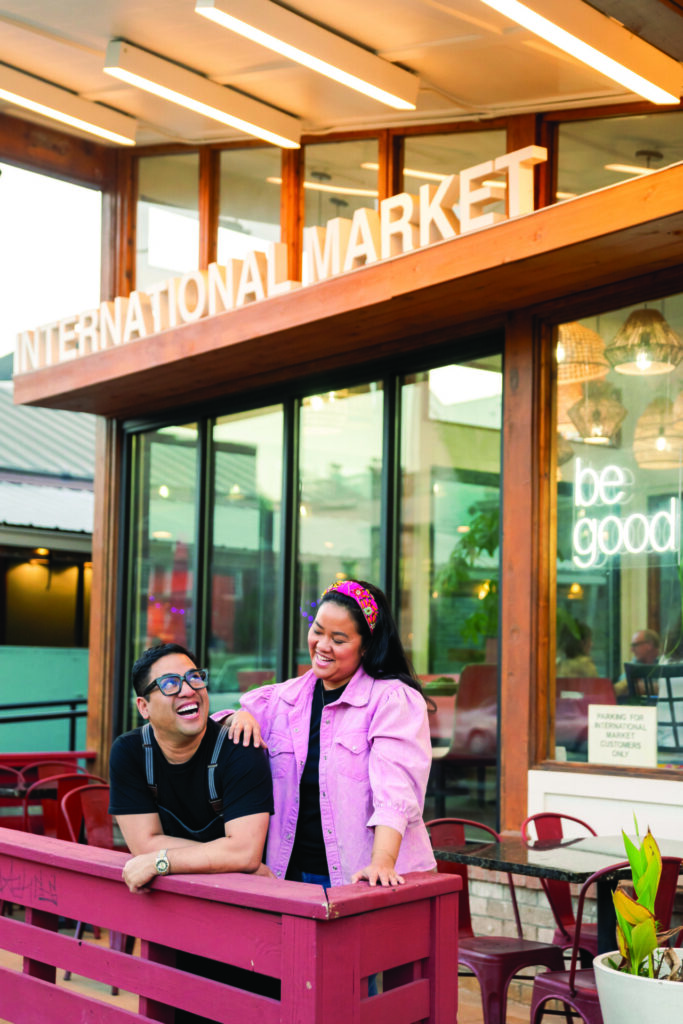
The new International Market, all clean lines and varnished wood, has a sleek, modern bar. Behind the counter, bricks from the old restaurant are built into the wall, and barkeeps in henleys and Nike Blazers tee up spritzes and fresh takes on old fashioneds. Across the room, a steam table serves as a tribute to Patti. Available during the lunch service, it consists of approximately thirty items, like cashew-chili tofu and Thai basil–chili noodles. An a la carte serving costs four dollars, and three items cost eleven dollars.
The new restaurant offers made-to-order Thai classics, including Patti’s original pad thai, but also serves Arnold’s creations: anchovy fried rice and eggs. Spicy basil duck lo mein. Pork belly and charred cauliflower. It’s a far cry from chicken-on-a-stick, although you can still snag those at lunch.
Dick and Geraldine Markus were patrons of Patti’s International Market. Now, they eat at Anna and Arnold’s version. They’ve lived on both coasts and in points in-between. Dick, a musician and Navy veteran, has traveled all over South America and Asia.
“What [Arnold] did,” Geraldine says, “is he moved it to the next level. It’s Patti plus. This is great Thai food, but he’s made it something special.”
“It’s his own,” Dick adds. “He’s doing his own thing, plus his other chefs are there. He’s giving them a run, which is very important to us. You can tell how a restaurant treats their staff. It shows in their food.”
On a Wednesday morning in January 2024, Anna’s phone pinged. A friend sent her an iMessage with no words, just a link from the James Beard Foundation. Anna scrolled until she saw a familiar name: Arnold Myint, International Market, semifinalist for Best Chef: Southeast.
Anna took a screenshot and started to text Arnold but caught herself. No, she thought, this deserves a phone call.
After she delivered the news, there was silence for a moment. Then Arnold started to cry. And Anna started to cry because her brother was crying.
“This is a big process of healing, right?” Arnold said later, in August 2024, sitting at a table in the new space. “We’re in our fifth year now [since they died]. And I think this restaurant has really helped with my grieving process, because I’ve been able to flip any kind of emotion to be more motivational and celebratory.”
“I’m at an age where a lot of my friends have people passing away. There’s no right or wrong with how you cope with things. But I think this restaurant’s new breath is really giving a nice shoutout and reminder of my mom’s spirit.”
Arnold started to say something, trailed off, then paused to arrange his thoughts.
“It’s totally sucked,” he said. “I mean, because she just bounced one day and was like, ‘Bye.’ But then, I’m like, that’s probably the best way for her, because she wouldn’t want any kind of fuss.”
“I’m basically the body,” he said, “working through Patti’s spirit.”
Fifty years have passed since Patti’s walk down Belmont Boulevard, and the city has become something entirely different. But if you’ve been in Nashville long enough, make your way to that curved stretch of the Boulevard, and walk into Anna and Arnold’s restaurant, you might feel the pangs of something familiar.
In the restaurant’s front window, there’s a sign lit up in neon.
be good, it says.
Mikeie Honda Reiland is a writer and ultimate frisbee coach in Nashville. His writing has appeared in SB Nation, Bitter Southerner, and the Oxford American.
SIGN UP FOR THE DIGEST TO RECEIVE GRAVY IN YOUR INBOX.