
A Feast Fit for Spirits
Could a Korean memorial ceremony help keep my Kentucky father alive?
by Mercedes Kane
The air sizzles and steams as my husband, Sanghoon, fills a hot skillet with gooey, off-white batter for buchimgae. Bubbles rise within the doughy mixture, which is studded with slices of scallions and matchstick-sized slivers of zucchini and sweet potatoes. He flips and presses the pancake as it firms and crisps before turning his attention to a pot of boiling water. Gently, he drops beef chunks, minced garlic, and snow-white shavings of daikon into its gurgling waves.
The aromas of meaty soup, tangy salted cod, and sweet rice permeate our boxy Atlanta bungalow. It’s December nineteenth, the date Sanghoon’s father passed away in 2018. Every year since, on the anniversary of his death, we welcome his abeoji (father) and our children’s harabeoji (grandfather) into our home for a feast in his honor, our version of the Korean jesa ceremony.
This ancient ritual was new to me when Sanghoon introduced it to our family. Rooted in Confucian practices that began nearly 650 years ago in the Joseon Dynasty, jesa has traditionally been a ceremony that honors generations of deceased ancestors. Today, many Korean families living all over the world continue to perform it, but mostly for their late parents or grandparents.
A customary jesa ritual takes considerable preparation and effort, work that women have historically assumed while being left out of the ceremony itself. Sanghoon remembers his umma (mom) and sister waiting in the kitchen while he, along with his father, uncles, and brother offered up the feast the two women had spent hours, sometimes even days, preparing. When Sanghoon initially shared the history of jesa with me and suggested our family perform it for his father, we knew without question that all four of us would participate.
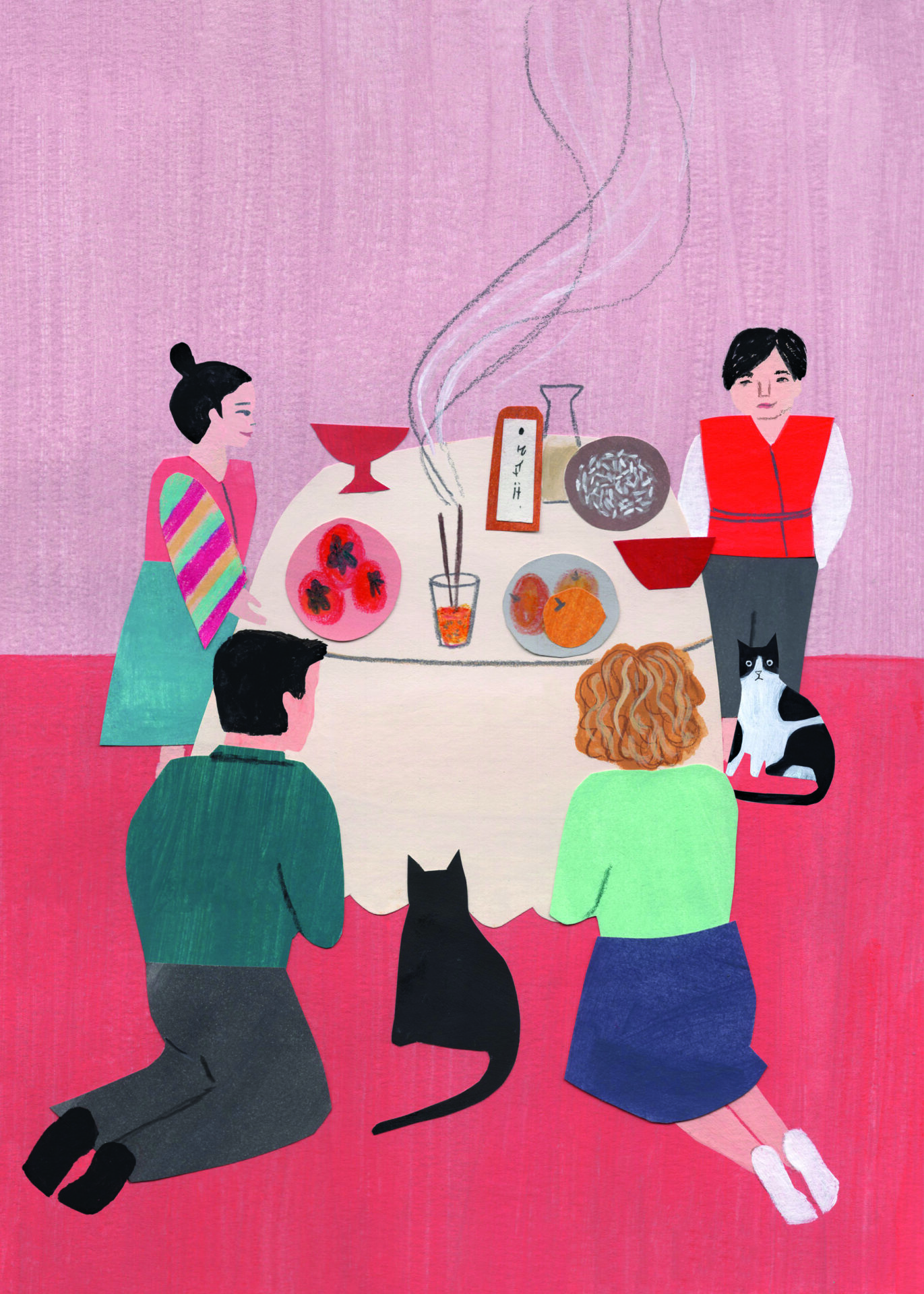
Sanghoon carries the bulk of the work, traveling forty minutes to the closest H-Mart in Doraville for ingredients before chopping vegetables, meat, and fish, seasoning the soup base, and steaming the rice. He transforms our coffee table into a makeshift Jesa table, turning it to face north (the direction of the dead) and draping it with a beige tablecloth. After carefully arranging a dozen or more dishes of food and fruit, he sets out a small carafe of rice wine with shallow ceramic shot glasses, rice bowls, and chopsticks.
In the center, Sanghoon lays out a shrine of candles, incense, and the chukmun, a written prayer that is read to the visiting spirit. The shinwi, or “spiritual body” of his father, Sung-Woo Lee, is represented on a piece of paper by his last name and its origin written in Chinese characters, as is the tradition. A photo of his dad glows from my propped-up iPhone. In the image, he’s a handsome twentysomething sporting a leather bomber jacket and slicked-back black hair.
Our children, Jasper, nine, and Daisy, six, claim jesa as their favorite “holiday” next to Christmas. When I pick them up that afternoon from a winter camp at the local Boys and Girls Club, the women working the front desk know all about the evening’s ceremony, having heard our children proudly explain their roles in it.
On the drive home, I ask them why they like jesa so much. Daisy beams and says, “Because I get to see Harabeoji.”
As soon as I park in the driveway, the kids tumble out and burst through the front door, tossing off their shoes and sliding their backpacks across the tiled hall. “It smells great in here!” Jasper announces. Daisy bounds upstairs and returns minutes later wearing her pastel-colored hanbok, a traditional Korean dress with striped arms and a billowy skirt. I adjust the stiff fabric and help tie the jacket’s bow as Jasper pulls on the pant-legged version of his own hanbok.
Once outfitted, their demeanor shifts. Jasper, who often shouts his sentences is suddenly speaking in a mellow, even tone. Daisy stops doing handstands against the wall and crosses her wrists across her waist, waiting patiently to begin.
Sanghoon and I clean up quickly and swap out our sweats—his for black slacks and a button-up shirt; mine for a cotton dress and tights. He lights the candle. It’s time.
Our family of four crowds the entryway, opening the door slowly and welcoming our dinner guest. The kids say, “Come in, Harabeoji. It’s cold out there.” Sanghoon sweeps the air with his hand, ushering the ghost of his abeoji into our home.
Sanghoon leads the ritual, but we all assist, each of us performing ceremonial bows and pouring sips of wine. As he reads the prayer, Sanghoon is overcome with grief, rare tears dampening his flushed pink cheeks. Jasper puts a hand on his dad’s back and moves it slowly side to side. Daisy wraps her small fist around his pinky. Their gazes rest on the altar. Jasper squeezes his eyes shut to prevent his tears from forming.
Sanghoon continues moving a set of chopsticks from plate to plate, serving his father the meal he’s made for him. Ladling a spoonful of rice into the beef soup, he leaves the utensil in the warm liquid so his abeoji can experience the rich flavor that took all day to develop.
After we all bow a final time, the ceremony is over. We walk our guest silently to the door and close it behind him, lingering a few seconds after it clicks shut. Sanghoon burns the shinwi, then we move each dish of food to our dining room table.
We hunch over our bowls of hot soup, Jasper and Daisy’s energy rising with each slurp. They fire off questions about their harabeoji and Sanghoon’s life with him. “What did you do together?” “Was he strict?” “Did he make this soup for you?”
Sanghoon speaks slowly, thoughtfully, about his complicated father, a man who stayed silent each evening after returning home from his office job in nearby Seoul. On Sundays, when their extended family visited the apartment, his solemn dad transformed into a loud and boisterous jokester whose silly behavior and wisecracks had their visitors crying with laughter long into the evening.
“Abeoji didn’t do the cooking; Umma did,” Sanghoon says. “When we would sit down to dinner as a family, we had to wait until he picked up his chopsticks before we could eat.”
Our children’s eyes grow wide. “You’re joking,” Jasper says.
“I’m not,” Sanghoon continues. “But Abeoji could be fun. He was a great storyteller, and I loved listening to him talk. I always wondered why he didn’t tell stories more often.”
Jasper visited Korea twice while Sanghoon’s father was alive. Daisy has only spent two weeks with him, when our family traveled to Incheon and stayed at Sanghoon’s parents’ small condo, just months before he perished. But they feel like they know him, and jesa is why.
My father died, somewhat unexpectedly, in October of last year. While our kids spent far more time in his presence, I worry that each passing month without his face on a video call, each year without a birthday card from him, each holiday spent without his famous butter-yellow mashed potatoes will push him further from their conscious minds.
On a recent Sunday morning, Sanghoon and I scooped scrambled eggs onto our kids’ plates as they dipped blueberry pancakes into pools of syrup, the winter sun peeking through the slats of our blinds. From a kitchen speaker, I heard the mandolin strings of Rod Stewart’s “Maggie May.” In a flash, my dad was before me, dizzy with joy, strumming an air guitar and singing along like he had done many times, much to my teenage horror.
I swallowed a bitter sip of coffee. As Stewart’s gravelly voice purred on, it struck me that my own goofy kids would never know their Kentucky-born papa’s love of rock music or that, despite his propensity to anger, he was also quick to love.
I began to imagine a jesa fit for a country-boy-turned-big-city-
Around the same table, I would share the details of my dad’s life that he never tired of talking about: running shoeless over the steep Appalachian terrain of his childhood, his one-room school, the dirt-floor cabin he grew up in, his long-standing luck with the ladies. And I could tell my own stories: the time he took me to a neighborhood festival and bought me a Cabbage Patch knockoff after a fiery explosion between my mom and him forced us out of the house; the dinner dates he would take me to on his rare nights away from the restaurant; the fun times and the fury.
“Dad,” I’ll say next October fourth, on the anniversary of his death. “Can I offer you another slice of hummingbird cake and a cold glass of milk?” Knowing he’d never refuse either, I’ll cut him a frosted chunk of cake and sneak a corner bite before passing it his way.
Mercedes Kane is a writer and documentary filmmaker living in Atlanta. Her most recent film, Art and Pep, is available to stream on Peacock. She will receive her MFA in narrative nonfiction from the University of Georgia in August 2024.