
A Comeback Story The Mayflower Cafe serves a new Jackson.
by Olivia Ware Terenzio
Photos by Eric Shelton
Nearly every Friday night for the past three decades, Judge Rhesa Barksdale and his wife, Claire, have dined at the Mayflower Cafe, a seafood restaurant in downtown Jackson, Mississippi.
Rhesa, who sits on the U.S. Court of Appeals for the Fifth Circuit, would take clients there for dinner early in his career, when he practiced law from an office nearby. After he and Claire married in 1996, Friday nights became a tradition.
“It felt like it was a club or something,” Claire says. “You knew everybody in every booth.”
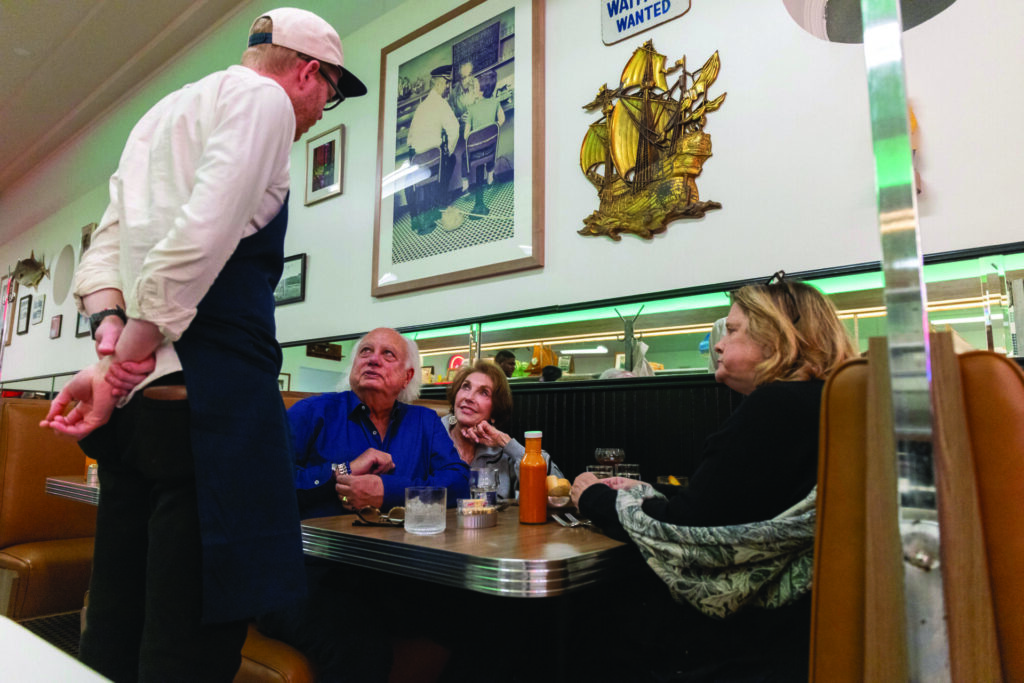
For years, Friday nights fell into a predictable rhythm—cheerful, but not overly boisterous. Guests drifted between tawny booths and four-tops set with ketchup and saltines, exchanging greetings and handshakes. Sometimes they combined tables to seat six or ten or twenty in the chrome-rimmed chairs.
The Barksdales always sat at the same back booth, near the kitchen. If they missed a Friday, they called to let the staff know. (Officially, the Mayflower didn’t take reservations, but regulars could snag one.) Cooks knew how Rhesa wanted his flounder before he ordered. At some point, the restaurant’s owner, Jerry Kountouris, installed a plaque in the booth: chambers of judge rh barksdale.
In April of 2024, Kountouris sold the restaurant, which his family had run since it opened in 1935, and the Mayflower closed for four months of renovations. It reopened in the summer under new ownership—that of Hunter Evans and Cody McCain, who also own Elvie’s restaurant in Jackson.
The Barksdales never asked if they would get their booth back. But when they walked in on opening night, there was the plaque.
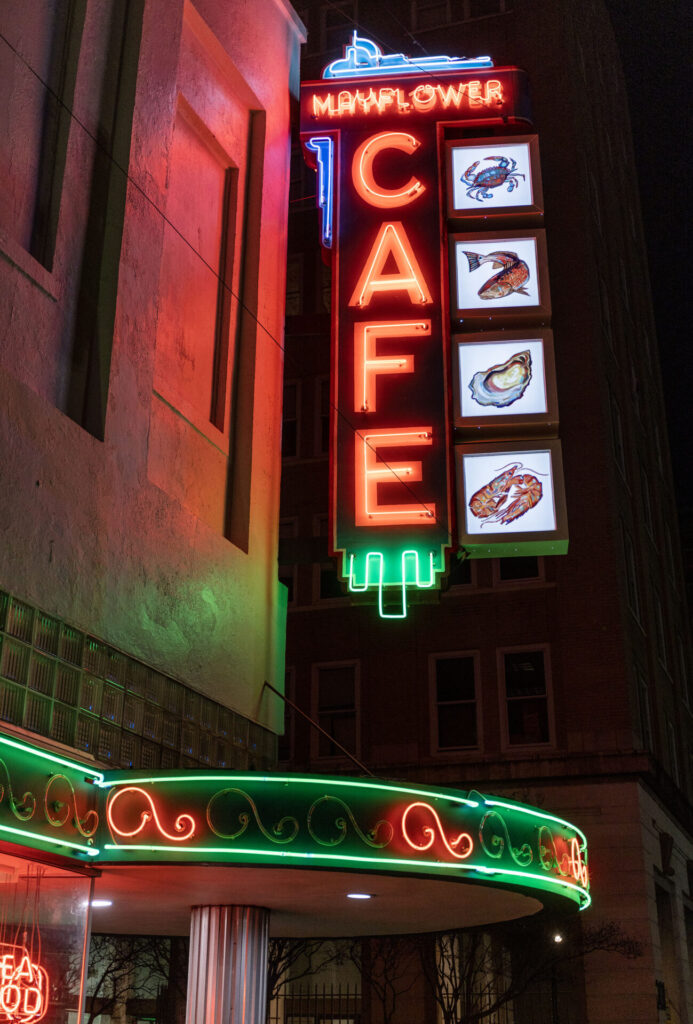
The Mayflower is believed to be the oldest operating restaurant in Jackson and one of the oldest in Mississippi. In 2023, the state Senate recognized it as “a downtown Jackson tradition.” George Kountouris, Jerry’s great-uncle, and a business partner named John Gouras started the business after arriving in the United States from the mountainous Greek island of Patmos, which many tourists skip because there’s no airport. The men traveled to Mississippi by way of Ellis Island following a wave of Greek immigration prior to the Great Depression. Jerry’s grandfather and father came to the States, too, but when his grandfather died of a heart attack shortly after their arrival, George became the family patriarch.
Initially, the Mayflower operated as a hamburger stand and beer garden out of the back of its current space. When it expanded, menus began to feature not just the fresh seafood dishes that made the restaurant famous—broiled redfish, stuffed flounder—but also soul food staples and Chinese dishes, including chop suey. Some have claimed the Mayflower invented comeback sauce, Mississippi’s ubiquitous chili- and Worcestershire-seasoned mayonnaise, though Jerry credits another Greek-owned Jackson restaurant, The Rotisserie, which is long shuttered.
Jerry grew up at the Mayflower but never planned to work there. He spent nearly twenty years practicing pharmacy instead, hoping to open his own drugstore. That dream never materialized, and in 1990, when his father was seventy-five—well past retirement age—Jerry decided to try restaurant work for a year or two. He stayed until 2024, when he sold the restaurant. He was seventy-six. His great-uncle’s establishment, which had seen its way through Jackson’s tumultuous history, reached the end of one era—and the start of a new one.
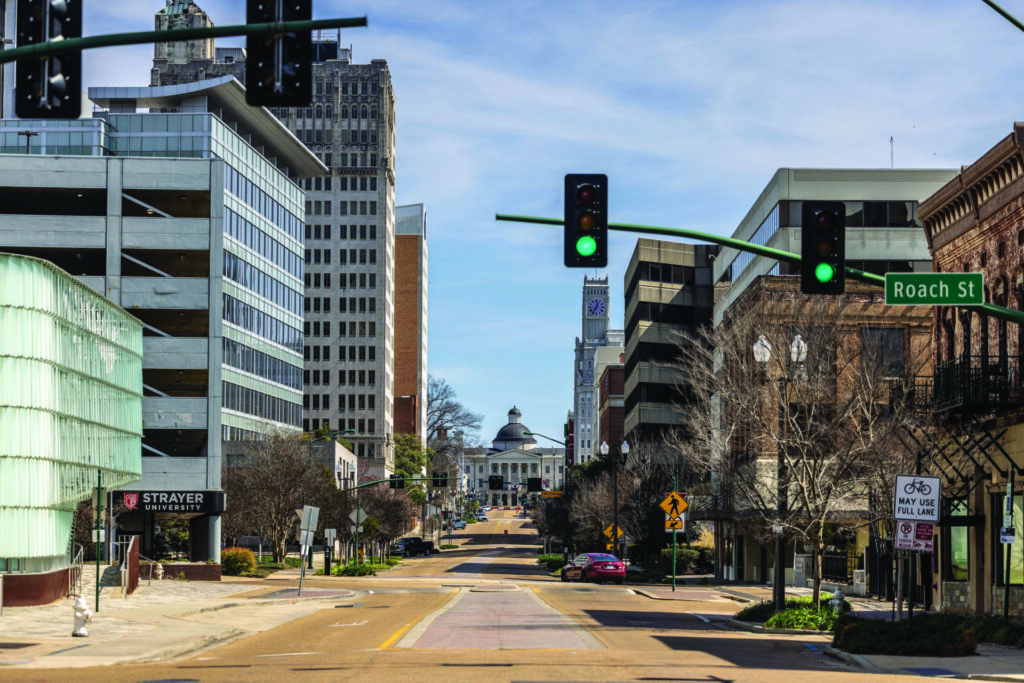
The Mayflower’s history and future tie closely to its home city. Jackson earned infamy during the Civil Rights Movement, when police arrested nine Tougaloo College students during a sit-in at the Jackson Public Library, and a Ku Klux Klan member named Byron De La Beckwith assassinated Medgar Evers, the NAACP field secretary who had trained those students in civil disobedience. After the Civil Rights Act of 1964 outlawed segregation in businesses, most of the restaurants on Capitol Street, where the Mayflower sits, either moved or closed. The Mayflower was one of very few that stuck it out. It was a haven for Jackson’s long-standing elite: business leaders, attorneys, politicians, and their families.
No one among the scholars and patrons I interviewed for this story could tell me exactly when the restaurant integrated, but records indicate prolonged resistance. In 1964, members of Jackson’s pro-integration movement renewed an economic boycott of downtown Jackson after being refused service in the area. At the Mayflower, according to an article in the Jackson Daily News, Black guests were “ejected physically” from the space. A year later the Justice Department filed suit against three downtown Jackson restaurants—including the Mayflower—for violating the 1964 Civil Rights Act. Tim Spofford’s book Lynch Street, about the May 1970 shooting by law enforcement officers at Jackson State College that killed two students and injured twelve, references signs of segregation still downtown that year, including three bathrooms at the Mayflower: “one for men, one for women, and one still labeled ‘colored.’”
Jerry Kountouris has said that the family’s Greek heritage “really kept us non-discriminatory,” as Greeks, Italians, and Jews all experienced bigotry at the time. Still, while European immigrants found themselves between Blacks and whites in the racial hierarchy—and while many were sympathetic to civil rights activists—serving only white customers was a way to scale the social ladder. One longtime patron told me that, until the recent ownership transition, the Mayflower had never employed Black people or men in the front of the house, nor had a significant Black clientele.
Meanwhile, Jackson’s demographics have shifted dramatically as white and middle-class flight continue to drive residents to subdivisions and gated communities in the nearby suburbs, including Madison, Ridgeland, and Brandon. In 1960, white residents made up 64 percent of the city’s population. By 1990, when Jerry took over, that number dropped to 44 percent, and as of 2022, it was less than 15 percent. At the same time, some suburbs have diversified as middle-class Black, Asian, and Latino families move north. Today, almost as many Black residents as white ones live in Ridgeland, though neighborhoods remain largely segregated. While its suburbs grow, Jackson’s poverty rate of over 20 percent is more than double the national average.
What the Kountouris family built is bigger than redfish and comeback sauce and Friday night regulars.
In recent years, the city has made global headlines for deadly crime, a prolonged water crisis, and its central role in restricting abortion access. It is in the face of this history and these sobering statistics that the Mayflower is trying to chart a new path forward, one craft cocktail and one crab cake at a time. What the Kountouris family built is bigger than redfish and comeback sauce and Friday night regulars. It’s bigger even than the family themselves. The Mayflower’s backers hope that the reinvigorated restaurant can begin to rekindle a downtown revival, both economic and communal.
My family was part of Jackson’s suburban exodus. I grew up in the city and moved with my mother and stepfather to Madison in the early 2000s, when I was in high school. Over the years, the sites of our everyday life—grocery shopping, dining, errands—mostly migrated north.
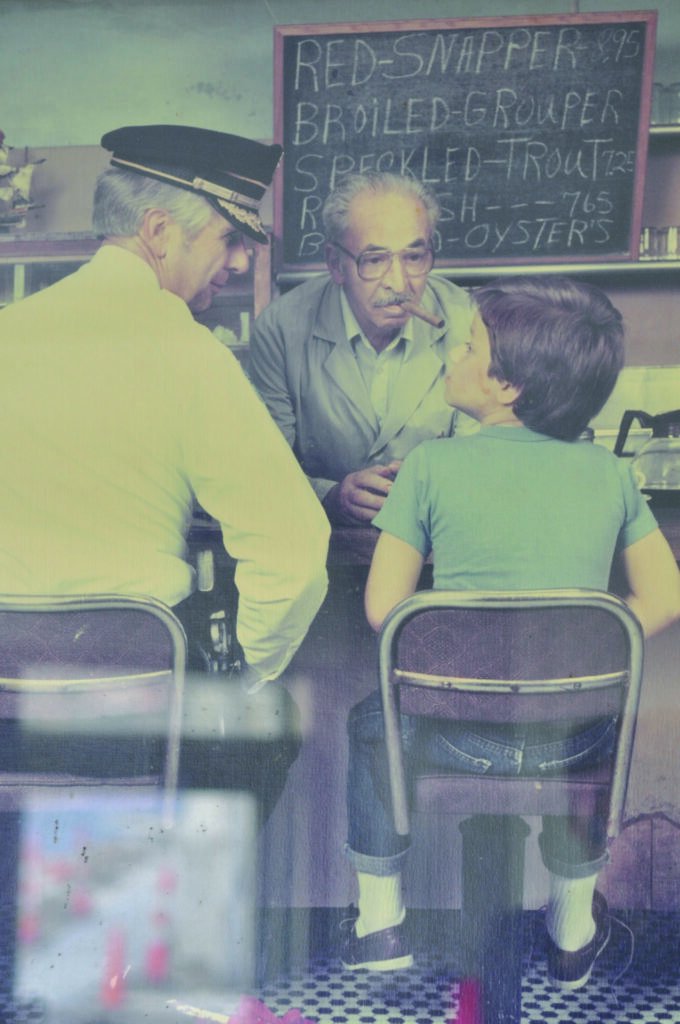
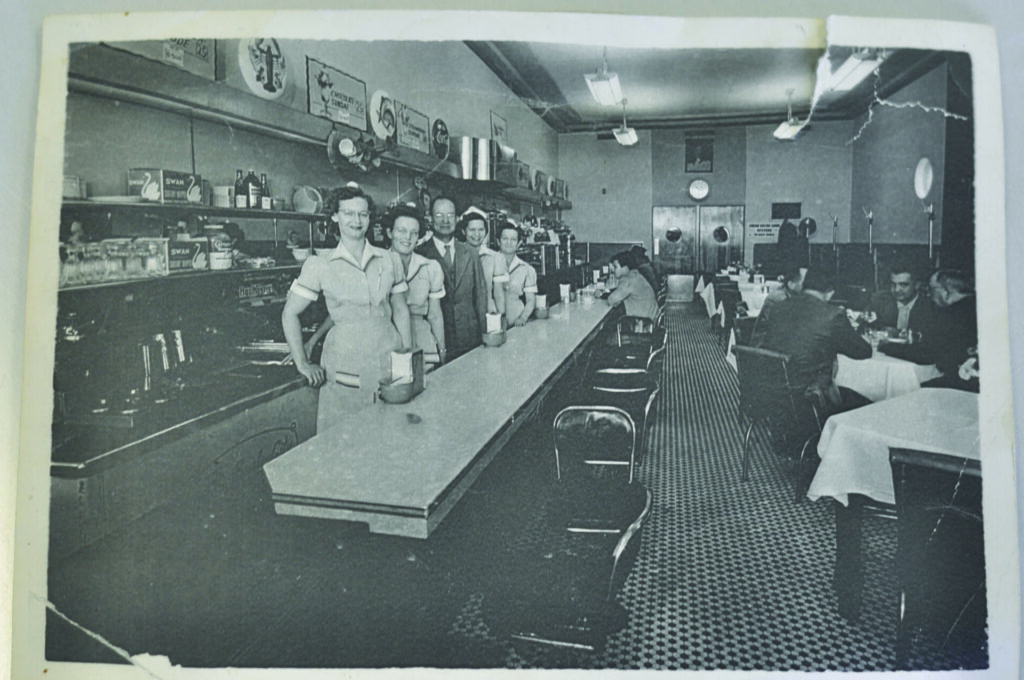
I grew up going to the Mayflower, too. I remember the neon sign that flanked the building at the intersection of Capitol and Roach streets and lit the corner in an orange-and-green glow. I remember the chalkboard that leaned against the front window, advertising soft-shell crab and fresh Gulf snapper. I remember walking outside the restaurant, around the building, and up a flight of stairs to get to the dim bathroom—a quirk that regulars accepted as part of the experience. I learned to slather comeback sauce on yeast rolls. On the way out, I would beg my parents for one of the mint chocolate candies that sat near the cash register. Even after we moved, the Mayflower remained a staple in our community, a place to keep going downtown for, year after year, even as downtown continued to hollow out and suburban Jacksonians warned each other about its supposed dangers.
***
Kountouris tried for a couple of years to find a buyer for the restaurant. In early 2023, he told J. Kane Ditto, a real estate investor, that he planned to sell the building and close the restaurant for good. (Ditto also served as Jackson’s mayor from 1989 to 1997 and, notably, was the city’s last white mayor.) In response, Ditto purchased both the building and the restaurant and brought on Evans and McCain as partners.
For Ditto, the Mayflower isn’t just iconic. The fresh fish dishes and blue-plate lunch specials are “built into the palate of people who go out to eat in the area,” he says. “People who come back to Jackson after they’ve left for many years always want to come back and eat at the Mayflower.”
I asked Ditto why he thought Kountouris struggled to find a buyer, and he declined to speculate. He acknowledged, though, that some people were afraid to come downtown at night because of safety concerns. Jackson’s homicide rate is more than fourteen times the national average, and most murders are in the poorest neighborhoods, which the Mayflower abuts. The actual risk of dining there is hard to read. According to longtime employees, the restaurant has never seen a violent incident, though surrounding areas do.
Another person close to the project, who spoke on background, told me that Kountouris considered relocating the Mayflower to other neighborhoods in Jackson, and even to Madison or Ridgeland, to make it more appealing for buyers. None panned out, in part because of the significant investment required. Starting over would have posed a challenge for anyone, and especially for someone already past retirement age with no succession plan.
Ditto resists a narrative of Jackson’s decline. Since the pandemic, downtown areas around the country have suffered a loss of retail and office occupancy, and he sees Jackson as part of a larger current. He says that Downtown Jackson Partners—a group of community leaders and elected officials, for which he serves as an officer—will be working “on both the actual safety downtown and the perception of safety downtown, which is what is important to change.” Ditto is actively invested in rebuilding the city’s core with residences, offices, and retail. He cites other projects: the Two Mississippi Museums, a $20 million–plus planetarium renovation set to open this fall—and, of course, the Mayflower.
“That’s the only way I think about rebuilding downtown,” he says. “One project at a time.”
***

It’s easy to see why Hunter Evans and Cody McCain were ideal candidates to take over the Mayflower. Both grew up in Jackson, and though they were never regulars at the Mayflower, they have bet their careers on the city. In 2020, they opened Elvie’s, an all-day café with a seasonally driven menu. Elvie’s not only survived the pandemic and water outages but went on to earn a spot on the 2022 New York Times list of America’s best restaurants and recognition from the James Beard Foundation. Since its opening, a handful of new food and beverage offerings have popped up in the Elvie’s orbit, concentrated in the historic Belhaven neighborhood, where Eudora Welty lived: Pulito Osteria, a wood-fired pizza restaurant; Fertile Ground, a craft brewery; and Mayday ice cream shop, to name a few. Also in Jackson, Evans and McCain have opened Good Bar, an outdoor bar; and Levure Bottle Shop, a natural wine store.
“I always said, ‘I want to open a restaurant downtown,’” says Evans, who attended culinary school and worked in kitchens in New York City before returning to Jackson. “It was sad to drive through on a Friday night and see nobody down there. There’s so much potential.”
McCain, who runs the front of the house, is more direct. Of Jackson’s negative press, he says, “We wanted to not run away from that but lean into it,” nurturing a community around the concepts. In carrying forward a nearly century-old restaurant, he hopes they can be “agents of change for the better in a place that’s traditionally struggled.”
I first spoke to Evans last summer, when the Mayflower was a coat of paint away from reopening. He was planning a series of soft openings to accommodate the many regulars and patrons who frequented the Mayflower: politicians, legislators, the mayor, the sheriff. Everyone had their opinions. Would they keep the catfish? The redfish? What about the comeback sauce?
“I understand what the Mayflower is, and we’re not going to let that be lost,” he promised.
Yes, the new Mayflower would look different, but primarily in ways that hearken back to the restaurant’s history. The new owners took the ceilings back up to their original height and installed an oyster bar where Jerry’s father, Mike Kountouris, used to ice his fish. A cocktail program and Greek-inspired wine list overthrew a longstanding BYOB policy. Artwork that pictures regulars’ families has stayed. They renovated the sign outside, which still glows neon. Abbreviated menus feature a new logo inspired by a matchbook Evans and McCain found upstairs in the building, likely from the 1950s or ’60s. An online system facilitates reservations for all. Also, Evans says, “We’re not going to mess with the salad dressing.” Crucially, they invited all of the staff members to stay through the transition, and most agreed.
Talking to Evans and McCain, it struck me that the community’s deep investment is both a gift and a challenge of reopening a historic restaurant like the Mayflower. Patrons want it to thrive, and to thrive, it needs to change. The new restaurant should appease regulars, honor their loyalty, and build a resilient business reflective of Jackson. Ditto credits the Friday night crowd for creating a strong customer base, but he says the new owners will need to attract a younger and more diverse audience for the Mayflower to not only remain a cornerstone of downtown into the future, but also to be profitable.
The Mayflower’s history and future tie closely to its home city of Jackson, Mississippi.
McCain understands this acutely. With Jackson’s history of segregation and its predominantly African American population, he says, “We wanted to intentionally diversify who feels welcome at the Mayflower.” That means hiring people of color in the front of the house and promoting an inclusive image to the public. It means a craft cocktail menu and guest chef dinners that draw in a younger, hipper crowd. In short, they need a new generation of Friday nighters—one that represents all segments of today’s Jackson.
Plenty of Jackson’s Black residents fall into the middle class and can afford to dine at the Mayflower, where a blue-plate lunch costs about fifteen dollars and dinner entrées hover around thirty dollars apiece. The question is whether they will choose a restaurant with the Mayflower’s history when other, swankier options abound—restaurants like Char, a northeast Jackson steakhouse, or Trio Prime & Lounge 3, an upscale cocktail bar near Belhaven. As one patron asked, why go downtown if closer restaurants are just as nice, with food just as good? Why go out of your way to spend time and money in downtown Jackson?
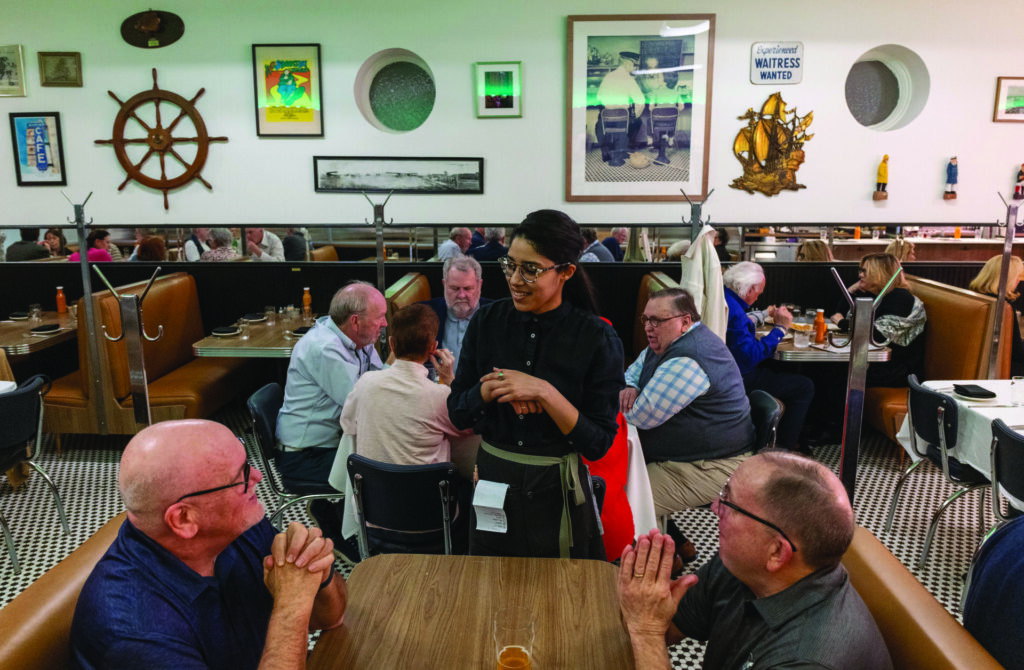
In August of 2024, I visited a soft opening service at the Mayflower with my mother, who began dining at the restaurant in the 1970s, when she was in her twenties. I booked a table for 7:30 p.m., and she felt apprehensive about driving downtown after dark. A mass shooting at the Daiquiri Bar, which sits caddy-corner from the Mayflower, had left one person dead and five injured the weekend prior. We arrived to the familiar sight of Larry Green, an African American security guard who has been with the Mayflower for seventeen years, only leaving his post near the front door to walk patrons to their cars. That night, a second guard joined him.
Inside, a friendly, frazzled staff navigated opening-week mishaps. An acoustic wall panel had fallen near a booth; tables had to be shuffled. McCain hustled through the dining room, quietly directing damage control. We waved to several of my mom’s friends scattered throughout the room. After a short wait and apologies, a host seated us at the bar, where we took in the new view. A wall of bourbon, vodka, and Italian liqueur bottles announced the cocktail program. Whole fish, oysters, and lemon halves nestled into deep wells of ice. A few fresh-faced servers eagerly instructed how to pronounce the Greek wine grape “assyrtiko.” I visited the new bathroom, finally on ground level. (The owners leased an event space next door expressly for its bathrooms). Otherwise, the experience felt…the same. I ate stuffed flounder and a wispy salad topped with grated carrots and comeback, both served on vintage Mayflower plates, ivory with emerald green rings. Black-and-white photos dotted the walls, including a signed shot of the late actress and Mississippi native Mary Ann Mobley and her husband, Gary Collins, behind the bar.
As Evans had predicted, Mayflower devotees crowded into the buzzing dining room. Most of the patrons looked to be sixty or older, and all were white. This was the Mayflower’s past. I wondered what it would look like in a year, or ten years, in 2035, at the restaurant’s one-hundredth anniversary.
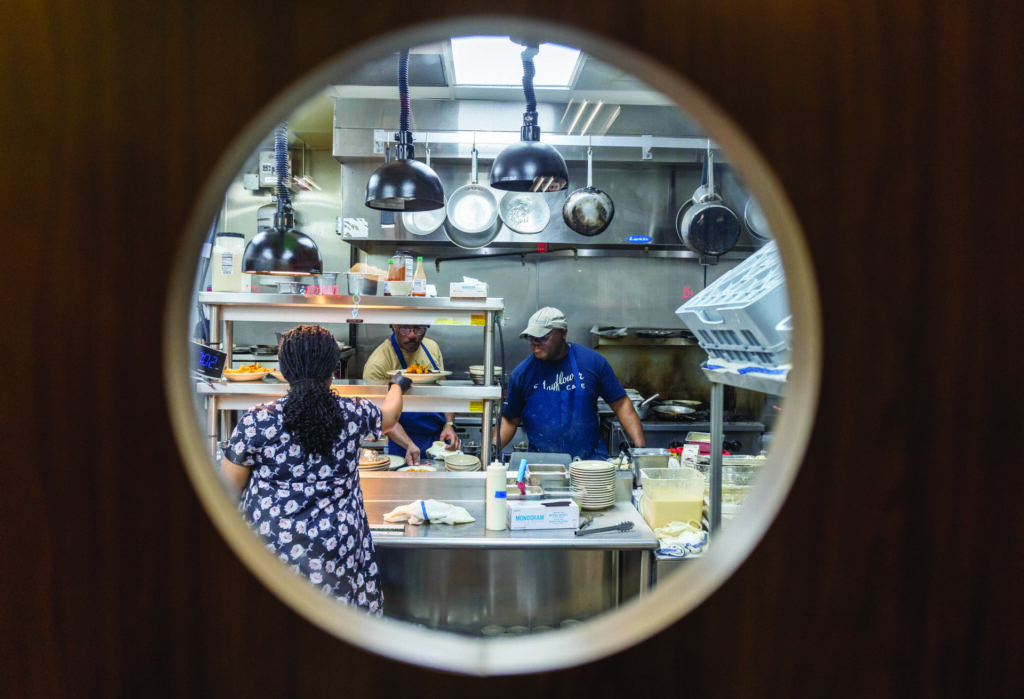
Tricia Sanders is one of the staff members who stayed through the ownership transition. She started serving at the Mayflower eighteen years ago, somewhat reluctantly. “I remember thinking, I don’t think I’ll make money here,” she laughs, recalling the restaurant’s humble atmosphere. “I made a lot of money here.” Friday nights brought reliable business, and a lunch rush might see two or three seatings. That was before the pandemic, though, and traffic slowed in subsequent years. Still, “we made it through,” Sanders says. Countless neighboring restaurants weren’t so lucky.
When Jerry Kountouris announced he was selling the Mayflower, Sanders was one of two employees left in the dining room, serving tables and working the cash register. The staff dwindled, but she stayed to keep the restaurant open. So did Anthony Monroe, the night manager, who has worked in the back of the house for fifteen years. “I had to just maintain because there was nobody else,” he says. Customers aged, and the climb to the bathroom grew burdensome. “It was time for a change,” says Monroe.
The ownership transition brought a learning curve. The staff on any given shift doubled. After decades of hand-writing orders and walking them to the kitchen, Sanders learned a digital system. The new owners solicited team members’ input before changing the menu to protect customer favorites, including the soft-shell crab, redfish, and, of course, the comeback sauce.
According to Monroe, for years only Kountouris knew the comeback recipe and mixed the spices upstairs, alone. “If you would stand there and talk to him while he was making the dressing, he would stop,” Monroe says. Eventually, he entrusted the recipe to one other employee—Willie “Frank” Morgan, who has worked at the restaurant for thirty-three years.
Employees often cite regular guests as reasons that they stayed for so long. And the Mayflower’s next era energizes them. Seventeen years in, Terra Thomas, an African American cook, says she looks forward to another seventeen years in the kitchen. “The perfect people bought it,” says Sanders. Monroe, too, praises the new owners’ skill and savvy. “But you can’t knock Jerry,” he adds, whom he credits for building an institution and providing jobs in Jackson. Kountouris, he says, wanted the Mayflower to live on.
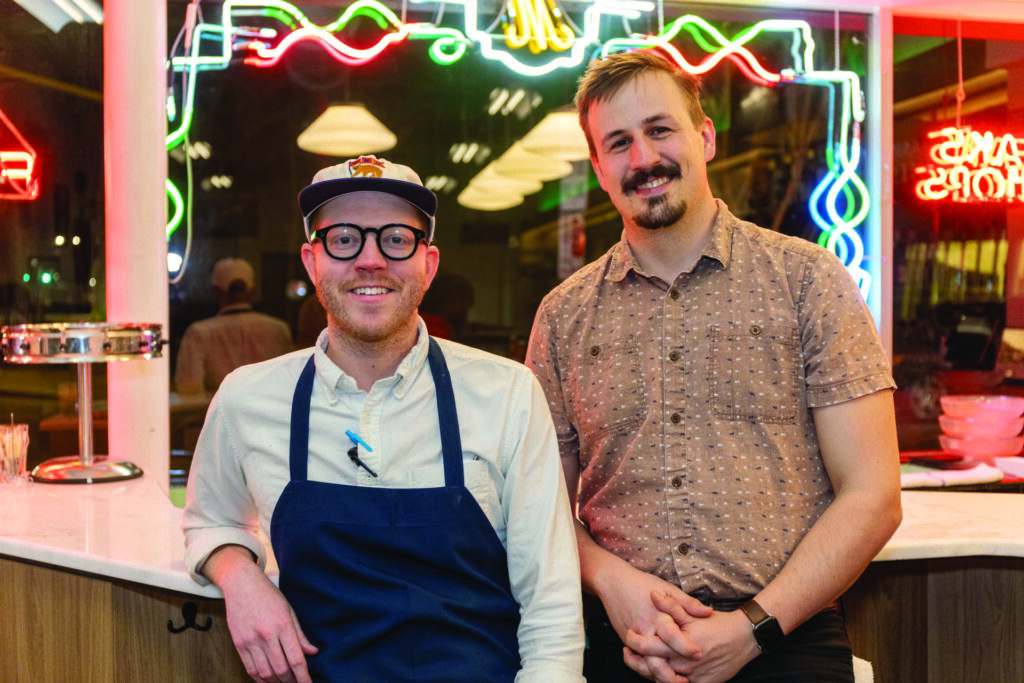
In a 2014 oral history interview for the Southern Foodways Alliance, writer Rien Fertel asked Jerry Kountouris what he saw as the future of the Mayflower. “Well, I have a son and I have grandsons, and I’m hoping maybe one day somebody will decide they want to extend the life of the Mayflower Cafe,” he said. “It’s up to them, not me.”
At the time, his son was thirty-eight years old and working for Nissan, which operates a large production facility north of Jackson; his grandsons must have been children. Kountouris acknowledged the challenges of running a restaurant, especially a family business. He wouldn’t encourage them one way or another.
A decade later, a different future has been written for the restaurant. In the same interview, Kountouris said he would “absolutely” like to see the Mayflower reach its one-hundredth year. “It represents something that Jackson is proud of over the years,” he said, “and I think they want to see it survive.”
I reached out to Kountouris for this story, but he never returned my call. He declined an invitation to the soft opening, too. Some speculated that it was hard for him to see the restaurant change. But he was right: The Mayflower’s longtime patrons care deeply about its future.
As this story goes to press, the new Mayflower has been open for seven months. In November, Evans hosted a Harvest Dinner—an annual event usually held at Elvie’s, in collaboration with local Jackson chef and friend Enrika Williams—in the Mayflower’s event space, exhibiting work by Mississippi artists. Evans was the only white person whose work was showcased at the dinner, and that was by design, he says. “We’re downtown, and we want to be involved.”
Although Williams has lived in Jackson on and off for fifteen years and previously worked at another restaurant two doors down from the Mayflower, she had never stepped foot inside before Evans took over. “It never felt welcoming,” she says. At the Harvest Dinner, though, “we literally had all sorts of demographics showing up,” says Williams. “We wanted to give people a new direction of what the Mayflower represents now…This is what we know Jackson is and can be.” Now, Williams dines at the Mayflower and encourages her friends to do the same.
Meanwhile, social media accounts highlight the work of Anthony Monroe, who prepares the iconic redfish filets, and Frank Morgan, who mixes the comeback, both of whom are Black. And the lunch crowd especially has begun to diversify, thanks to offices, construction sites, and warehouses downtown. Evans has heard of plans to renovate other buildings nearby, which gives him hope.
“People have always said, ‘Downtown’s on the cusp,” he says. “I believe that now more than ever.”
Downtowns have revitalized in other mid-sized Southern cities in recent years. Birmingham, Alabama—where I now live—shares Jackson’s history of racial violence and segregation, but also has the $200 million Protective Stadium and City Walk, a thirty-acre park built underneath the interstate that once cut off northern neighborhoods from downtown. Raleigh, North Carolina, is one of the fastest-growing cities in the country, and of the hundreds of shops downtown, nearly all are locally owned. Couldn’t Jackson go the same way? And might the Mayflower—materially or symbolically—represent a small step forward?
As for the Barksdales, they still go to the Mayflower on Friday nights. These days they arrive early, around 4:45 p.m., eat dollar oysters, and drink happy-hour wines. An unfamiliar crowd greets them, maybe because the old guard arrives later, or maybe they’ve stopped coming altogether (some longtime guests mourn the end of the BYOB policy). There is less table hopping and more reservations. When the restaurant first reopened, Claire couldn’t find broiled shrimp on the menu, and McCain seemed to have never heard of it. A month later, it was back and “better than ever,” she says.
The Barksdales marvel at how the new Mayflower sparkles: the convenient bathrooms, the high ceilings, the oysters on ice. They like supporting downtown Jackson, but that’s not why they come. They come, and will keep coming, for the excellent food and the people—the staff and new owners.
Occasionally, their booth isn’t available when they arrive, and another guest will apologize: “I’m so sorry, I got your booth!” The Barksdales don’t mind. Rhesa tells them, “I hope you left five dollars for maintenance.”
Olivia Ware Terenzio works in editorial and marketing for SFA and is the associate director of Project Threadways, a nonprofit that documents, studies, and interprets history, community, and power through the lens of fashion and textiles. She lives in Birmingham, Alabama.
SIGN UP FOR THE DIGEST TO RECEIVE GRAVY IN YOUR INBOX.