
On the Levee In 1955, Louisiana sugar refinery workers went on strike. Before they could change their future, they had to grapple with the past.
by Katie Carter King
Come September each year, it’s time for farmers in South Louisiana to start thinking about cutting their cane.
Sugar is in high demand no matter the month, but the crop that produces it grows on its own schedule, not the market’s. Sugarcane is a finicky plant and needs to be cut after its fountain of spear-shaped leaves have begun to brown but before the winter frost sets in, when the weather is still hot and dry. The entirety of the harvest should be at the mill by January, waiting to be alchemized into the “white gold” that has long been a staple product of the state: granulated white sugar.
Whether sold in five-pound bags to a local grocery or two-thousand-pound sacks destined for industrial giants like Sysco and Nestlé, the crystals move from Louisiana out into the world and, eventually, into your pantry. The specifics of who does this work and how it’s done have changed over time, but the product’s trajectory has stayed much the same for hundreds of years. Right now, there’s a decent chance you have some Louisiana cane in your bloodstream. Your parents probably did, and their parents too.
This is a story of labor, one that is particularly important in this moment of heightened uncertainty around the strength of workers’ rights. For thousands of years, sugar remained a supreme luxury, only available to the wealthy and aristocratic. Its evolution into ubiquity and necessity—and its long journey into your veins—has always been reliant on unheralded, unseen, and often dangerous work, and the people who perform it.
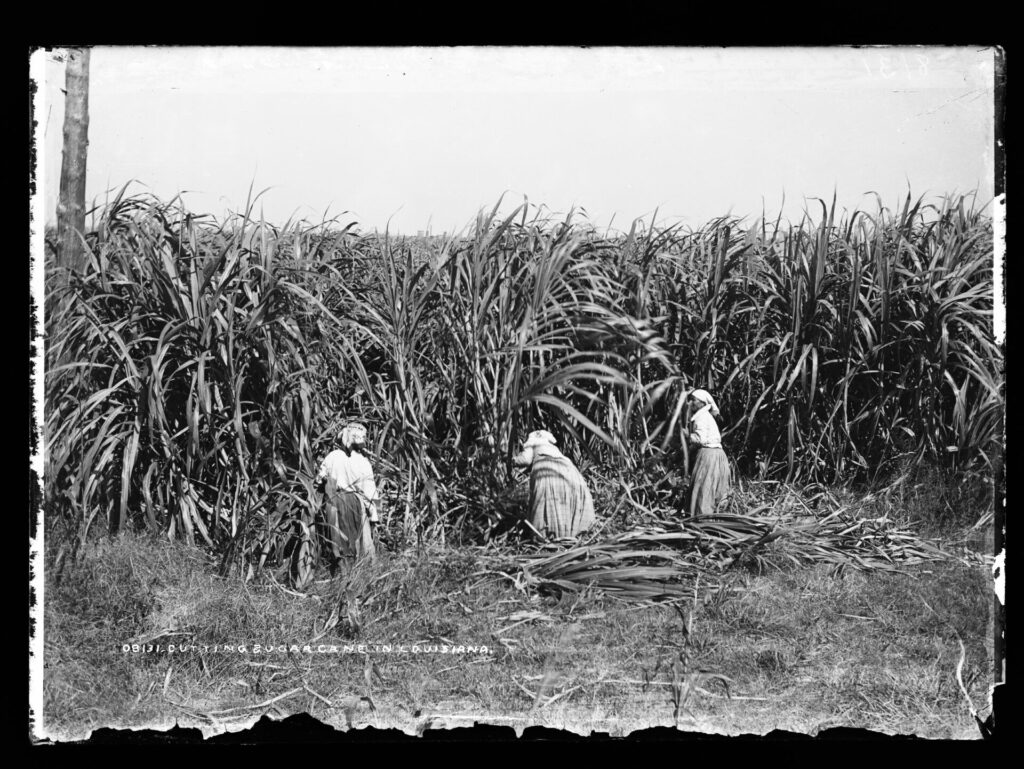
By all meteorological measures, 1955 was shaping up to be a banner harvest. In the small community of Reserve, forty miles upriver from New Orleans, highs were still in the low nineties as Labor Day weekend approached. The thick, sturdy reeds were already taller in the fields than the workers who tended to them. Growing conditions had been so favorable, in fact, planters believed they’d be able to harvest more than twenty-two tons of cane per acre, the second-highest yield ever on record in the state.
Generations of families had worked in the fields surrounding this notch in the Mississippi River. But over the first half of the century, the jobs had mostly shifted inside the refinery—a towering factory that loomed over endless rows of crops, a sort of levee-backed Oz topped with billowing smokestacks. Inside, hundreds of employees worked in concert to turn chopped Saccharum officinarum into raw sugar before reprocessing the granules into something more pure. Rather than the Wizard, they answered to a family named Godchaux.
This time of year, the Reserve refinery would typically be abuzz with local men preparing for the onslaught of harvest season. Those who usually walked the plant’s floors knew the sugar-making process as well as they knew the stretch of the river the factory sat on. These were union men, many of whom had spent their careers in the same refinery. But Godchaux had filled these jobs with unskilled men over the summer, shipped in from 200 or more miles away—many were said to be college students on break—while almost all the longtime workers found themselves without pay.
By the time Labor Day rolled around, the humid air in Reserve had grown taut. Brief moments of violence had punctuated the last six months, each threatening to explode into something larger: A truck’s windshield shattered by a brick. Shots fired into the factory foreman’s home. A station wagon carrying the company’s vice president, Walter Godchaux II, had been overturned by fifteen men, although neither the VP nor his passenger had been injured. As August became September, the town continued to wait for its reckoning.
A vitriolic charge in the air seemed to be pervasive that year. Throughout the South, the segregationists had been organizing panicked speaking campaigns and White Citizens Councils in response to the Supreme Court ruling that said schools needed to integrate “with all deliberate speed.” Then, only a few days before, a Black child named Emmett Till was brutally murdered by two White men in Mississippi, and horrific revelations about the case had been splayed across headlines all week.
But Reserve had drawn their battle lines differently that summer, delineating allies and enemies by whether someone was a union or company man. Workers had been striking for better wages all over the country the last few years, often with violent results. People still talked about the walkout at a paper mill in central Louisiana in September 1952 that “had threatened for a time to touch off a full scale civil war,” according to a local write-up. By the time the strike was resolved in late 1954, the gas main leading into the town had been dynamited more than fifty times.
Earlier that spring, the engineers and machinists and filter operators who made up the Godchaux Sugar Company workforce decided to seek their own labor justice. The company had refused to recognize their union local, which had affiliated itself with the United Packinghouse Workers of America (UPWA), an organization that had long represented meatpackers across the country. Top to bottom, UPWA was a multiracial effort and often publicly advocated for civil rights on a national scale.
The demographics of the factory reflected those of the community. About half were White, Catholic, and Cajun, while the other half were Black Protestants whose ancestors had been enslaved somewhere nearby. In this isolated pocket of the country, most families could trace their lineage back well before the Civil War. And for a hundred years at least, their lives and livelihoods had remained intertwined with the sugar industry.
Although Black men worked side-by-side with White men in the factory, only the latter were allowed to use the sanitary facilities. This kind of rigid segregation extended to all public spaces in the community, as it had since the town was founded in the late 1800s. On principle, the union was as opposed to segregation as it was to discrimination, and it had begun advocating for common use of the bathrooms rather than the building of separate facilities, as one member had initially suggested.
After attending integrated organizing meetings early in the year, workers had quickly found that a legacy of depressed wages and a hope for something better connected them. “The old custom of self-segregation has disappeared,” one internal report noted, “for the most part spontaneously.” When Godchaux rejected their request for a factory-wide, ten-cent-per-hour raise, almost 900 employees, Black and White, walked off the job in protest. The papers reported that by 10 p.m. on April 14, the entirety of the plant’s workforce was “on the levee.”
After attending integrated organizing meetings, unionized Black and White employees of Godchaux Sugar Company quickly found that a legacy of depressed wages and a hope for something better connected them.
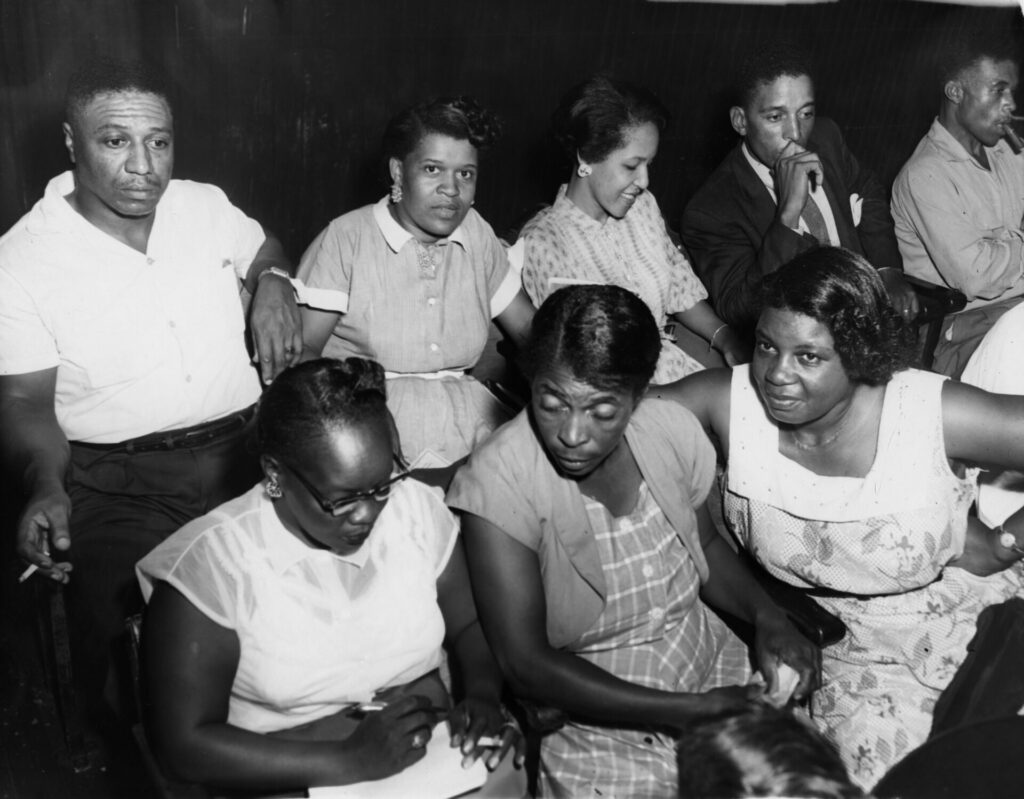
The refinery was overwhelmingly male, but more than 150 wives and family members of union men packed into a nearby garage-turned–meeting hall over Labor Day weekend. They had deliberately integrated their seating patterns, and dozens of delegates huddled in a tight circle to discuss the problems of the nation as well as their own. Amid chatter about the ongoing strike, the conversation quickly turned to the recent lynching of Emmett Till.
A collective statement felt both necessary and integral to their cause. “This was a move to intimidate people and also a move to deter Negroes and whites from the unity UPWA is trying to develop,” the delegation wrote. “Further, it is a move to keep organized labor out of the South; a move to keep corrupt politicians in office…a move against the Supreme Court’s decision regarding non-segregation passed in May of 1954; and a move to set back progress.”
The strike caught the eye of a few national reporters traveling the South that summer. One, Murray Kempton, had been writing a series of pieces for the New York Post about the violent lengths White society would go to in order to preserve the racial hierarchy. “They are alone on an outpost on the wild frontier of Southern labor,” he wrote of the UPWA local’s efforts. “Whatever happens to them, they have already accomplished a kind of revolution, and their town can never be what it was when they began.”
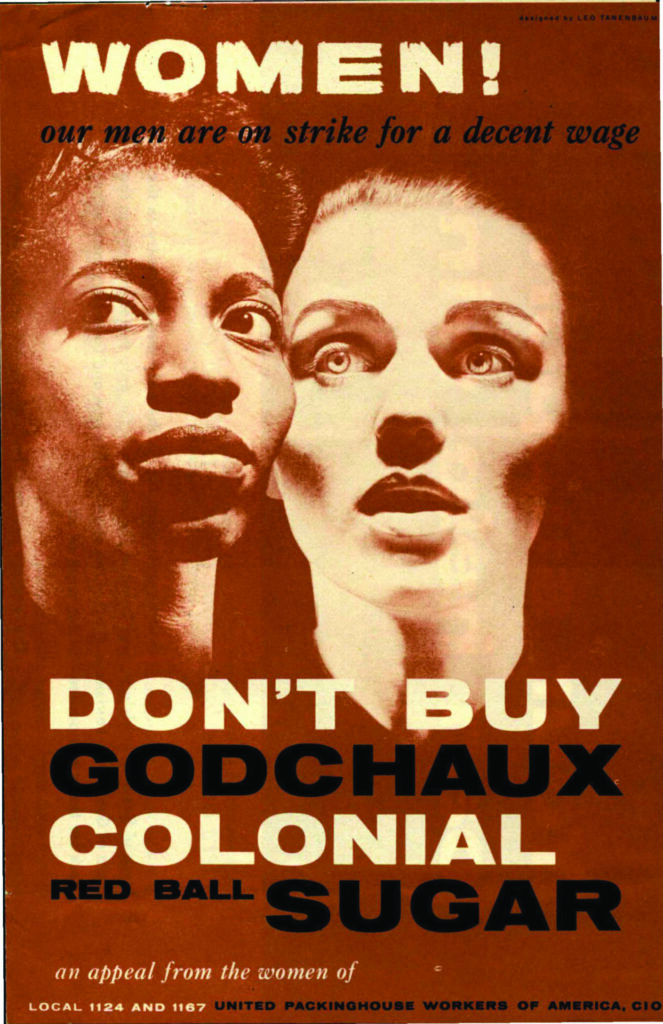
When the strike started in April, the Godchaux Sugar Company’s first instinct was to turn to the local legal system. Skeleton crews resumed limited operations at the plant after a judge issued a restraining order severely limiting picketings. Within four weeks, seven union-sympathizers were being held in contempt of court, and thirty-one had been indicted on conspiracy charges. Godchaux lawyers alleged they’d attempted to incite violence by invoking the word “scab” and by giving “hard looks” at anyone crossing the picket line (twenty-one strikers had defected). The governor deployed state troopers to monitor the parish, and by the end of June, state senators were advocating for the implementation of martial law in the area.
Then, in July, company president Leon Godchaux II issued what amounted to a public ultimatum. Speaking to LIFE Magazine, the namesake and great-grandson of the company’s founder bemoaned his inheritance was under direct attack. Local lore said that the original Leon Godchaux named the town in a fit of spite, wanting to “reserve” the fertile land for himself alone, and the heir seemed to have inherited his ancestor’s antagonism. The corporation had already hired 410 “permanent” new workers, and it was publicly threatening to blackball union supporters from future jobs in the parish. Now, if the strike continued, “we may be faced with repopulating the entire community,” Godchaux II stated plainly.
Contrary to local folklore, the elder Godchaux purchased La Reserve Plantation name and all in 1869 from a widow who had fallen into postwar bankruptcy. He immediately founded Godchaux Sugar Company and continued to purchase land as nearby farms fell into similar distress: LaPlace, Belle Pointe, LaBranche. The cane from all these plantations went to his mill in Reserve, and the French-born planter began to develop a company town there, establishing a post office and a train station. Godchaux soon doubled his acreage and gained notoriety across the South for the immensity of his sugar operations.
Eighty-six years in, the company had mostly shifted away from managing the fields, choosing instead to focus on the more specialized—and more lucrative—process of milling and processing the sugar. Even so, the Godchaux family still operated a handful of cane plantations, and they still owned Reserve. They provided the town’s water and electricity. They had donated the land for Leon Godchaux High School, which only allowed White students to attend. They built the primary third space in town: a sprawling clubhouse complex with a movie theater, a baseball diamond, a pool, and more—all of which was similarly segregated. And, most importantly, they still owned most of the town’s housing stock.
The United Packinghouse Workers Association (UPWA) had already managed to create a uniquely interracial coalition that understood segregation to be a tool of social control against the working man.
When Godchaux field laborers had attempted to strike two years prior, bosses fired ninety-seven men, many of whom had counted the company as both their employer and their landlord. Along with their 600 dependents, the men were turned out of their homes. It had been a major blow, but the area had limited employment options. More than 90 percent of the breadwinners in the community still worked in the refinery.
Ruminating on the threats Godchaux II made in LIFE, Murray Kempton speculated the company would likely seek to “repopulate” the town with a more pliant citizenry—that is, “if people who can’t elect their own mayor can be described as citizens.” He did not take into account that plantation and refinery owners had rarely taken up for their workers’ rights as citizens in the decades and centuries prior. Throughout Western history, planters instead chose to rely on the legal codification of enslaved labor and the social tactics of violent persuasion.
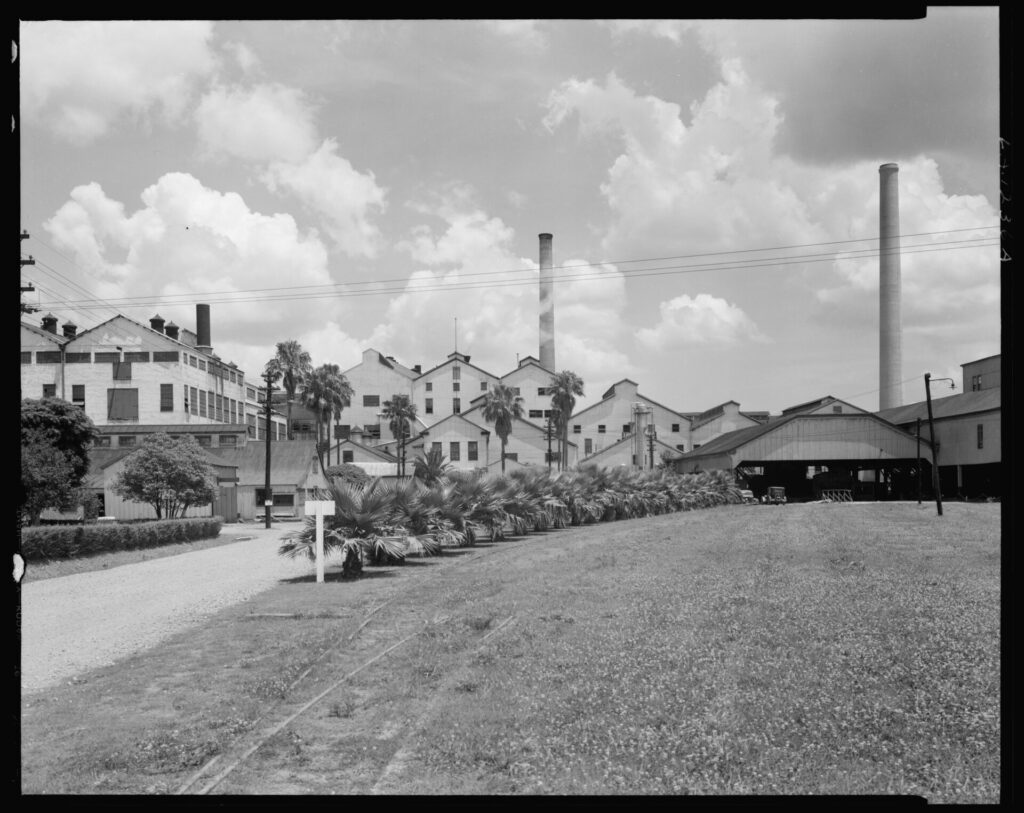
A member of the grass family, sugarcane requires the hot, wet climes that hug the equator. First cultivated in 1501, in what is now Haiti and the Dominican Republic, the crop had always been brutal to harvest. Mature stalks could stand twelve feet high and had to be cut expertly by hand with curved machetes. Workers had to press the segmented stalks within hours of the harvest, as the juice inside the cane began fermenting almost immediately. It wasn’t uncommon to scald oneself with boiling sucrose or to lose an arm to the hundred-pound rollers leveraged to crush the reeds.
By the time French Jesuit priests planted the first cane seedlings in New Orleans in 1751, sugar had morphed into a major global commodity. This rapid expansion in production was exclusively enabled by the transatlantic slave trade: planters brought hundreds of thousands of enslaved West African laborers to work the fields of the “sugar islands,” as the archipelagos of the West Indies had come to be called.
In contrast, Louisiana was relatively late to the sugar boom, only developing a commercial industry in the final years of the eighteenth century. Antoine Morin, a Haitian-born free man of color, was the first to successfully granulate Louisiana cane into raw sugar in 1795. His employer sold that first batch for twelve thousand dollars—more than three million today. Immediately sugarcane plantations began to spread west from New Orleans, lining the banks of the Mississippi River for more than a hundred miles.
Within five decades, Louisiana was producing a fourth of the world’s total sugar supply—a statistic aided by both the region’s rich alluvial soil and the Haitian Revolution, which freed the island’s enslaved and expelled their colonizers.
Antoine Morin, a Haitian-born free man of color, was the fi rst to successfully granulate Louisiana cane into raw sugar in 1795. Within five decades, Louisiana was producing a fourth of the world’s total sugar supply.
Louisiana was a haven for tens of thousands of these White “refugees,” many of whom brought their remaining human property and their understanding of sugar making.
Tensions between Louisiana planters and enslaved Black workers reached a breaking point in 1811. Beginning in LaPlace, just five miles east of Reserve Plantation, 500 enslaved men marched in military formation toward New Orleans. They planned to take control of the port city, and the group drew supporters and soldiers with every plantation they passed. The revolt was quashed after three days and two White deaths; local planters killed ninety-five Black men in direct retaliation. In the aftermath, a New Orleans judge ordered the insurgents’ heads to be placed on pikes along the levee as a stark warning for anyone who walked the same path.
These fearmongering tactics helped to enforce the status quo for another fifty years. Meanwhile, the Louisiana sugar industry only continued to thrive and expand. By the beginning of the Civil War, the area was home to more than 1,000 sugar plantations spread over twenty parishes.
Leon Godchaux immigrated from France to New Orleans in 1844, intending to make his fortune as a specialty clothier. By the time he began to dabble in sugar in 1869, Louisiana’s cane plantations had already begun to consolidate and modernize. Cane farms were failing at a rate previously unseen as planters were forced to grapple with the concept of paying their laborers. In the wake of the war, Godchaux was able to buy up land and ratchet up production, processing all of his cane at the centralized facility in Reserve.
Propped up by a series of protective tariffs, Godchaux and others like him raked in profits. This new generation of planters paid their workers miniscule wages, often in company script (agricultural laborers did not qualify for minimum wage until federal standards were amended in 1966). The field hands remained primarily Black, and companies housed them in the same cabins their enslaved parents and grandparents had slept in. Sugar-processing facilities continued to consolidate, and the number of mills and refineries in the state fell from a prewar peak of 1,100 to fewer than 300 by the end of the nineteenth century. Open evaporation kettles in cypress-walled sugarhouses were replaced by centralized, technologically advanced factories often owned by Northern investment groups.
Throughout the 1880s, local sugar workers—many of whom were Black—attempted to assert their rights, demanding better conditions in a series of actions backed by the national Knights of Labor movement. Beyond striking, they threatened to leave the area altogether: “A Dollar a Day or Kansas” became a key slogan of their movement.
Organizing ended abruptly in 1887. That October, just as the harvest was set to begin, the Knights called a strike. Faced with the potential loss of their crop, planters and their henchmen turned violent and vitriolic, firing and evicting workers from their homes at gunpoint. They were aided by a series of militias that patrolled with both a cannon and a hand-cranked machine gun. The workers fled some thirty miles southwest of Reserve to Thibodaux, where White vigilantes barricaded the town before turning to all-out massacre. The violence was both personal and indiscriminate: Black laborers and their families were killed for housing strike supporters, and one survivor remembered being attacked by his own employer. By the end of November, some sixty Black Louisianans had been murdered, and the local labor movement was effectively dead.
By the 1950s, Godchaux Sugar Company was one of the only refineries still run by a local family, and the Godchauxes held significant political sway in the region. For decades, union advocates had been unable to pierce the cane belt, but in 1952, the National Agricultural Workers Union reached out to the company regarding some local wage claims—their “first step toward negotiation with the big sugar interests,” a study of the movement wrote. Organizers staged a strike for the next year after being rebuffed by the corporation, and 1,200 people walked out of the fields the following October. Now a few generations removed from the atrocities in Thibodaux, papers all over the state breathlessly reported that the strike was the first of its kind in Louisiana sugar history.
Although it began on four large plantations, the strike soon spread to seventy-five others. A few hundred refinery workers in nearby Houma walked off their jobs in solidarity. But in less than a month, a district judge granted an indefinite restraining order against public striking and dissemination of union literature. “So vital does the element of time appear to us,” the judge reasoned, “we are disposed to regard any affirmative action intended to disrupt, deter, or prevent [sugar] operations as wrongful.” Workers were back in the fields the next week.
In many ways, the 1955 strike followed the same patterns as those that came before. Workers were evicted from their homes. Restraining orders hampered strikers’ abilities to protest. Violence had been reported as coming from both sides. But as summer began to fade into fall and the cane grew ever taller in the fields, there was still reason to hope.
The UPWA had already managed to create a uniquely interracial coalition that understood segregation to be a tool of social control against the working man. Now local organizers sought to sway public opinion just as the Godchauxes had in the pages of LIFE. Strikers and their wives organized television and radio spots to advertise their plight. They papered A&P grocery stores all over the state with fliers and visited hundreds of markets to ask them to stop carrying Godchaux sugar. The union made headlines across the state when thirty women presented a petition with 3,000 signatures at the state house in support of recalling the judge who had issued the most recent restraining order.
While the Godchauxes remained the face of the company, the family-run corporation had in fact fallen prey to the same market forces as the rest of the industry just the year before. “The Godchaux family are barons no longer,” Murray Kempton wrote. “Their company is largely owned by Eastern capital, and Walter Godchaux, its executive director, is only a colonial agent. Yet the strikers think of themselves as somehow enlisted in a war against the droit du seigneur; the memory of a tradition often survives its fact.”
While true, this cognitive dissonance seemed to hold on both sides of the battle line: According to the locals, only a few days before workers walked off the refinery floor, Leon Godchaux II had stood in the high school named after his great-grandfather and “asked them in all sincerity if he hadn’t been a good master.”
The “century is reserved for Leon Godchaux no longer,” Kempton concluded.
Seventy years later, anxieties over labor continue. Stagnant wages, Immigration and Customs Enforcement (ICE) raids, and the rise of artificial intelligence have stoked fears new and old in America’s working class. But while well-meaning consumers claim to “know their farmer,” few, if any, can say who grew and refined their sugar, or under what conditions.
The Godchaux strike ended quietly in December of 1955. The company agreed to the proposed ten-cent raise but insisted that the details of the settlement remain confidential. Following the months-long upheaval, UPWA continued to organize in the area and eventually developed an interracial “voters league” in the parish. By the end of the decade, the Godchaux family had completely cashed out of the enterprise, selling the factory, their long-held plantation home, and even the trains used to carry cane in from the fields. (Refurbished to its original splendor, modern amusement seekers can still ride the Godchaux locomotive on the Disneyland Railroad inside the California theme park, although it’s known now as the Fred Gurley #3.) The refinery continued to run under the banner of “Godchaux-Henderson” until 1985, when it folded for good.
Today, fewer than a dozen sugarcane refineries operate in Louisiana. Even so, twenty-two parishes continue to produce 45 percent of the nation’s crop. In fact, local farmers have markedly increased their cane acreage over the past decade. Sugar production remains vital to the state’s economy, generating more than four billion dollars a year and employing roughly 16,000 people end-to-end. On average, refinery workers earn about twenty-five dollars an hour. For field workers—seasonal labor, typically—the hourly pay is closer to fifteen dollars. Some of those workers are unionized, but it is difficult to find an accurate figure of how many.
There are significantly fewer refinery positions these days than there were in the mid-twentieth century. Across the country, the industry has lost more than 100,000 jobs since the 1980s. While support for unions is the highest it’s been in America since the 1950s, fewer than 10 percent of employed adults are currently represented by organized labor. For those employed in sugarcane in Louisiana, whether unionized or not, the hard-won changes their elders fought for defined the world they now live and work in. Many are fifth-generation refinery employees. Even so, that history remains largely unseen and unknown.
After the strike ended, the community was quick to put the violence and mass unemployment in the past. The fight in Reserve was quietly forgotten, buried in old newspapers and academic textbooks. It’s a common American process that makes it much easier to believe we arrived at modern standards naturally, gradually, calmly. But the strikers and their supporters understood that progress was made of active momentum; it was hard work that required individual and corporate change. Even once their fight was won, they knew that too many people across the country remained underpaid while laboring in grueling, dangerous conditions. And then, as now, too many workers still clung to the prejudices of their parents and aimed their righteous anger at the most disenfranchised among them.
That had been Reserve’s story since its founding. Standing on the levee in 1955, the workers said more with their actions than just what was written on their picket signs: They proclaimed that they could create something brand new, something they’d never seen before but believed could exist. “Out of our struggles today,” the delegation wrote that balmy Labor Day weekend, “we are building a new, free, unafraid South.” It was a declaration that they intended to remake the century in an image all their own.
Katie Carter King is a writer, researcher, and the founder of Magpie Projects, a boutique consultancy that helps journalists build historical narratives. Based in Atlanta, Georgia, she is a graduate of the MA program in Southern Studies at the University of Mississippi.
SIGN UP FOR THE DIGEST TO RECEIVE GRAVY IN YOUR INBOX.