
East Meets West in the Big Green Egg The story of an iconic grill wafts from Japan to Atlanta and back again.
by John Kessler
Photos by Noriko Hayashi and Ben Gray
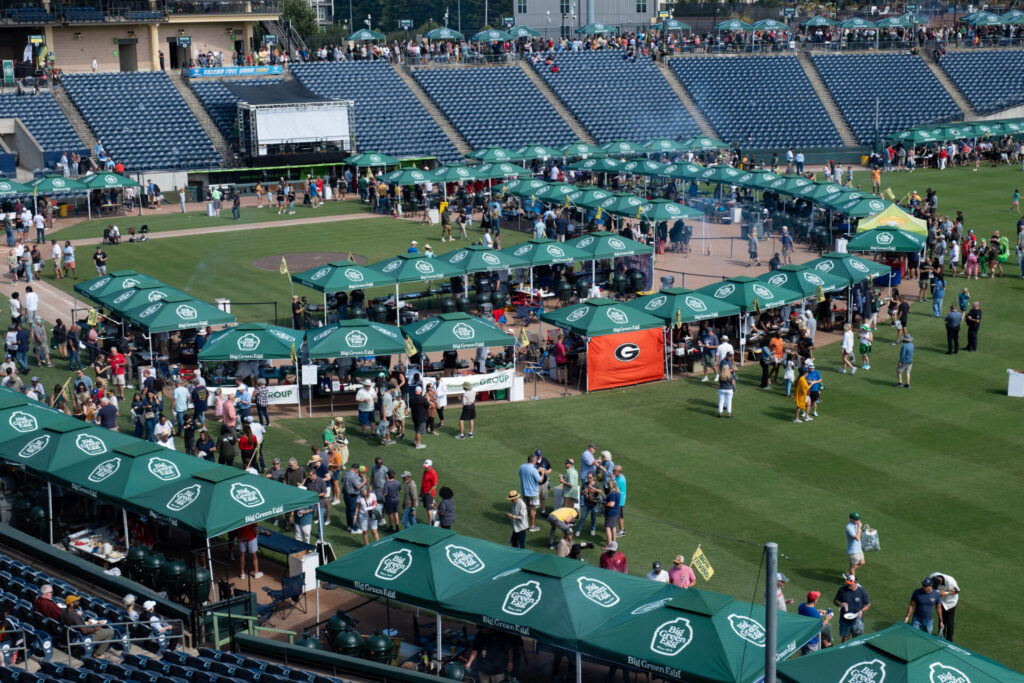
On a Saturday afternoon last October, about 3,500 people arrived at Coolray Field, a minor-league baseball stadium in suburban Atlanta, for an event that was part Mardi Gras, part cult rally, and all cookout.
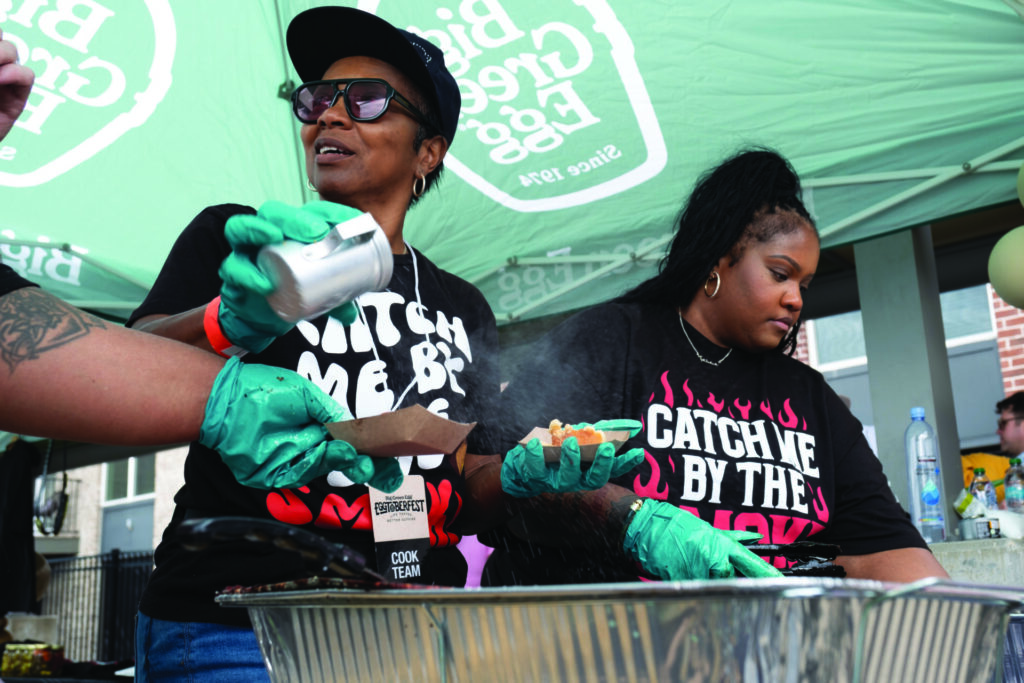
The Seed and Feed Marching Abominable—a pep band with burly tuba players in drag, drum majorettes, and children with bubble blowers—entertained the crowd. Attendees dressed to show their allegiance to the almighty Egg: They wore garlands of colored eggs and T-shirts proclaiming i’m just here for the egg-sperience. This was the twenty-eighth annual EGGtoberfest staged by Atlanta-based Big Green Egg, which supplied 350 of their cheerful, shiny, and instantly recognizable ovoid smoker grills for the occasion.
“We bring the Eggs, they bring the food,” said Dan Gertsacov, the company’s CEO, who’s tall and broad shouldered and still carries himself like the rugby player he was in college. Around him, the grill’s fans—collectively known as EGGheads—cooked a bewildering array of dishes to share, from pork belly burnt ends to seared bok choy to smoked pound cake. And of course there were the ribs, chicken, and pork butts that people have staked their barbecue bona fides on. EGGtoberfest attendee Michael Carmody is such a fan that he built a pavilion in his Connecticut backyard to house all seven of his Eggs—one in each size the company offers. All hail the Egg.
“It’s magic, and it’s more than just a grill,” said India Glass, half of the sister duo Black Girls Grilling, who won their fourth consecutive People’s Choice Award trophy, thanks to their high-energy hospitality and fantastic roasted oxtails over gouda grits.
“The mission of Big Green Egg is less about the grill and more about getting friends and family gathering outside,” said Gertsacov, repeating a line he has used a lot since assuming control of the company in 2024. He tells it to his employees, to the board of this privately held company, and to the network of distributors that sell the product in over fifty countries.
Gertsacov’s bromide makes for a good mission statement, but it doesn’t fully explain the mania that brought so many souls to a Lawrenceville, Georgia, ball field. It is about the Egg—a contraption that obsesses people like an Italian sports car or a Swiss watch might—a minor marvel of engineering and a way of satisfying that deepest human impulse to master fire. Its fans are legion, from Foo Fighter Dave Grohl to Noma chef René Redzepi.
The Big Green Egg obsesses people like a sports car or a Swiss watch might—a minor marvel of engineering and a way of satisfying that deepest human impulse to master fire.
Within the crowd was a sixty-seven-year-old Japanese man named Hisashi Kato of the Japanese grill manufacturer Kamado Q. He prepared a dish believed to be a first at EGGtoberfest: sushi. He had dressed his Big Green Egg in samurai armor, with a horned headdress, and used it to cook rice in a special pot called a hagama that he had wedged inside. Guests lined up to create their own handrolls with sheets of seaweed, rice, and slivers of Wagyu beef.
“This gives me such a sense of accomplishment, purpose, and community,” he said in Japanese, his son, Masa, translating for him. Both wore T-shirts with a hagama on the back and the outline of a grill with the characters for “big,” “green,” and “egg” on the front. “Some guy told me our T-shirts were the best at the event and wondered why we weren’t selling them,” said the father.
Kato wished he could tell that man just how much meaning his shirt communicated. On the back of his head he wore a mask depicting pursed-lipped Hyottoko, a Japanese folk character regarded in northeastern Japan as the god of fire and luck—and, he reasoned, of the cooker itself. It wasn’t until late in his life that Kato discovered the Big Green Egg. He learned that its roots lay in the Japan of a century prior, where it was called a mushikamado and wasn’t a grill but a rice cooker. It fascinated people then as it does now. That fascination had survived a war and an occupation and carried this contraption across the ocean and around the world, and it had changed into something now emblematic of the American South. His purpose, he said, was to bring it back to Japan, where appreciation is growing again. “I believe Hyottoko selected me to let people know about the grill, to protect its culture and story, to work with the Americans and become its voice.”
Gertsacov says essentially the same thing, though he uses the language of corporate strategy instead of spiritual destiny. The company’s founder, Ed Fisher, ninety-one and still chairman of the board, tasked Gersacov—formerly the chief marketing and digital officer at Arcos Dorados, the largest independent McDonald’s franchisee—with reenergizing this icon, which is a leading barbecue brand in the United States. Its obsessive fans keep thousands of accounts on online forums, where they discuss recipes, charcoal, and accessories with a rare degree of fanaticism. All this from a company that trades on folksy charm and employs fewer than 100 people in its metro Atlanta headquarters. Yet customers, when polled, were ready for upgrades. “It was resounding,” he said. “Our biggest fans were asking for innovation.”
Gertsacov leaned hard into the Egg’s Japanese roots. “I asked what we could learn from history that could set the strategy going forward.” He familiarized himself with the principles of Zen design, such as kanso (simplicity) and shizen (naturalness) to see if they resonated with the outdoor-cooking lifestyle. As Gertsacov began to piece together the story of the Egg, questions piled up. When and where did American barbecuers first lay eyes on these bulbous clay vessels meant for rice? How did they learn to repurpose them? And why did a cooker designed for indoor use become a premium backyard grill?
He decided he had to go find answers. Three months prior to EGGtoberfest, he set off for Japan where, over the course of a few whirlwind days, he learned about the Egg’s origins. He met with Kato and other fellow obsessives. As Gertsacov learned about the Egg’s passage to America and its journey back to Japan, he found a kink in the narrative, a way in which it flipped over on itself like a Möbius strip. In Japan, it had become an emissary of America’s Southern culture.
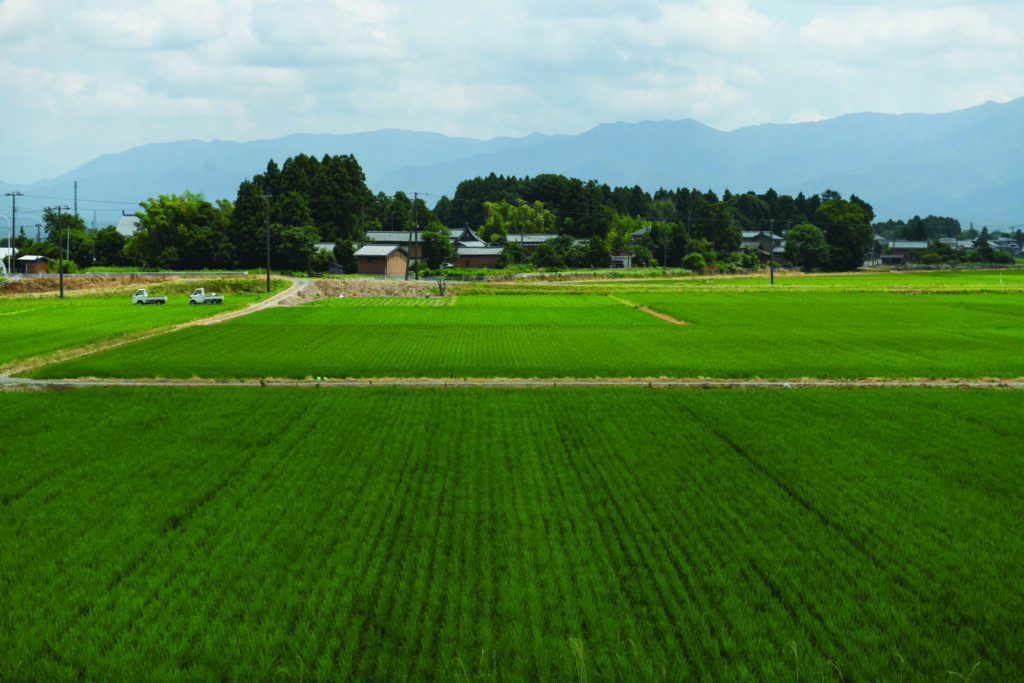
Last July I accompanied Gertsacov and his research assistant, Sam Flemming, on that trip. We spent a few days crisscrossing Honshu, Japan’s main island. Our first stop was Niigata City, a city about 200 miles northeast of Tokyo on the Sea of Japan. Masao Oda, the sixth-generation owner of Oda Pottery Works, a company that makes clay irrigation pipes for rice paddies, picked us up in his minivan and drove us for thirty minutes into the countryside with a Japanese game show blaring on his dashboard video console. We drove through the farmland for which the area is famous; the local koshihikari rice, generally considered Japan’s finest, is the variety coveted by sushi chefs the world over. We crossed the Agano River, one of two major rivers that bring soft water of low minerality from the mountains and flood the rice paddies before emptying into the sea, making this terroir so ideal for rice cultivation and clay deposits.
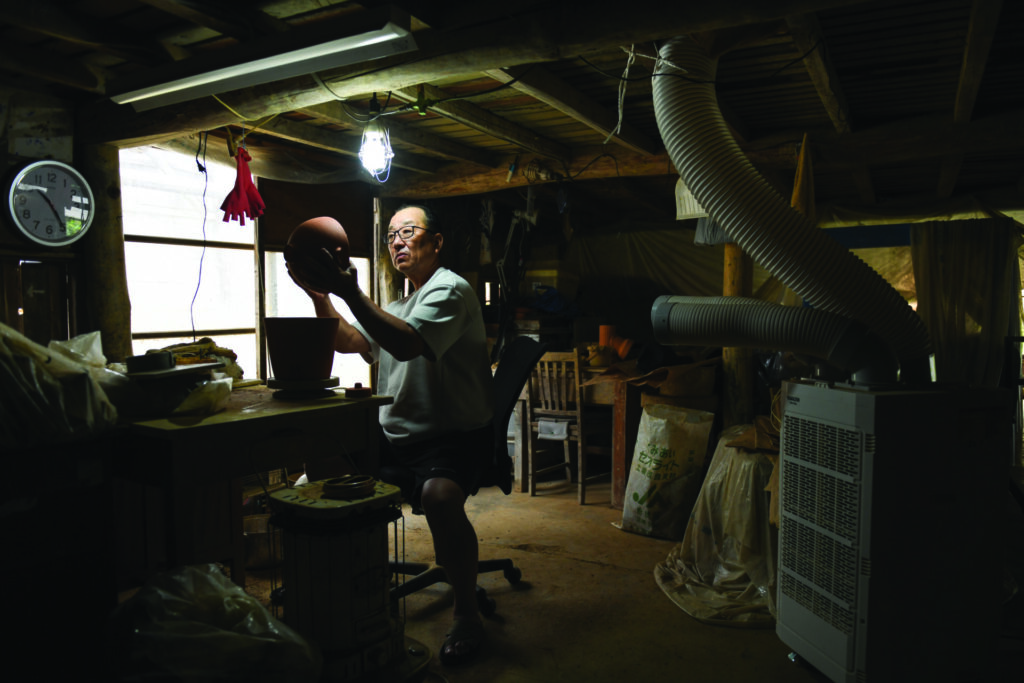
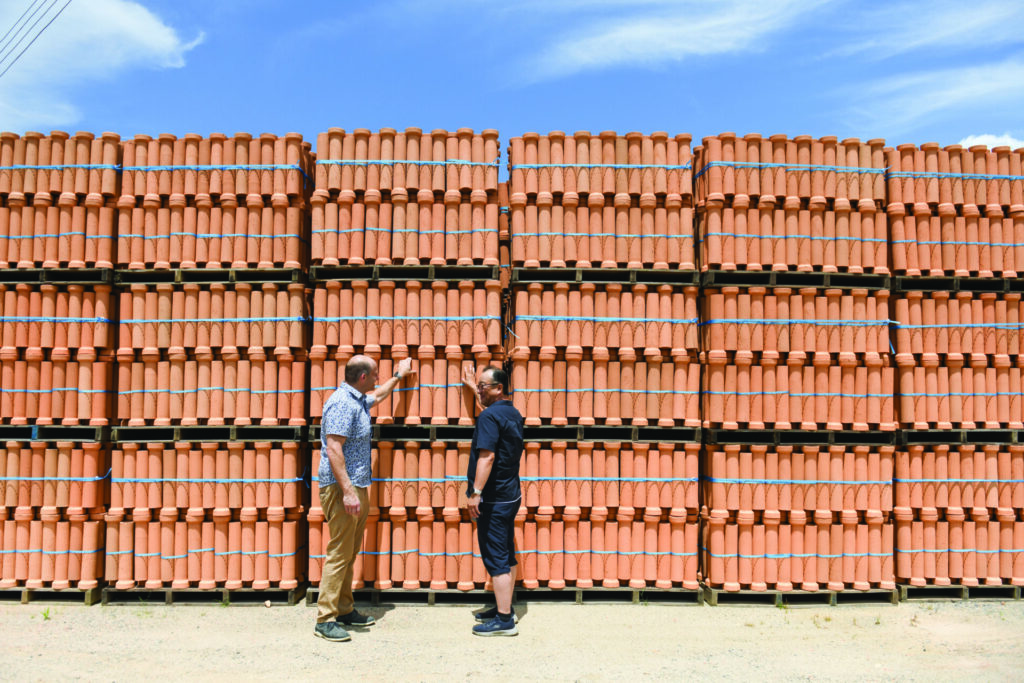
Oda-san explained all this to us during our visit. Founded by his great-great-great-grandfather in 1873, the rambling Oda Pottery Works facility wore its history like a pair of old coveralls. Pallets of clay pipes lined the driveway like a barrier wall. To one side, in a partially covered ditch, stood a bunny slope of unprocessed clay. The sprawling but decommissioned original structure held a collection of retired machinery. Behind a vaulted brick door lay the kura, an old-fashioned storehouse designed to resist flood and fire. When he was a child, Oda’s relatives found a mushikamado inside.
His grandmother knew what it was; she had seen her own mother use one at the estate where she worked as a servant. They cleaned it off and put it to the test; the pot of rice that emerged from it was the best the young Oda had ever tasted. As he wrote later, “It was deeply aromatic, slightly sweet, and each grain had a distinct, delicate flavor.” The vessel, and the rice it produced, remained in his memory.
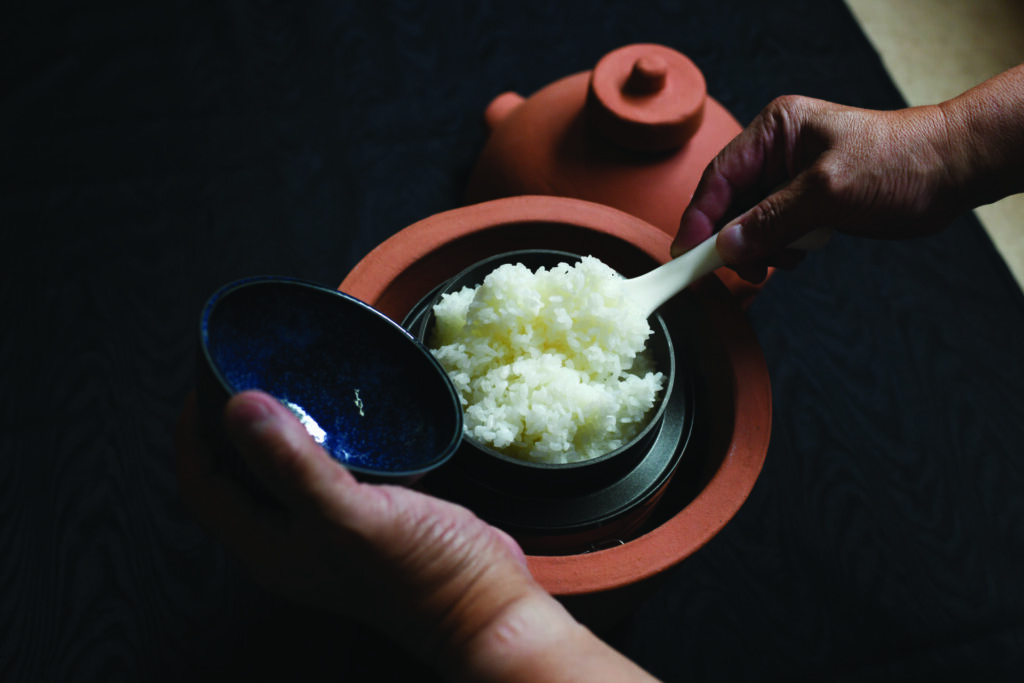
In 2010, he began producing mushikamados as a side hustle. He led us to an open-air ceramics studio, where a worker put the finishing touches on one fashioned from rough terra cotta. She hand carved the company’s turtle logo—half on the lid, half on the base— just before sending it to the kiln to fire. We then retired to the cluttered back office to watch one in action. Oda-san assembled the various clay pieces of the mushikamado, which stood forty-three centimeters tall. He slipped a puck of solid fuel into the firebox on the bottom, wedged a pot of rice into the base, and finally twisted the domed lid on top so that the two halves of the turtle logo aligned. “Twenty-three minutes, we wait,” said his translator. Waiting for rice to cook is only slightly more exciting than watching paint dry. The talk started small and only got smaller. Finally, the timer dinged, and Oda-san scooped rice into polystyrene bowls. It was tender, springy, truly the best rice imaginable.
In the 2010s, Oda began selling his mushikamados to high-end restaurants and to the area’s many hot-springs hotels, which draw tourists from all over Japan for communal baths and gourmet seafood meals. After our visit to Oda Pottery Works, he took us to dinner at Chihara Rokusuke, a Niigata City restaurant where the chef, Kento Hayakawa, kept two large charcoal-fired mushikamados behind the counter as showpieces. Two women coming in from a street festival dressed in kimonos posed for selfies in front of them. The meal culminated in the presentation of a lidded pot from the mushikamado, opened at the table with a flourish of fragrance and steam. Inside was tomorokoshi gohan—a mixture of the best local koshihikari rice, sweet corn, and cultured butter. If a pot of steamed rice could make adults weak-kneed, this was it.

Kamado means oven, and for centuries in Japan, the word signaled a bulky, built-in hearth. Rice cooked this way, over a direct heat source, creates another by-product: a scorched bottom crust, called okoge. Many rice cultures, such as those of Korea and Iran, celebrate the crust as the prize of the pot. In Japan, not so much.
A young inventor named Kanekichi Kokaji came up with a solution inspired by the small lidded ovens he saw in silk factories to keep silkworm larvae warm. In 1924, he presented an enclosed clay oven fired by charcoal at a housewares show in Fukushima Prefecture, near Tokyo. He coined the name mushikamado, combining the words for “steam” and “oven.” He designed it with a clay insert that could hold a hagama—the traditional vessel consisting of a steel or ceramic bowl with a heavy, tight-fitting wooden lid—in its center. The heat circulated up and around it and then maintained a constant temperature in the dome once the top was covered. It worked like a convection oven, used far less charcoal than conventional ovens, and produced pots of rice that were fluffy all the way through without any crust. The mushikamado was also portable—a boon to homemakers in eastern and northern Japan who still cooked over sunken hearths in the living room.
Working with relatives, Kokaji secured a patent for the mushikamado in 1930 and went into sales mode. Their company, Kokaji Shoten, placed newspaper ads that touted the cooker’s beauty of design and its ease of use. In bold characters, the ads proclaimed: “No okoge!” and “Beware of Counterfeits!” As word spread, Kokaji Shoten formed a collective of small, family-run pottery studios in areas rich in baka-tsuchi: “stupid clay” that was porous and highly plastic, making it terrible for dishware but great for high-temperature cooking.
For several years, the mushikamado enjoyed a kind of Veg-O-Matic popularity. It was a gadget before gadgets; an affordable and handy invention designed to ease the home lives of hardworking families. After a strong debut that saw the openings of dozens of manufacturers, domestic sales declined with the onset of World War II.
As a last-ditch effort, Kokaji Shoten set up near military installations, so that Japanese servicemen could buy and ship mushikamados home to help ease the burdens of wartime.
Two events of the early 1950s set this story forward, edging us closer to today’s Big Green Egg. The Weber Grill debuted in 1952, making the outdoor patio a locus for dinner in typical middle-class homes and giving men a role in meal preparation. There had been stationary barbecue pits and outdoor hearths, but smaller, portable grills didn’t come into play until the advent of mass suburbanization. “It’s that whole white-picket-fence time,” Gertsacov says. “Mom’s cooking on the inside, and Dad’s outside with hot dogs and burgers.”
Meanwhile, in Japan, Toshiba debuted the first electric rice cooker, and the domestic market for mushikamados disappeared with a resounding poof.
An alternative market emerged. The formal occupation of Japan ended, and a new alliance was forged, one that gave America full control of military interests in the region. Servicemen arrived with their families, and Yokota Air Base near Tokyo began to look like a suburb, with detached houses surrounded by grassy yards. Shopkeepers who had noticed American families barbecuing meat outdoors—something that would never happen in a Japanese home—saw a way to offload the surplus of mushikamados that had previously been sold to their countrymen. They simply replaced the hagama with a grilling rack and, by at least one account, enticed passersby with a whole baby pig cooking inside.
For several years, the mushikamado enjoyed a kind of Veg-O-Matic popularity. It was a gadget before gadgets; an affordable and handy invention designed to ease the home lives of hardworking families.
Akihisa Miyazaki, a representative of one such shop, Kikuya Shoten, described the scene in an email to Waseda University cultural historian Hiroto Yano: “There was an entrance to [Yokota Air Base] across from our building. Many of our customers were foreigners. They came to purchase Noritake tableware but also mushikamados. We delivered many daily. Americans called it a ‘barbecue pot.’ Housing inside Yokota had large yards; it seemed that almost every home had a mushikamado.”
As these servicemen discovered, the Webers from back home did well enough for char-grilled weenies, but they came to prefer the Japanese barbecue pots for chicken and ribs. They used comparatively little fuel, distributed heat evenly, and maintained a calibrated temperature. Their dampers controlled the heat, and the clay walls held it.
During the 1950s and 1960s, the United States Air Force sent supplies to Yokota in Douglas C-124s—massive cargo planes capable of carrying Jeeps, ambulances, jet engines, generators, and even helicopters. Their pilots were the first to start transporting mushikamado “barbecue pots” back to the States in the otherwise empty cargo holds.
Bill Litty, a retired salesman for a freight company, remembers one such pilot who retired and went to work for his father, who headed the
aviation team for Southern Airways out of Memphis. Shortly after joining the team, he gifted the family an orange kamado grill that he brought back from Japan, one of many. “This was back in the early sixties, and I was seven years old,” Litty recalls. “It came from Yokota, packed in this wooden crate with rolling wheels.” His father, Bill Sr., cooked chicken on it until he didn’t.
“It was just sitting in the backyard until about thirty years ago, when I was visiting and said, ‘Dad, let’s cook some chicken.’” His father gave it to him that night, and it followed him as he moved his family around the country for his work. “Whenever we’d relocate, I’d tell the movers that I don’t give a crap about the china, I don’t give a crap about the furniture, but this thing right here—don’t break it.”
Owners treated these early Japanese imports with the care they’d afford family heirlooms. Elise Garner remembers when a member of her family’s church in Panama City, Florida, a retired serviceman, bequeathed a kamado to her family that he had owned for thirty years. “At first we had to figure out how to cook on it. It had that vent on the bottom to move the air and that little round hole on the top where smoke and air could flow.” They used it weekly for another twenty years, until it started to crack.
Without such care, these clay vessels were prone to breaking; it didn’t help that the C-124s rattled and vibrated so much in the air they were nicknamed “Old Shaky.” By some estimates, as many as half the kamados they transported were cracked by the time they arrived. Some American kamado enthusiasts began to wonder: Could the grills be designed and manufactured at home? Richard Johnson, who claimed to have encountered mushikamado smokers as a pilot in Japan, was first out of the gate with a design patent in 1965 that looked almost identical to the one issued in Japan thirty-five years earlier. The same year, Farhad Sazegar, a flight engineer for the Flying Tigers (a group of US fighter squadrons in wartime Asia), secured a utility patent, which gave him rights for the mechanics and functionality rather than the appearance. He made a few design tweaks—introducing a hinged lid, for instance—and began importing baka-tsuchi clay to produce Casa-Q kamados in California.
The Kikuya Shoten company, meanwhile, had found a more direct route to the US market. Rebranded as Imperial Kamado, the grills first began showing up in a California shop called Pachinko Palace that primarily sold the upright pinball game, which was having a moment. The owners of Pachinko Palace had become enamored of the mushikamado, as people do. (One, a former pilot, had been instantly smitten when he saw them on a tarmac in Japan). They were looking to expand throughout the country and, through a mutual friend, heard about Ed Fisher in Atlanta. Fisher had recently been laid off and was looking for a new venture. They offered to set him up in the pachinko business with one provision: He had to sell the Imperial Kamados too. Fisher had no idea at the time that he was in a race—not a sprint but a marathon—nor that he’d win it.
In 1974, Fisher opened Pachinko House in a strip mall just off Buford Highway in Atlanta. The pinball games sold well leading up to Christmas but then sales dropped off, so he tried to move the kamados. His solution: grill chicken wings in front of the shop to lure people in. “I didn’t have a background in cooking or barbecuing. I just took the chicken wings, made sure they were properly washed, and put them on the grill,” he recalled. “Interestingly enough, doing nothing at all, they tasted great.” He sold a grill that first day.
Fisher and company weren’t the only retailers of kamados. A half-dozen Japanese manufacturers found distributors, and they began showing up in Sears department stores. Casa-Q flamed out, but Richard Johnson continued to tinker with the kamado design. Could they be gas powered? Could they be made of cement covered in ceramic tiles?
By the mid 1980s, Japan’s “bubble economy” had so driven up the value of the yen that Fisher realized he’d have to manufacture kamados himself if he wanted to keep selling them. First, he’d need to locate a kiln large enough to fire a 500-pound clay pot. He found one in Taiwan and settled on a shiny green glaze, distinguishing it from his competitors’ shades of red, orange, and tan. He took out ads in the Atlanta Journal-Constitution, and, as he has often told the story, he and the ad rep decided they needed a more memorable name than “Kamado Barbecue Grills.” It was big. It was green. It looked like an egg. The rest is history.
By the end of the decade, Fisher began to reconsider clay. Too many Eggs Humpty Dumptied during shipment, arriving broken and cracked. He needed a manufacturer for replacement parts that wouldn’t necessitate overseas shipping. Material scientists at Georgia Tech suggested a trip to Monterrey, Mexico, where local factories were at the cutting edge of high-heat-resistant refractory ceramics. Fisher literally knocked on doors, looking for a partner. When he arrived at Dal-Tile, they suggested making not just parts but the whole Egg.
Big Green Eggs became a fixture in middle-class Atlanta backyards, and at dinner parties people swapped stories of all-night pork butts cooked on the Egg. They’ve always been a bougie luxury: Today, a large Egg (the size that can just fit a turkey) retails for about $1,200, while a Weber kettle grill costs about $200. But Fisher offset the investment by offering a limited lifetime guarantee, which the company still does. An Egg is not a simple tool; it’s a relationship.
Atlanta gave birth to two more ceramic kamado producers, Kamado Joe and Primo Grill. A kamado grilling subculture began to emerge on online message boards, where grillers obsessed over materials, history, brands, accessories and so many instances of chicanery in the resale market that one of the most active boards bore the name “Kamado Fraud Forum.”
“There’s a lot of weird acrimony about all this,” said Rick Holcomb, who bought his first Richard Johnson–made kamado at a camping store in Fairhope, Alabama. “As far as I’m concerned, you need an adjustable hole on the bottom and top, a spot for coals, and a grill in between, and you are ready to cook.”
The setup is simple, yet it obsesses people to no end.
Big Green Egg’s headquarters since 2015 is visible from I-85. In front is a shop filled with branded hot pads and hoodies along with grills and accessories, everything green. To one side is a two-room “museum” filled with vintage kamados and black-and-white photos. To the other lies a test kitchen and conference room where the company can entertain distributors, and beyond that lies a decked patio that could only be here: Eggs upon Eggs (twenty in total) but few places to sit.
Every week, Gertsacov conducts a “lunch and learn” with the whole team. “Everyone on the team, no matter what they do, needs to be an EGGhead,” he said. I attended one such lunch and learn last spring, before our trip to Japan. On that day, the Eggs had all been outfitted with the wok accessory, basically a ring set over the fire to hold a blazing hot wok. Chef Taylor Carroll had scoured the nearby Asian grocery store for ingredients and filled the expansive test kitchen counter with every foodstuff that could possibly go into a stir-fry. I joined the staff and assembled a plate for my stir-fry, heaping it with raw shrimp, chow fun noodles, snow peas, bean sprouts, Thai basil, and chili soy sauce. The cooks on staff helped the employees navigate the woks, some of which had superheated to over 600 degrees. One woman screamed for help as the flames darted above her head. My stir-fry also came out incinerated. Gertsacov looked at it dubiously and suggested we go out for lunch. At a Chinese restaurant, he told me about the mushikamado and the history he had been piecing together.
Kamado Q’s showroom in Nagoya lies discreetly behind a privacy wall with the kanji for kamado printed over a wooden doorway. Hisashi Kato slid open the door and greeted us effusively with an ear-to-ear smile. Foreign chefs and expats love the grills, but Japanese home cooks have proven elusive. People in Japan grill indoors, usually threading small cuts of meat onto skewers that cook hot and fast. Backyard gardens in Japan are small—places for quiet contemplation, not sizzling burgers. Kato aims to change that.
Just inside the door is an area called the Maple Garden Studio, set up to look like a suburban American backyard, with a terraced patio and several kamados built in. Guests come for classes and demonstrations.
“Mushikamados have been out of fashion for nearly seventy years,” Kato told us. “We’re trying to spread awareness.” He explained the history and mentioned the hugely popular 1992 comic book Shota no Sushi, whose teenage sushi-genius hero has a vintage mushikamado. He pointed out that Kei Kobayashi, a national hero since he became the first Japanese chef in France to earn three Michelin stars, uses a kamado. Here at the Nagoya showroom, Kato encourages prospective buyers to bring their own food and take one for a test drive.
“After actually using it, I saw that it was more relaxing than Korean-style barbecue,” writes Tsuyoshi Kozuka in an email. He bought one for his parents’ garden, where it admittedly sits decoratively most of the year but gets fired up for special occasions such as the Obon summer festival and New Year’s Day.
Kato led us up a flight of steps cutting through a hillside garden until we reached a 100-year-old pavilion with sliding doors and a large tatami mat room. At the entrance was a small museum of historic mushikamados from all over Japan and an alcove with a small shrine to the Big Green Egg. There, Kato recounted his epiphany.
In 2015, he attended the World of Concrete trade show in Las Vegas for his work as a flooring contractor. There, in a parking lot, he ate some ribs grilled on an Egg and was gobsmacked when the cook explained to him it was called a kamado. He went home and researched the history of Big Green Egg and connected with Hiroto Yano, the Waseda University scholar who had just completed his masters thesis on the mushikamado. Together they snapped the two pieces of the story together, like a lid and a base. He began manufacturing kamados that year with this thought in his mind: “You have been chosen by the god of mushikamado. If you don’t protect it, the gods will be angry.”
After a lunch of kamado-grilled duck breast, Kato cleared the tatami room to set up all the ancient mushikamados along with all the shiny new Kamado Qs and Big Green Eggs for a group photo, an important ritual following any gathering in Japan. When asked if the kamado today was more Japanese or more American, Kato thought and said, “I agree with the Big Green Egg philosophy. I’m in this business to try to connect and unify people.” And with that he asked everyone in attendance to don a plastic cowboy hat, strike a thumbs up, and say cheese. The circle had been completed.
John Kessler is the dining critic for Chicago magazine. Jon Waterhouse contributed additional reporting for this story.
SIGN UP FOR THE DIGEST TO RECEIVE GRAVY IN YOUR INBOX.