
Object Permanence Our kitchens store our histories and feed our sense of belonging.
by Martin Padgett
Photos by Daniel Fishel
“Why do we need five of them?”
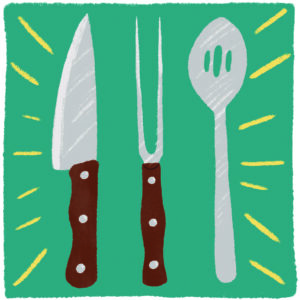
I get so exasperated, having to shuffle through every drawer to find the one that works best. The one that cuts through a sheet of paper and the food I need to prep, and once, in spectacular fashion, my own hand.
“Really? Five?” It falls on ears blessed with selective hearing.
I don’t need five knives, I need one. Parsimony has too many letters. I live in shorthand. The pen I prefer; the sole notebook for the occasional word written instead of typed. A fleece jacket I wear everywhere. Four gym shirts that get laundered into oblivion and tossed out in a year when they no longer hold up under heightened scrutiny.
“That one stays sharp,” he answers, pointing to the knife sleeved in cardboard and Scotch tape by his father.
“And this one’s for watermelon,” he says, raising the scabbard with a pirate’s menace while it swashes and buckles through the air.
Each had been handed down for a reason. To me, they were clutter. To him, they had earned immunity.
“Can we at least donate this one,” I flustered, “and this one?”
He paused. To him, they’re not tools, they’re dowry. Throwing out any of them would betray the past. Then he would begin to forget, just as his father had.
I worked in archives for most of my career, but it wasn’t until I shared a home with my husband that I learned how we live in them too. The clutter, the books, the art works, the curated ephemera of a life lived instead of the one planned or hoped for: They all take on meaning that transcends their material and purpose.
The kitchens of the past
When I relented, I began to understand how the kitchens in my own past and the tools in them could trigger scenes deeply buried.
I felt unsafe when I ate in my grandmother’s kitchen, in a newly invented suburb on the awkward frontier of Maryland, where North and South both leave unmistakable traces. It wasn’t the generic cans of oysters Granddad would down, one after the other, or the saltines my grandmother ate only after every hole and corner had been spackled with butter. It was the hovel that engulfed it, as her grandchildren took over her life every day for a decade, an unclean refrigerator, foodslop left to cure on the stove. I only ate cereal and harbored suspicions about the milk. But in the mess, her aluminum stock pot meant Thanksgiving and enormous yeast rolls made with lard. I can see every scratch in the metal, though I haven’t seen the pot since college.
I worked in archives for most of my career, but it wasn't until I shared a home with my husband that I learned how we live in them too.
That memory offers more than I know of my father’s mother. Since she died when I was not yet four, I mostly remember her through pictures. When I smell onions, I think of the sandwiches she was forced to eat by neighbors who had taken her in during the 1918 influenza epidemic. Many believed the vegetable would ward off the disease, which had already claimed her father and had left her orphaned to neighbors at thirteen.
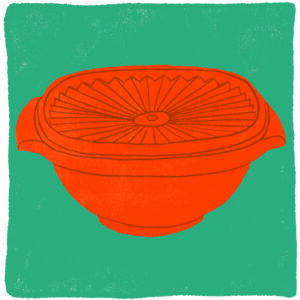
My parents kept a spotless kitchen though they both worked. We ate at a table my father cut from heart pine and wood-burned to a warm brown, in a room near their bedroom, in a half of the house they had built on rather than uproot us. Orange Tupperware canisters filled the kitchen’s dark, Amish-made walnut cabinets. Those canisters became prey. My sister and I could creep in stealth, past their bedroom door, open the cabinets and free the Tupperware for Saturday Night Live snacking. We knew how to avoid the squeaky betrayal of a single peel-and-stick floor tile by timing our steps during Dad’s snores.
The prized heirloom from that kitchen lived in a dovetailed drawer: the Shaky Knife. It had been dropped at some point, and inside it a metal fragment created a percussive rattle. Instead of banishing it, we celebrated it. That knife became the subject of turf wars and hallway races that ended at the cutlery drawer. She or he who ate with the Shaky Knife dined with the gods, or so we thought.
Child-like tendencies
We are not alone as we put those utensils, containers, and memories in our personal repositories. Julia Child’s entire kitchen has become a piece of our collective. And as it turns out, Child’s connection to Washington, DC, was as strong as my own. She worked in a predecessor to the CIA in the 1940s and tested recipes for Mastering the Art of French Cooking from her Georgetown kitchen. Only a few blocks away and a few years later, my mother gave birth to me at the hospital where she had been born, where her mother had been born, not far from where an ancestor had haggled with George Washington over the price of family land, which later became the White House’s front yard.
Decades later, Child’s kitchen from her home in Cambridge, Massachusetts, would be transplanted entirely to DC—to the National Museum of American History, where it remains on display. Curator Paula J. Johnson, author of Julia Child’s Kitchen: The Design, Tools, Stories, and Legacy of an Iconic Space, writes that Child brought with her from France to Cambridge a huge variety of hardware: She was “a self-avowed knife and gadget freak” who assembled the pans, bowls, pots, and serving ware that would grace her TV show. Her batterie de cuisine included favorite tools marked with a j so that her own implements would follow her when the show was done—Moustiers bowls, Norwegian wooden chairs and a table, French food mills, and pestles with mortars.
Like other migrants, Child tried to maintain food traditions as they sustain people through transition and resettlement. Serving vessels in particular serve a higher purpose; ceremonial ware transports the ceremony to a new and different world. Of course, the nonmaterial has its place too, Johnson says: “Food-related cultural knowledge is always brought along and doesn’t take up any space.”
The science of consumer psychology affirms this outsized value we place on material goods. Our brains connect our possessions with our sense of self-worth and our ability to be loved by others, studies have shown. A cooking vessel passed down through generations comes with all sorts of encoded messages about who loves us and how we love them in return.
Johnson herself hangs on to her mother’s pickle dish. “I was put in charge of arranging pickles and olives whenever we had company over, and, although I don’t use the dish now, I cannot bear to part with it,” she says. It’s kin, then, with the flame-orange fondue pot that sits in our pantry, waiting for the Gruyère that I wouldn’t even discover until my first trips abroad.
A nation of immigrants
When I left my first home, the one my parents had half-built, I took almost nothing with me. Most of the Crock-Pots and electric can openers and Colonial-patterned stoneware still was in use, and I had no place or money to bring them along.
Like millions of Southerners, I am an immigrant, one with roots in the English Midlands, the Scottish Highlands, and Lapland. Most of us are relatively new here, just a generation or three removed from somewhere else. The South has gained 100 million people in a hundred years, growing more quickly than even the West. We’re a country inside of a country, whether we came here from a reversal of the Great Migration, from in-migration from the North, or from a place beyond political borders.
Sometimes we can’t afford to bring our memories with us, whether we come from Washington, or Minnesota, or Ghana, or Ukraine. They may be the easiest things to carry with us, but we can’t always keep the blackened baking sheets or mismatched wine stems. It sometimes is too simple to replace them with regret.
I would move through a baker’s dozen of homes, from New York to North Carolina, from Michigan to Alabama, before I settled down in my second home of Georgia. Each time, I had to decide what would make the next leg of the journey and what would not. I grew more callous and ruthless with each move, buying myself off the karmic hook with more expensive replacements wherever I landed. I had survived my early life alone on flatware and a set of cornflower dishes bought at an outlet mall for eight dollars. When they finally left, I thought I’d arrived.
Ours, but not ours alone
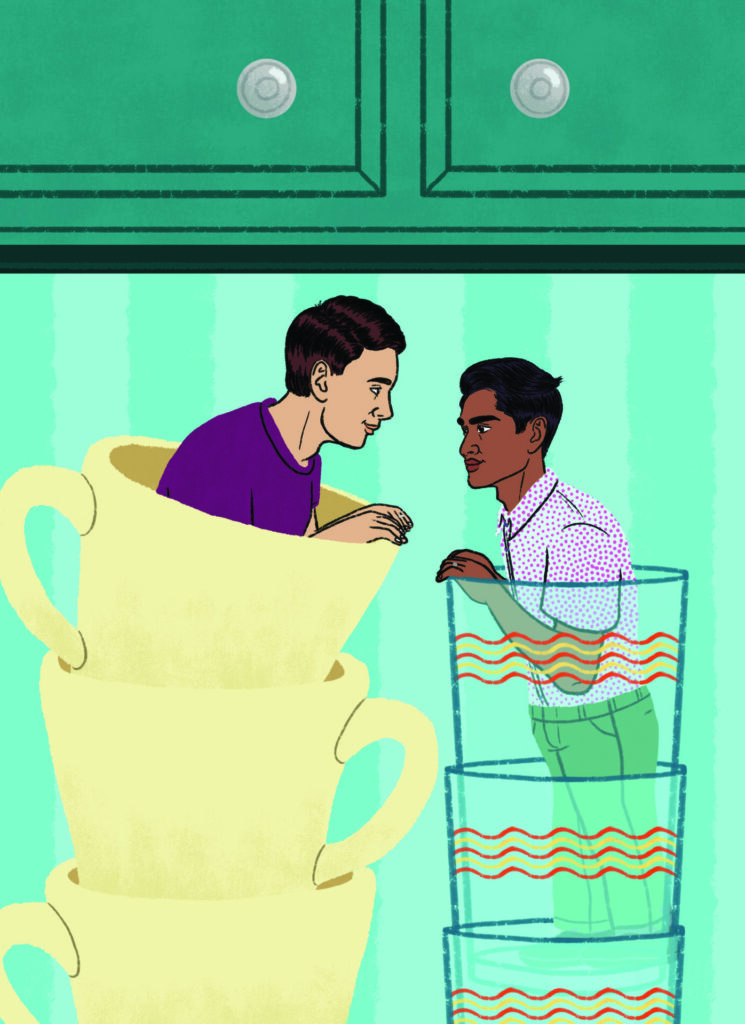
I met my match in Atlanta, someone whose family kitchen heirlooms weren’t fought over or stolen. His family’s birthright cascaded over him in the form of silver gravy boats and pink Depression glass and highballs frosted with state flags, an Expo 67 Montreal shot glass as a chaser.
Before we could marry, our homes had to. In his kitchen, which became mine, too, the cobalt-blue tile counters were shallow and short. There was just enough room for the raucous crowd of friends that rang in the New Year during our honeymoon phase, beneath a dense canopy of tall men and a hedgerow of smaller women beneath. But it didn’t carve out much space for his collection or mine. His aunt’s china was stacked perilously in a glass-fronted cabinet left behind by the owner before, who couldn’t take it with her either.
By the time we grew into a larger home, the kitchen gained its own partner—a pantry with a wall of shelves staffed with chafing dishes and slabbed in the same Alaska White granite. The archives grew weeds—cast-iron skillets for frying chicken and baking upside-down Bananas Foster cake, an enameled cast-iron pot that sends fragrant steamed spice water around the house, a half-dozen crumb-catchers and wine openers lifted from table-waiting jobs, and a ramekin for every occasion, of similarly dubious origin. We served hundreds on New Year’s Day with every available plate and utensil and washed them for days after. This kitchen didn’t always have a theme, but it had an undeniable zest. It knew how to party.
We wrote new family memories at that house, and around my sister-in-law’s table nearby, and out in the suburbs with my in-laws. The night my mother-in-law died, we sped eighteen miles in sixteen minutes by car to get there too late. From the driveway I could see my sister-in-law as she stood in the kitchen, near the cabinet where an Army-green tin hoarded family recipes, silhouetted and framed in the lower right of the picture window, like a long-lost Edward Hopper painting.
Curating a present
We’ve migrated once more since then, from a big city to a small beach town on the Florida Panhandle. Our kitchens condensed over time, and we delisted some of the museum-quality pieces: Depression glass bowls with equally glum lids, done in incongruously cheery pink; silver serving pieces of a dozen different genealogies; a large platter that doubled as our Venus Rosewater Dish, held aloft when we’d won a particularly grueling league-tennis match.
I put myself in charge of the culling. It was easy to box the pieces we knew had to come with us, like the thin-rimmed bowls I’d thrown myself; harder to imagine the space where they’d live in a home half as small. The edge cases haunted me. Do these things matter at all? I wondered. I moved china five times that once belonged to women I never knew, and each time I blinked. What if I gave away a birthright?
The difficult decisions got easier when I began to put a face or a moment to them. I gave no quarter to the stamped-steel forks from five different patterns, sourced from God knows where. I tucked the green recipe tin and the family china safely aside.
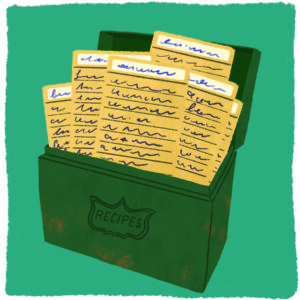
Today our core memories remain. We fill my in-laws’ Christmas mugs with coffee from the percolator they received as a wedding gift before Kennedy took office. Their pristine, platinum-rimmed wedding china nestles in a vintage bar cabinet. That Army-green recipe tin? It bears the secret codes for Welsh cookies and sauerbraten and no-bake chocolate treats from a Nana I know only from the photos my husband lingers over. It lives in my office—our library—right next to Julia Child’s cookbooks.
The pieces that have gone missing, like the aluminum stock pot, still course through the kitchenverse somewhere, I’m sure. Object permanence dictates it.
Meanwhile, the Noritake positively gleams next to buff linen napkins brought by dear friends for dinner one summer, whenever we serve the latest additions to our family of choice from the history of us. Every morning, that old orange Tupperware offers me my daily protein shake fix, silently clocking me as a third-wave gay. The totems that remain fill the gaps in our memories. They’re unconventional tools of kintsugi—the Japanese art that uses gold filigree to repair broken vessels.
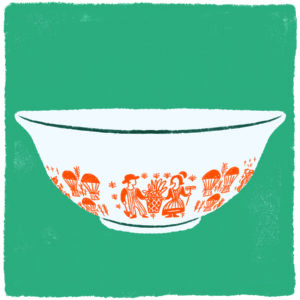
In one knee-high cabinet across from my kitchen sink, my mother’s butterprint Pyrex sits on call. It held the batter for my ninth birthday cake, with aqua-blue icing and cowboy-themed hard-candy studded on top. That bowl survived sixty years intact when nothing else could. Now it helps when I get the urge to roll out Finnish korvapuusti or to mix a white box cake for a berry trifle. I can lift out the big bowl and be small again.
When I got the Pyrex butterprint bowls on a trip up to Maryland, I gave up on a lifelong quest to own that other archival lodestar from my past. The Shaky Knife still sat in a drawer, in a house I never lived in. Its cornflower-stamped handle still rattled like the Latin percussion sounds I’d played during a childhood stint in a marching band.
I lifted it, more than once, before I put it down for good. I’d played a long game, and taking home the butterprint was a victory all on its own. Not every memory needed to be mine alone. This one had to go to my best and favorite rival, even though her own kitchen overflows with a career’s worth of cookware and a sourdough starter I named for her: Gluto, because it goes great with olive oil.
So, I relented.
you can have the shaky knife now, I texted my sister into our family group chat, going on the record.
omg i finally win! she cheered. on my way to grab it!
Did she really win, though? I think I let her have that one. We all need some reminder of where we are from.
Martin Padgett is the author of A Night at the Sweet Gum Head and The Many Passions of Michael Hardwick. He previously wrote about Atlanta’s queer food history in Gravy in 2020, in “Your Fried Chicken Has Done Drag.” He and his husband live in Pensacola Beach, Florida.
SIGN UP FOR THE DIGEST TO RECEIVE GRAVY IN YOUR INBOX.