
Seeding Climate Resilience How seed savers across the Southeast are preparing for an uncertain future
by Holly Haworth
Illustrations by Hannah Bailey
If you’re part of the local food movement, you might relish the fact that the perfect summer tomato you’re slicing was grown by the farmer down the road, or even in your own backyard. But what about the seed from which that tomato grew?
Chances are, it came from far away.
“It’s hard for our farmers to access Southern-grown seeds, because most of the seed industry is in the Pacific Northwest,” says Chris Smith, author of The Whole Okra: A Seed to Stem Celebration and founder of the Utopian Seed Project in Asheville, North Carolina. And that’s a problem, he and other farmers across the region believe—especially as our climate changes more drastically.
“Seeds have the ability to change and adapt over time,” Smith says. “As soon as you recognize this, you can start working with those seeds to adapt them to where you’re growing. But because we’re currently living in a farming system where our access to seeds isn’t regionally appropriate, we then have to modify the environment to suit those narrow seed genetics.”
This means using chemical interventions, including fertilizers, herbicides, pesticides, and fungicides. Even drip-tape irrigation and row cover, Smith argues, are environmental modifications that become necessary when seeds are not well-adapted to the place they are growing—its unique soil, resident pollinators, pests, diseases, and local climate. “If you give time and space for the seeds to learn [where they’re growing], they need less of those external inputs, and you can grow seeds in a more environmentally sustainable way,” he says. “We see that in nature, in wild ecosystems, all the time. They don’t require all these inputs, because they’ve had time to adapt to the place they live in. We just don’t give our seeds that same opportunity.”
A robust local seed system, then, as the foundation of a local food system, is key to climate resilience in agriculture. Beyond not requiring seeds to be shipped from other bioregions of the country for planting every year, it also enables farmers to grow food less resource-intensively and, potentially, to gain higher long-term crop yields.
To save seed for future plantings, farmers and gardeners allow a portion of their crops to go to seed. Some species’ seeds can be left to dry on the plant, while others must be dried out after harvesting. They can be saved by growers on any scale. Household gardeners, for example, might save handfuls and store them in baby-food jars, while large-scale farmers might save bucketsful and use mechanized equipment like threshing machines. Unless they are frozen, most seeds are viable for only a handful of years. (And even though freezing seeds extends their viability to several decades, it also means they become “frozen in time,” unable to continue adapting to climate changes, as Smith argued recently in The Guardian.)
"Seeds have the ability to change and adapt over time. As soon as you recognize this, you can start working with those seeds to adapt them to where you're growing."
With increasing heat and drought, it’s more important than ever to ensure that seeds are saved in the region—and it’s also important that the highest diversity possible of traditional varieties are kept in circulation.
While thousands of varieties of food plants were lost throughout the twentieth century as agriculture became industrialized and large seed companies rose to prominence, the United Nations’ Food and Agriculture Organization (FAO) reported iseeds n 2022 that the decline continues. “The biodiversity of our fruits and vegetables is depleting at an alarming rate with devastating effects on the future of our food production,” the report stated. “Diversity is our food’s life insurance.”
In the French Broad River Valley, northwest of Asheville, the Utopian Seed Project grows trials of varieties of crops like okra and collards, observing genetic characteristics. It has a small creekside plot with unusually sandy soil for the mountains, and another plot on a windy, isolated hilltop. When the organization planted twenty-one varieties of collards in 2020, they watched to see which individual plants of all the varieties survived frigid February temperatures, then later that summer allowed those hearty plants to flower, cross-pollinate, and go to seed. The resulting Utopian ultracross collard seeds now hold a rich spectrum of genetic diversity that has demonstrated survivability in extreme cold (which had followed a freakish February warm spell).
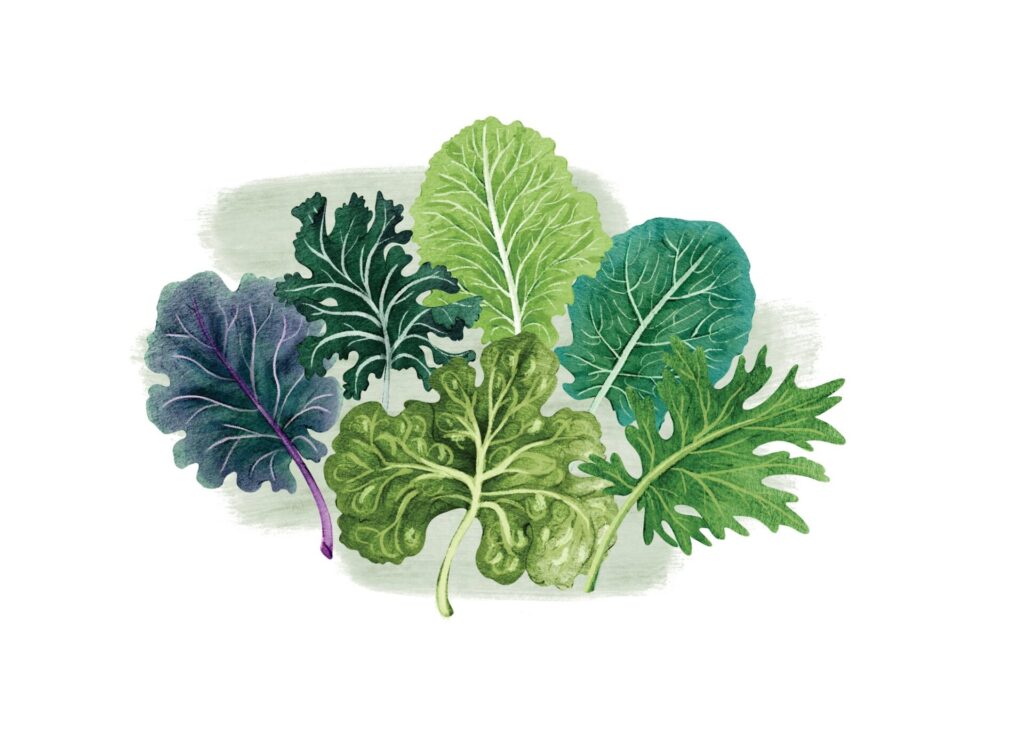
The seeds are listed in this year’s Southern Exposure Seed Exchange (SESE) catalog along with nineteen heirloom varieties such as Alabama blue, Big Daddy greasy green, Granny Hobbs, and Lottie collards. Some are bright green to yellow in color, some are deep green with white midribs and veins, while others are blue-green with vibrant purple midribs and veins. Some are frilly and wavy-edged, while some are flat like fans.
Founded in 1982 by Jeff McCormack and Patty Wallens in Charlottesville, Virginia, SESE, with its tagline “Saving the Past for the Future,” has long held one of the most robust collections of heirloom southeastern seeds. Yet the collards in SESE’s catalog are only a portion of the more than sixty varieties that now make up a collection stewarded by the Heirloom Collard Project.
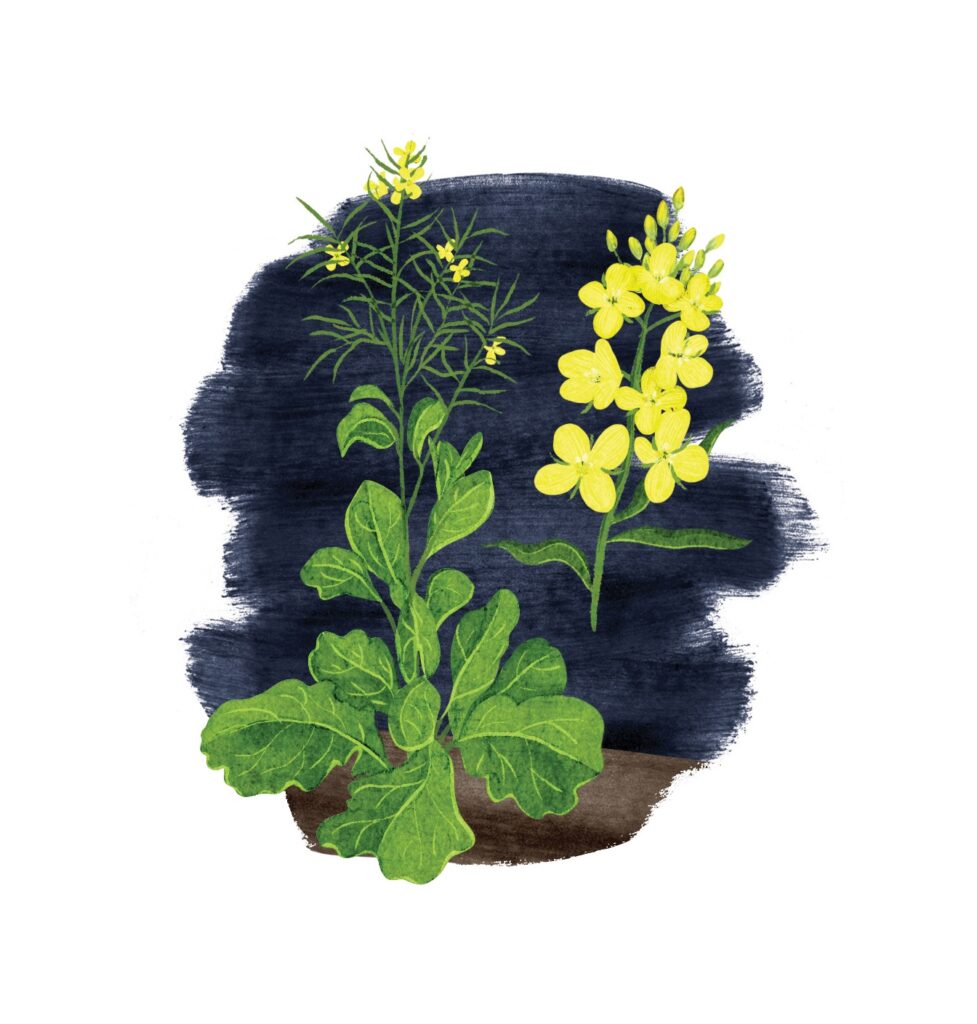 The Heirloom Collard Project was founded by Ira Wallace, a Black farmer and seed saver who bought SESE from McCormack in 1999 and moved it to the egalitarian, anarchist Acorn
Community Farm that she helped to found in Mineral, Virginia. As a young girl growing up in Tampa, Florida, Wallace learned from her grandmother how to grow mangoes and avocadoes, roselle hibiscus, and pecan trees. Later, in the 1960s, she traveled the world to learn about organic agriculture and seed-saving. For decades, Wallace has been a tireless organizer, educator, and writer working to preserve the heritage seed varieties and food traditions of the South. She received the Lifetime Achievement Award from the Southern Foodways Alliance in 2016.
A lover of collards, in 2015 she was inspired by the work of the geographers Edward H. Davis and John T. Morgan, who had just published their book Collards: A Southern Tradition from Seed to Table after several years spent collecting heirloom collard seeds and stories from household gardeners across the South. Wallace invited Davis to speak about collards at the annual Heritage Harvest Festival she had founded in 2007 at President Thomas Jefferson’s Monticello plantation in Charlottesville. Afterward, they assembled a team of “collard enthusiasts.” They acquired more than sixty of the varieties from the Davis-Morgan collection held at the United States Department of Agriculture (the ones of which there was enough seed to spare). In 2016, Wallace officially started the Heirloom Collard Project with a commitment to regenerating and making those sixty collard varieties available for future farmers.
Through their website and other grassroots efforts, the project invites seed savers to cultivate heirloom collards and save the seeds to bring them back from the brink of disappearance. It also invites “collard-loving folks” to grow collards, cook them, and share the stories of the varieties. Participant Amirah Mitchell, who farms in Pennsylvania, chose to steward the Moses Smith yellow cabbage collard when she learned it had been handed down by a Black farmer from Scotland Neck, North Carolina, where her grandmother Patty had grown up. She remembers eating her grandmother’s celebratory pot of collards every Thanksgiving.
“I thought, wouldn’t it be special if I grew a variety that came from the same area that my grandma was born in, and I was able to make a big pot of greens just the same way she made them? Finding a collard variety that came from the area where my grandma grew up was a really special thing for me,” Mitchell says.
“A central part of the Southern foodways tradition is collecting stories and sharing them,” Wallace says. Seeds and stories travel together, and so resilient local food systems must also do the crucial work of remembering traditional seed lineages, even as those seeds adapt to a changing climate. “We should feel proud of our ancestors,” says Wallace, “who worked with less resources and still produced abundant harvests.”
The William Alexander heading collard, for example, is from a seed shared with Davis by seventy-nine-year-old Black farmer William Alexander of Columbia, North Carolina. Alexander had saved the seeds all his life, he said, which were likely given to him by his father. He was drawn to the slight “heading” behavior of this collard, a growth pattern similar to cabbage, and selected for that trait when saving seeds through the years, hence the name of this collard. Too often, the seeds that Black farmers have saved through the generations have been ignored by industrial agriculture, along with their stories. As we work to protect diversity in our food system, then, it is crucial that we work to document and highlight the stories of the Americans who grew them.
Seeds and stories travel together, and so resilient local food systems must also do the crucial work of remembering traditional seed lineages, even as those seeds adapt to a changing climate.
Collards remind us of the biodiversity that grows from and is intertwined with cultural diversity. They are just one of many forms of a single parent species, Brassica oleracea, along with cabbage, broccoli, cauliflower, kale, Brussels sprouts, and kohlrabi. Each of these exhibits its own rich distinction thanks in large part to diverse lineages of seed-savers. “African American cooks deserve the lead credit for the diffusion of collards across the South,” Davis and Morgan write.
Because Black farmers and other farmers of color have had a more difficult time acquiring land historically, though, their seed lineages are at higher risk of being lost. If seed savers like Alexander don’t have descendants who own land or farm, preserving their seeds requires extra effort.
According to USDA data, just 1 percent of farmers in the United States identify as Black. (This data was removed from the USDA website as of January 22, 2025, but is archived on other sites.) In 2022, Feeding America reported that, “Over the past century, Black farmers in America have lost more than 12 million acres of farmland because of systemic racism, biased governmental policy, and inequitable social and business practices.”
Wallace says that many of the African American farmers who shared seeds with Davis and Morgan otherwise would not have been able to pass on the seeds they had saved for decades. That’s why she is working with Black, Indigenous, and People of Color (BIPOC) farmers “to help them find their place in the seed world” and hosted a BIPOC seed savers conference at Acorn Community Farms this spring.
She celebrates new germinations like the Ujamaa Cooperative Farming Alliance, whose mission is to increase the number of BIPOC growers of culturally meaningful heirloom seeds, advocating for more diversity in the 15 billion-dollar American seed industry. Its small seed company, Ujamaa Seeds, offers seeds produced mostly by Black and immigrant farmers in the greater DC area.
 Austin, Texas–based chef and food-policy advocate Adrian Lipscombe—who served as a culinary diplomat to the White House during the Biden administration—believes that chefs and restaurants also play a role in safeguarding biodiversity. She says that chefs should adapt to the changing political and environmental climate and the urgent need to preserve heirloom varieties.
“Chefs are leaders. We need to redefine what a chef is, because our role is changing. We need to have knowledge of heirlooms and learn from people like Ira Wallace,” she says. “When the Heirloom Collard Project started, I had no idea there were that many varieties of collard greens. We should be willing and open to bringing new varieties to our communities. It’s a good opportunity to open eaters’ palates to more.”
She goes even further, though, to suggest that chefs can play a larger role in the food system. “Why aren’t we saving seeds?” she asks. “Is there an opportunity to work with our heirloom farmers? We open so many bell peppers, slice so many tomatoes, go through so many pumpkins, so many squashes. Why are we throwing all these seeds away? We will lose taste and varieties and recipes as well if we continue to lose these heirloom seeds. It’s very important to work with the farming and seed-producing communities to make sure we don’t lose these legacies.” Resilience, then, also depends on reconnecting farmers, gardeners, seed savers, chefs, cooks, and eaters—which means all of us—where connections have been severed in the past.
Seeds, when cared for properly, eventually lead to roots. Back in western North Carolina, the Appalachian Seed Growers Collective has sprouted from the Utopian Seed Project. It’s a group of farmers who are working to grow, share, and sell seeds in the region. Shelby Mandonado, a member of the collective, is a farmer inspired by the global agroecology movement that champions small-scale growers. While she has grown for direct-to-consumer markets like CSAs, farmer’s markets, and restaurants for a decade, she now considers herself a subsistence farmer. “My family focuses on feeding ourselves and our neighbors first,” she says. When Hurricane Helene passed over the region as a tropical storm in September of last year, they had to evacuate, leaving behind a field of okra, sweet potatoes, sorghum, and collards. “We really weren’t sure what we would return home to,” she remembers.
When they were able to return, they were devastated to see that they had lost the garden beds they had spent years building up with good soil. “Our fencing was a mess, the okra and sorghum destroyed. But the collards were just as shiny and happy as the day before the storm struck. Their roots held them to [the soil]. I sat down and wept at the lesson they were quietly teaching me: even through danger and increasing uncertainty, our roots can offer stability and a promise of survival.”
Holly Haworth is an award-winning author based in the Georgia Piedmont whose essays have appeared in The Best American Science and Nature Writing and The Best American Travel Writing. She is a recipient of the Middlebury Fellowship in Environmental Journalism.
SIGN UP FOR THE DIGEST TO RECEIVE GRAVY IN YOUR INBOX.