
Secondhand Bird Dog A full plate is the gift of a good hunt with a loyal companion.
by Wesley Pirkle
Illustrations by Cait Brennan
Hot air blasted through the open windows as Papa drove our well-worn Ford F-100 along the backroads of Southwest Georgia.
I was only a year older than the 1972 truck, a lovely seapine green when it left the factory but now covered in a patina of rust and red clay. It was a late-summer day in the early 1980s, and I was on the edge of my seat with excitement—and because the vinyl was as hot as the blacktop under our tires. There was no air-conditioning, just the wind, scented with pine and burnt leaves.
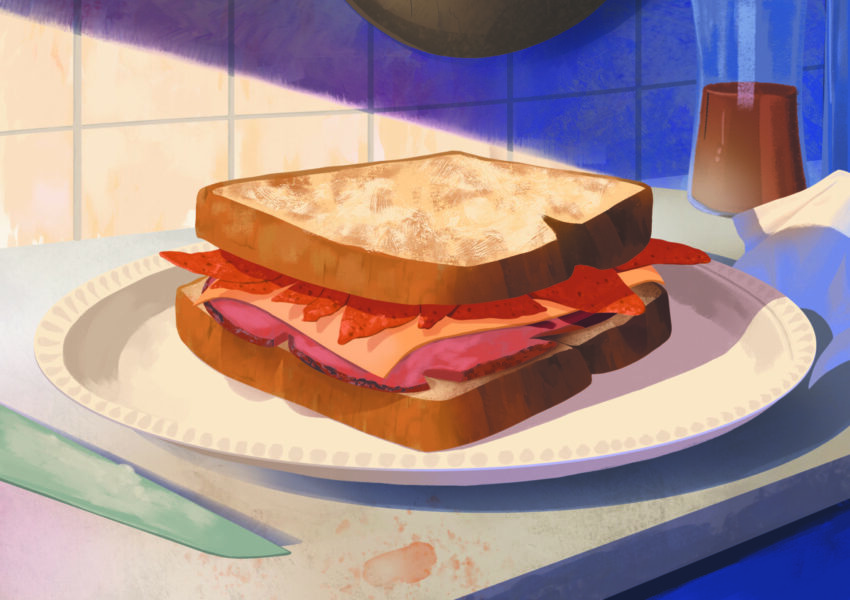
I was thrilled to get a secondhand bird dog. My father had enabled my interest in quail hunting, and in the Worth County of my childhood, wild quail still roamed in modest but sufficient numbers to fill the plate. Whether it was chicken-fried quail or baked quail in Campbell’s cream of mushroom soup, we could consistently harvest a handful of birds to serve on the dinner table.
Unbeknownst to me, my father had made a deal with my Sunday school teacher. Mr. King was willing to part with his aged bird dog, Sissy. While her best days were behind her, he knew she still had the heart of a huntress, and she would be the perfect teacher for a young man in need of hunting wisdom. In a behind-the-scenes negotiation, my father and Mr. King worked out the terms of Sissy’s transfer and Papa let me in on the deal as he drove.
Son, we can take her, but she is your responsibility.
Yes, sir, was my automatic, yet respectful, reply. I was getting a free bird dog and would agree to anything. My father was, at best, neutral on the acquisition and knew there is no such thing as a free dog. He glanced over at me to see that I understood. I nodded and said, I understand. She is my responsibility.
Papa smiled. All right, then, let’s pick up this bird dog.
Mr. King brought Sissy out of the kennel. She moved steadily but without urgency, seemingly unsure of the situation. He handed the leash to me, and I sensed that he was passing over an old friend.
You be good to her, okay. But don’t spoil her.
Yes, sir, I replied.
And don’t be too hard on her either, he added.
Yes, sir.
She’s a little sensitive, so let her lead you to the birds and you’ll do just fine.
I will, sir, and thank you again.
He looked at me with a sad smile and said, You’re welcome.
He bent down one last time and gave her ears a gentle tussle, quietly praising her in the only way he knew how.
He then stood abruptly but did not wipe his eyes.
He exchanged a handshake with Papa, then with me. Be good to her, he said, and then he turned and walked away.
A dust contrail billowed behind us as Papa turned into the Brand place. He let me drive the last a mile or so until we stopped near a stone chimney standing sentry over the ruins of an old homestead. Next to it, a rough-barked pear tree stretched its limbs upward like arms seeking to touch the sky. The fallow field, overgrown with native grasses and bordered by pines and hardwoods, was terraced by some long-forgotten farmer who had opened this land with axe and mule and plow. This was wild quail country, an ecosystem that once flourished but was already in decline by the time I came along.
My grandfather and uncles told tales of quail so plentiful that hunters could find five or more coveys a day. But times changed. Between 1966 and 2019, Georgia’s quail population decreased by more than 72 percent and the annual quail harvests fell from four million birds to fewer than 280,000. When a wildlife population plummets like that, there is never just one cause. The prince of gamebirds lost ground to clean fencerows and industrial farming; the increased use of pesticides and loss of native grasses, which removed essential food sources and cover; and fewer controlled burns, which serve to renew native grasses and forests.
By the 1980s, my father and I would be lucky to find one wild covey during a day’s hunt. We were fortunate to live in Worth County, where some families still dug firebreaks around their property and used controlled burns to keep the woods healthy. Although massive industrial farms and clear-cut pine plantations covered vast swaths of the county’s acreage, there remained small oases of old-growth longleaf and loblolly pines towering over a forest floor carpeted in golden wiregrass, broomsedge, and sage grass.
I dropped the tailgate and Sissy’s nubby tail wagged uncontrollably. I gently lowered her to the ground, and she leaned forward to stretch, then trotted off without paying me any attention. Papa slid on his faded game vest and pulled out his shotgun. I looked to the woods and tried to call Sissy back, but my commands fell on deaf ears.
Son, papa offered, why don’t we just let her hunt? I bet she knows what she’s looking for.
I consented in sullen silence and reached into the truck to pull out my old Stevens 20-gauge single-barrel shotgun. Papa bought it used from my uncle; my cousins used it for years before me, and they probably weren’t the first to hold it with young hands. Manufactured for reliability and not looks, the metal was now a worn, smoky, silver-gray and the inexpensive oak stock bore the smooth surface of long use.
We followed Sissy into the waning heat of the day. The late-afternoon light cast long shadows through the trees as she quartered back and forth. She carried her nose high as she scented. The feathered hair on her legs and side waved as she trotted, and her white head bobbed above the wiregrass as our shirts darkened with sweat. The heat slowed her pace and ours. The sand spurs stuck to my jeans and pricked my legs. The sun sank lower, and I was convinced it was time to pack it in when the magic happened.
Son, Papa offered, why don’t we just let her hunt? I bet she knows what she’s looking for.
Sissy froze on point, all business in her stillness. She was a Brittany, a breed created in the wild and forested western peninsula of France where hunters and poachers mixed setters, pointers, spaniels, and local feists to create this scrappy little pointing breed. Sissy was the embodiment of a workingman’s bird dog, and she had found the birds. Now, the rest was up to us.
Papa gave me the nod to walk in and flush the quail. I closed the breach of my shotgun and moved forward, shuffling my feet gently. I knew what was to come, but still I was stunned when the quail exploded around me like shrapnel. I swung my gun and focused on one bird. I led him slightly, then I gently squeezed the trigger, but nothing happened. I looked down and saw that I had not cocked my shotgun.
Sissy held her pose but looked at me with disappointment. She did her job, but I failed to do mine. I bent down and gave her a gentle pat in apology.
I’m sorry girl, that was my fault. Now go hunt ’em up. For the good of our new relationship, she set aside her feelings and went after the singles.
We didn’t get many birds on that outing, but that first day with Sissy was one of the best hunting days of my life.
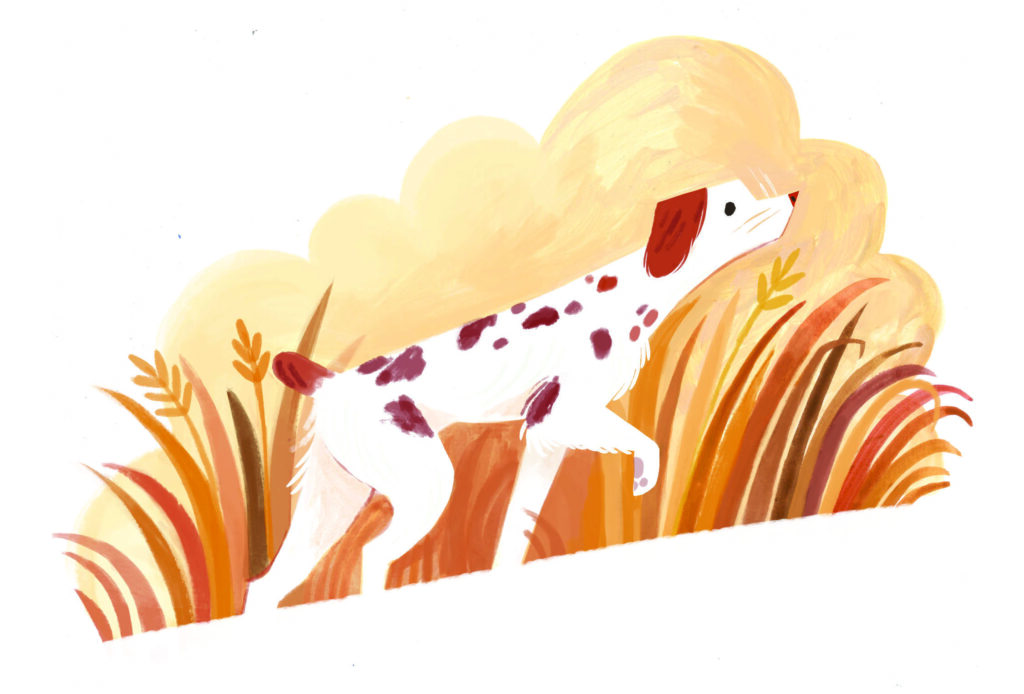
We hunted often that season and into the next. Sissy trotted along, her white and orange coat dancing in the wind. We followed her along endless fencerows and beside fields that smelled of fresh green peanuts turned up in the soil. The long, hot days of early autumn dissolved into the short, cold afternoons of winter. Sissy remained steady in second gear. She was never fast but quartered faithfully, and she never failed to find birds if there were birds to find.
We ate some of the birds Sissy quarried, and we gave the rest away to family or friends who loved the taste of quail. When cooked properly, the lean meat goes tender, its flavor milder than dove or duck. When giving away game, it is always good manners to clean the birds first. Papa and I would pop open each bird’s breast, peel off the skin, and remove the head, gizzards, and entrails. The birds taste better with the skin on, but plucking a tiny quail is tedious. Still, we were happy to share the bounty of our hunts led by Sissy. Slowly, though, those trips began to change.
The increasingly cold winter days were harder on Sissy. Her time in the field shortened, and she would hunt for only an hour or so before tiring. She would stop on her own accord and walk slowly back to the truck. Knowing her day was done, Papa and I would turn back with her and watch the winter sun surrender to the darkness.
One cold, clear afternoon Sissy disappeared over a hill and did not come to my repeated calls. We searched, straining to see a hint of white and orange in a sea of tall grass and scattered pines. I finally stumbled upon her curled up tight in a sun-warmed bed of pine straw. She would not budge from her spot, so I gave Papa my shotgun, and I picked her up and carried her back to the truck.
I swaddled her in an old towel while the truck’s heater warmed us. She was tense in my arms and her eyes looked soft and worried. We drove to the vet’s office on Highway 82, and she trembled as I carried her in. We were shown to an exam room, and it felt like hours before the doctor finally opened the door. He wore the uniform of the rural veterinarian: a worn flannel work shirt, soiled jeans, sturdy work boots, and an ancient stethoscope around his neck. He washed his hands and then walked over and shook my father’s hand, then mine.
He asked pertinent questions but seemed almost uninterested in the answers. With gentle hands, he felt her ribs and underside and then listened to her heart. He looked in her eyes and gave her head a gentle stroke, then returned to her ribs and stomach.
Let me carry her back and take an x-ray to see if we can find anything.
Papa and I waited in silence. The peculiar vet- clinic smell of antiseptic and animal permeated everything, and I shifted uncomfortably in a chair that had probably never been comfortable. He returned and tenderly set Sissy on the exam table.
He spoke kindly but without emotion.
It’s cancer. I would like to give you better news, but it’s everywhere. In her stomach; in her bones; in her liver. That’s why she has no energy. She’s just tired and old and in pain.
My heart sank.
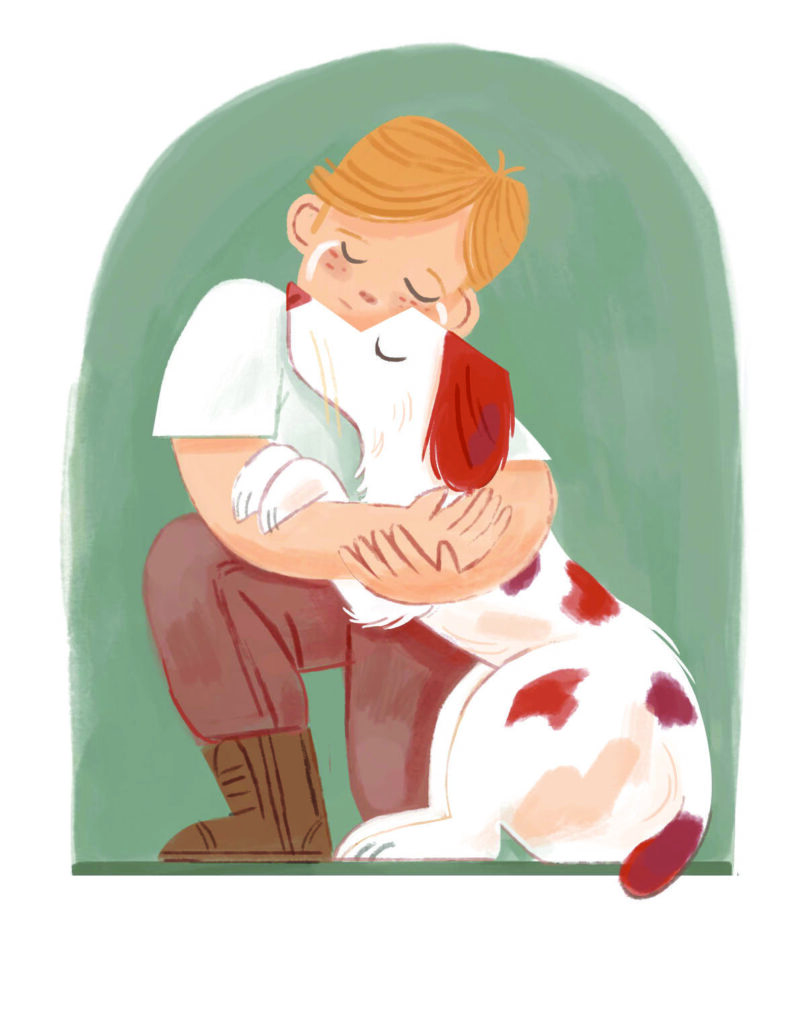
My best recommendation is that we need to put her to sleep. In that moment, I was overwhelmed with sorrow for her pain. Tears streaked down my cheeks and my father put his hand on my shoulder, It’s okay, son he said quietly.
The doctor offered me a way out. If you want, you can leave her here with me and I will take care of her.
No, she’s my responsibility I responded. I was thirteen years old, and this was my first real adult decision. I knew I was responsible for her, for being with her when the pain stopped. No one should die alone.
The vet nodded, and I cradled Sissy and stroked the stray curl that always rose atop her head. I heard the creak of the medicine cabinet and the clink of the vial as he prepared the syringe.
It seemed that her eyes were deep with sadness and pain and weariness. I whispered to her, You’ve been a good girl, Sissy. He steadied her front leg, inserted the needle, and slowly plunged the syringe. She closed her eyes and stopped breathing.
I wept as her body went limp in my arms. With red eyes and a tear-stained face, I carried her past patrons in the waiting room, not caring what they thought of me. Papa paid the vet while I sat in the truck, stroking Sissy’s head as I cried.
The creaky truck door opened, and Papa got in. Through the tears, I asked, Why is this so hard?
Papa thought for a second and said, It is hard because you chose to relieve her suffering over your desire to hold on. It was the best answer he could give.
We drove home in silence. Behind the pastorium where we lived, a great muscadine vine had overgrown its trellis, and the bower beneath it felt like an appropriate resting place. The vast vines produced sweet, thick-skinned, golden “scupnum” grapes, as we called them. Those we could not pick shriveled and fell to the earth with the cloying fragrance of decaying fruit; there the pulp and seeds served as a banquet for wild birds. Illuminated by the truck’s lights, our shovels turned up the sweet smell of damp earth in the cool evening air.
I laid her down with all the gentleness in me, and when we were finished, I placed a large rock on top as a headstone.
Papa put his arm around me and prayed.
Father, we thank you for Sissy and we give her over to You. You are a loving God who created all things, and we ask You to take Sissy into Your care... He kept his arm around me and squeezed, Amen.
He looked into my reddened eyes. I am proud of you, son, he said. Then we turned in the dark together and walked home towards the light.
. ***
They say war is months of boredom punctuated by moments of violence. It was in a moment of boredom on a dusty Army base in Afghanistan in 2002 that I made a promise to myself: When I made it out of combat and onto safer shores, I would get a bird dog again. I was thirty-one and an Army captain in a war zone. It had been eighteen years since I lost Sissy, but I wanted that life back. To be in the grass with my dog, happy and free, hunting for quail. From that moment in Afghanistan, it would take another eighteen years of combat and operational deployments before I’d get the chance.
Though mine was a military life, it was blessed. I had an incredible marriage and two sons. My career as a solider and officer had been distinguished. But there was still one thing missing.
In 2002, on a dusty Army base in Afghanistan, I made a promise to myself: When I made it out of combat and onto safer shores, I would get a bird dog again.
In January of 2020, I drove nine hours from Germany—where we were stationed—across France to get a bird dog I had only seen on the internet. My wife thought I was crazy, but she came along for the ride. South of Reims, unending rows of barren, winter-brown Champagne vineyards rolled past my window. The slate-gray sky and light rain reflected my anxiety.
On the spectrum of dog decisions, there are extremes, and I was trying to straddle the poles between my head and my heart. On one extreme was my professional experience with our special operations multipurpose canines. Rambo, one aptly named Belgian Malinois I worked with, was a marvel. His handler, a softspoken son of Michigan’s Upper Peninsula, told me in Afghanistan: Before we begin training these dogs, we spend upwards of $40,000 on just breeding and screening. Rambo was the most intelligent and driven dog I had ever seen, and he had single-handedly saved lives, making him worth every penny.
On the other end of the spectrum was Teddy, our elderly rescue cocker spaniel mix. Teddy was a lover and as smart as a truckload of lumber. Despite his supposed lineage, Teddy had no bird-hunting sense. Between the head and the heart, I was hoping for a dog that was somewhere in the middle.
My wife dozed as we exited the A11 autoroute before reaching Le Mans and then headed north on small French roads. I drove by pastures filled with Norman cattle with hides like Rorschach splotches. I turned towards Mortagne-au-Perche and passed through tiny French villages with a little more than a town hall, a boulangerie, and La Poste. We veered off the main road and followed the twin ruts up to the breeder’s farm. The stone home, stone barn, and stone perimeter walls were offset by modern cattle gates and state-of-the-art farm equipment that made the place feel both ancient and contemporary. Monsieur Bensoussan met us in the courtyard wearing calf-high rubber boots, mud-splattered work pants, and a stained utilitarian work coat to fend off the cold.
Welcome, Monsieur Pirkle, he intoned in a northern French accent that was difficult for me to follow. Let’s go see Penelope.
This was his kennel’s twenty-first litter of French Pointers, and every dog in this litter had a name starting with the letter P. Her litter mates were named Pepsi, Pako, Phoenix, and Poppins. We chose Penelope, but four syllables is a mouthful in the field, so we decided to call her Ellie. In the warm barn, the constant whirl of an industrial heater circulated the earthy smells of hay, feed, and cattle. Monsieur Bensoussan handed Ellie to my wife. It was love at first sight for both of us.
It has been five years with Ellie. We hunt quail each fall and have recently begun chasing grouse in the North Georgia mountains. We train and work and live together. Sitting in the dim autumn light on this cold night, Ellie is curled up next to me on the couch as I stroke her velvety, chocolate-colored ears. She has helped me reclaim some part of that boy who hunted with Sissy all those years ago. We are just a boy and his dog, and that’s enough.
Wesley Pirkle is the director of global military programs at the University of North Georgia – The Military College of Georgia and a student in the MFA program in narrative nonfiction at the University of Georgia.
SIGN UP FOR THE DIGEST TO RECEIVE GRAVY IN YOUR INBOX.