
Bless This Food? The etiquette of prayer in restaurants.
by Hanna Raskin
Illustrations by Lindsey Bailey
Eating and drinking establishments are the quintessential third spaces, those places where strangers can socialize outside of home and work.
Close to half of the venue types that the late sociologist Ray Oldenburg namechecked in the subtitle of his book The Great Good Place couldn’t operate without an OK from the health department.
Yet, as plenty of cultural commentators have noted, usually while wringing their hands, cafés and bars appear in danger of shedding their third-place status.
The reasons are unsurprising—business owners paying exorbitant rents aren’t inclined to let patrons linger; many diners during the pandemic developed a lasting dislike for interaction—but this shift amounts to a sea change for the hospitality industry. Now, absent mingling at a bar, chatting with a human server, or engaging with diners seated nearby, restaurant tables have morphed into fully private sanctums, at which customers can carry on the most intimate discussions without regard for anyone else in the room.
It’s fine for a boss to conduct a performance review over calamari. Totally OK for a spouse to broach the topic of divorce while eating fried Brussels sprouts.
But there’s another confidential conversation that takes place in dining rooms across the South.
At the beginning of my phone interview with Reverend Dr. Russell Meyer, before I could pose any questions to him, he told me a story about the journalist Bill Moyers and President Lyndon Johnson. “The President asked Bill to say table grace, and Moyers started to say a prayer, but the President couldn’t hear him, so he says, ‘Speak up, Bill.’ Moyers responded, ‘But I’m not talking to you, Mr. President.’”
Meyer, executive director of the Florida Council of Churches, characterized the exchange as “an inside joke between two very devout men.” But it also dramatizes the considerations that shape some Christians’ choice to pray openly before eating in restaurants.
(To be clear, there are many religions besides Christianity practiced in the South, but because observant adherents of major faiths such as Islam, Judaism, and Hinduism follow dietary restrictions, their theology often comes into play long before their plates reach the table. As such, this column is concerned with Christian prayer exclusively.)
There are Christians who say grace despite the public nature of restaurants: “I dread it,” Alan Noble wrote in a 2019 column for The Gospel Coalition. “I try to time the prayer so that the server won’t interrupt us. The idea of a server waiting while my family prays over a meal makes me feel self-conscious and guilty.”
Then, there are Christians who say grace because restaurants are public: “Everything we do is seen,” Melissa Holland, interim executive director of the Kentucky Council of Churches, told me. Praying aloud “may make someone else think about why we do it, and what it would be like to be part of it.”
Either way, as Americans’ attitudes toward restaurants change, the practice of praying within them seems likely to evolve, too.
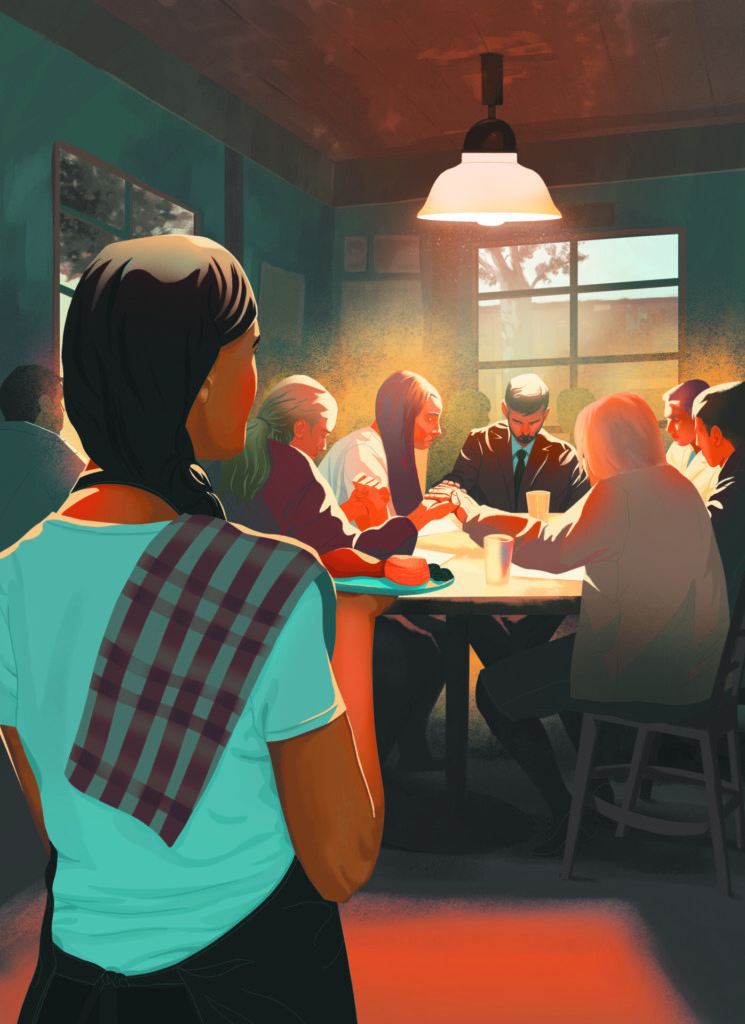
Noble may have sensed that restaurant servers also wonder whether to approach a table when diners have their eyes closed and hands joined. At least, I remember carrying trays of shrimp and grits to booths at The Lobster Trap in Asheville and stopping short when I realized their occupants were having a spiritual moment.
I knew enough not to mix the seafood with the sacred, but I didn’t have a clue what the people were saying. As a Jew, I have one standardized blessing to recite at the start of a meal, although I don’t think I’ve ever said it outside of summer camp and organized Shabbat dinners. (There are different blessings to say over different kinds of food, but so long as some kind of grain is anticipated at the table, the ancient Hamotzi is the go-to.) But I was incredibly curious about the content of their prayers.
While restaurant grace sometimes provokes curiosity, in Noble’s experience, it’s more frequently met with scorn. “Seeing someone practicing religion in public feels a bit like watching the inebriated or mentally unstable in public,” he wrote, speculating that most Americans are more comfortable with public displays of affection than public displays of devotion. “What are they going to do next? Why aren’t they being rational? Why couldn’t they keep this to themselves?”
Perhaps because Noble correlates praying in restaurants with feeling awkward, he didn’t respond to my request for an interview. Fortunately, others who always pause to say grace were willing to shed some light on what’s said over restaurant tables.
“Years ago, I developed a process of always choosing a ‘grace word’ to offer before eating,” said North Carolina Council of Churches executive director Rev. Dr. Jennifer Copeland, who likes to work out the word with her dining companions. “Sort of like a toast before sipping a drink, but this is an intentional word of grace and thanks.”
For Meyer, the pre-meal prayer varies depending on who’s at his table. If he’s dining with colleagues, he might refer to the purpose of their meeting. If he’s dining with visiting family members, he might thank God for their safe trip. Always, though, he said, “I want to recall the hands that sacrificed and those who don’t have bread today, understanding that our gratitude comes when we recognize our position and our privilege.”
Not every Christian is as comfortable “praying from the heart,” as Holland, who was raised Catholic, terms the skill she had to cultivate once she started praying with people from different religious backgrounds. Some Christians buy books of table graces to repeat or riff on. Jesus, be our guest, let these gifts to us be blessed, is a “very popular one,” Meyer said.
So long as the prayer doesn’t turn prideful or stretch into a sermon, any words of grace are appropriate, even in the absence of a full meal, my sources agreed. “I give thanks for the drinks I have,” Holland said. “Hopefully, God is watching over me and protecting me from drinking too much, and those in the bar from drinking too much.”
The what and why of restaurant grace is less of a mystery than the who and when. Researchers know almost nothing about how many Christians regularly pray before meals in public, in part because American religion surveys usually only ask about “prayer, aside from prayer at meals.”
“There’s this assumption that it’s a different animal,” University of Texas at San Antonio sociologist Christopher Ellison said of grace. From a scholarly standpoint, “prayer at meals has been neglected. We looked pretty hard and couldn’t find anything.”
In this case, “we” is Ellison and Jong Hyun Jung, who in 2021 published a study of mealtime prayers and life satisfaction in Americans aged sixty-five or older. They found that “the frequency of prayers at mealtime is associated with an increase in life satisfaction over time,” especially among unmarried people.
“Saying grace may trigger perceptions of gratitude or take people’s attention away from their own personal problems,” Ellison said. But, he cautioned, “We can’t tease those things out with the data.”
Presumably, Christians who engage in mealtime prayer at restaurants are more focused on its purpose than its outcome. But Meyer isn’t sure that the purpose is always godly: He worries about the performative aspect of some prayers he’s witnessed in restaurant settings.
“There is a form of American evangelicalism that is aggressive,” he said. “I’ve never been a server, but I always wonder, does the gratuity meet the gratitude? If you’re going to be saying sacred things in public, they better show in your public behavior: I hate being cut off by a car with a bumper sticker that proclaims jesus is lord.”
(Since Meyer has never been a server, he’s never opened a check presenter to find a Biblical tract instead of money—a familiar routine for servers across the South—but I feel certain he wouldn’t approve of the scheme.)
Even if the hypocrisy isn’t blatant, Meyer cautions that Christians need to take heed of their surroundings when praying. As he sees it, restaurants remain an extension of the public square, and he believes it’s incumbent upon Christians to make sure everyone feels welcome there.
“Most people don’t intend to do harm in public, but we’re not learning [the] skill of practicing our rituals with humility in spaces where there are multiple cultures present,” he said, calling that a “prayer worth pursuing” in a pluralistic democracy. His vision of inclusivity entails a restaurant hanging a sign that reads, we welcome your prayer. just include us.
Holland is also interested in the strength of American society. For her, Christians saying grace in restaurants is a sign of it.
“I grew up praying at home, but I think we’ve come further,” she said. “I was raised with this idea of you don’t talk politics or religion out in public.”
If Holland had her druthers, people would still leave political chatter at home. But before eating in a restaurant, as she reminds her young grandchildren when she brings them to her Monday lunch club, she believes they ought to pray.
Hanna Raskin, a Gravy columnist, publishes The Food Section newsletter, “covering food and drink across the American South as though it mattered as much as crime and politics (because it does).”
SIGN UP FOR THE DIGEST TO RECEIVE GRAVY IN YOUR INBOX.