
Oh, Christmas Tree Marking the holiday with Little Debbie
by Silas House
illustrations by Molly Brooks

In my family, everyone has always taken Christmas seriously, but no one more than my Aunt Sis.
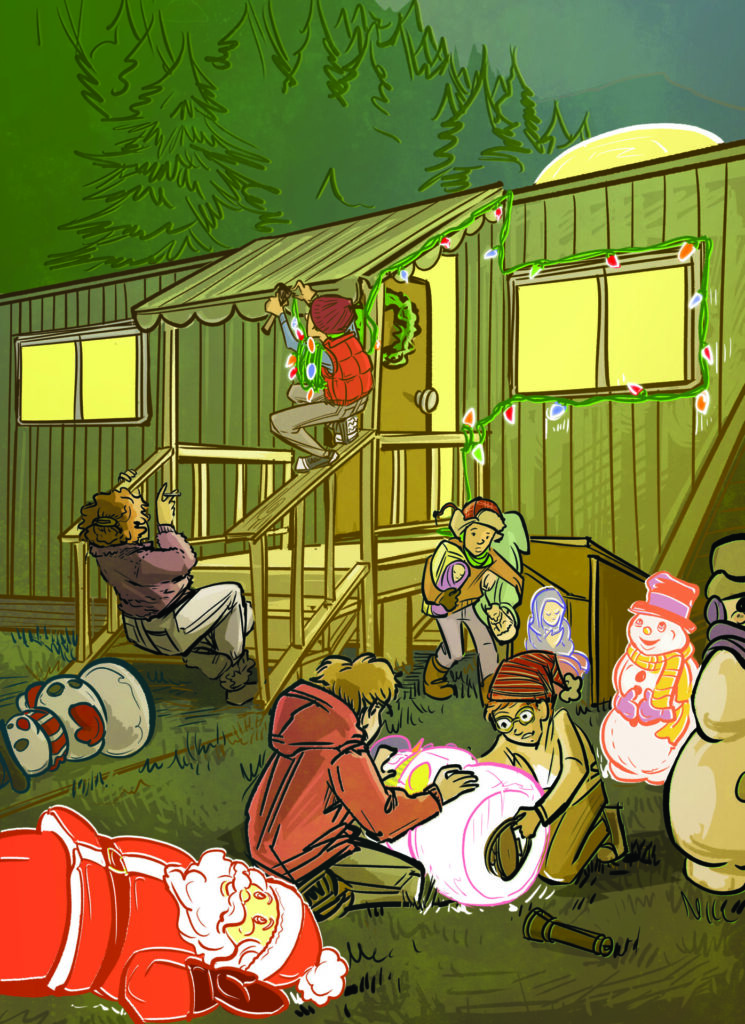
She put up all her Christmas decorations the day after Thanksgiving without fail. It was a complicated affair that required me, her children, and others to complete the task. Sis put on Elvis’ Christmas Album, lit a cigarette, and sat on the edge of the couch, smoking like a 1940s film star while she gave directions. We put out an army of snowmen and their families on every available surface, latched wreaths to each exterior door, changed all the candles in the house from white to red, strung the outside lights, spread the poinsettia tablecloth, plucked the blow molds (Santas, snowmen, a nativity scene with a specially built stable) from storage, cleaned them all with wet rags, and set them up in the yard of her home in the foothills of southeastern Kentucky.
Lastly, a sort of altar was arranged on the kitchen counter that greeted visitors entering her trailer: a wooden bowl full of in-the-shell pecans, walnuts, and Brazil nuts, along with a nutcracker and two slender picks; a can of old-fashioned hard candy filled with an assortment of tiny orange squares, peppermints, and sugary neon ribbons, all of it with sharp edges that cut the roof of your mouth; and—most importantly—a plate, painted with holly and cardinals, where several Little Debbie Christmas Tree Cakes lay in neat rows. This last offering would need to be replenished many times throughout the season, as they were everyone’s favorite.
For many people throughout the Southeast, Christmas doesn’t start properly until they’ve had their first Christmas Tree Cake. Whereas my late grandmother and great-aunts prepared elaborate stack cakes and fruitcakes for the holiday season, my mother and aunts long ago surrendered to prepared cakes or cake mixes. In our family, almost every cake originated from a box, even if it was a dressed-up version, like apricot nectar cake, Better Than Church cake (called Better Than Sex by the less prudish), or banana-split cake. All of the women in my family worked full-time jobs, and few had time for the labor-intensive baking that previous generations had done. By the time Little Debbie released Christmas Tree Cakes in 1985, folks didn’t even have to bake a boxed cake anymore. They could simply put out perfect confections, still in their cellophane packaging, and everyone was happy.
Almost forty years after they debuted, these cakes have become a bona fide phenomenon across the nation. They are especially popular in the Southeast, according to the company that makes them, McKee Foods. Most people I know, myself included, wait for the day of release so we can buy multiple boxes. Perhaps that’s why the cakes often sell out, causing a frenzy that has led some to go so far as purchasing them on the black market (read: the internet).
There’s that initial crunch when you bite through the green sprinkles—miniscule grains of sugary perfection. Then, the icing: a perfect balance of grease and sugar that offers another sensation before your teeth slide through the soft yellow cake, the dreamy cream in the middle, then on through to experience it all backwards now: cake again, icing, crunch of sprinkles. A Little Debbie Christmas Tree Cake is a perfect Appalachian petit four, an impeccable combination of texture and taste. At once decadent and down-home, a mouthful of nostalgia that transports us to happier times, simpler times, when more of our people were alive or families were not wrecked by vitriolic politics. Those cakes take us back to holiday gatherings, presents, music, and multi-colored lights. For many people, they are the taste of home.
Kenny Hammontree, Little Debbie brand manager at McKee Foods in Chattanooga, says that while the cakes have steadily grown in popularity since they were introduced, they have become a true phenomenon over the last few years. “My thought is that during Covid, people just wanted comfort and wanted to feel really good,” he said. “Christmas Tree Cakes are comfort food. That’s nostalgia, that feels special.” All of that in exchange for about three dollars for a box of five small delicacies. Last year, McKee produced 150 million of the cakes between October and December and still could barely keep up with demand.
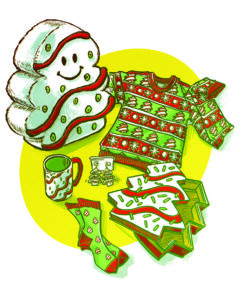
That popularity has crossed over into branded merchandise: T-shirts, earrings, tote bags, ornaments, and outdoor decorations, such as the seven-foot-tall inflatable Christmas Tree Cake the company sells on its website for $99.99. There is an online phenomenon of people trying to recreate the look and taste of the cakes at home. The company has collaborated with Goose Creek Candles to create a tree-cake scented candle and with Hudsonville Ice Cream, which released a Christmas Tree Cake flavor in 2023 that became the bestselling pint in company history in a single week. The flavor will now be released annually. “And that was people buying ice cream in November and December instead of July and August,” Hammontree says.
The Little Debbie brand has been around since 1960. Its parent company started in 1934 when its owners bought a failing bakery in Chattanooga and hung a sheet in the back as a make-shift room divider: the owners, O.D. and Ruth McKee, lived back there when they weren’t baking in the front of the shop. It has remained a family company. The model for the famous picture of Little Debbie on every box, Debbie McKee-Fowler, only recently retired from day-to-day work but still serves as chair of the board. (McKee Foods did not respond to a request to contact her for this story.) Her brother is involved in the company as well, and one of their cousins is the chief operating officer.
“Their family permeates everything we do, so it really feels like a small family bakery that happens to sell products around the world,” Hammontree says. The confections are sold in all fifty states as well as in Mexico and the Caribbean. Despite its homey image, the company’s annual sales average about $1.5 billion.
Executives and employees at Little Debbie tell me that most of the people who work on the Christmas Tree Cake line are natives of the region and that different generations from the same family often work together. At the same time, the South is changing. Ours is the fastest-growing region in the country. The area around Collegedale, Tennessee, where Little Debbie is based, has recently seen solid growth as well.
Austin Hughes grew up in Collegedale, which is just east of Chattanooga, and has worked at Little Debbie for almost ten years. He is now the first-shift line supervisor for the line that makes Christmas Tree Cakes. He says there is a certain pride among workers in being part of such an iconic brand and that there are “a ton of family members” who work there. Newcomers to the region are joining the company, too. “Lately we’ve seen a lot more come in from other states, like California, Texas.”
The working-class people I grew up around are probably the type of people who helped the McKees amass their fortune. As Appalachians, we saw the Little Debbie company as a source of pride. When you are from a culture that the rest of the world is telling you to be ashamed of, you tend to either reject your homeplace or feel that much prouder of it. In my family and community, we most often chose the latter. And when we identify these sources of pride, whether it’s Dolly Parton, Lee Smith, Loretta Lynn, or Little Debbie, we tend to love them fiercely.
For my family, a lot of that tremendous pride is wrapped up in class. My parents, uncles, and aunts grew up poor. My father was raised by a single mother of nine after her husband died. She supported them all by hitchhiking back and forth to her job at the first Kentucky Fried Chicken in nearby Corbin, Kentucky. My mother was orphaned at the age of nine and raised by cousins. She never had a bicycle as a child and didn’t have a birthday cake until she was an adult. My Aunt Sis was older when their mother died, but her struggle to rise out of poverty was difficult, too. Everyone in my family worked labor-intensive jobs that many within our society often take for granted. They were waitresses, mechanics, lunch ladies, coal miners, factory workers. Even though their work was turning the engine of America, most films, television shows, commercials, and comic strips reinforced the notion that they should be ashamed of where they were from and who they were. The poverty of their childhoods shaped everything about them: their work ethic, their values, the way they parented. This was true of my entire family, and most of my community growing up as well. We were a people defined by class and the divisions it caused.
We were frugal because of this. Electricity and gas had to always be carefully conserved, eating out was a luxury, and trips to the grocery store were closely monitored affairs where we bought necessities and rarely anything else.
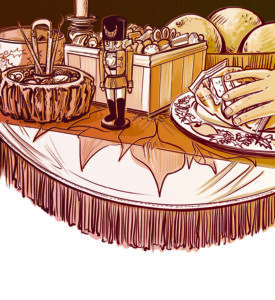
I believe this is why so many people in Appalachia, and throughout the South, love Christmas so much. Drive through any little country town, certainly in the mountains, and you will see the earliest and most elaborate displays of Christmas lights and decorations. When I was growing up, Christmas was the one time of year for extravagance. My Aunt Sis, who bore raw hands all the time from her job at the local yarn factory, saved all year to surround her huge tree with towers of wrapped gifts and to constantly add to her collection of Christmas decorations. She searched yard sales with great determination for the increasingly valuable blow molds. She waited for the Blue Light Specials at K-Mart to buy her lights, wrapping paper, and other décor. And she never allowed that holly-and-cardinals plate to be empty of Little Debbie Christmas Tree Cakes.
I’m a first-generation college graduate, and I often feel out of place in the monied worlds of academia and literature. Those of us who navigate these worlds, after being raised lower-working class by people who were raised poor, often struggle with imposter syndrome. Throughout my career, I have felt constantly judged because of where and who I am from. After all, I’m from Appalachia, so even if I wasn’t from a poor family, most Americans would assume I am. There is certainly no shame in it. In fact, I am proud of that. But the associations of ignorance, violence, and worse that people make with working class people are very real.
Years ago, early in my time directing a program at a college in Appalachia, I thought it would be fun to decorate our gathering space elaborately for Christmas: lights strung everywhere, two themed Christmas trees (one festooned with Dolly Parton ornaments, the other decked out in pictures of Loretta Lynn). I even brought in a couple of the treasured blow molds I had inherited when Sis passed away in 2015. And I set up the altar: mixed nuts in their shells, oranges, hard candy, and the traditional plate of Little Debbie Christmas Tree Cakes.
The nuts, fruit, and candy were left untouched, but our students gobbled up the Christmas Tree Cakes, delighting in them. Many said they tasted like home. I suspect the cakes brought up mixed feelings of joy and homesickness for some of the students.
Then a colleague I had never really been able to connect with, mostly because of class differences, witnessed a group of students descending upon the holiday offerings. She let loose a loud laugh. I thought she might be about to criticize them for choosing a snack cake over the healthier options. I thought she might even be about to make fun of my explosion of decorations. Instead, she snatched up the last remaining cake, tore it from its packet, and bit into it, closing her eyes in satisfaction.
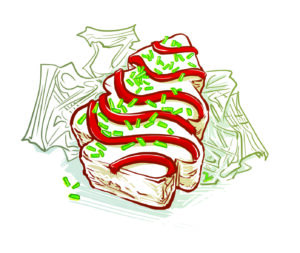
“Tastes like Christmas,” she said.
I was so happy to have this moment of connection with her, but I have to admit that I grieved a little, too. I had always felt like Little Debbie Christmas Tree Cakes belonged to us, somehow. They were a Southern thing, a Southeastern thing, an Appalachian thing. This professor was from New England and often talked about her wealthy family, her Cape Cod upbringing that was so different from my own. She hadn’t grown up with this delicacy, but she was a convert. And here we were, just two people eating Christmas Tree Cakes together, marveling at their perfection.
As a Southerner, I’ll continue to be proud that Little Debbie and Christmas Tree Cakes were born of our culture. As a member of the New South, an evolving, contemporary place that isn’t so easy to simplify, I’m also happy to welcome new folks to the fold and to share a holiday delicacy with them. After all, my Aunt Sis put that pretty plate of cakes out for everybody.
Silas House is the author of seven novels, most recently Lark Ascending, which won the 2023 Southern Book Prize and the 2023 Nautilus Book Award. In 2022 he received the Duggins Prize, the highest award for an LGBTQ+ writer in the nation. He is currently serving a two-year term as the poet laureate of Kentucky. He teaches at Berea College.
SIGN UP FOR THE DIGEST TO RECEIVE GRAVY IN YOUR INBOX.