
Texas-Style Pinto Beans by Sheri Castle
Recipe by Sheri Castle
Photos by Forrest Mason
We like to talk about barbecue, both the rendition and consumption. We know there are regional specialties, fierce loyalties, and spirited debates.
Like a Proust questionnaire with a single query, you can gain insight into people by asking what they will even acknowledge as barbecue, much less eat. Barbecue sides can be just as evocative and map-dot specific. Few of us will ever attempt pit-smoked barbecue at home, much less expect to master it. The sides, on the other hand, are reassuringly accessible.
There’s little consensus (no surprise there) on what exactly constitutes a barbecue side, but there are common denominators, especially among places that take barbecue seriously. They don’t fiddle with dishes that draw undue time and attention away from the pit. There’s no à la minute in the world of barbecue. Sides are usually made in large batches that keep a day or two, or don’t need much minding once underway. Their quality can’t fade during service hours or during a stint on a steam table. Seasonal specials might come and go, or not come at all, but the core lineup is made from inexpensive ingredients that are readily available year round.
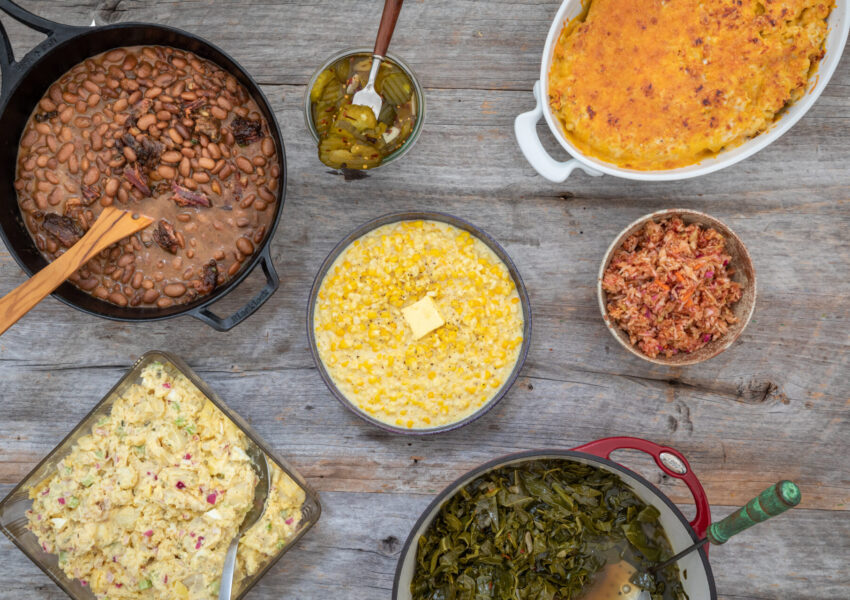
This throughline doesn’t imply that all barbecue sides are the same. Far from it. We count on the meat, but we anticipate the sides. (For those who don’t eat meat yet find themselves at a barbecue restaurant, the sides are everything.) We expect slaw, for example, but we marvel at the various ways different cooks will make it. We look forward to beans, and we know those beans will change as we eat our way westward from the Atlantic to the other side of the Mississippi. We delight in novel dishes found in only a handful of places, or perhaps only one location, such as the orange-hued hash of South Carolina that’s pretty much unheard of in other states. I admire the forthright nature of barbecue sides and appreciate that we get to pick what we want. Barbecue places fix us a plate; they don’t plate our meal.
Side cooks are on a par with the pit cooks when it comes to putting their local spins on menu items we deem essential to the overall barbecue experience. The pitmaster might get the hype as the front man, but the side cooks deserve love for being the tight house band.
The pitmaster might get the hype as the front man, but the side cooks deserve love for being the tight house band.
Taking inspiration from classic Southern barbecue joint sides, I developed eight recipes that we can cook at home. I chose dishes that can go together and complement all types of barbecue. Some are common. Others you might not have heard of. Of course, these recipes are not the final say on barbecue sides, nor the only way to make them. Just as there will never be consensus on barbecue, there is no single recipe for any side dish. We all get to talk about our favorites, but none of us gets the last word. I made these sides the way I would if I could have y’all over to my house. You can bring the barbecue.


Texas-Style Pinto Beans
by sheri castle
Traverse the South from East to West and you’ll notice a shift in the type of beans served with barbecue, especially after you cross the Mississippi. Up to that point, the word “barbecue” implies pork and you’re most likely to be served sweet and sticky baked beans made from dressed up canned beans, even though the finished dish is deemed homemade.
These are not baked beans. Texas-style pinto beans are brothy, cooked from scratch with dried beans. Unlike most dried bean recipes, however, these turn out better when you don’t soak the beans so that they can absorb the liquid as they cook, ensuring that they are deeply flavored. Part of that flavor comes from smoky, fatty, salty, meaty seasoning. Once you’re in brisket country, the pintos are often seasoned with burnt ends, so I encourage you to use those dark and smoky bits if you can get them from a local barbecue restaurant, or from a brisket you smoke at home. Otherwise, smoky bacon is a good substitute.
The type of fresh, fragrant chili powder you use will determine the heat level of the finished dish. No matter your choice, don’t go overboard; use only enough to flavor the beans without making them fiery hot.
Although dried beans last a long time, they are not immortal. At some point, they’ll be so dried out that no amount of cooking can soften them up. Fresh-crop dried beans that are no more than a year old cook quickly and beautifully. (I order mine online from Rancho Gordo.)
A pot of pintos is impressive when you know what you’re doing.
Makes 8 servings
1 pound dried pinto beans
1 medium yellow onion, chopped (about 2 cups)
2 cups coarsely chopped brisket burnt ends, divided
3 garlic cloves, chopped
1 tablespoon chili powder
1 tablespoon onion powder
1 tablespoon garlic powder
1 tablespoon ground black pepper
1 tablespoon salt
2 teaspoons dried Mexican oregano
1 teaspoon ground cumin (optional if your chili powder includes cumin)
Pour the beans into a large bowl and cover with water. Stir them with your fingers and discard any chaff or broken beans. Drain the beans and pour them into a Dutch oven or other similar large, heavy pot. Add enough water to submerge the beans by a depth of 1 1/2 inches.
Add the onion, 1 cup of the burnt ends, garlic, and all of the spices. Bring to a boil over medium-high heat. Reduce the heat to low, cover, and simmer gently until the beans are tender, 1 to 2 hours. The fresher the dried beans, the more quickly they will cook. Do not let the beans boil.
Remove the pot from the heat, stir in the reserved 1 cup burnt ends, let stand uncovered for 1 hour, and then check the seasoning. The rest gives the beans time to absorb more seasoning from the delicious broth. Reheat gently before serving. (You can prepare the beans up to 2 days ahead. Cool, cover, and store refrigerated.)
Variation:
To use bacon instead of burnt ends to season the beans, cut 8 to 12 ounces smoky, thick-cut bacon crosswise into 1-inch pieces. Cook in the large pot you’ll use for the beans over medium-low heat until crisp and rendered, about 20 minutes, stirring often. Use a slotted spoon to transfer the bacon to a separate bowl and set it aside. Stir the beans to coat them in the drippings before adding the water at the start of cooking. When the beans are cooked, stir the reserved bacon back into the pot just before you check the seasoning. As with the burnt ends method above, let the finished beans rest before serving.
Sheri Castle is the host of The Key Ingredient, a cooking show from PBS. She’s also a writer, recipe developer, and author of many cookbooks, including The New Southern Garden Cookbook. She hails from the Blue Ridge Mountains, right on the North Carolina–Tennessee line, which explains why she cut her barbecue teeth on east Tennessee–style pork shoulder and didn’t partake in a whole-hog pig pickin’ until she went to college. Her Appalachian roots also established a lifelong loyalty to beans—she never passes them up as a barbecue side. Sheri’s next big culinary and personal goal is to visit her beloved daughter in New Zealand and introduce those folks to Southern biscuits and gravy as an instrument of global goodwill. Check her out at shericastle.com.
Forrest Mason is a food-focused photographer, video producer, and documentary filmmaker based in Chapel Hill, North Carolina. Quick to crack a joke—or a crab claw—Forrest has been moseying around the country making friends and art for many years. You can find his work in Garden & Gun, Ebony, The Local Palate, Eater, and around town. Of his barbecue preferences, he says, “Being a Carolina guy, how can I not go with whole-hog barbecue? Pile my plate high with pulled pork and fried okra, toss me an ice-cold beer, and point me to some shade. I’ll take it from there.”
SIGN UP FOR THE DIGEST TO RECEIVE GRAVY IN YOUR INBOX.