
Creamed Corn by Sheri Castle
Recipe by Sheri Castle
Photos by Forrest Mason

We like to talk about barbecue, both the rendition and consumption. We know there are regional specialties, fierce loyalties, and spirited debates.
Like a Proust questionnaire with a single query, you can gain insight into people by asking what they will even acknowledge as barbecue, much less eat. Barbecue sides can be just as evocative and map-dot specific. Few of us will ever attempt pit-smoked barbecue at home, much less expect to master it. The sides, on the other hand, are reassuringly accessible.
There’s little consensus (no surprise there) on what exactly constitutes a barbecue side, but there are common denominators, especially among places that take barbecue seriously. They don’t fiddle with dishes that draw undue time and attention away from the pit. There’s no à la minute in the world of barbecue. Sides are usually made in large batches that keep a day or two, or don’t need much minding once underway. Their quality can’t fade during service hours or during a stint on a steam table. Seasonal specials might come and go, or not come at all, but the core lineup is made from inexpensive ingredients that are readily available year round.
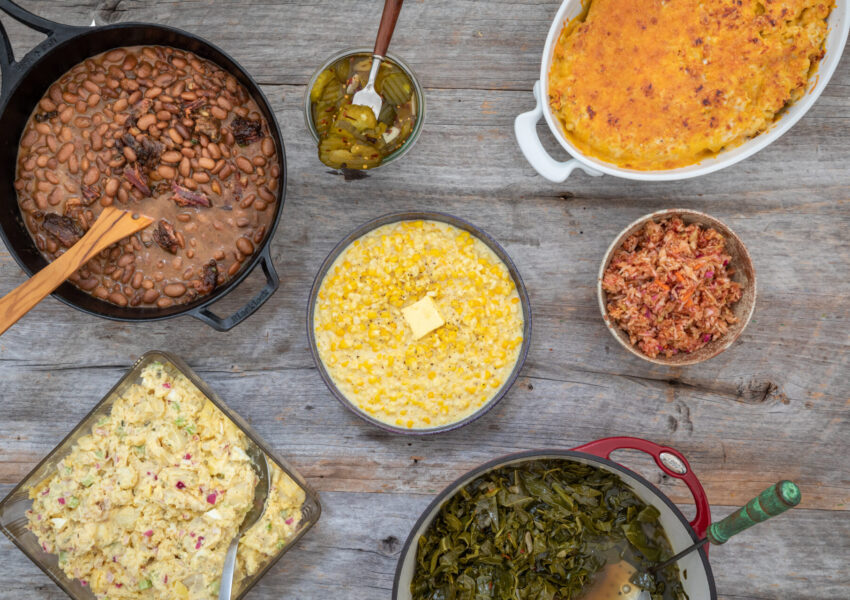
This throughline doesn’t imply that all barbecue sides are the same. Far from it. We count on the meat, but we anticipate the sides. (For those who don’t eat meat yet find themselves at a barbecue restaurant, the sides are everything.) We expect slaw, for example, but we marvel at the various ways different cooks will make it. We look forward to beans, and we know those beans will change as we eat our way westward from the Atlantic to the other side of the Mississippi. We delight in novel dishes found in only a handful of places, or perhaps only one location, such as the orange-hued hash of South Carolina that’s pretty much unheard of in other states. I admire the forthright nature of barbecue sides and appreciate that we get to pick what we want. Barbecue places fix us a plate; they don’t plate our meal.
Side cooks are on a par with the pit cooks when it comes to putting their local spins on menu items we deem essential to the overall barbecue experience. The pitmaster might get the hype as the front man, but the side cooks deserve love for being the tight house band.
The pitmaster might get the hype as the front man, but the side cooks deserve love for being the tight house band.
Taking inspiration from classic Southern barbecue joint sides, I developed eight recipes that we can cook at home. I chose dishes that can go together and complement all types of barbecue. Some are common. Others you might not have heard of. Of course, these recipes are not the final say on barbecue sides, nor the only way to make them. Just as there will never be consensus on barbecue, there is no single recipe for any side dish. We all get to talk about our favorites, but none of us gets the last word. I made these sides the way I would if I could have y’all over to my house. You can bring the barbecue.

Creamed Corn
by Sheri Castle
Corn is a must-have side in certain parts of the South, and not just in cornbread and hushpuppies. In a swath across Tennessee, Alabama, Mississippi, and parts of Louisiana—areas that, not coincidentally, excel in meat-and-threes and steam-table plate lunches—we find a lot of corn pudding and creamed corn. While it’s true that straight-up corn on the cob is so much fun to eat that it qualifies as entertainment, it’s food of the moment. Creamed corn made from those freshly shucked ears makes more sense as a barbecue side. Once cooked, all it needs is for someone to look in on it once in a while, to keep it stirred up. For the best creamed corn, track down local sweet corn in season. Choose ears so fresh that if you nick the raw kernels, you’ll see beads of milky corn liquid, full of natural starch that helps thicken the dish without having to add so much flour that it turns pasty.
Makes 8 servings
8 ears of corn, freshly shucked with silks wiped away
3 tablespoons salted butter, plus more to taste
3 tablespoons instant flour (such as Wondra) or all-purpose flour
1/2 cup heavy cream
2 tablespoons granulated sugar
1 teaspoon kosher salt, plus more to taste
1/2 to 3/4 cup whole milk, as needed
Ground black pepper, to taste
Working in a large bowl, cut the kernels off the cobs. Don’t go all the way down to the cob on the first pass; make shallow cuts that remove the tops of the kernels, and then use the back of the knife or a spoon to scrape off the remaining corn and the milky liquid. You should have about 6 heaping cups of corn. Pulse 1 1/2 cups of the kernels in a food processor until very finely chopped and add them back to the bowl. (If you don’t have a food processor, hold back 2 ears of corn to grate on the small holes of a box grater.)
Warm the butter in a large skillet over medium heat. When it begins to sizzle, whisk in the flour and cook for 2 minutes, whisking continuously. Do not let the flour brown.
Add the cream and whisk until smooth.
Stir in the corn, sugar, salt, and 1/2 cup of the milk. Cook only until the corn loses its raw taste and the mixture begins to bubble and thicken, 5 to 8 minutes, stirring slowly and continuously. Add more milk, if needed. The fresher and juicier the corn, the less milk you’ll need.
Season the corn with pepper and taste for salt. Serve warm, topped with another pat of butter, if you like.
Sheri Castle is the host of The Key Ingredient, a cooking show from PBS. She’s also a writer, recipe developer, and author of many cookbooks, including The New Southern Garden Cookbook. She hails from the Blue Ridge Mountains, right on the North Carolina–Tennessee line, which explains why she cut her barbecue teeth on east Tennessee–style pork shoulder and didn’t partake in a whole-hog pig pickin’ until she went to college. Her Appalachian roots also established a lifelong loyalty to beans—she never passes them up as a barbecue side. Sheri’s next big culinary and personal goal is to visit her beloved daughter in New Zealand and introduce those folks to Southern biscuits and gravy as an instrument of global goodwill. Check her out at shericastle.com.
Forrest Mason is a food-focused photographer, video producer, and documentary filmmaker based in Chapel Hill, North Carolina. Quick to crack a joke—or a crab claw—Forrest has been moseying around the country making friends and art for many years. You can find his work in Garden & Gun, Ebony, The Local Palate, Eater, and around town. Of his barbecue preferences, he says, “Being a Carolina guy, how can I not go with whole-hog barbecue? Pile my plate high with pulled pork and fried okra, toss me an ice-cold beer, and point me to some shade. I’ll take it from there.”
SIGN UP FOR THE DIGEST TO RECEIVE GRAVY IN YOUR INBOX.