Shell of a Comeback One oysterman aims to revive Tampa Bay's oyster fishery amid coastline development
Text and Photos by Jeff Houck
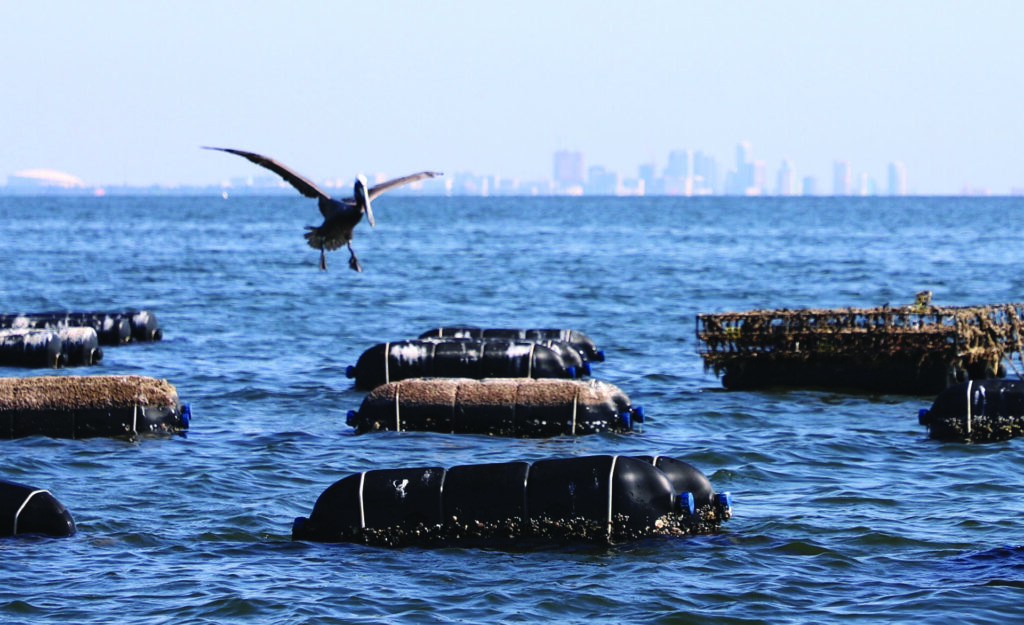
Reed Smith’s boat heaved to starboard as the oysterman tied a rope on to one of his floating farms in the golden Florida morning sunlight. The nest of bobbing rafts holding each cage looked like a string of black pearls on the water, if those pearls were adorned with pelicans.
Brown birds with cottony-white heads and long beaks spied for breakfast near the rafts. The white pelicans that fly south in winter along the Gulf Coast made the browns look small, Smith said. Dozens of pelicans, cormorants, and egrets perched on his aquaculture investment. A handful of seagulls were so noisy, they could have been arguing over politics. There’s a fine line between an oyster farm and a bird sanctuary.
“And they don’t pay rent,” he joked.
Tampa Bay might seem unlikely as an oyster breeding ground, at least to those who don't know about the bay's rich seafood history.
As the lone man onboard most days for Calusa Oyster Company, Smith devised a system of leverage devices for checking on the 250,000 oysters growing on his four watery acres of Lower Tampa Bay. Situated a few miles east from the morning commuter traffic on the gleaming Sunshine Skyway Bridge and a mile or so west of tankers at Port Manatee, he tied off his twenty-one-foot, flat-bottomed Sea Salt Sally to a licorice-black OysterGro float bobbing in the bay. (The boat is named after a pirate character from Scooby Doo.) Then he used a motorized winch to pull the float out of the water at an angle. The idea: Leverage the floating oyster buoy’s anchor on the bottom to keep the boat stable while he pulls out the cage-like plastic inserts that hold his growing bivalves. No use fighting the current and the wind. Farm smarter, not harder.
His wife of twenty-two years, Maura Smith, with whom he founded the company about three years ago, helps on the boat when she isn’t working as a corporate meeting and event planner. Intern Elizabeth Villalba, a recent University of South Florida marine biology graduate, assists three days a week.
If there’s one part of the Gulf that is synonymous with oysters, it’s Florida’s Panhandle—specifically, Apalachicola Bay. Until the state imposed a five-year ban on commercial harvesting there in 2020, ninety percent of oysters sold in Florida came from Apalachicola. To save the lucrative industry, the state imposed the ban for a host of reasons, all of them vexing to oyster harvesters and eaters: Years of drought that limited freshwater flow, overharvesting, stormwater runoff, and hurricanes. Some also pointed to the Florida-Georgia water wars, a complex lawsuit in which Florida accused Georgia of limiting water flow from the Apalachicola-Chattahoochee-Flint River basins, a case Florida lost in 2021 in a unanimous US Supreme Court decision. The state’s oyster harvest fell from 23.5 million oysters in 2019 to 13.1 million in 2023, according to the Florida Department of Agriculture and Consumer Services.
While the harvest of wild oysters is banned in Apalachicola Bay for now, oyster farming is still allowed. Smaller aquaculture operations in places like Pensacola and the nutrient-rich Indian River Lagoon on Florida’s east coast are taking their shot, too, just like Smith is in Tampa Bay. It might seem unlikely as an oyster breeding ground, at least to those who don’t know about the bay’s rich seafood history. Smith is betting that his family’s business will take off just as efforts to restore the bay’s aquatic health are slowly taking hold. And he is doing it in the shadow of a busy interstate bridge.
Most days, Reed Smith is out on the water doing the work of checking on his crop, harvesting, and sorting. He’s owner, captain, navigator, lifter, sifter, cleaner, and tour guide, clad in a pair of waterproof overalls with rubber-soled shoes and a powder-blue, long-sleeved shirt and neck gaiter for sun protection. He’s the one with the anemometer checking wind speed and direction. He’s the hydrologist with the salinity gauge making sure the bay has the right salty cocktail for making oysters grow. And he’s the deckhand, hoisting cages into his boat. It’s been like this since he started.
“If the wind is coming from the east or west, you get these big rollers and that makes it difficult,” he said.
Between hauling dripping bags of oysters, Smith shared that his oyster journey is a distinct left turn from his prior work in a family barbecue sauce company. He also worked in investment banking and, more recently, in insurance before going to the water full-time.
The idea came while he and Maura were watching an episode of Chad Crawford’s How to do Florida travelogue that spotlighted the shrimp and crabs and off-bottom oysters of Florida’s Big Bend region. Thirty years earlier, while Reed and Maura were both in college, they sampled backroad oysters on a road trip between Dallas and New Orleans. They’d shuck in the front seat and throw the shells out the window.
“She saw that TV show and said to me, ‘We could do that.” Smith said. “I quoted a line from the movie French Kiss back to her: ‘You want to be a farmer?’”
It took a couple of years to get the necessary permitting and equipment, but the answer, eventually, was, yes. As they set those first cages in the water, the couple became part of the bay’s long, but nearly forgotten, history of oystering.
Tampa Bay’s oyster population astounded nineteenth-century visitors. Army Lieutenant George Archibald McCall, who arrived at Fort Brooke from Philadelphia in 1824, an outpost on the east bank at the mouth of the Hillsborough River, wrote to his brother, “The lower Bay is the finest oyster-ground on the continent…. I have not eaten such oysters anywhere.” The waters were so rich with shellfish that the Manatee River, which flows west into the southernmost part of the bay, almost to the open Gulf, was once named Oyster River.
By the late 1800s, oyster purveyors in Tampa relied upon growing communities around the Bay. In Tampa, oysters sold for a dollar a barrel at the wharf. Tampa Bay oysters became a nationally known commodity, much like the citrus and strawberries grown in the state. Magnate Henry Plant’s railroad shipped Gulf pompano, snapper, and oysters to markets far from Tampa. The area’s population continued to swell, driven by Plant’s railroad and steamships, the cigar and phosphate industries, and later, the defense sector. But the relentless growth and the attendant pollution, particularly during the twentieth century, steadily decimated the surrounding estuary. The once-prolific seagrass forest that fed aquatic life slowly became something of an aqua desert.
“The volume of aquaculture prior to the late twentieth century is sort of amazing to me,” said historian Evan Bennett, author of the new book, Tampa Bay: The Story of an Estuary and Its People. “Learning about the oyster harvesting part of it, because that had somewhat disappeared by the time I came around,” Bennett said. “I knew people who fished and crabbed, but they weren’t central to the economy…. The shrimping industry no longer gets its shrimp from Tampa Bay. The sense of it as a working bay has been forgotten.”
As the area grew into a megalopolis, seagrasses and mangrove stands were destroyed, reducing habitat for the building blocks of marine life. The shellfish that once filtered the water disappeared en masse as well.
Tom Ries is president and founder of the nonprofit Ecosphere Restoration Institute in Tampa. Methodical planting by the state and Ecosphere boosted the sea grass acreage more than 40,000 acres, Ries said, but 6,000 acres were lost between 2018 and 2024 due to red tide, rain runoff, and a phosphate containment spill into the bay. Even so, Ries is hopeful that new mapping data coming soon from the Southwest Florida Water Management District will corroborate anecdotal evidence that the habitat is on the upswing.
Ecosphere and Tampa Bay Watch separately have been gathering leftover oyster shells from area restaurants, bleaching them in the sun until they are clean, and then bagging them to place back into the bay along shorelines, adjacent to concrete reef balls that also provide hiding places for tiny fish to grow. During the warmer months when oysters spawn, their spat cling better to the recycled shells than other objects. The wild oysters already clinging to piers and mangroves and other structures in the water show that it’s a viable ecosystem, if the water remains clear.
“Oysters can filter fifty gallons a day,” Ries said. “That will help the seagrass.”
Out on the water, downtown St. Petersburg’s tall condos and the white roof of Tropicana Field were visible off the port side of the Sea Salt Sally. Downtown Tampa’s skyline was barely visible over the northeast horizon. The oysters that Smith is growing benefit from state and federal efforts to restore habitat. That oysters can breed in these waters says something positive about the rebounding aquatic health of this nook of the estuary. That Smith is the only one farming oysters full-time in Tampa Bay tells you he’s either a pioneer, an optimist, or a dreamer.
Like any farmer, Smith’s business model is a long-term plan. This is the first year he has started to see some monetary gains. The first few years were about getting the farm established and learning how viable it was. Now it’s about refining the process. He has another 220,000 oysters being grown for next year as last year’s now come to market. His wholesale price: $85 per hundred oysters. At retail, they go for $1 to $1.25 each, depending on harvest volume. Then there are pop-up events, where he shucks 400 to 500 at a time. At this point, he said, he’s up to selling between 2,000 to 4,000 oysters per month. Though his operation is covering operating expenses, that doesn’t provide consistent wages. Work done on the boat is either volunteered—his diving buddy anchors the oyster cages to the bay floor—or covered by a state grant for his intern.
Eventually, the heavy float tilted partially out of the water, pulling Sea Salt Sally’s gunwale closer to the water’s edge. Smith yanked a cage full of oysters out of the device. Even that’s a struggle. Leave anything in the water long enough and living things start to grow all over it. Algae, barnacles, crustaceans. Whatever clings.
Oysters are nature’s filters, and an oyster farm is its own kind of watery lint trap.
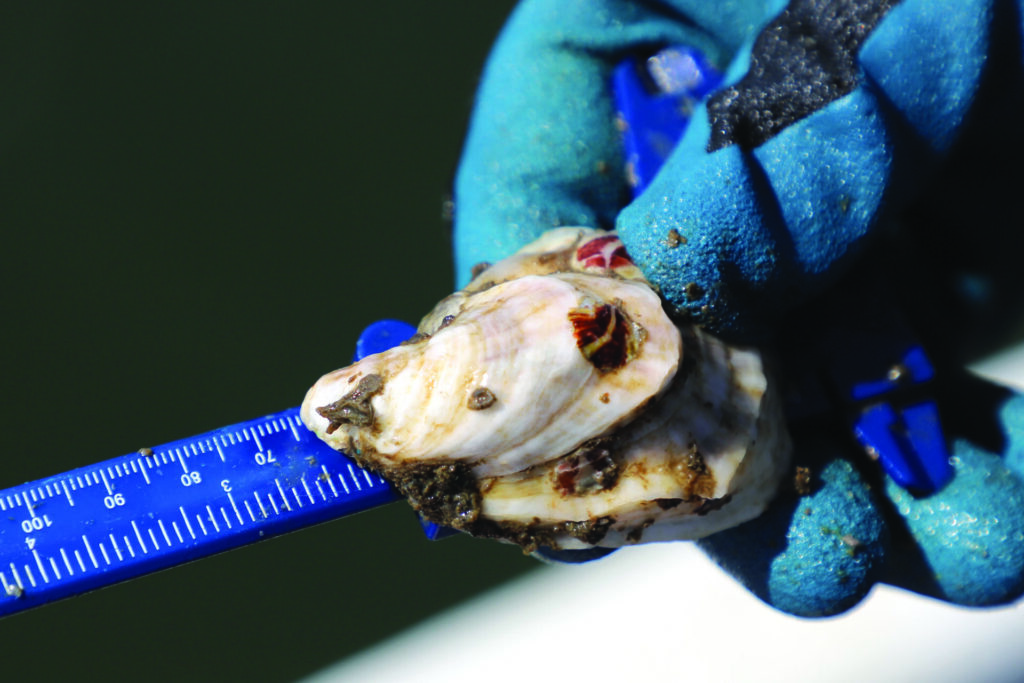
Opening the plastic cage, Smith turned it over until the prizes skittered out like coins from a slot machine. Eastern oysters, most about three inches long, tumbled into an orange laundry basket for sorting. They grow from spat to market-ready in about a year. On the deck, all sorts of creatures dropped and scurried. Baby blue crabs waddled sideways. Tiny amphipods, little crustaceans that feed on algae and detritus, waited to be washed back into the bay.
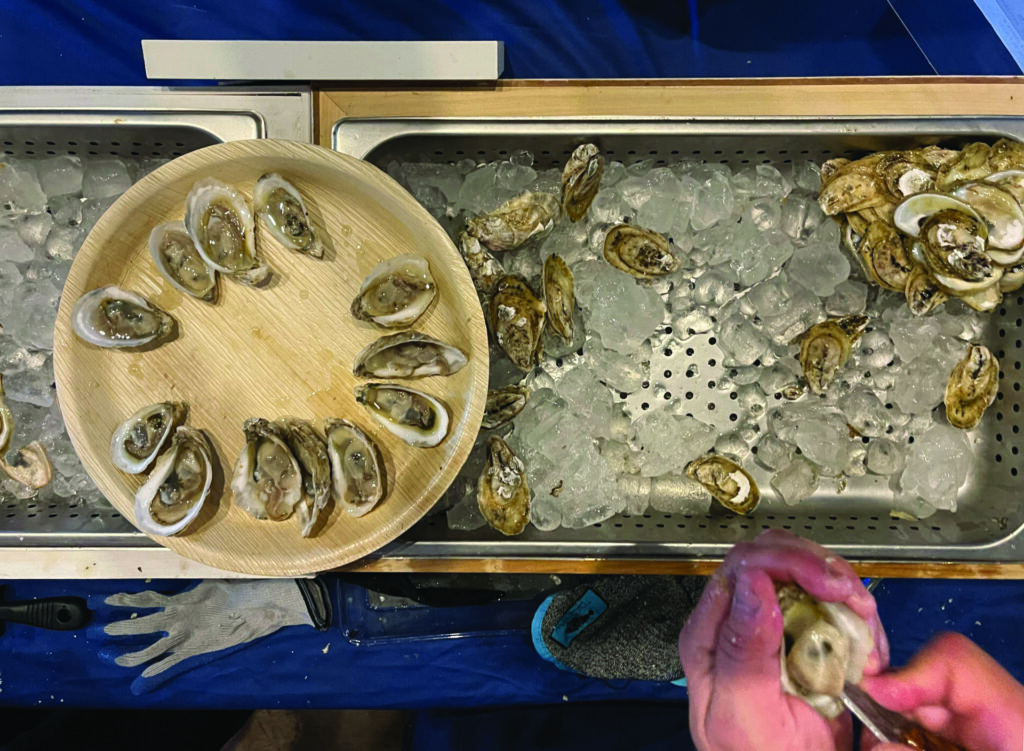
He picked up one of the oysters. He scrubbed the shell clean to reveal a beautiful radius of gray and pearl shadings. With the sharp edge of a putty knife, he twisted his wrist and pried the shell open, revealing a tender oyster swimming in its own sauce. A few slices to separate the adductor muscle from the shell and it was ready to slurp. Local restaurants like The Tides Seafood Market & Provisions in Safety Harbor or The Helm Provisions & Coastal Fare in St. Pete Beach serve Calusa oysters. Cooks from The Helm visited Smith’s farm in June to see where the oysters on their menu come from.
“I was so skeptical with the oysters coming out of the warm water, I thought, ‘Nah, never that!’,” said Garrett Clayton, kitchen manager at The Helm. “Then I ate them, and I am a true believer now. Plus, the cleanliness of the shells is impressive; no need to rinse in the restaurant.”
Taste convinced him the oysters were right for the menu; each deep cup cradled meat that was plump, creamy, buttery, with a flavor like a strong pinch of salt.
It will be January 2026 at the earliest before Apalachicola Bay reopens to wild oyster harvesting. Many observers hope that area will eventually dominate the Florida oyster market again. Nevertheless, Smith intends to push forward with his gambit in the briny waters southwest of Tampa. He is hopeful that Tampa Bay, too, is poised for a comeback.
Jeff Houck is vice president of marketing for the 1905 Family of Restaurants, as well as a co-author of The Cuban Sandwich: A History In Layers.
SIGN UP FOR THE DIGEST TO RECEIVE GRAVY IN YOUR INBOX.