In an Instant A tick bite rewrote a hog farmer’s life.
by Karry King, Illustrations by Daniel Fishel
I scrub my sink and pull out the scale that I bought ten years ago to use at farmers’ markets. Next, I heave my KitchenAid stand mixer onto the counter and attach the meat grinder. I hold the leg of my fourteen-pound turkey and separate the thighs and wings. My knife slides carefully along the breastbone. I slice the breast meat and push it through the grinder. Minced meat falls into a glass bowl. Using a repurposed ice cream scooper, I transfer the meat into Ziploc bags, then weigh and freeze it.
I spent three hours this morning cutting up a whole turkey that I purchased from an organic turkey farm in Pennsylvania. Tonight, I will slather the legs in herb-infused plant butter and roast them at 450 degrees to serve with root vegetables. The thighs will be cooked down and made into gumbo with no sausage. The back and neck will become broth. I pour the broth into large-cubed ice trays and freeze it to make gravy and soup.
Earlier this week, a driver traveled nearly two hours to our house in Citra, Florida, to deliver quail and turkey from a meat distributor near Orlando. Occasionally, I order emu and duck online from Amaroo Hills in Tennessee. The farm is at times out of stock because of high demand from people like me. Emu is an excellent substitute for recipes that call for beef. The legs and necks make hearty broth.
I am not a foodie, nor am I Amish. But I do make everything from scratch. My survival depends on it. I have alpha-gal syndrome, which means I am allergic to beef, pork, lamb, and mammal-derived ingredients. When I consume these meats, my body reacts violently. Eating out is dangerous. Because this is still a lesser-known allergy, I fear not being believed when I ask for my food to be prepared separately. If the waiter or chef doesn’t take me seriously, I might die, or at the very least end up sick. One wrong meal, one slip with cross-contact between “safe” food and off-limits fare, and I could die. I have gone into anaphylactic shock three times because of alpha-gal. Once, because I ate a hamburger. Another, because a restaurant used shared equipment to prepare my turkey sandwich. I’ve even reacted from a microwave at an Airbnb that was previously used to heat mammal products, so you can imagine what a challenge it is to travel. All of this stress, all of these precautions, all of this work is because I got bitten by a tick.
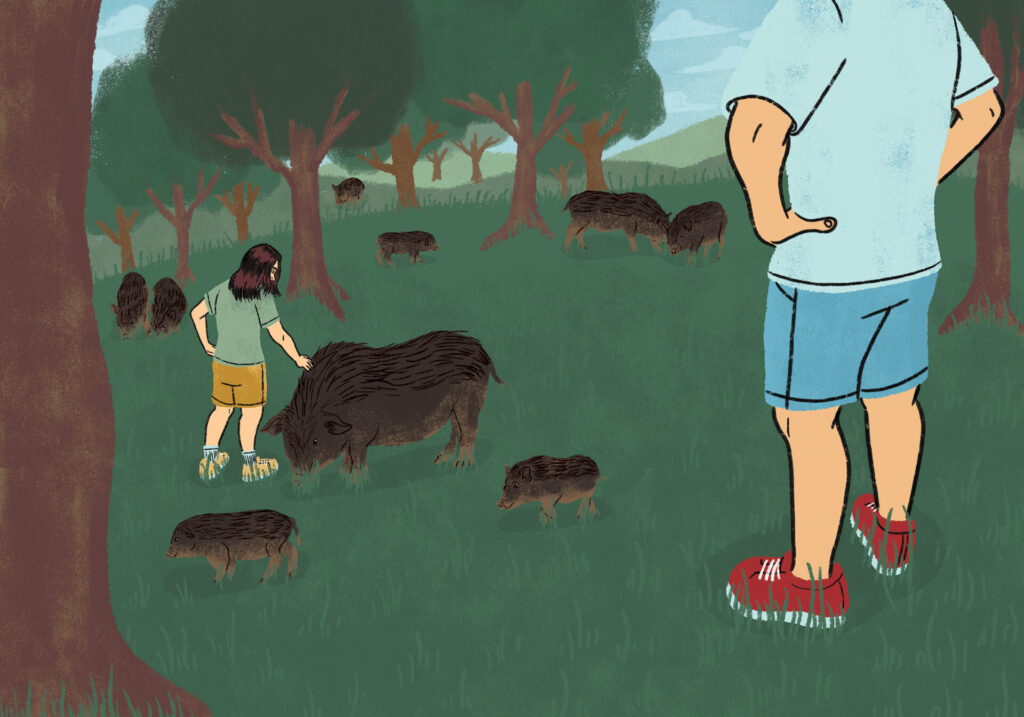
Before the bite, I wasn’t allergic to red meat. My husband and I raised heritage black hogs for fancy restaurants. Our pigs rooted in wooded pastures and dined on acorns, which gave the meat a bold, sweet flavor that chefs savored.
Years before we bought our hog farm, we owned two small natural and organic grocery stores, one in my home state of Illinois and one in Florida. We sold those in 2012 and 2013 and used the money to purchase the farm. Everything changed after we loaned our hogs to a friend to help clear land on their newly acquired eight-acre property.
On Mother’s Day 2017, we loaded six of our hogs onto the livestock trailer and drove them ten miles to a buffet of oak and pine saplings. We strung electrical wire to surround the area where they would graze, and we cooked out on the grill. We walked through the woods to survey the land and squatted between the trees.
Two days later, I found a tick entrenched deep in my thigh. I removed it with tweezers and was relieved when a red bullseye didn’t circle the wound, an early indicator of Lyme disease. I didn’t notice whether the tick had a star on its back. I didn’t know I should look for one.
The lone star tick, named for the single dot that appears on its back, is common throughout the southeastern United States and to date has been found as far west as Texas and as far north as Maine. These ticks carry alpha-gal in their saliva. Other ticks can be carriers, such as the blacklegged tick, but the lone star is the most common. Alpha-gal, short for galactose-alpha-1,3-galactose, is a molecule found in most mammalian cells, except those of humans and the Old World family of primates, such as baboons and macaques. Beef, pork, and lamb contain it, as do dairy products and gelatins that come from mammals. Surprisingly, carrageenan, a plant-based extract from red seaweed used to thicken vegan products and some medicines, also contains the alpha-gal molecule. Luckily, for people like me, poultry doesn’t.
When a lone star tick bites a human, the immune system responds by making immunoglobulin E (IgE) antibodies. From then on, each time alpha-gal enters the body through a hamburger, gel capsule, or even fumes for some people, the immune system releases a cascade of allergic reactions. Though I can’t be certain, the tick that infected me was most likely a lone star tick. They’re migrating farther every year, thanks to a warmer climate and longer breeding season. Fourteen states now require mandatory reporting of alpha-gal syndrome diagnoses to their state health departments. Five other states have optional reporting, with bills passed or pending in three additional states. The Centers for Disease Control and Prevention estimates that as many as 450,000 people have been diagnosed with the allergy in the United States. Many are undiagnosed. It’s a difficult illness to recognize, let alone live with.
Hidden ingredients
Mammal-derived ingredients are in many products you wouldn’t expect, and labels don’t always reveal them. Some breakfast cereals and baking mixes are enriched with animal-derived vitamins, and white cane sugar can be processed with bone char. Depending upon the manufacturer, orange juice can be fortified with vitamin D from lanolin, and wine may be clarified with gelatin from pork or beef. Certain brands of bottled water are filtered with bone char, which has the potential to cause a reaction in some people. Pharmaceutical drugs, over-the-counter medications, and even sutures can also pose a threat. Even some brands of toilet paper report using animal-derived ingredients for “product performance.”
My first allergic reaction was after returning from a trip through the rolling hills of Mississippi. We traveled there to pick up a herd of American Guinea Hogs for Nineteen61, a white-tablecloth restaurant in Lakeland, Florida. We partnered with chef Marcos Fernandez to raise them for Cuban sandwiches and special dishes.
On our way back, we stopped for lunch at an exit along I-75. I ordered a Reuben sandwich with corned beef and sauerkraut. When we got home a couple of hours later, I lay on the kitchen floor in a fetal position with my stomach in excruciating pain. I assumed that I’d grown sensitive to inferior ingredients and whatever preservatives they used.
Unlike some allergic reactions that happen in a few seconds or minutes, with alpha-gal syndrome, reactions are delayed two to six hours, which makes them difficult to recognize. Most food allergens are proteins, which digest quickly, while alpha-gal is a sugar molecule that is usually attached to fats. Researchers believe the slower digestion and absorption of those fats may cause the allergen to enter the bloodstream much later, making it difficult to identify what triggered the immune response. At first, I just had severe stomach pain. Over time, I became anaphylactic.

One night, after eating a hamburger, I woke up covered in hives. My lymph nodes were swollen. The worst part was the projectile vomiting. That calamari appetizer I had earlier must have been spoiled, I thought. Playing armchair epidemiologist, I did an extensive Google search. While vomiting is a manifestation of food poisoning, my overall symptoms aligned with alpha-gal syndrome. This was the first time I’d ever heard of it. Though I didn’t have an official diagnosis at that point, I decided to cut out beef, thinking that had to be the only culprit. At least, that’s what I wanted to believe. We were hog farmers and our livelihood revolved around meat.
I ate lamb chops for dinner a few weeks later and reacted again. A turkey sandwich prepared— unbeknownst to me at the time—on the same surface as other meats probably caused my hand and foot to seize. It felt as though electrical surges were coursing through my body. This is why I have to order any meat I eat from trusted sources. But even suppliers can have a hard time processing food that’s safe for people with this syndrome. Processing must occur at a USDA-inspected facility, something many farmers struggle with. The consolidation of the meat industry has left small farmers with few options for such preparation, which is required when meat is shipped across state lines. Even fewer facilities are equipped to handle large birds such as emu and ostrich.
Though there is no confirmed count, there are currently two known deaths attributed to alpha-gal syndrome: a teenage boy from Australia in 2022, and a pilot from New Jersey in 2024. Neither knew they had the allergy before eating the sausage and steak, respectively, that caused anaphylaxis and led to their deaths.
Typically, alpha-gal is called a syndrome rather than a disease; although its cause is known, its symptoms vary. Every patient is different. Every reaction is different. Some people never experience anaphylaxis, while others report becoming ill from merely breathing cooking fumes. Some patients go into remission and can eat red meat without any reactions. Others go into remission and eat meat for years until one day, their hypersensitivity returns and hits even harder. Some remember getting bitten by a tick. Others do not. Alpha-gal is an anytime allergy, not an every-time allergy. That’s why many of us carry epinephrine pens wherever we go.
Always vigilant
Just as there is a laundry list of things we can’t eat, the list of symptoms we can experience sounds like the litany of side effects narrators rush through at the end of prescription drug commercials: Symptoms might include hives, digestive issues, joint pain, debilitating migraines, chest pains, severe fatigue, cognitive dysfunction, coronary artery disease—though researchers aren’t yet sure why. As researchers learn more, the list continues to grow.
While there is no cure for alpha-gal, and researchers are still learning the full scope of its effects, University of Michigan researchers published a study in 2024 that used nanotechnology to retrain the immune system in mice to ignore the alpha-gal sugar molecule. Delivered intravenously, nanoparticles reduced the immune response and prevented anaphylaxis.
Alternative treatments have also been explored. A 2021 study published in the journal Medical Acupuncture used Soliman Auricular Allergy Treatment (SAAT) to treat alpha-gal. Needles were inserted in the ears of patients and covered with tape, then left for three to four weeks. Many of the alpha-gal patients who previously experienced anaphylaxis went into remission. SAAT is mentioned often in Facebook alpha-gal groups. Some patients report temporary remission and long-term success, while others have said their reactions became more intense after SAAT.
Being in a community through online groups like Alpha-Gal Kitchen and Alpha-Gal Support has proven extremely valuable. I’ve found that strategic planning and self-advocacy are necessary for survival. I met Rita Gardiner, a seventy-one-year-old from Tennessee, through a Facebook group for people who are trying to navigate life with this allergy.
Rita was lucky to be diagnosed almost immediately after being bitten. The average amount of time between a bite and a diagnosis used to be as much as seven years, but now it can be identified in as little as twenty-eight days, especially if someone is presenting with symptoms. A blood test is used to detect antibodies. Even so, many doctors are still unfamiliar with the malady, which can lead to misdiagnoses or unnecessary medical procedures. Some people have mistakenly had their gallbladders removed because of their symptoms, only to find out later that their recurring discomfort was caused by alpha-gal syndrome.

Since being diagnosed, Rita has had a difficult time explaining her condition to her doctors. Twice, hospitals canceled her scheduled medical procedures after learning about her allergy. Some anesthesia medications contain mammal-derived ingredients, as do absorbable sutures that are made from animal intestines. Cartilage from cattle and pigs can be used to make some gelatin capsules. Pharmaceutical drugs can also pose a threat, as not all medications list every ingredient on the bottle and require thorough vetting online. Rita finally found a doctor in Nashville and drives two hours to her appointments.
“Dr. Stone has changed a bunch of my medicine from my heart doctor and my asthma doctor. They were putting me on beta blockers, which keeps the EpiPen from working,” Rita said.
For me, it took six years and a ten-hour drive before I was diagnosed by Dr. Scott Commins, an alpha-gal specialist at the University of North Carolina School of Medicine. Prior to seeing Dr. Commins, I contacted several local doctors who seemed to have no idea what I was talking about.
Since then, I have been to four different doctors for other health reasons. None were familiar with alpha-gal. Two prescribed medications that contained mammal-derived ingredients, despite my condition being listed in my medical chart and my telling them verbally that I was allergic to such ingredients. I caught it the first time and didn’t take the medication. The second time, I took two pills and vomited all night.
Rita and I have both learned how to substitute ingredients and to navigate the supermarket for foods we can eat without much worry. We research ingredients with our smartphones while standing in the grocery store aisle and can scan products with an app called Fig, which is designed for people with various dietary restrictions and tells us whether a food is safe based on our specific needs.
Rita uses ostrich fillets instead of beef to make her favorite recipe, country-fried steak. She pounds the ostrich with a mallet to tenderize the meat, dredges it in flour and egg, and fries it in vegetable oil. Instead of simmering her turnip greens in ham hocks, she uses smoked turkey. Rather than pork lard and beef tallow, we both cook with duck lard and plant butter. Duck lard is excellent for frying, and it makes my strawberry-rhubarb pie crust nice and flaky.
My favorite meat is duck. I find its breast meat is comparable to steak, and I buy whole ducks when they are available. I used to love pork rinds. Now I make cracklings from the duck skin left after I render it into lard. Instead of beef fajitas, I slice emu fillets into thin strips, marinate them in salt, cumin, oregano, and paprika, then sauté them with red peppers and onions.
All of this special ordering and precaution-taking is enough for one person to bear, but what about their friends and family? Alpha-gal has a major impact on relationships. People in my Facebook group regularly post about their spouses and in-laws not believing them or not taking their concerns seriously, which causes strife. In some cases, the tension over dietary restrictions and the inevitable emotional toll on both parties is too much for a couple. Some partners break up. Some divorce. I am lucky to have a spouse who is supportive and understanding. But the allergy has affected us. Even before I was bitten, we began having difficulty finding reliable processors for our hogs. Increasingly, we were traversing the state to bring our hogs to slaughter facilities and then deliver the meat to our customers. Between that and the discovery that I could no longer eat what we raised, we closed our farm, sold our hogs, and both went to work in offices. But working outside the home is extremely difficult with this allergy, at least for me. I can’t eat out for lunch or use the break-room microwave.
Over the last few years, I went back to college to earn degrees in advertising and nonfiction writing. But advertising changed a lot during the Covid pandemic, and I quickly came to feel that I had aged out of the industry. I don’t want to be a TikTok star. I took courses to become a Certified Public Bookkeeper and started a bookkeeping business.
My husband, an entrepreneur at heart, started a shed-building business in 2025. I do his marketing and sales. My current endeavors allow me to work mostly from home. Many mornings, I cook breakfast and turkey burgers for my husband’s crew. And I’m putting my MFA degree in nonfiction writing to the test: I’m working on a manuscript about frac sand mining in my hometown of Utica, Illinois. That project will take many years to complete. In the meantime, I’m drawing on my cooking skills and all the lessons I’ve learned while coping with this syndrome: I’m creating a cookbook filled with flavorful recipes that people like me can savor and safely enjoy.
Karry King is a recent graduate of the Narrative Nonfiction MFA Program at the University of Georgia. This is her first story for Gravy.
SIGN UP FOR THE DIGEST TO RECEIVE GRAVY IN YOUR INBOX.