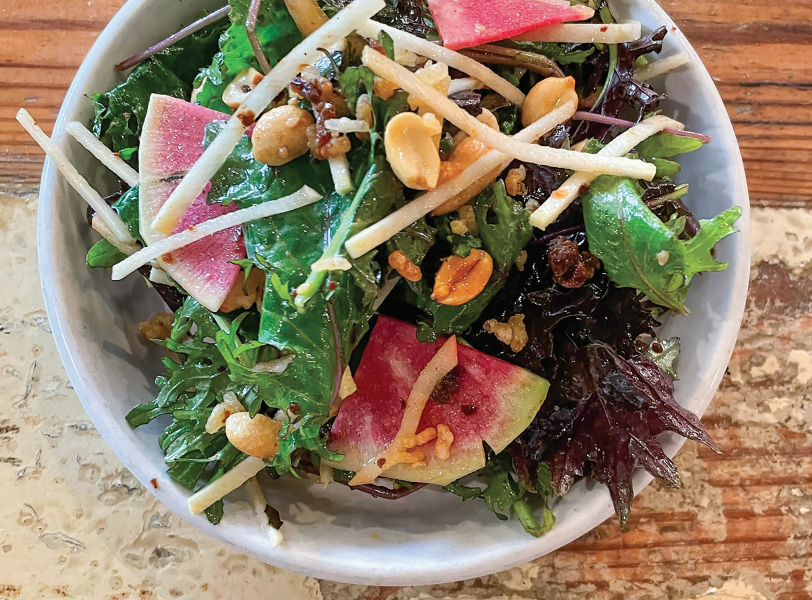

Change, Innovation, and Ambition At Bread & Butterfly, Atlanta chef Demetrius Brown broadens diners’ understanding of French cuisine.
by Jewel Wicker
Traditional French food isn’t everything. Chef Demetrius Brown isn’t afraid to say that with his whole chest, but, most importantly, he says it with nearly every dinner he prepares at his Atlanta restaurant, Bread & Butterfly.
For almost a decade, the restaurant, then owned by veteran chef Billy Allin, felt like an echo of a Sixth Arrondissement café: rolled omelets, asparagus topped with capers, baguettes with jam. A year and a half ago, Brown and business partner Brandon Blanchard purchased the Inman Park neighborhood mainstay from Allin. Brown saw a chance to let diners taste diners how colonization has influenced a foundational cuisine. Customers can still order baguettes and omelets during breakfast and lunch service. But Brown has recently garnered recognition for his changes to the dinner menu at Bread & Butterfly.
The bistro now highlights the influence of the African diaspora. Trained at Johnson & Wale and a veteran of the beloved but long-gone Pinewood restaurant in Decatur, Brown isn’t so much retooling French food as he is showcasing the ways Black and Brown people colonized by France have transformed the flavor profiles of French gastronomy. In doing so, they have created their own classics.
Before Brown and Blanchard purchased Bread & Butterfly, the pair dreamed of finding a permanent location for their pandemic-era pop-up restaurant, Heritage Supper Club. The supper club pulled deeply from Brown’s Trinidadian roots, as well as the culinary traditions of the African diaspora, from the continent to the Americas: mofongo, callaloo, cassava cake. Gravy recently spoke to Brown about how he went from experiencing slow nights—sometimes serving ten guests—at Bread & Butterfly, to the recent influx of new diners they’ve drawn in just a year’s time. In many ways, he says, the work he’s doing is a practice run for the larger plans he and Blanchard still have for Heritage.
Responses have been lightly edited and condensed for clarity.
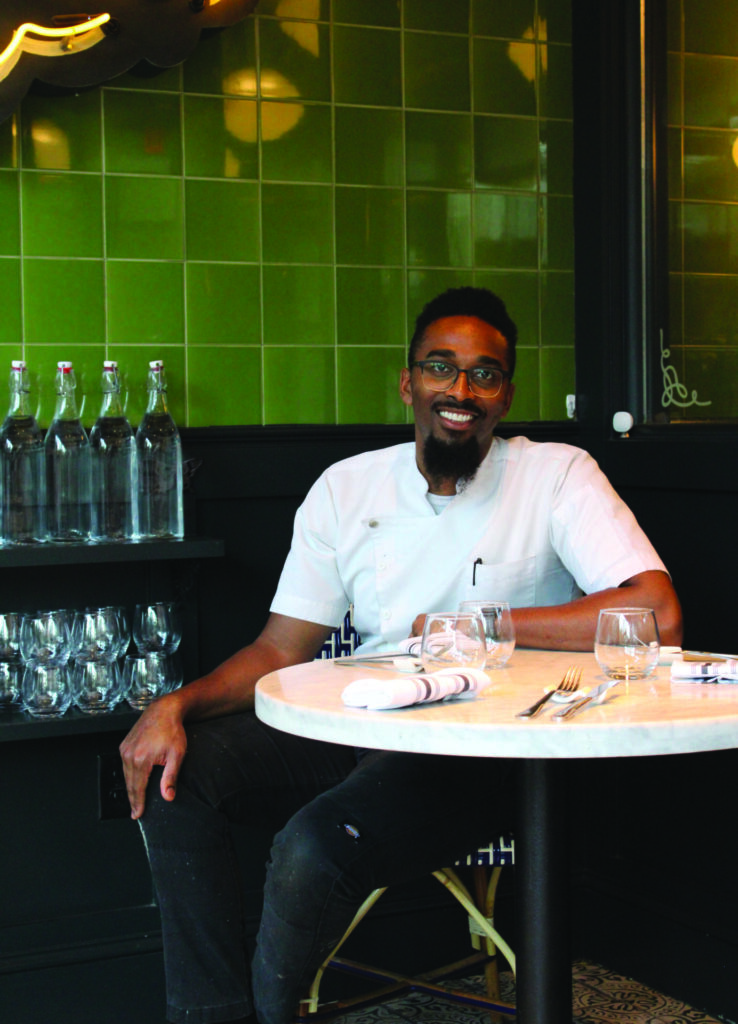
Jewel Wicker: Bread & Butterfly was recently named one of the best restaurants in America by the New York Times. What was that like for you?
Demetrius Brown: It was definitely appreciated. It was very unexpected. When we first took over Bread & Butterfly, Brandon and I sat down with the entire staff and told them that we wanted to be one of the best restaurants in the country. To do that, there were steps that we had to take. We had to be the best restaurant on our street, in our neighborhood, in the city, [and] so on and so forth. To be recognized for the food that we do and the message that we try to spread in our first year of operation here was very humbling.
JW: I was listening to a podcast episode you did with Maximilian Hines, the chef at Breaker Breaker in Atlanta. You were talking about French cuisine, and you called it “overrated.” I’m curious why you’d buy Bread & Butterfly, which is a French restaurant.
DB: When we got the offer, initially I said no. [Brandon and I] had just got off of doing a dinner to donate money to [Hope for] Haiti. [We thought about] all the French influence they have and other places around the world that have influences that are within the African diaspora. It started to make a lot more sense. We talked about maybe just buying it and turning it into Heritage, but that would have [taken] way too much money that we didn’t have. I still firmly believe French food is overrated. There [are] so many other cuisines that are more receptive to change and receptive to innovation than French food is.
JW: When you decided to purchase Bread & Butterfly, it was always with the idea of exploring French colonialism through the menu?
DB: One hundred percent. I didn’t want to change who I was or what I made just because I was in a “European restaurant.” I knew there was a way to tie those two together.
JW: In a lot of businesses that are creative, you have to make negotiations. In your case, you still have to serve the regular menu for brunch and lunch, but you can be more experimental for dinner.
DB: Honestly, brunch and lunch [are] what keeps our doors open and I realize that. But if we could make the decision to close for brunch and lunch, we definitely would. We feel what we’re doing at dinner, that’s what really put us on the map with The New York Times. We were hoping to get a Michelin recommendation. It didn’t happen [this year], but I think next year we’ll definitely be in the picture. Hopefully.
JW: Take me through your recipe development process. You’ve talked before about wanting to have depth and not wanting to just have surface-level cuisines, especially when we think about the African diaspora. What goes into researching and recipe developing to make sure that menu items have a depth to them?
DB: We’re actually about to add soup joumou back on the [dinner] menu, but we’re going to change it up a lot from what it was when we first opened. We want to flip it on its head to where we are now using better cuts of meat. We’re making our own pasta—so that adds back in the colonialism and the European aspect of it—and we’re turning it into a dumpling rather than just having it as a soup. We’re trying to mix cultures as much as we can but also keep the roots and the story.
JW: What does the future look like for Heritage? And what’s the plan for Bread & Butterfly with that in mind?
DB: We actually have a space [for Heritage] we’re looking at now that Brandon and I both are really, really excited about. We can’t say anything now, but it’s in an up-and-coming neighborhood that has a lot of history in Atlanta from the 1990s. I’m sure you can do the math on that. One of our goals is to be the second Black-owned restaurant in America to be Michelin-rated. Beyond that, we want to be one of the best in the country [and the] best in the world. For Bread & Butterfly, we’re going to put somebody in place here who can carry on what I’m doing. Not to say that I’m going to walk away completely, but our main focus will be Heritage and building that concept and getting the recognition that Black and Brown people have been devoid of for 500 years at this point.
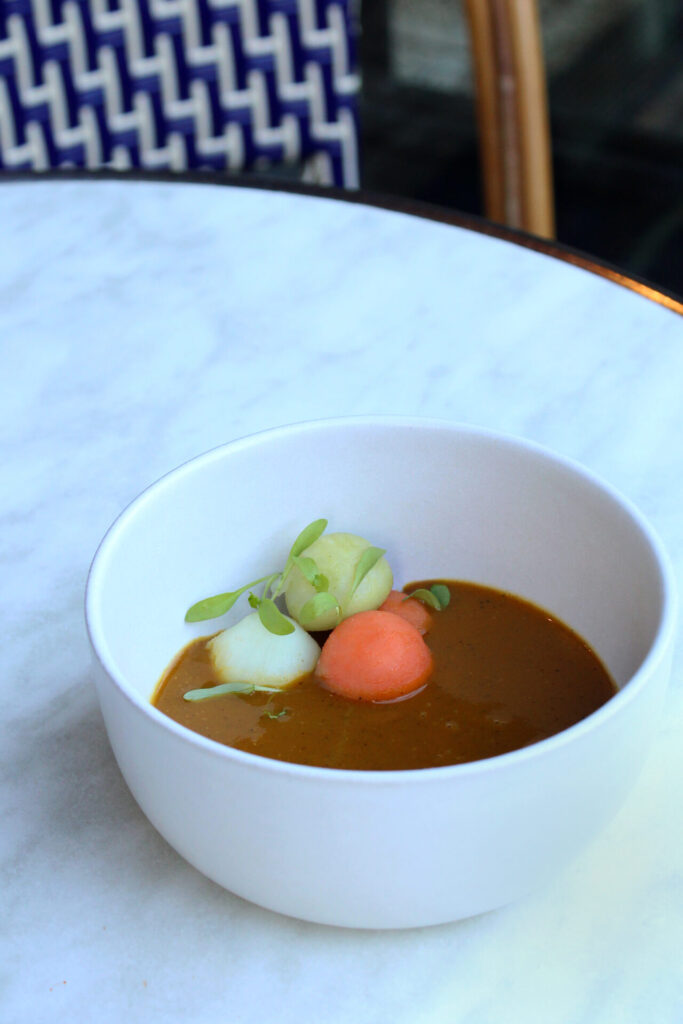
Chef Demetrius Brown’s Soup Joumou
Soup Joumou is a Haitian celebration food, traditionally served on January 1 to mark Haiti’s independence from France on that day in 1804. The star of this savory soup is calabaza squash. The recipe typically includes many more ingredients, including noodles, beef, cabbage, and a variety of root vegetables. In chef Demetrius Brown’s simple adaptation below, which is also vegan, winter squash is the star of the show.
Serves 6 to 8.
1 small calabaza squash (about 4 pounds), peeled, halved, and cut into 2-inch cubes
2 tablespoons olive oil, divided
2 medium yellow onions, diced
5 cloves garlic, crushed
2 tablespoons smoked paprika
1 tablespoon nigella or cumin seeds
1 tablespoon besobela (Ethiopian basil) or dried basil
1 tablespoon freshly ground black pepper
1 teaspoon kosher salt, plus extra to taste
1 14-ounce can unsweetened coconut milk
1 green Scotch Bonnet pepper or habanero left whole
4 cups water or vegetable broth
*Note: Leaving the Scotch bonnet pepper whole during the simmering process is meant to add a warm, pleasant heat to the dish. Remember to remove it before blending the soup, and do not let it disintegrate and release its seeds into the rest of the soup while simmering. Otherwise, it will be too hot to eat.
Heat the oven to 400° F.
Place the squash and 1 tablespoon of the olive oil in a large bowl and toss to coat. Transfer to a rimmed baking sheet lined with parchment paper and roast in the oven for 30 minutes or until lightly golden in color. Remove from the oven and set aside.
Place the remaining tablespoon of oil in a Dutch oven or large pot and set over medium heat until the oil shimmers.
Add the onion and garlic and sauté until the onion is translucent, being careful not to let garlic brown, about five minutes
Add the roasted squash, smoked paprika, nigella seeds, besobela, black pepper, and salt to the pot and stir to coat until spices are fragrant, 2 to 3 minutes.
Add water to cover the squash mixture, using more if needed to cover completely.
Add the coconut milk and whole Scotch Bonnet pepper and simmer, uncovered for 30 to 45 minutes, or until the squash is fork tender. Do not allow the Scotch bonnet to break down and release seeds into the soup or it will be too hot.
Remove the bay leaves and whole pepper, and puree with an immersion blender or transfer the mixture in batches to a food processor or blender and puree until smooth. Taste and adjust the seasoning as desired.
Jewel Wicker is the former interim managing editor for Teen Vogue. The award-winning writer and producer currently hosts the film and television podcast, The Boom, on WABE in Atlanta.
SIGN UP FOR THE DIGEST TO RECEIVE GRAVY IN YOUR INBOX.