Where’s the Spirit of ’76? A big birthday deserves a big cake, but they were conspicuously absent this summer.
by Hanna Raskin
To the bargain shopper who’s grown accustomed to browsing Facebook Marketplace, with its bold headlines and detailed photographs, encountering a page of classifieds from a 1984 edition of the Atlanta Journal can be startling, like seeing a country sky after a lifetime of stargazing in the big city.
Yet amid the dense and tiny text on July 5—in the first of ten columns, about three dozen listings down from the top—was an offer that must have stood out. “CAKE, 1 slice,” the ad hawked. “Cut by Miss Lillian Carter in 1976 from Bicentennial cake in Plains Ga. Mother of Former President Jimmy Carter. Going for world’s record.”
Every eight-year-old slice of cake is intriguing. But this piece of pastry poses more than the usual number of questions because there is no record of a Plains attempt to produce the biggest bicentennial cake in history.
According to an archivist at the Jimmy Carter Presidential Library and Museum, there isn’t even any evidence of Lillian Carter participating in a July Fourth party.
Obviously, I wanted to know more about this cake’s provenance. Plus, I was curious why the seller had paid extra for a sentence defining Miss Lillian, since it seemed so unlikely that anyone who wasn’t a Carter devotee would rather have stale cake than an Apple IIe or a hi-fi VCR, among the hundreds of other items hawked to Atlantans that day.
Unfortunately, both phone numbers at the end of the ad are now disconnected. So, I don’t know where this advertiser acquired said cake, nor who first baked up the story accompanying it. Perhaps it was a scam, because such a ruse could only work if there was national consensus on something that’s been barely discussed in our semiquincentennial year: A big birthday deserves a big cake.
Bicentennial cake fervor seized the United States even before 1976 began. At Trinity Senior High School in Thomasville, North Carolina, a town best known for its eponymous furniture, student council members got together in December 1975 to make and freeze cakes that, smushed together, would feed their 800 classmates—but not before they frosted the conglomerate to read 1776.
In Brownsville, Texas, schoolchildren got started even sooner, launching a can drive in 1974 to fund the purchase of $1,300 worth of ingredients (nearly $9,000 in 2026 dollars) for a patchwork quilt–style cake saluting American history that stretched 12-by-14 feet. The cake, displayed at the Amigoland Mall, was cut and served for free on July 4, 1976.
Nowadays, it seems almost quaint to bake as an expression of patriotic sentiment, even though it was just a quarter-century ago that The Onion—reaching for humor in the wake of 9/11—reported, “Not Knowing What Else to Do, Woman Bakes American Flag Cake.” As with all satire, it’s only funny if it’s true.
This year, though, if Americans are making 250th anniversary cakes, they’re not saying so publicly—at least, none of my online searches or casual conversations turned up any proof of them. Maybe it’s GLP-1 drugs that are keeping Americans out of the kitchen in 2026. Or maybe we’ve gotten past the point at which we needed to conceal our collective anxieties in carbohydrates, since we now have less appetizing ways to broadcast worries widely. Because while bicentennial cake baking might strike us as charming now—and surely was seen as harmless fifty years ago—the yearlong obsession crystallized deep tensions between fondness for the nation’s folksy past and enthusiasm for its technological future.
That wasn’t a dynamic confined to cake in 1976. As New York Times columnist Russell Baker wrote in the aftermath of Jimmy Carter’s election, “In its old age, America yearns for the sticks.… As for the Democrats, in Carter, they have chosen the most countrified candidate of all.” Carter’s campaign embraced and encouraged the idea. His autobiography explained proudly, “My life on the farm during the Great Depression more fully resembled farm life of nearly 2,000 years ago than farm life today.”
In other words, bicentennial celebrants were in a mood to combine flour, sugar, and eggs the way they believed their forebears did—a belief that wasn’t shaken by the fact that those grandmothers and great-grandmothers may have “made cake” by instructing an enslaved or underpaid cook to do so. But the results sometimes revealed how much the country was already changing.
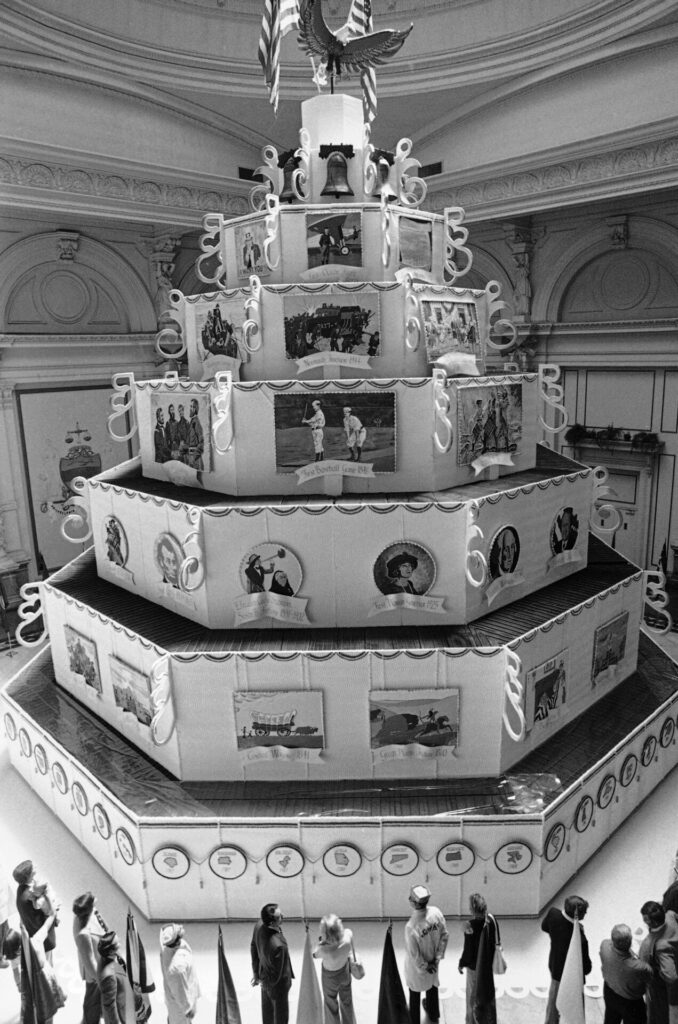
To be sure, home economics had little to do with the most newsworthy bicentennial cakes, including an 800-pound monolith constructed for the 1976 Jacksonville Home and Patio Show, which incorporated a bubbling fountain, a spinning wheel, and a depiction of George Washington, along with miniature replicas of “modern cars, airplanes, and rockets.” Other cakes built to wow included a five-story-tall chocolate cake put together by Sara Lee for Philadelphia’s Memorial Hall and a butter pound cake prepared for the National Archives to slice with a historical sword from its collection as the US Army Band played “Happy Birthday.”
Still, of all the cakes based in bluster, none received more unwanted attention than the misbegotten effort by the city of Baltimore to claim a world record for cake magnitude. Soon after the 72,000-pound cake was positioned along Baltimore Harbor, it started pouring. “I was promised a covering,” head baker Harry Herman glowered as red, white, and blue icing bled into a purplish murk.
Weeks later, he was still fuming. “I pleaded with [the Bicentennial Commission] not to sell the cake for $2.25 apiece,” Herman told a reporter as the city disposed of more than 17 tons of unsold cake, mostly spoiled and rat-infested. “Sell it for $1, or $1.25, I told him.”
That episode was thankfully an outlier. Far more common were the modest local commemorations, like the one in Statesville, North Carolina, for which a quartet of school cafeteria workers iced the Liberty Bell on a sheet cake. Also popular were bicentennial cake contests, such as the one mounted by North Carolina’s annual Culinary Arts Show: Second place went to a resident of the facility now known as the Sanford Correctional Center, who decorated his cake with an eagle and the slogan, the free man.
And what was the material incentive for home bakers to demonstrate their command of traditional American cake-making methods? In several places, it was a microwave.
One of the requirements for the Rural Electric Cooperative Corporation’s Bicentennial Cake contest was every entry had to “travel well,” since representatives of county co-ops across Kentucky were charged with bringing countywide winners to the state finals in Louisville.
Otherwise, though, contestants were given wide latitude to determine what defined Bicentennial Cake, beyond color schemes and Colonial figurines. In Mercer County, submissions included prune nut cake, three-layer fruit cake, jam cake, fruit cocktail cake, custard pumpkin cake, pecan cake, and Bacardi rum cake.
They were all bested by a sour cream cake, which earned its maker an electric frying pan and a chance to win a microwave oven. Ultimately, though, the grand prize went to Brenda McDowell of Shelby County, who’d advanced on the strength of her fresh apple cake.
“Oh, my goodness, I haven’t baked that cake for years and years and years,” McDowell, eighty-four, said when I reached her by phone at the Bedford, Kentucky, home she shares with her eighty-eight-year-old husband. “But it was a three-layer cake, and I iced it with brown sugar icing.”
According to McDowell, after she remade her cake for the state judges, it was whisked away by RECC member services adviser Sybil Krieger. The contest was aired live on WHAS, but she wasn’t watching TV when the station’s legendary farm reporter, Barney Arnold, read out her name.
“I was stripping tobacco for a friend of ours down the road,” she said. “He told me it won.”
Soon thereafter, Krieger returned with her microwave. But McDowell didn’t start clipping recipes for microwave cakes. Even though she owned the appliance before 96 percent of Americans did, she doesn’t recall ever looking for microwave-ready cake mixes at the supermarket either.
“I’m not a microwave cooker,” said McDowell, who was preparing jars for raspberry jam when I called her this past spring.
McDowell hadn’t considered coming up with a cake for the country’s birthday this year; entering the 1976 contest was the sum of what she did to mark the Bicentennial. But if she had to enter another bakeoff, she has an idea of which cake she’d make.
“I have a pineapple banana cake; you can freeze it and everything,” she said. “Everyone thinks it’s out of this world.”
Nobody thinks it’s out of a microwave.
Hanna Raskin is founder of The Food Section.
SIGN UP FOR THE DIGEST TO RECEIVE GRAVY IN YOUR INBOX.