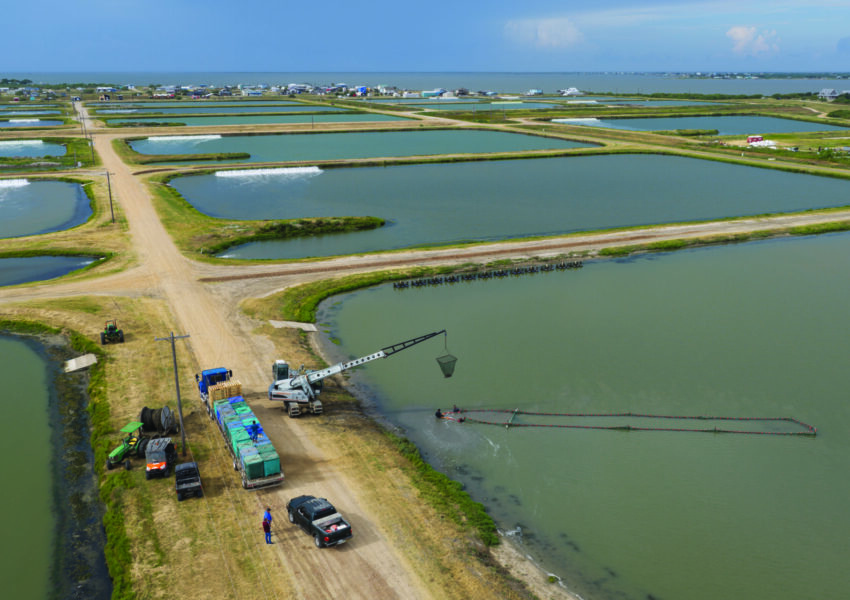
Catch of the Day: Travels with Bud Fishing for mullet and Florida history
by Michelle Zacks
It is the kind of fish that will smack you in the face or thump you on the back. Not intentionally, mind you. But if you happen to be in the way as it jumps up and slaps back into the water, moving in schools for fun or to run from predators, you might get a face full of mullet. That’s how I first encountered the species, paddling a canoe across a Georgia inlet and winding up with a boatload of fish. A common adjective attached to this fish is humble, yet it is a confident creature with places to go. Long a staple on many a Southern table, mullet these days more often is labeled as trash.
For a fish little known to Americans outside the southern Atlantic and Gulf coasts, Mugil cephalus carries a lot of names: striped, black, gray, flathead, sea, popeye, or—on account of its predilection to leap—jumping mullet. Some folks in Mississippi call it Biloxi bacon, a name that signifies how the species has kept hunger at bay during high times and low. Nineteenth and early-twentieth century newspapers referred to mullet as “the staff of life” and the Gulf of Mexico as the “people’s meat house” because of its plentiful stocks of the species.
Along with its many names, mullet holds deep meanings for Southerners who catch and eat this inshore fish.
Florida waters are where the fish thrives and where the biggest mullet fisheries have been. Since European colonization, Florida’s beaches and tropical plentitude have fueled fantasies of escape and transformation, personal and collective. The history of mullet reveals an organic essence, a cultural world based not on transformation but on accommodation to Florida’s waterlogged ecology. Ample schools of the fish occupy shallow shorelines, bays, and estuaries, moving between salt and fresh water. Plenty of mullet means plenty of food. Mullet feeds on detritus, and all the saltwater carnivores feed on it: sharks and seatrout, great blue herons and brown pelicans, porpoises and people.
The fish is a significant component of the shallow-water ecosystems of the Gulf of Mexico and the inshore waters of the Atlantic coastline, up through North Carolina, where mullet fisheries are also an important part of the region’s culture. So much mullet was harvested in Florida over the years—an average of 24 million pounds annually between 1950 and 1993—that it was long considered Florida’s “money fish.” That money was earned by virtue of volume, not price.
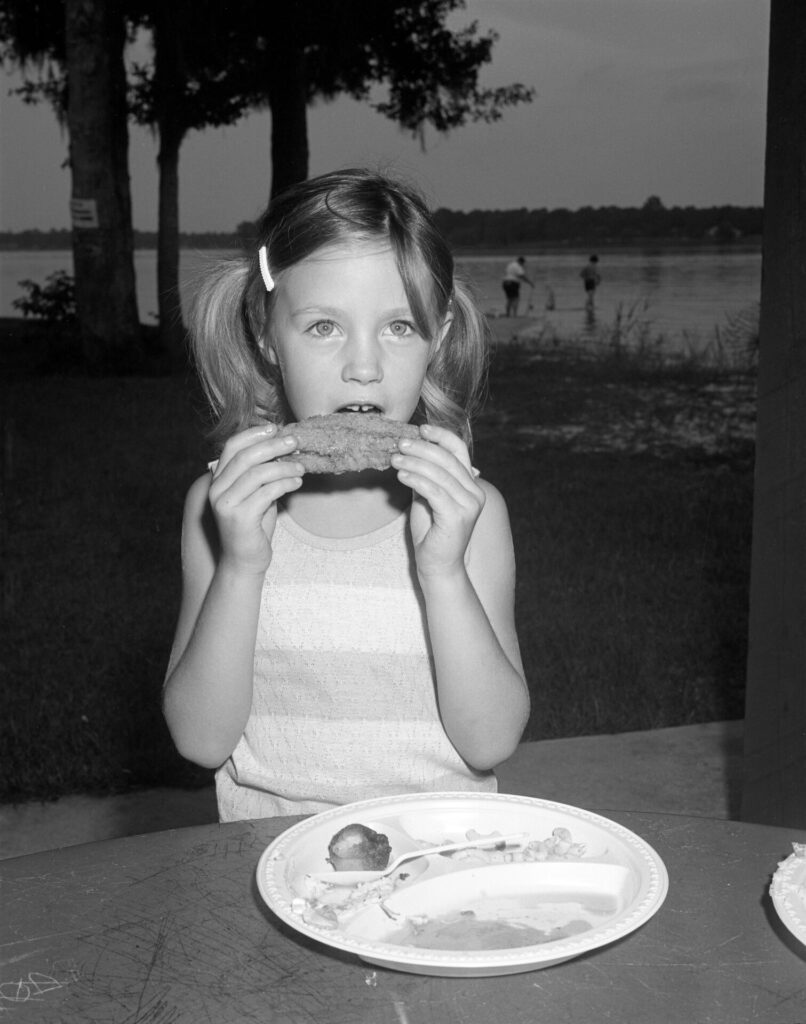
(State Archives of Florida/Holland)
CREATOR
Holland, Karl E., 1919-1993.
While I have eaten lots of mullet over the past several decades, the fish did not feed me as I was growing up. The daughter of a German immigrant mother and Polish on my father’s side, I was reared in Connecticut on kielbasa, sauerkraut, and potatoes. Pickled herring and smoked bluefish were on the seafood menu in our house. But somehow, the Indigo Girls’ tune “Southland in the Springtime” became my theme song: “When God made me born a Yankee, he was teasing.”
Though I’m back in Connecticut now, I spent most of my adult life in the South: North Carolina, Georgia, the mid-Atlantic borderlands of Maryland’s Eastern Shore. And Tampa, Florida, where I lived for thirteen years.
It took a while to call Tampa home. Like so many others, I moved there for employment and educational opportunities, part of the demographic boom of the late twentieth century. For the first couple of years, it felt steamy and soulless, a flat expanse of fast-food chains, clogged roadways, and endless construction. When the mom-and-pop fried chicken joint around the corner went out of business, a mortgage brokerage company replaced it. But there were local tastes to be found, and gradually they reeled me in. Café con leche, devil crab, and the Cuban sandwich put Tampa on the map. These foods are clues to Tampa’s history as the final step in the growth of the tobacco industry, after Cuba and Key West, to become the leading late-nineteenth century “Cigar City.”
Then, in 2003, around a decade after I arrived, I found the city’s culinary heart in a trailer on a dirt road about a mile west of Tampa International Airport. At a cluttered kitchen table, I dove into fried mullet, boiled cabbage, and stewed okra, all doused with Crystal Hot Sauce and hot-pepper vinegar, served up by a septuagenarian by the name of Mr. Grady Albury, Jr.
Bud, as he was known, has since passed on to the tangled mangrove shorelines of the great beyond. Twenty years ago, the snowball nature of oral history work led me to his door. While interviewing Tampa net fishermen, Bud’s name came up again and again. A fourth-generation Florida fisherman, Bud was the one to talk to, I was told. Following in his uncles’ footsteps, Bud was a commercial mullet fisherman, blue-crabber, net-hanger, and boat-builder—the last of the old-timers of Tampa’s fisheries. Born two years before the stock market crash that augured the Great Depression, he came up in the days of push-poles and motorless skiffs, when nets were made of linen or flax and mullet sold for pennies a pound. The great-great-grandson of white Bahamian immigrants to the Keys, he was a child of Florida well before the post–World War II population boom, before Disney, before Tampa and so much of the state turned from country to city and suburban sprawl.
Bud fed me mullet and stories. During the last few years I lived in Tampa, we spoke every week, on the phone or at his kitchen table. We hunkered down on spiderwebbed chairs in front of Big Mama, the wood stove beneath the corrugated tin roof of his barn. He showed me where his uncles had a fish camp at the mouth of Double Branch Creek. While other drivers honked their horns and gave him the finger, he cussed liberally as he drove me around town, very slowly, in his Ford F-150 pickup—battered and blue, the panels covering the inner guts of the doors long gone. The more time I spent with Bud, the more Tampa and Florida came alive.
Long before Bud’s ancestors settled there, and before Seminole settlement of the region, the rich estuaries of the Tampa Bay area were home to multiple Indigenous peoples: Manasota and Mocoso, Tocobago and Timucua, Pohoy and Uzita.
The sparsely populated rural landscape he grew up in was only possible because of the centuries of conquest of native cultures, initiated by the Spanish and drawing to a bloody close with the United States’ acquisition of the territory. By the time Bud was born, Tampa’s built environment was centered in the tightly drawn boundaries of the city proper. Dirt and shell roads, farmland, and cattle pastures made up a large part of surrounding Hillsborough County. The coastlines were mostly mud and mangrove, dotted with temporary wooden fishing shacks. Sweetwater Creek, a tributary that enters Tampa Bay on the western edge of the county, Bud told me, was “like some river in a foreign land, unmolested. It ran swift and cold and you’d jump in, and it would take your breath away.” As we spoke, the section of the creek that ran through Bud’s former neighborhood looked like a muddy drainage ditch.
For Bud and his uncles and all the other inshore commercial fishing families of Florida’s west coast, there were ample sheepshead and seatrout, blue crabs and oysters to harvest, but mullet was the bread and butter of the industry. Fundamentally Southern as a fish and a food, mullet is an oily fish and does not keep well, so it rarely travels far from net to plate. Another factor contributing to mullet’s regionality is merrior—the way particular environmental characteristics shape the taste of marine creatures, like oysters and like mullet. Sandy seagrass beds and higher salinities produce a good-eating fish. Plenty of people consider mullet to be a muddy trash fish, only good for bait. Possibly such folks have only ever tasted it from muddy-bottom habitats. Or maybe they have convinced their taste buds that bottom-feeding creatures are déclassé.
With so much of it available so close to shore, mullet has been a staple protein for many Southern communities. The dependability of the fish allowed diverse populations of people to adapt to challenging environments over the course of thousands of years. In southwest Florida, mullet was the base of the rich shallow-water ecosystems that formed the foundation for the mighty Calusa kingdom. Between the first and fifteenth century AD, the Calusa grew into the only hierarchical, sedentary North American civilization, and one of few in the world, built through fishery surplus, rather than agriculture. During Spanish colonial rule, ethnically mixed communities of Cubans, Indigenous people, and self-emancipated Black people harvested mullet from fishing ranchos along Florida’s southwest coast. After the United States took possession of Florida in 1821, the mullet fisheries continued, eventually dominated by white commercial fishing families who migrated from North Carolina and other Southern states. Some Gulf Coast locations that were home to these successive waves of mullet-dependent communities—such as Pine Island, Cortez, and Cedar Key—continue to be centers for what remains of Florida’s fisheries.
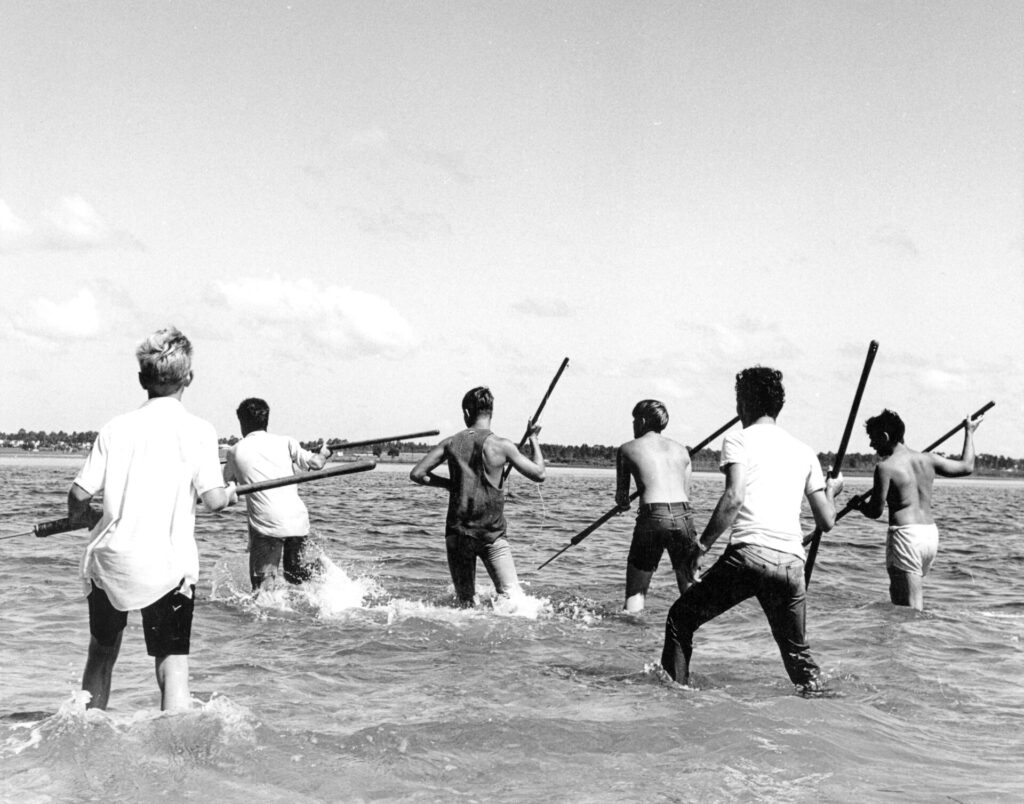
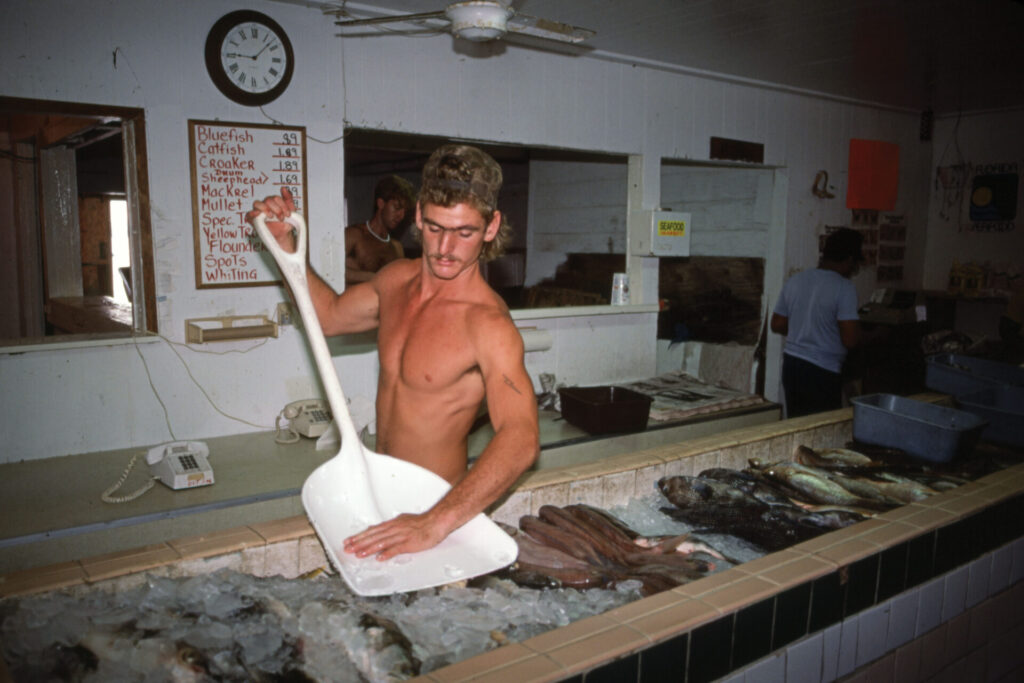
Mullet has always been a low-cost species, selling for well under a dollar per pound through much of the twentieth century. For some households in Florida, Alabama, Georgia, and the Carolinas, it was on the table at least once a week, and every day for commercial-fishing families. Many mullet-eating folks describe their love of the fish by explaining how it kept their families fed during times of deprivation. As Bud put it, “They say when there ain’t no mullet, your belly’s pinching your backbone.”
Throughout most of the twentieth century, you could buy fresh, salted, and smoked mullet in the grocery stores of Florida’s growing cities. Peddlers drove oxcarts, and later trucks, through the countryside, selling fish in coastal and inland Florida, Alabama, and Georgia. Bud’s mother was one such peddler. Her rural customers, Black and white, generally had little cash to spare, so the “Fish Lady” often traded mullet and crabs for farm produce. Riding in a truck with coolers in the back, his mother would ring a brass ship’s bell and call out, “Here comes the Fish Lady!” Bud remembered. “She brought home watermelon, cantaloupes, tomatoes, turnip greens, mustard greens,” and the rare treat of a chicken or two, if not cash.
At his kitchen table, Bud’s fried mullet gave me a visceral taste of the histories he shared. During my visits with other commercial fishing families along Florida’s west coast, I likewise was treated to generous platters of mullet fillets, dusted with cornmeal and cooked quickly in a deep fryer. The same oils that make it spoil quickly also impart a rich, nutty flavor. Fresh from the water, crispy and meaty, mullet is a savory meal. I would fight somebody for the last bite.
As Florida’s population boomed, eating fried mullet became a symbol of grassroots authenticity. In segregated public gatherings throughout the state, fish fries brought people together for outdoor political rallies, Fourth of July gatherings, bridge openings, and community fundraisers. Swamp cabbage, hushpuppies, grits, coleslaw, and sweet tea were the traditional Florida sides. With the fish often donated by individual commercial harvesters or fish wholesalers, fishermen, most of them white, and seafood processors, many of them Black, generations of Floridians breaded and deep-fried massive quantities of fillets in large cast-iron kettles.
At a 1963 fundraiser in St. Petersburg for the Pinellas Park Boys Club, the public was invited to eat their fill for the price of one dollar. As “happens every year,” a reporter wrote, the organizers quickly ran through their first one-and-a-half tons of mullet and had to send for more. By the end of the event, over five thousand people had been served. While barbecue was king at political events in other Southern states, mullet fish fries reigned in Florida.
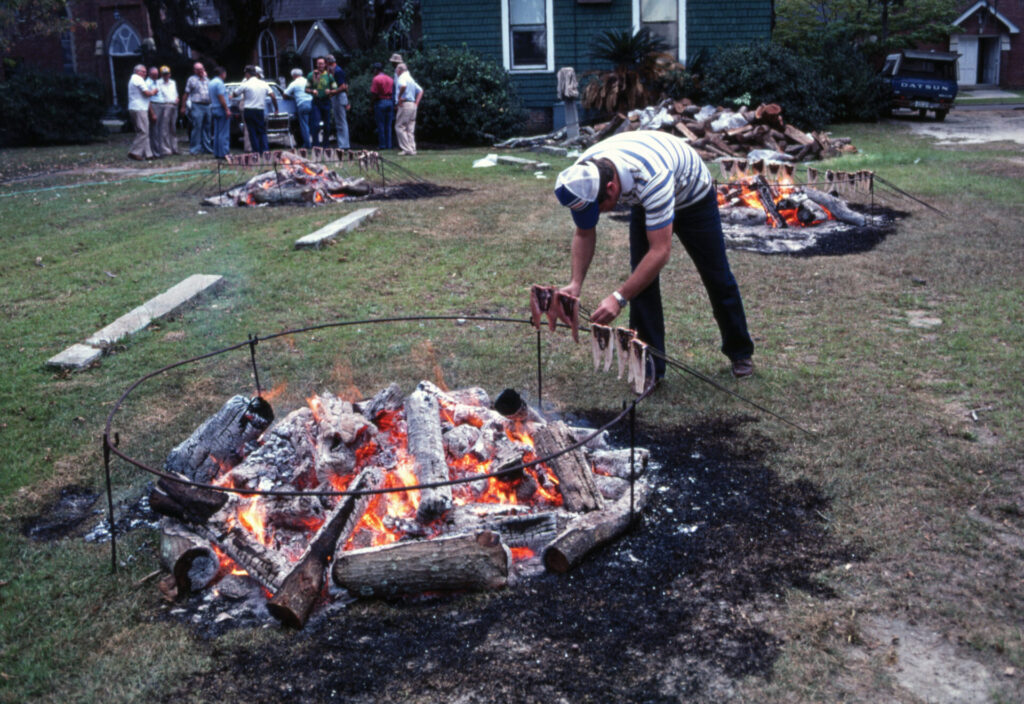
Photo by Ormond H. Loomis, State Archives of Florida
To prove their Floridian bona fides, candidates for local and state office rolled up their sleeves and tucked in at public fish fries and hosted out-of-state business leaders and politicians as well.
World War II exerted profound influences on the state of Florida as a whole and on its ubiquitous fish. The war itself brought massive development as military bases took hold, while service members and veterans flocked to the state in the aftermath, drawn by the climate, the postwar car culture, and the new interstate highways. As tourism, specifically sport fishing and beachgoing, became the dominant ethos and economy of the region, the value of coastal property soared. At first, Florida mullet held little significance for many new residents and tourists. The limited marketability of mullet was a thorn in the side of Florida fishery managers, state economists, and chambers of commerce. In the 1950s and 1960s, they created marketing schemes to increase the consumption of what they deemed to be an “underutilized species.” The popularity of smoked mullet in beachside locales came out of these marketing campaigns. Among Florida newcomers, shoreline restaurants such as the Mullet Inn on Tampa’s Courtney Campbell Causeway and Ted Peters Smoked Fish in South Pasadena helped popularize smoked mullet as part of the middle-class, beach-oriented recreational experience. Smoked mullet became a tasty snack for people flocking to Florida as a Sunshine State playground.
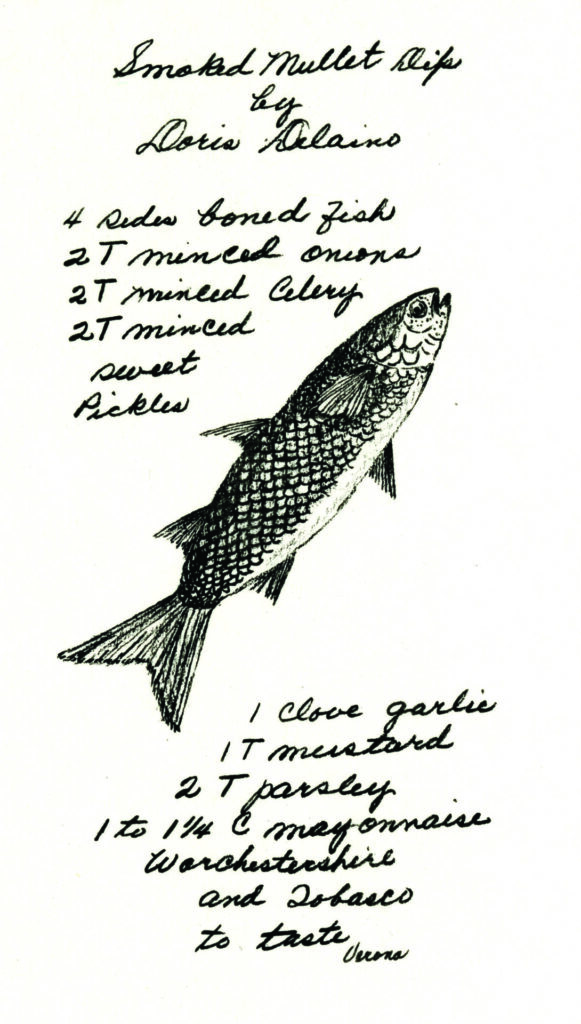
State agencies also promoted smoked mullet as part of Florida’s growing suburban culture. Residents could send away for free plans to build backyard smokehouses as well as mullet fishing guides and recipes. Promotional recipes ranged from mullet guacamole to canned mullet casserole to smoked mullet in peanut sauce. Smoked mullet dip or spread took hold most broadly, becoming part of the culinary culture of coastal Florida and remaining popular in home kitchens, restaurants, and fish markets to this day. When I visit Tampa now, I sometimes freeze a few smoked fish to carry home. For a taste of Florida in New England, I thaw out a side of fish to flake off the skin and eat straight up, mix into a dip, or add to a pot of grits. Like the bluefish I grew up with, smoked mullet has an umami flavor that is hard to give up.
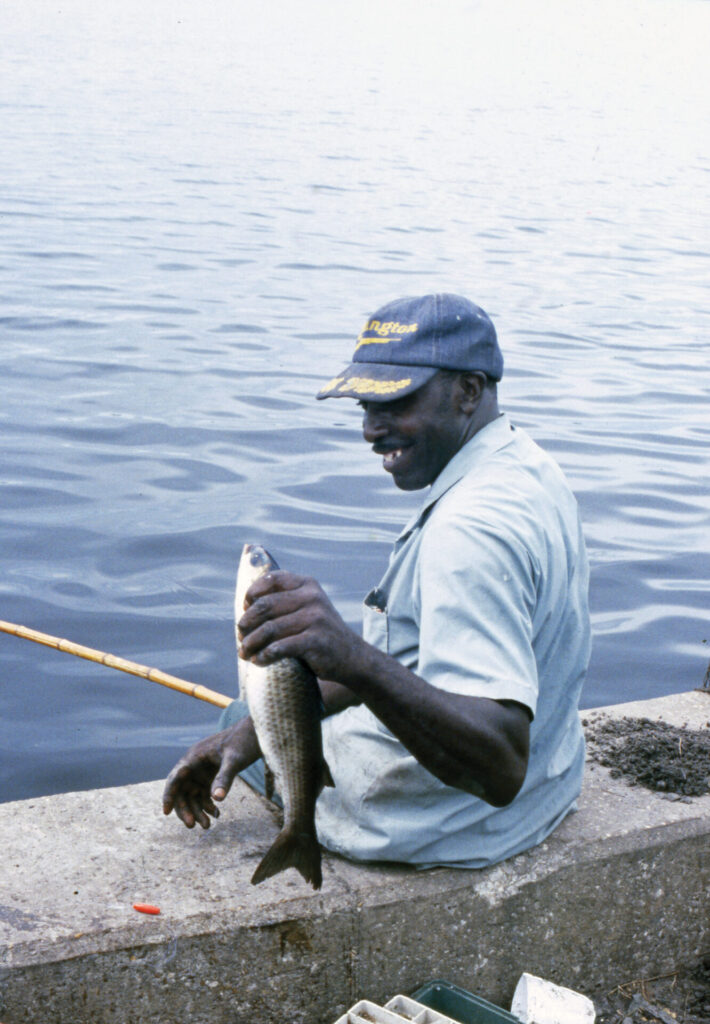
If eating mullet is addictive, so is catching the fish. Towards the end of his fishing life, Bud harvested mullet for fun, not money. During our first conversation he explained his postman’s holiday retirement: “Some people like to golf, right? Some people like to go hunting. Me? You don’t know how much I was thrilled just to go get in the boat…. I’d go catch two or three hundred and give ’em to friends, or we’d smoke a bunch of ’em.”
Despite being what my British friends would call “moreish”—the more you eat, the more you want—Florida mullet in any form is harder and harder to come by. Ted Peters smokes about three dozen mullet a day, down from 180 per day five years ago. Mahi-mahi, salmon, and mackerel have become the more common fish for Ted Peters’ customers. This is partly because people moving to or visiting Florida are more comfortable with mass market species. Many are accustomed to using mullet as bait, rather than as food—if they have heard of the fish at all. These days, mullet is also far less available in the marketplace. Ted Peters and other erstwhile mullet joints cannot meet the demand of their customers.
The lack of availability of mullet is not due to a crash in the stocks. Instead, the decline comes from another kind of marketing campaign: a 1994 citizens’ ballot initiative commonly known as the Florida “net ban,” which outlawed gill nets per an amendment to the state’s constitution. Sold to the public by a well-funded political action committee that was backed by sport fishing and marine tourism organizations, the ballot initiative bypassed state fishery management agencies. Gill nets are the best gear to catch an herbivorous fish like mullet, so this initiative put a lot of fishermen out of business. It also removed huge volumes of Florida mullet from markets within the state and in Georgia and Alabama. Following the ban, mullet landings dropped to an average of 7 million pounds between 2016 and 2021, with lower quantities each year.
The ban on gill nets, Bud told me, “hurt me very bad because it’s about like losing one of your family.” Afterwards, he kept “walking around in a daze.” After his wife died, his retirement plan had been to “go every other night with the mullet boat. Then—bingo.” The net ban crushed those dreams. As we spoke at his kitchen table, some eight or ten years after the ban was implemented, out in his yard a ninety-three-foot stretch of foam cord ran between two trees, in perpetual suspension for a net that never got hung. Rats ate holes into the wad of stiff netting abandoned in the bed of a defunct Chevy pickup. Boxes of donut-shaped corks, used to keep the net suspended in the water, lay scattered about the yard and barn.
The gill net ban was a nail in the coffin of Florida’s biggest fishery. Nevertheless, Florida mullet abides. At Marvin’s Oriental Fish Company in the predominantly Black neighborhood of East Tampa, for example, smoked mullet is available most Thursdays. With mullet procured from the few men who can make a living throwing a cast net or running a seine, the market’s employees use an offset barrel smoker, with a fire made from oak or cherry wood, doused with a squirt bottle of water when it gets too hot. The fish are butterflied open, scales left on, brined, coated with a secret sauce that cannot be divulged, and smoked for about two hours. Customers start calling early in the day: “You got any smoked mullet?!” Some people buy four or five fish at a time, at seven dollars to $9.50 a piece, depending on the size.
Passing from fishermen’s hands through the skilled hands of a cook to the mouths of the people, Florida mullet was and remains a creature of the commons. Bud, who described himself as a Southern “Cracker SOB” and a “Bohemian Key West Conch,” told me that the business of commercial mullet fishing taught him to live with all kinds of people: Cubans, Mexicans, Puerto Ricans, “Yankees, Crackers, hippies, and Black people.” The true worth of mullet for him and many Floridians was that it connected “the poor that’s living from hand to mouth,” no matter their race or nationality.
Traversing Tampa with Bud helped me learn to love the place that had become my home. Bud’s memories, along with the fish he served me, gave substance to previous moments in the life of the city and the Gulf Coast. Although the presence of the past might be overshadowed by contemporary developments, its resonance pokes through—like mullet, still to be found swimming and leaping through Florida’s Gulf, creeks, and bays. How we choose to live with this fish and what values it embodies is up to us to say.
Michelle Zacks is the Associate Director of the Gilder Lehrman Center for the Study of Slavery, Resistance, and Abolition at Yale University. Her book, The People’s Fish: Florida Mullet and the Marine Commons, is under contract with the University of Georgia Press.
SIGN UP FOR THE DIGEST TO RECEIVE GRAVY IN YOUR INBOX.