Taking Root How gardens bridge cultures for my Indian-Appalachian family
by Neema Avashia
In the first Spring after my parents moved to Cross Lanes, West Virginia, in 1974, just a few short years after immigrating to the United States from India, my dad’s boss, Dr. Richard Sexton, showed up in the backyard one Saturday with a rototiller.
By way of explanation, he said something to the effect of, You live in West Virginia now—you have to have a garden. Then he proceeded to till up half of our one-acre backyard. Over the course of that spring and summer, he showed my mom and dad, former residents of dry and dusty Gujarati towns (and thus novice gardeners), how to plant rows of peppers and eggplant and tomatoes and corn. How to nurture seeds and sprouts until they bore fruit.
Dr. Sexton knew that my parents were outliers back then in southern West Virginia: Brown-skinned immigrants with accented English that made it clear they didn’t share the generations-deep Appalachian roots of their White neighbors. The garden, I think, was his effort to help them build a bridge. To show their new neighbors that, in spite of clear differences, they sought to belong.
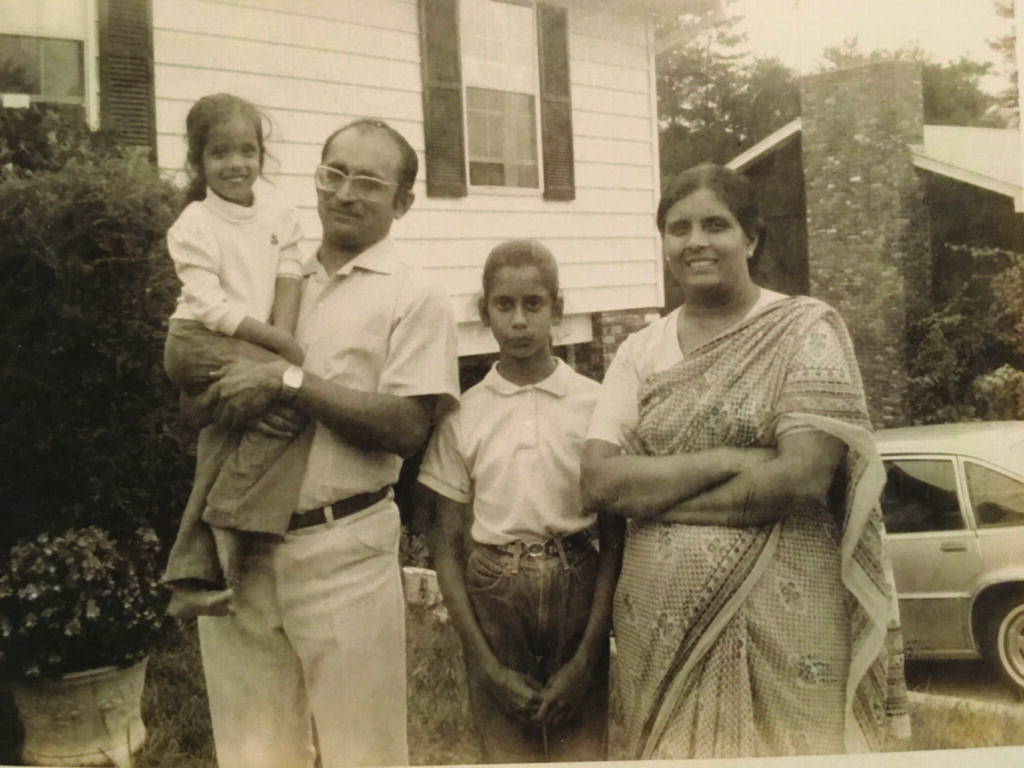
And it worked. My parents gardened like it was a second job every spring and summer. My sister and I woke early many mornings (not by choice) to water, fertilize, weed, and harvest alongside them. Each week, we stuffed some of our garden’s bounty into Kroger bags and hand-delivered them to our neighbors on Pamela Circle, then drove around Cross Lanes and Charleston. We left the bags of prdouce on the porches of colleagues at the chemical plant where my dad worked and with friends from the small Desi community that became our family in the absence of blood relations. There was no way our family of four could consume the abundance that grew from our patch of West Virginia clay. During their thirty-year stay in Appalachia, my parents, whom everyone called “Doc” and Rita, became beloved West Virginians. My sister and I were beloved by extension—in no small part, I think, because of the garden.
What Dr. Sexton could not have intended was for the garden to become a bridge to my parents’ homeland. To the culture and cuisine they grew up with. Yet it did.
We couldn’t get the core ingredients for Gujarati cooking at the Cross Lanes Kroger. The closest Indian grocery store at the time was in Pittsburgh, a four-hour drive away. We shopped there once or twice a year, at most. If the garden could yield tomatoes and mint, my parents theorized, why couldn’t it also bear bottle gourd and bitter melon, okra and colcassia, coriander and fenugreek? A renegade friend shared starts and seeds smuggled from India through US Customs. Those smuggled seeds took root in our garden and soon nourished our family with food from home: patra and methi na thepla, undhiyu and dudhi batata nu shaak.
As a child, I loved eating summer tomatoes, but I hated the hours my dad made me spend standing beside the water faucet, increasing or decreasing water pressure as he watered the plants and flowers, deadheaded the geraniums and petunias, adjusted the cages and trellises. (Why couldn’t he buy a nozzle with a regulator? Forty-odd years later, I still wonder about this.) When I left West Virginia, first for Pittsburgh, then for Madison, Wisconsin, I moved to dorm rooms and apartments that made gardening impossible.
Still, when I bought my apartment in Boston in the summer of 2010, one of the first things I did was install a wooden swing on the back porch like the one we had in Cross Lanes. Then I planted tomatoes in boxes on my porch, much as my sister planted them in her backyard in Austin, Texas. I’d spent the previous seven years struggling to make New England feel like home, its culture and climate so profoundly different from the ones I was raised in. Perhaps the path to rootedness, I thought, was through recreating these elements of my childhood home.
It took years of nurturing a relationship with my neighbor, Anne—the closest I’ve ever gotten to the kind of neighboring I experienced in West Virginia—before we began to garden together. Now, we pore over ReVision Urban Farm’s catalog and choose our seedlings together each winter. I pick them up from the greenhouse come spring, and together we plant them in the raised beds in her backyard. Mostly she directs, and I dig and plant. Ours is a tiny scrap of a garden compared to my dad’s half-acre plot, but it provides us with greens and tomatoes and peppers and tomatillos and herbs. Come summer, it makes Boston feel more like home than any other time of year.
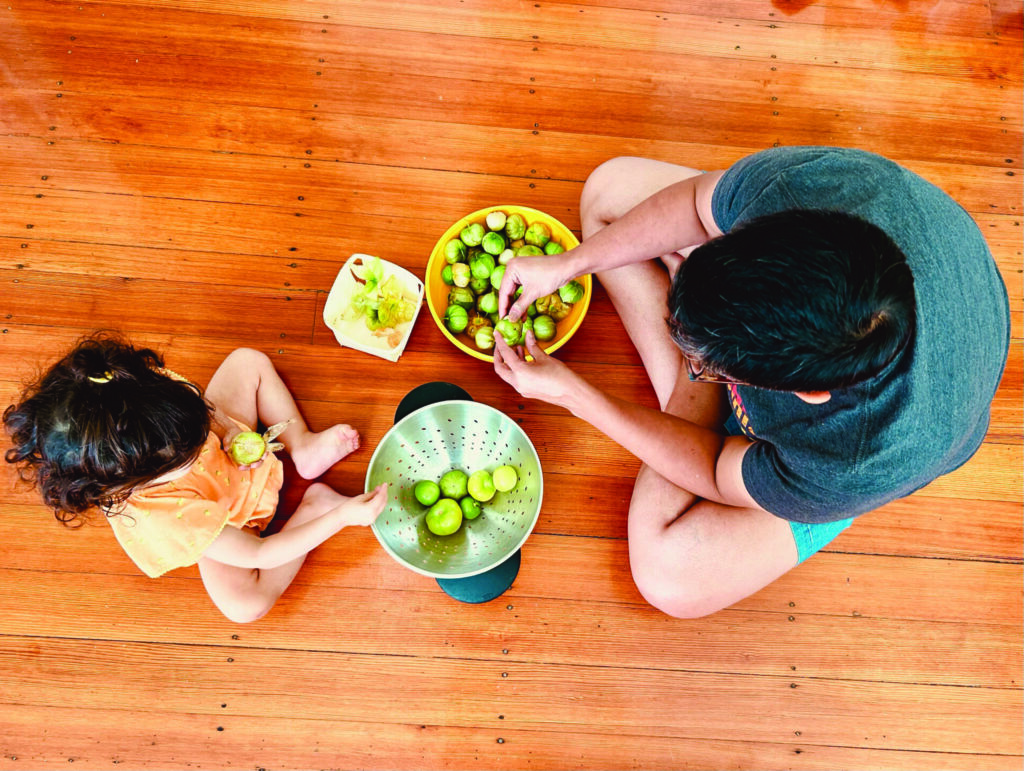
This past May, my nascent toddler joined us in the garden we share with Anne, whom she calls “Buela.” My daughter touched her crown to mine as I planted tomatoes, and I felt an unexpected current of transmission pass between us. In July, she came with me into the garden each morning to pull ripe cherry tomatoes from the vine, plop them into her mouth whole, chew and swallow, then beg, “More, more.” In August, she sat knee to knee with me on our wooden kitchen floor, watching as I husked the first tomatillos from our garden. I put one in her hands and showed her how to peel off the papery skin. I let her loose to peel on her own, sorting skins and fruit into different vessels, and watched, stunned by the wash of emotions that came over me.
My child is not Appalachian. At this point, almost three decades out from living in the hills of West Virginia, most days I’m not sure I should even claim the label. Most days I wonder how I’ll ever share this culture and its practices with her, when Boston’s long a’s and breathy r’s drown out my quiet y’alls.
And then I think, how do I know what I know about Appalachian music, literature, foodways?
I learned knee to knee with my guitar teacher in his pink particleboard studio. Shoulder to shoulder with my mom and Mrs. Bupp in the kitchen as they went through the stages of the canning process for pickles and salsas and tomato sauce. Crown to crown with my dad in the garden. Heart to heart with my writer friends in eastern Kentucky, sitting on porches and sharing stories each summer.
I learned the same way my parents learned. By doing with those who had done so before us.
How then, will I teach the ways of my home to my daughter, for whom Appalachia is a word she tries to say that comes out sounding like “App-a-la-la,” which is also how she says “applesauce” and “I love you”? A place we’ve visited more than any other during her two short years of life to bind her to my chosen family, but not the place where she is rooted? I want her to feel a connection to Appalachia, just as my parents wanted me to feel a connection to India.
She will not learn from YouTube. Not from TikTok. Not from Reddit threads. She’ll learn from relationships. She’ll learn from gardens, which Dr. Sexton and my parents taught me can be bridges both into the communities where we live, and back to the communities where we come from.
So, we plant and weed and fertilize and harvest in Buela’s garden. I pickle and make salsa and preserve in our steamy third-floor kitchen, thinking, with each project, of how to involve my daughter. I think, too, of the ways in which I can teach her about my Indian-Appalachian heritage and foodways.
Maybe someday she’ll make these ways her own.
Neema Avashia is an educator and the author of Another Appalachia: Coming Up Queer and Indian in a Mountain Place.
SIGN UP FOR THE DIGEST TO RECEIVE GRAVY IN YOUR INBOX.