
On Gratitude & Blue Crabs The ritual of the boil is both comforting and complicated, familiar and fraught.
by Deesha Philyaw
illustrations by Lindsey Bailey
Stamford, Connecticut: Spring 1994
There’s a joke I used to tell about the time my then-fiancé, Mike, gave me crabs. Brought me crabs is more specific, but the clarification ruins the joke. He brought me a dozen live blue crabs in hopes of relieving my stress in the midst of grad-school finals. Mike knew that seafood is my favorite food, that crab is my favorite seafood, and that some of my fondest memories of growing up in Jacksonville, Florida, were of crab boils with family and friends. Whenever he visited me in Jacksonville, we’d sit in the backyard for hours with my mother, my grandmother, and whoever else was invited, eating dozens of crabs, corn on the cob, and potatoes. On that spring afternoon in Stamford, he bought the crabs to give me a taste of home, a thousand miles away.Mike and I met at Yale, both first-generation college students. On my eighteenth birthday, we went on our first date. I can’t say that we were still going strong five years later, but we were still going. Engaged to be married that summer of ’94. Then, after twelve years of marriage—for reasons we would sort out, separately, in therapy—we divorced. Suffice it to say, we were incompatible, too young, too wounded.
But the day Mike brought me blue crabs? We were still possible, inevitable, enthralled. He saw how stressed I was and remembered how much I love crabs. He remembered how my mom always bought medium or large crabs (never small), how everyone at the table competed to see whose piles of discarded shells would be largest, and who would fail to pace themselves and tap out first.
But Mike forgot he didn’t actually know how to boil crabs, which meant I had to do it. He forgot the crabs had to be cooked alive, which meant they couldn’t wait until I finished studying. I would have to stop reading and heat a pot of water before they died. Instead of relieving my stress, Mike had inadvertently added to it.
Jacksonville, Florida: Summer 1990
“Do you eat crabs?” I had asked Mike before his first visit to Jacksonville. We’d dated all through freshman year, and while he’d never mentioned any food allergies, I wanted to be sure. I also asked because over the course of our relationship, I’d learned from him, a Black man from the predominantly white Pittsburgh suburbs, that much of what I’d grown up attributing to Blackness and Black culture were actually facets of Black Southern culture. How I spoke, for example. I didn’t realize I had an accent until I left the South for a campus in New Haven with very few Southern students or faculty. Years later, I read an interview with actor Angela Bassett, who grew up in St. Petersburg, Florida. During her undergraduate years at Yale, her classmates remarked on her saying, “finna,” as in, “I’m finna go.” When I read this, I felt so seen. Or rather, heard.
Like Bassett, I grew up in a Black neighborhood and attended predominantly white schools. I didn’t recall any of my white classmates ever mentioning crab boils. So it didn’t occur to me back then that white folks might eat them, too. Prior to college, I hadn’t traveled much beyond Florida and Georgia. Pittsburgh, like New Haven, like every place that wasn’t the South, might as well have been another planet. I had no idea if anyone in the suburbs of Pittsburgh ate crabs. My family ate crabs on special occasions and just because. Mike’s visit was a special occasion, so we wanted to have a crab boil. I was relieved when he told me, yes, he ate crabs.
On the Saturday morning after Mike arrived, when my mother went to the fish market to buy dozens of live crabs, she included him in her estimate. We rarely had leftovers after a crab boil because my mother had a knack for knowing the right amount to buy so that everyone left the table stuffed and satisfied. My mother, my grandmother, and I could easily put away two or three dozen ourselves. Crab boils were the only time my hospitable family hoped folks wouldn’t stop by unannounced.
Before she left for the market that July morning, my mother Phyllis stacked three rows of bricks in a loose circle in the backyard, piled firewood in the middle, and made a fire. Mike helped her carry a large aluminum washtub about halfway full of water and set it on top of the bricks.
My mother, who, for much of my childhood, was partial to wearing high heels, Daisy Duke shorts, and a full face of makeup to the grocery store, wasn’t exactly a build-a-fire-in-the -backyard type. But she did it. My maternal grandmother, who we lived with, was an excellent cook in her own right, but crabs were my mother’s domain. My mother believed there was a right way to cook everything, and that way was her way. She preferred chain restaurants and had no interest in trying something new or being adventurous when it came to food or anything else. We clashed a lot, about food and everything else, because I was adventurous and curious. We clashed because my mother had wanted me to stay in Florida for college, and I couldn’t wait to leave. We clashed because I saw myself as my own person, and my mother saw me as an extension of herself. She took my independence as a personal rejection of her. Our fights about food—how to make spaghetti, how to make potato salad—were never really about the food. They were about my mother’s fears.
Learning to pick my own crabs had been a childhood rite of passage, and I was excited to teach Mike.
But blue crabs were neutral territory for us. I had no interest in experimenting, and I loved watching my mother work her magic.
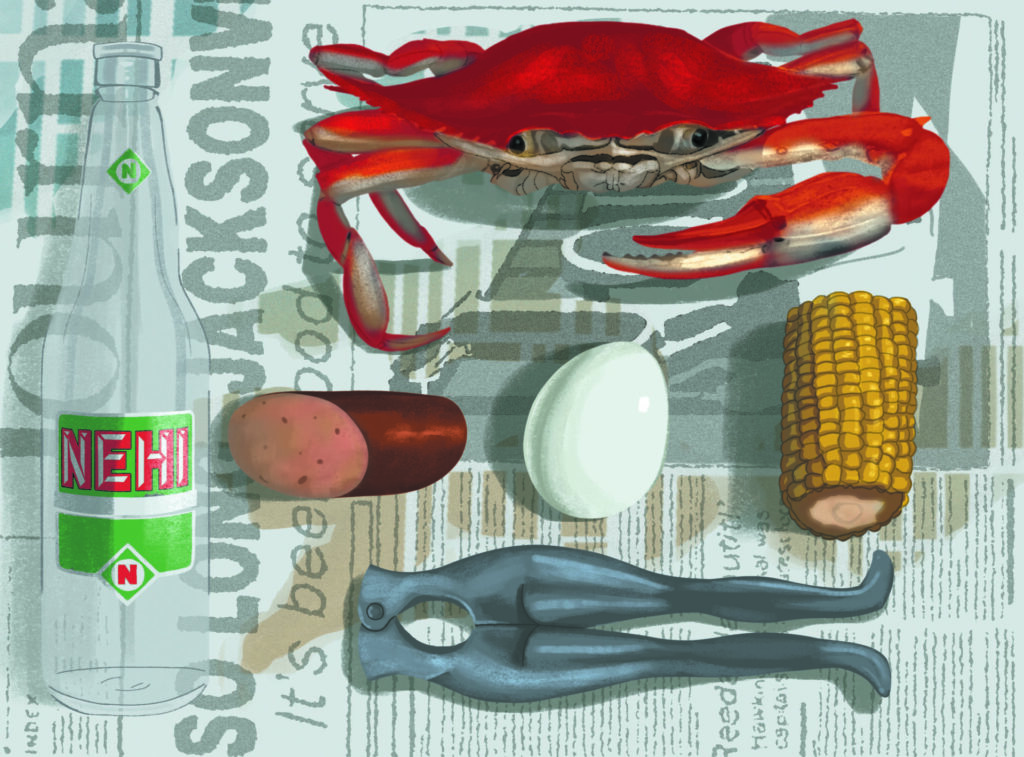
To the water in the washtub, my mother added rock salt, whole bottles of cayenne pepper, and several mesh bags of Zatarain’s seafood boil seasonings—a mix of brown mustard seed, coriander seed, red pepper, dill seed, bay leaf, and allspice. Then she added halved green peppers and white onions, whole russet potatoes, corn on the cob, uncracked eggs, and thick chunks of sausage.
My mother told Mike and me to keep an eye on the fire while she was gone and make sure we didn’t burn down the yard. While we waited for her to return, Mike and I prepared the two card tables where we would eat. First, we positioned them end-to-end, then covered them with newspapers.
“You don’t have a tablecloth?” Mike asked.
“We do,” I said, not sure where he was going with this. We had a tablecloth—somewhere. But why would we mess it up with funky crab gunk? I shrugged and put a brand-new roll of paper towels on each end of the table.
Soon, the water in the washtub came to a boil and roiled red from the cayenne. The water would be perfectly seasoned by the time my mom returned. The fish market wasn’t far.
I looked at Mike, in his white button down shirt and a pair of khaki shorts. “You should change into a T-shirt,” I said.
“Why?” he asked.
I laughed. “So you don’t mess up the shirt you’re wearing.”
“Mess it up how?”
“From eating the crabs. Duh,” I said. Why was he being so weird?
It wasn’t until my mother returned with several brown paper bags full of crabs, their claws click-clacking through the bags, that it dawned on Mike, and on me. All this time, he’d thought my mother and I had been talking about snow crab legs, which is the only crab he had ever eaten, always in restaurants.
Whole blue crabs caught locally were a summertime staple for my family, but they were entirely foreign to Mike. From dumping the live crabs, claws flailing, into the boiling water, to pressing their frantic bodies down to their deaths with a long-handled spoon—all of it was new to him. He watched, amazed, as the crabs cooked. “I promise, it’s going to be delicious,” I told him.
In the meantime, we finished prepping the table. We set out bowls of plain melted butter, my concoction of melted butter mixed with Louisiana Hot Sauce and ketchup, and a mayonnaise-mustard dip. My family never owned the kind of shell pliers and pickers you get at seafood restaurants to extract the meat. Instead, we used an assortment of tall glass Nehi soda bottles, nutcrackers, and our fingers and teeth. Mike was mildly scandalized when I put my grandmother’s favorite nutcracker on the table, the bawdy one shaped like a woman with a curvaceous body and legs that opened wide to crack nuts—or in this case, blue crab legs.
The formerly blue crabs were a deep red by the time my mother spooned them from the spicy depths of the washtub into large aluminum serving pans, along with the potatoes and corn. She set the pans on the table, my grandmother joined us, and we prepared to dig in.
Learning to pick my own crabs had been a childhood rite of passage, and I was excited to teach Mike. I took two crabs from the pan, a male and a female. On the crab’s “belly” (underside), the section you pull open to separate the outer shell (exoskeleton) from the rest of its body is called the “apron.” On a mature female, the apron is short, resembling the United States Capitol Dome. The apron on a mature male is longer, resembling the Washington Monument.
I removed all the legs from the male. I chewed on one of the smaller legs (a walking leg), crushing the thin shell and sucking the peppery, flavorful juice. I handed a walking leg to Mike, and he did the same. “We spare nothing,” I said.
I picked up two of the larger front legs (the claws or pincers) and gave one to Mike, along with a nutcracker. Or if he preferred, I told him, he could put the claw on the table and gently crack the shell with the soda bottle. But I warned him not to smash it, or he’d grind bits of shell into the meat.
Mike nodded and carefully cracked the shell with a bottle. “How are you going to do it?” he asked. I pointed to my mother and grandmother who were using their canine teeth to crack claws. Once cracked, the claw was easy to break apart, revealing the tender meat.
Next, I picked up the female crab and demonstrated how, with the right amount of pressure and at the right angle, you can pull a hunk of meat from the crab’s body through one of the leg sockets. I dipped the meat dangling from the end of the claw into my butter-hot sauce-ketchup mixture and handed it to Mike. He loved it, as I knew he would.
I removed the shell from the legless male crab and broke his body cavity in half. The cavity halves, lined with cartilage, are filled with meat. After removing the crab’s gray, shriveled gills—we call them “dead man’s fingers”—from each half, I dragged one of the cavities across the newspaper to remove the yellow gunk some folks call the “mustard.” It’s actually the crab’s hepatopancreas, an organ that functions like the human liver, filtering impurities from the crab’s blood. Next, I picked around the cartilage to get to the meat, which I shared with Mike. Then I gave him the other cavity half to clean and pick himself.
After Mike and I ate the female crab in similar fashion, I chose another female in hopes of getting one filled with “cheese,” our name for the tasty, fatty, bright orange crab roe (eggs). Third time was the charm, and we found a female with cheese.
Describing this now, it all sounds so…barbaric. “We ate the whole crab, like savages!” Mike would tell people when we went back to Yale for sophomore year, and for years to come. I didn’t unpack the racism inherent in “like savages.” We didn’t “unpack” things in the ’90s. Eighteen-year-old me was just happy to share something so special, so fundamentally home, with this great guy from Pittsburgh I’d fallen in love with.
Stamford, Connecticut: Spring 1994
Unfortunately, on that evening four years later, that great guy from Pittsburgh did not think through his idea for an impromptu crab boil. For starters, my roommate and I didn’t own a pot big enough for the crabs and all the fixings. Further, I learned to boil crabs the way I’d learned to cook everything else – by watching my mother and my grandmother, who didn’t measure or write down anything. I learned to season food by eye and hand, by look and feel, trial and error. There was no recipe I could jot down for Mike to follow. Already anxious and pressed for time, I’d have to take a break from studying for my finals in order to cook the crabs before they died.
I learned to boil crabs the way I’d learned to cook everything else – by watching my mother and my grandmother, who didn’t measure or write down anything.
Don’t be ungrateful, whispered the voice in my head. That voice sounded a lot like my single mother, who talked about my engagement and pending marriage like it was an act of charity. She’d actually thanked Mike when he formally asked her for my hand in marriage. When he told me this, I felt like some damaged goods my mother had managed to sell off. I know that wasn’t her intention; she had never married, and no doubt imagined that with a husband, my life would be happier, easier than hers. But there was also the implication that I was a difficult person, so Mike should be commended for signing up to do life with me. And I should be grateful.
In the end, gratitude and nostalgia conspired against me. I reluctantly pulled myself away from my studying and began prepping for the boil while Mike ran out to buy a large pot. This would not be the last time I settled for a man giving me what he thought I needed, rather than what I really needed. I didn’t feel homesick; I felt overwhelmed. I just needed a quick bite to eat that I didn’t have to cook so that I could get back to prepping for finals.
Under different circumstances, I would’ve welcomed Mike’s crab boil surprise. In fact, a version of the sweet gesture showed up twenty years later in my short story, “Snowfall.” Rhonda surprises her girlfriend Arletha with a crab boil when their relationship hits a snag after they move from the South to Pittsburgh. Here, though, Rhonda does the cooking and all her lover has to do is partake.
After
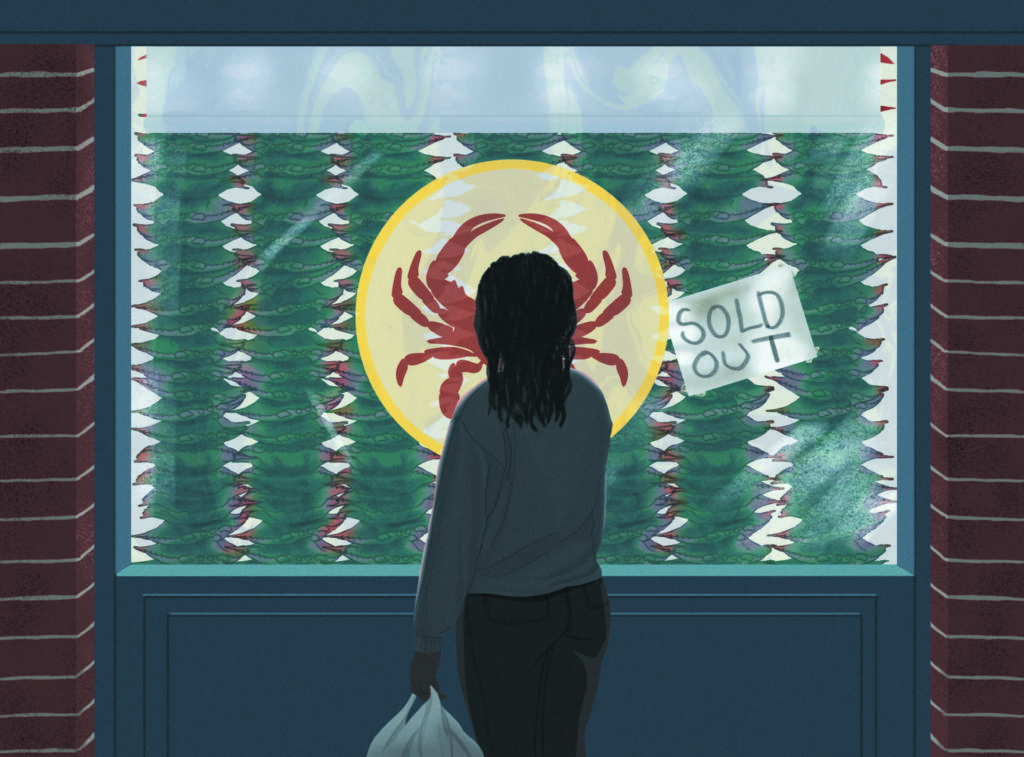
When Mike and I moved from Connecticut to Pittsburgh three years later, I learned that Wholey’s, the city’s big seafood market, shipped in live crabs weekly. They sold out within hours; during the twenty-five years I lived in Pittsburgh, I only managed to get them twice. Not that I tried every week. Over time, life and motherhood took over. Scoring crabs became less of a priority. Boiling them and eating them felt less like a ritual that reminded me of home and more like another chore. Whenever we visited my family in Jacksonville, my mother always had a crab boil for us, and I was delighted to introduce my daughters to the whole production. But for the most part, their idea of “crab” is still snow crab legs.
The last time my mother boiled crabs for me was in the early 2000s, prior to her death from breast cancer. I didn’t have blue crabs again until my daughters and I visited Jacksonville in 2019. We ate them at a restaurant recommended by a family member. My mother always turned her nose up at the steamed crabs sold at the grocery store and in restaurants, so I imagined her disapproval from the afterlife. The restaurant’s crabs were meatier than the ones I grew up eating, but not as flavorful.
Last summer, I left Pittsburgh for good after my younger daughter graduated high school. I still don’t know where home will be in the future, but my first stop has been a yearlong writing residency at the University of Mississippi. Excited to return to the South, I had every intention of finding blue crabs upon arrival in Oxford, but to date, that hasn’t happened. Maybe I’ve put it off because what I want isn’t just the crab, but the experience of the boil. That experience won’t be the same without my mother, and I’ve been in no rush to recreate an approximation.
Blue crabs will always be a bittersweet reminder of two of my most complicated relationships, both of which ended in 2005, the year my mother died and Mike and I divorced. Almost twenty years later, I prefer to dwell on the sweet. On memories of rituals of care and food. Memories of messiness, tenderness, and laughter. And of love, however imperfect, shining through.
Deesha Philyaw’s debut short story collection, The Secret Lives of Church Ladies, won the 2021 PEN/Faulkner Award for Fiction and was a finalist for the 2020 National Book Award for Fiction. She was the 2022-2023 John and Renée Grisham Writer-in-Residence at the University of Mississippi.
SIGN UP FOR THE DIGEST TO RECEIVE GRAVY IN YOUR INBOX.