
Miami’s Bahamian Roots How a shellfish became soul food
by Nadege Green
photos by Taimy Alvarez
On easy Saturday nights, when I plan to curl up on my comfy blue couch to binge-watch the latest series I’m behind on, first, I like to pick up loaded conch fritters from Miss Tammy Gallon.
She’s one of the street vendors who used to regularly set up on Northwest 79th Street and 12th Avenue on the edge of Liberty City, the Miami neighborhood where the movie Moonlight was filmed and where I went to high school. Miss Tammy’s people are from the Bahamas, and she calls her stand Conchtime. A master of conch, she’s also a public health sweetheart who places free condoms next to the rolls of paper towels because that particular strip where she transformed an empty lot into a conch kitchen is known to be a hub for sex workers.
While Miss Tammy has expanded into a pickup and delivery business, the same area continues to attract at least half a dozen food vendors competing for customers with the allure of smoked meats, fried seafood, and even more conch options.
When I was growing up in Miami, conch—pronounced kunk—was on most menus in Black restaurants. Conch salad, fried conch, conch fritters, stewed conch, dressed conch, cracked conch, there was always conch. And this remains the case.
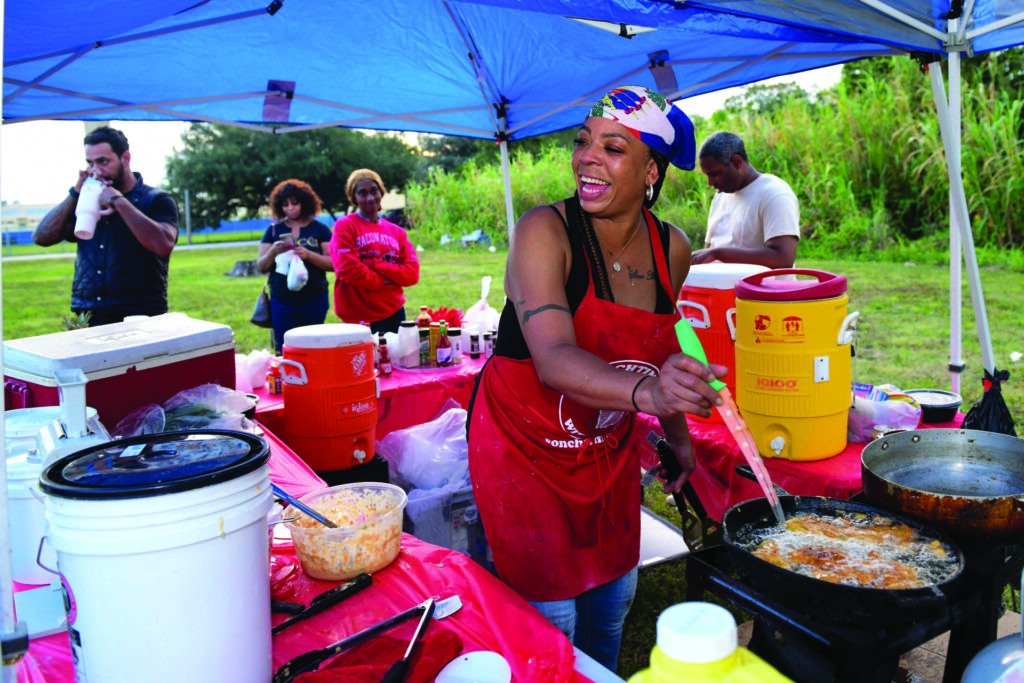
Most weekends, weather permitting, conch is sold by roadside vendors across Miami. They set up beneath canopy tents with propane-powered deep fryers dropping ladles of conch fritter batter —a chunky mixture of diced conch, peppers, and onions, seasoned with held-close-none-of-your-business blend of spices—into sizzling oil. In minutes, puffy, golden fritters float to the top, waiting to be lifted up with a slotted spoon and placed onto a platter lined with paper napkins.
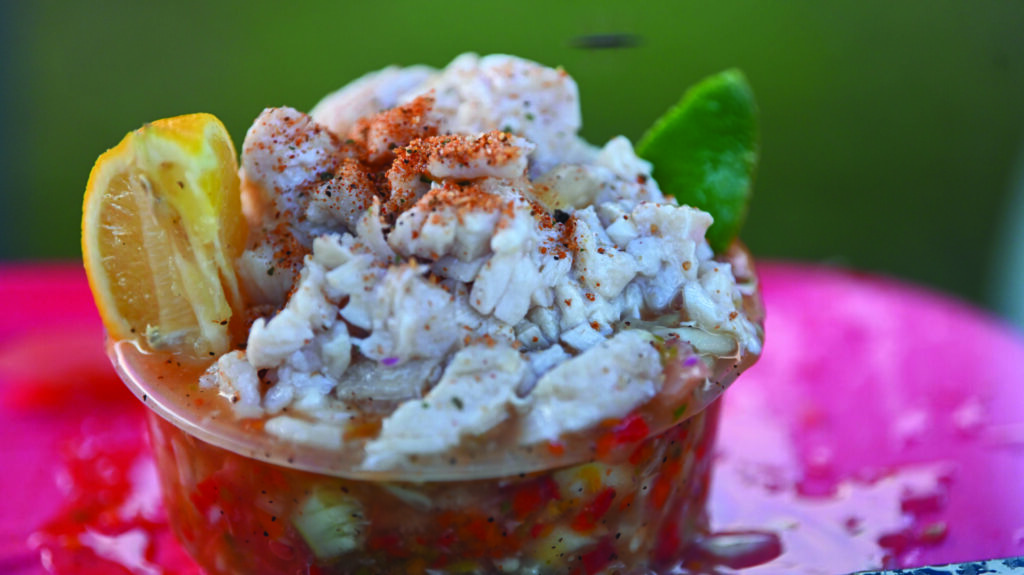
Nearby, folding tables hold giant clear bins brimming with freshly made conch salad. Finely chopped-up raw conch meat is studded with diced tomatoes, onions and bell peppers and marinates in a seasoned citrus juice mixture. For the spice cautious, some vendors offer their conch salad on the milder side, accompanied by an optional selection of hot sauces or pepper sauces. I prefer my conch salad from vendors who mix in scotch bonnet peppers.
Conch is a fleshy sea snail that can be found in the Bahamas, the Florida Keys, and throughout the Caribbean and western Atlantic Ocean waters. The large, spiral, caramel-cream colored shell it’s harvested from is a showpiece, revealing a flush of pink on its interior lip. This beautiful shellfish isn’t just a popular menu item offered by Miami’s Black food entrepreneurs. It tells a deeper story about Miami’s history.
Miami is a Deep South American city with Bahamian roots.
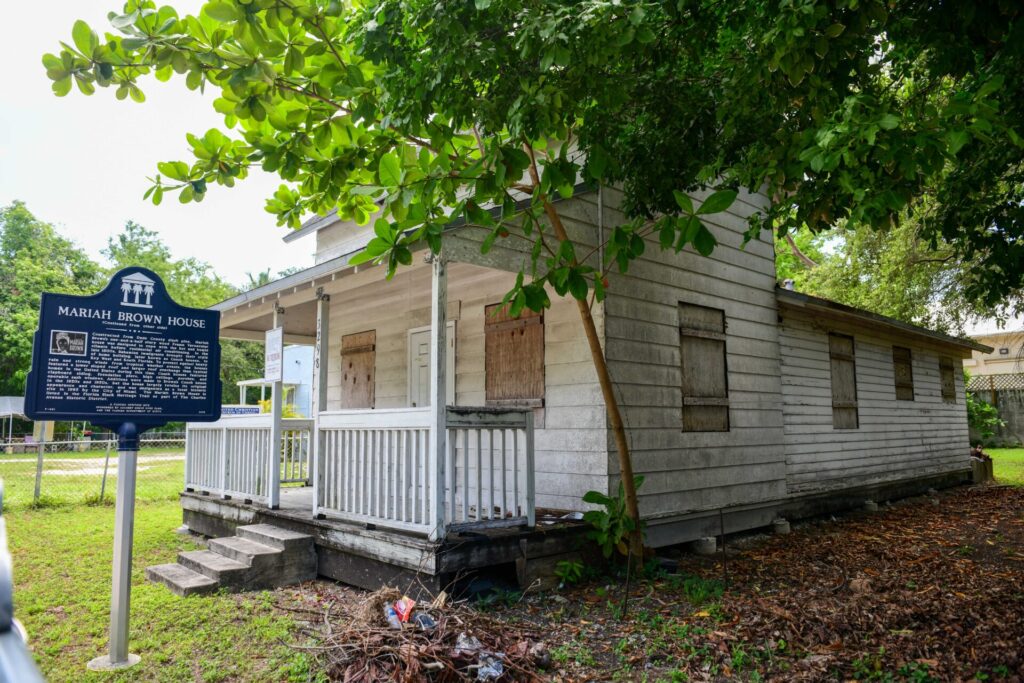
Before the City of Miami was incorporated in 1896, Black Bahamians brought their culinary practices to this place they would call their new home, migrating to south Florida for maritime jobs, farm work, and, later, to build the city’s physical infrastructure. In 1834, decades before slavery was abolished in the United States, the British emancipated the Black people it had enslaved in the Bahamas since at least the 1700s. As in the United States, many Black workers in the Bahamas post-enslavement were ensnared in a sharecropping-like system that saw them working pineapple farms owned by predominantly white landowners with exploitative labor practices. As economic prospects continued to dwindle at home, Bahamians in search of stronger financial futures found work plentiful in nearby south Florida in the late 1800s.
Miami could not have become a city without Black Bahamian laborers. Forty-four percent of the men who signed the incorporation papers in 1896 to establish Miami as a city were Black men, some of whom were Bahamian.
Miami could not have become a city without Black Bahamian laborers.
When I give talks about the making of early Miami, I always make sure to tell folks that many of the Black men who signed the city’s incorporation papers were from the Bahamas, such as Alexander C. Lightbourne, who gave a passionate speech that day in support of Miami’s incorporation. Miami is a city that loves to reinvent its image over and over and over again, more recently presenting itself as a waterfront-diverse-colorblind-utopian amalgamation of Latin America and the Caribbean. There are regular jokes that Miami isn’t even in America. In the process of this imaginative remaking, Miami makes invisible its integral Black history, in part to rebrand from the legacy of racial terror here, which reminds you that this is in fact the Deep South, an American city with a strong Black Caribbean influence.
“Bahamian ancestry in Miami is deeply rooted,” says Miriam King, who grew up in north Miami-Dade County to Bahamian parents from Nassau and Eleuthera. It is that history, just beneath the surface, that isn’t always visible— even as our modern foodways in Miami remain strongly influenced by Bahamian culture.
“It’s very special the way our food intertwines,” says King. “You can’t go into a soul food restaurant in Miami and not see some island food, too. Mac and cheese, collard greens, and there’s going to be some conch, too.”
In 1920, Bahamians made up just over fifty percent of Miami’s Black residents. In their quest to build a new life in this very young city, Bahamians found work and white terrorism plentiful.
Their wages made it possible to ease the burdens of loved ones back home by sending them money, as most immigrants do, but then there was the cost of existing in Miami as a Black person. Black Bahamians experienced the indignities of segregation, fear of lynchings, and abuse from Miami’s white police force, which had close ties to the Ku Klux Klan.
After H.H. Higgs, a Black minister from the Bahamas, built a congregation in Miami’s Black section of Coconut Grove to share his theological teachings about justice and racial equality, he was kidnapped and brutalized by the Klan. Higgs was only released on the condition that he’d leave the country immediately for Nassau.
“I am going to leave,” he told The Miami Herald in 1921. And he did. This is a common historical thread in Jim Crow Miami: Black people being chased away by white-supremacist violence.
I was in high school the first time an elder told me, “The Klan ran him right outta here,” referring to Hollywood great Sidney Poitier. His mom, a poor farmer from Cat Island, sailed from the Bahamas to Miami to sell her tomato crop in 1927, not knowing the child she was carrying would come much sooner than expected. Though born nearly three months premature in Miami, Poitier spent his early years in the Bahamas before being sent back to Miami as a teenager to live with relatives. Before he became the Sidney Poitier, the first Black man to win an Academy Award, he was a fifteen-year old Black boy making deliveries for the Burdines department store in Miami. One day, Poitier upset a white woman by bringing a package to her front door instead of using the servant entrance for Black workers.
Two nights later, the Klan showed up searching for Poitier, but he wasn’t home.
This snapshot of Poitier’s experience in Miami is told in his eponymous biography by Carol Bergman. Over his lifetime, the actor shared bits of that harrowing story in press interviews. After the Klan incident and a racist run-in with the police, Poitier decided to head North, leaving Miami.
“I just had to get out of Miami when I had accumulated enough money, by whatever means,” Poitier said in an interview with the PBS series American Masters nearly half a century later.
I spend a lot of time digging through old public records and periodicals and talking to elders about Miami’s Black past as a researcher and cultural memory worker. What I’ve learned is that, though many left justifiably disaffected and out of fear for their safety, the perseverance of the Black folks who remained is a story worth telling.
So populous were Bahamians in early Miami, The Miami Times, the largest Black-owned newspaper in south Florida, ran a regular section dedicated to “News from the Bahamas” well into the mid-twentieth century. The newspaper itself—an important publication that documented Black resistance and existence in Miami—was founded in 1923 by Henry E.S. Reeves, a native of San Salvador Island, Bahamas.
Bahamians opened restaurants and food stands in segregated Black Miami alongside Florida-born Black folks and those who came from Georgia, the Carolinas and other parts of the US South, the Caribbean, and Latin America.
Enterprising Bahamians set up street conch stations on bustling Northwest Second Avenue in Overtown—or “Colored Town,” as it was called back then. Their food drew such a loyal following, a fight would occasionally break out over the last of the fritters when the conch batter started running low.
Overtown was where Miami’s segregated Black nightlife drew big celebrities. Cab Calloway, Ella Fitzgerald, Count Basie, and Josephine Baker could perform in whites-only Miami Beach, but they were not allowed to book rooms in the beach’s hotels.
When they crossed the color line back into Overtown, also dubbed “the Harlem of the South’’ for its lively music scene and clubs, a variety of options from multiethnic Black cooks awaited them: barbecue black-eyed peas, Spanish chicken, roast veal, and baked ham were on menus throughout the neighborhood. Holding down many of the kitchens at the places of rest and entertainment were Bahamian chefs like “Nassau Frank,” who ran the Sir John Hotel Restaurant and the Knight Beat Hotel Restaurant. His menu was famous for conch fritters, conch salad, and Bahamian souse—chicken or pork cooked in a lime-and-vinegar–based clear broth with potatoes and served as a soup. That souse is a different preparation than the gelatinous loaf of boiled pig parts flavored with savory spices and vinegar, a version of souse dear and familiar to many Southerners.
Away from Overtown’s nightlife, the inequalities of segregated Black Miami-Dade became regular topics of community meetings. Black schools were under-resourced, as were activities for youth. Where the white-run school board and local government failed them, it was necessary for the Black community to raise money for important causes on its own. One profitable way was by selling food.
Barbecue dinner sales sent Overtown’s children to summer camp. To shore up James E. Scott Homes Nursery School in the Black neighborhood of Liberty City, just north of Overtown, community members sold conch fritters as their fundraiser. And when Booker T. Washington High, the segregated Black high school, was running short on supplies for students in 1953, two of its students held a Saturday night fundraiser in one of their homes; they sold conch salad.
Miami’s Bahamian past is certainly reflected in food—and in the love stories that pour out when the question is asked: Where are your people from?
“My mom’s side of the family is from Mississippi,” Sharony Green tells me. “My dad’s side of the family is from Georgia and the Bahamas.”
Green was born and raised in Miami’s Black section of Coconut Grove, an area now officially designated Little Bahamas for the early Black Bahamian settlers who called it home. In the Grove, there’s also a small area known to locals as Little Georgia.
Her parents’ love story is a Black migration story of Miami.
While movement from the Bahamas to Miami continued into the 1950s, Black Americans from across the South likewise continued to relocate here for better economic opportunities. This little-recognized route was also part of the Great Migration, a reverse migration deeper South to find work in agriculture, construction, and in the tourism industry, despite the pervasive racism.
Sharony Green’s maternal grandmother, Lillie Mae Earvin, was a sharecropper from Belzoni, Mississippi, a Delta town that calls itself the catfish capital of the world. Like the early Bahamians who migrated to Miami, Earvin experienced working a similar sharecropping system that provided little financial payoff or stability.
“She and my grandfather were sharecroppers. With the mechanization of cotton, they were jobless,” says Green (who is not related to me). “They followed the crops. Peaches to be picked in South Carolina, cabbage in North Carolina, pole beans, tomatoes, and strawberries in Florida.”
Earvin worked the agricultural fields in south Miami-Dade County as a seasonal worker making enough money to care for her family. When the picking season was over, she returned to Mississippi with her husband and dozens of neighbors who, like her, came down from Mississippi to work the fields. By 1958 Earvin decided to make Miami’s Black Coconut Grove community her full-time home. There she raised a daughter who would fall in love with a Miami man with parents from the Bahamas and Georgia.
When families intermingle, so do their recipes. The Bahamian side of the family taught their Mississippi in-laws the magic of conch making. Earvin, from Mississippi’s catfish capital, became a star student of preparing conch meat, so much so, she started her own traveling conch food enterprise.
“All of the Bahamians knew she was from Mississippi. No one cared,” says Green. “The Bahamians were buying her food, too.”
On weekends, Earvin sold the seasonal produce—tomatoes, pole beans, strawberries—she picked herself in south Miami-Dade along with her homemade conch salad in the neighborhood farmer’s market where she meticulously decorated her display with an ocean theme. Nets draped across the table anchored by empty conch shells and showy displays of conch salad in fish bowls.
“Just a beautiful display. She always had an eye,” Green says. “Everything she did looked beautiful.”
Earvin became a mainstay on the local festival circuit as a conch food vendor. Green says that her grandma’s setup always had the longest lines.
“We would be chopping onions and peppers in grandma’s living room in Coconut Grove every Friday night if there was a festival coming,” Green tells me. “She sold her conch at the Martin Luther King Jr. parade, Calle Ocho, the Goombay festival. She even prepared food for the Miami Vice [television show] crew and actors.”
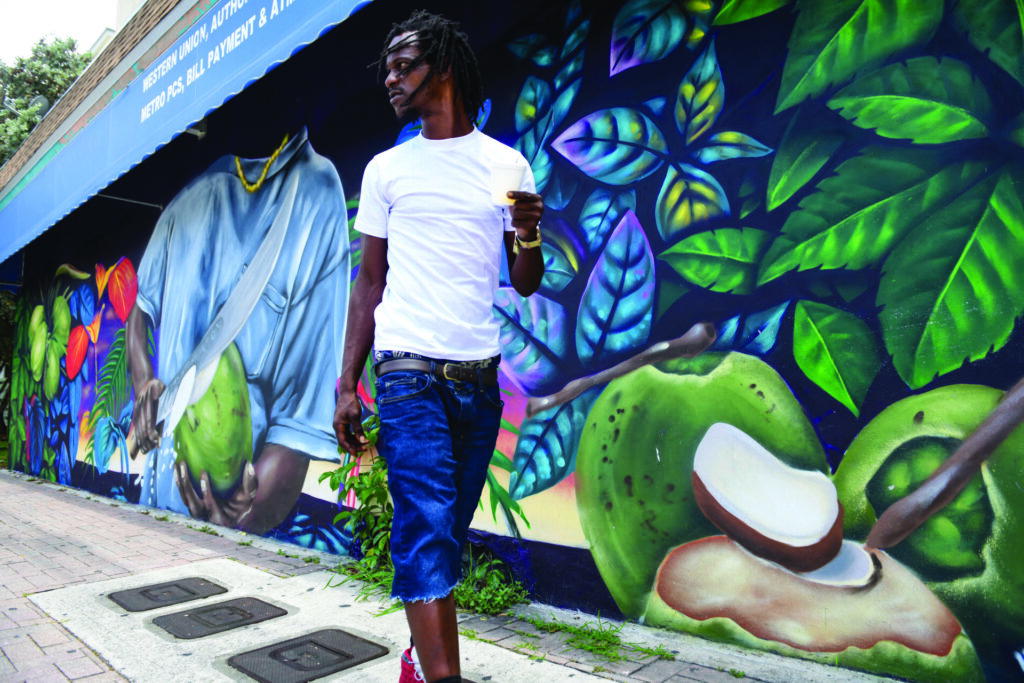
Conch is never hard to find in Miami, fresh caught from the Florida Keys or imported from the Bahamas. The tradition of conch vendors by the roadside, at farmer’s markets, and community events continues. Just a few months ago, the track team at Miami Northwestern, the high school I graduated from, held a fish fry fundraiser with conch salad on the menu.
Even as we live in Florida, where Black histories and narratives are being scrubbed by legislative action, our food holds our stories. Memory work is resistance in a state that seeks to wipe out the nourishment of knowing the fullness of the Black experience here. Miami may be a master of marketing and reinvention, but the city’s Black Bahamian roots and history remain strong, passed down in recipes filled with conch.
Nadege Green is a writer and community historian based in Miami. She is the founder of Black Miami-Dade, a history and storytelling platform that resists the erasure of Miami’s Black past.
SIGN UP FOR THE DIGEST TO RECEIVE GRAVY IN YOUR INBOX.