
The Other Side of Sunlight A meditation on two lives intertwined
by Thao Thai
illustrations by Yuki Murayama
Your life begins with a misnaming. They call you many things, actually.
Scientists know you as Cynoscion nebulosus, or a weakfish, named for your tender mouth that tears with the first graze of a hook. Because of your protruding fangs, you’ve also been called a Nosferatu fish, summoning images of sunken-eyed vampires lurking in dark corners. Fisherpeople refer to you colloquially as a spotted seatrout or a speck, a title that belies your size. (The largest among you are called gator trouts. One of your captured kin topped seventeen pounds, roughly the size of a six-month-old baby.)
The thing is, you’re not a trout at all. You belong to the drum fish family, named for the rat-a-tat sounds male seatrouts make to attract females during mating season. Locals say that on summer evenings, an hour or two before nightfall, boaters can press their ears against their hulls and hear the drumming of seatrouts just beneath the surface of the ocean.
I wonder how often I’ve stood on the narrow piers above your habitat, studying the sway of palmettos from shore, the pinched white peaks of tides in the distance, completely oblivious to your movements beneath my feet. I’d drink a Sprite and crumple the can between my palms, thinking of what I’d watch on Nick at Nite later, or why Justin Waters flirted with every girl in the fifth grade except me, or why it was just so difficult to talk to my mother about even the simplest things.
I thought you and I belonged to two separate worlds. All the while, my life intertwined with yours in silent and mysterious ways, though it would be years before I understood how we coexisted.
My life starts with a misnaming, too. My name—Thao—translates to “one who honors their parents” in Vietnamese. Minutes after I was born, my grandfather named me with the hope that I would take on some filial virtues of obedience, respect, and gratitude. I was respectful and grateful, but I never felt obedient. In my mind, I rebelled against my family’s rules about what I could read or watch on television. (Nothing involving romance or untoward behavior.) I hated that I wasn’t allowed to stay in the sun for too long, out of their fear of darkening my skin, or that I couldn’t swim in the ocean, because of sharks. Sundays at the beach, plunked sullenly in the sand, I’d watch other kids skimming the waves on their boogie boards, and I’d tell myself that someday, I’d go anywhere I want. Even the ocean, sharks be damned.
Back then, the sea seemed interminable, clear and faithful, dependable as air. Back then, I didn’t foresee the way the world around us would change.
I thought you and I belonged to two separate worlds. All the while, my life intertwined with yours in silent and mysterious ways.
Maybe if I was allowed in open water, I would have met you earlier, flicking past me, on your way to catch the annual migration of shrimp with the rest of your school. I might have shivered as your body brushed against my leg hairs, standing at attention at your touch. “Mom!” I’d have called, wonder supplanting my usual reticence. “Come look!”
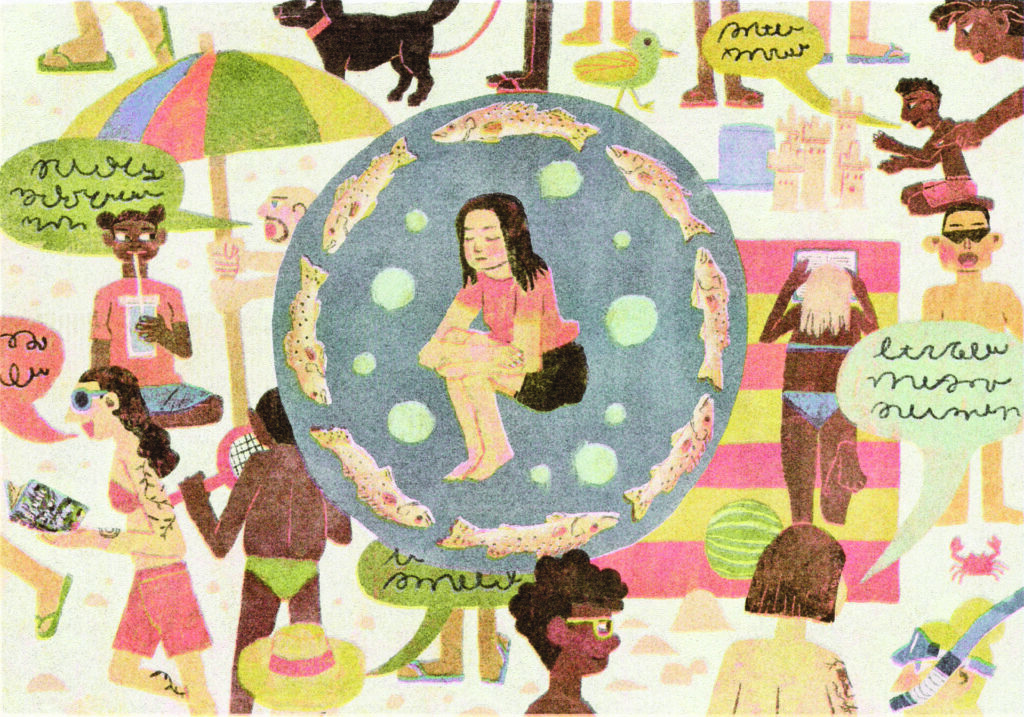
You’re something of a celebrity in Florida, especially where I grew up an hour from Tampa Bay, the state’s largest open-water estuary, known for its proliferation of seatrout. About Bradenton, my sleepy hometown, we always joked that the only things to do were go to the beach or die. We were overrun by the very young, who could not yet escape, or the very old, intent on spending their last years wallowing in sunshine.
They all say you’re good eating. Your sweet, tender flesh flakes off in buttery chunks, ideal for grilling, braising, or baking. That makes you a boon for lay fisherpeople as well as commercial boats, especially since it’s open season on spotted seatrout all year round. Every day, you’re in danger of getting caught. There’s no seasonal reprieve. No mercy. Maybe that’s why I feel your life to be precarious, in a way that endears you to me.
Looks-wise, you’re an undeniably captivating specimen. You’ve got that long, silvery body with a slight blue cast; that protuberant lower jaw; prominent canines; a tail fin like a paper fan snapped open. And, of course, there’s that speckled pattern running along your spine. The spots resemble ink blots or black holes dotted among the luster of a shifting galaxy. In pictures, your body undulates ever so slightly, belly sagging as your head arches for a sky you’ll never get close enough to touch. Did I ever draw you? I should have.
As a kid, I was obsessed with the ocean. After all, the ocean carried me to America from my birthplace in Vietnam near the Mekong Delta—another estuary where the fresh water of the rivers melts into the salty brine of the sea. And even before that, a decade before I was born, my mother and grandparents looked to the sea for escape during the war, their bare feet flopping in soggy swamps under the moonlight, eyes squinting for the black thread of water that might tug them to safety. In some ways, the ocean was a mother to us, offering rebirth even as it threatened doom. I loved those stories of the ocean. I wanted not to be above it, in a boat keeping me afloat, but within it, like you.
I spent hours drawing fish in my notebooks: marlins with their needly snouts, curly-finned bettas, catfish with trailing whiskers. I went through so many blue crayons, trying to fill the depths around the fish, unable to capture the shifting, jeweled hues. I was an isolated kid, never allowed to go on sleepovers or attend birthday parties, so the idea of the sea—teeming with creatures, all operating in varying degrees of consciousness—appealed to me. One could be lonely in the ocean, yet never alone.
I loved those stories of the ocean. I wanted not to be above it, in a boat keeping me afloat, but within it, like you.
My stepfather was the kind of avid fisherman with khaki vests to hold all his hooks and a tackle box that slid open into stepped compartments, like the ledges of a Maya temple. When he drove to the beach, my mother sometimes tagged along to clean his catch on the pier. Working with her fillet knife, she stained the barnacle-crusted wood rust-red before tossing fish guts back into the sea. I watched the sacs sink slowly out of sight and wondered what it would be like to fall that gracefully.
At night, I had a recurring dream where I floated in the depths of the ocean, watching the porous gauze of the afternoon dance above me. Fish would glide past—once, a giant whale with a plaintive moan—and I’d stare up, wondering what lay on the other side of sunlight. Now, decades later, I find myself wanting to kick my way back to that dream. Like it’s home.
Do you dream? There’s evidence that fish enter a phase similar to REM sleep in humans. But scientists warn us not to conflate experiences between species. Humans are not fish, and fish are not humans. I seem to forget this when thinking about you for too long.
Not to be indelicate, but it seems like the right time to talk about how you ended up on our table. I’m sure that my stepfather would have pulled his mud-stained white truck off near some shallow grass flats after finishing his work as a gardener for the wealthy. He’d have wiped the sweat from his brow as he fumbled for the right lure. You’re not particular: You’ll chase live bait, dead bait, artificial bait. Fisherpeople know you as a brawler, those teeth put quickly to work the moment you spot your prey. You fight back, they warn, twisting their lips in reluctant admiration. But your mouth tears easily, so reeling you in takes care. It’s a parry, not a battle. My stepfather would have understood gentleness in fishing, even if he and I could not find such grace for each other.
After he caught you, he’d have placed you in the old cooler to flop on ice from the Shell gas station. He’d drive you past the emergency room where the doctors once examined a mysterious speckling of hives along my body when I was ten; past our preferred Applebee’s, where my mother ordered chicken fajitas every time; past the community college my family wanted me to attend one day, even as I yelled, “No, no, no, I need to go much farther than that,” making my mother cry and ask why she wasn’t enough to keep me close.
Once home, my stepfather would have deposited you in our laundry room, announcing that he’d caught dinner. He always seemed proud of himself after a fishing expedition, though I’m sure I looked at his splattered, brackish-scented clothing with disgust. There’d be a flurry of excitement in the household, my mom peeking in to measure you with her thumb and index finger lined up against your scales, my stepfather washing the murk and salt off his hands and his face.
And me, I’d have pushed myself off my narrow twin bed to see what the commotion was about. I’d probably have said something ungrateful, like, “Fish, again? I’m sick of it.” Maybe my stepfather would have corrected me and said, “Speck. It’s seatrout.” Then I would have rolled my eyes, and he and my mother would have gotten in a fight over how bratty I was. The three of us never did learn how to talk to each other.
The truth was, I loved when we had fish for dinner. My mom had this way of preparing seatrout. She cut parallel grooves along the flesh, then stuffed each groove with a mixture of lemongrass and salt and shards of dried chili pepper from her garden. She fried the whole thing in peanut oil, even the fins, which crisped up so beautifully that they shattered like potato chips in your mouth, saltier even than the sea. Salty enough to cut my gums and still be 100 percent worth it. She’d have done that with you, I’m sure.
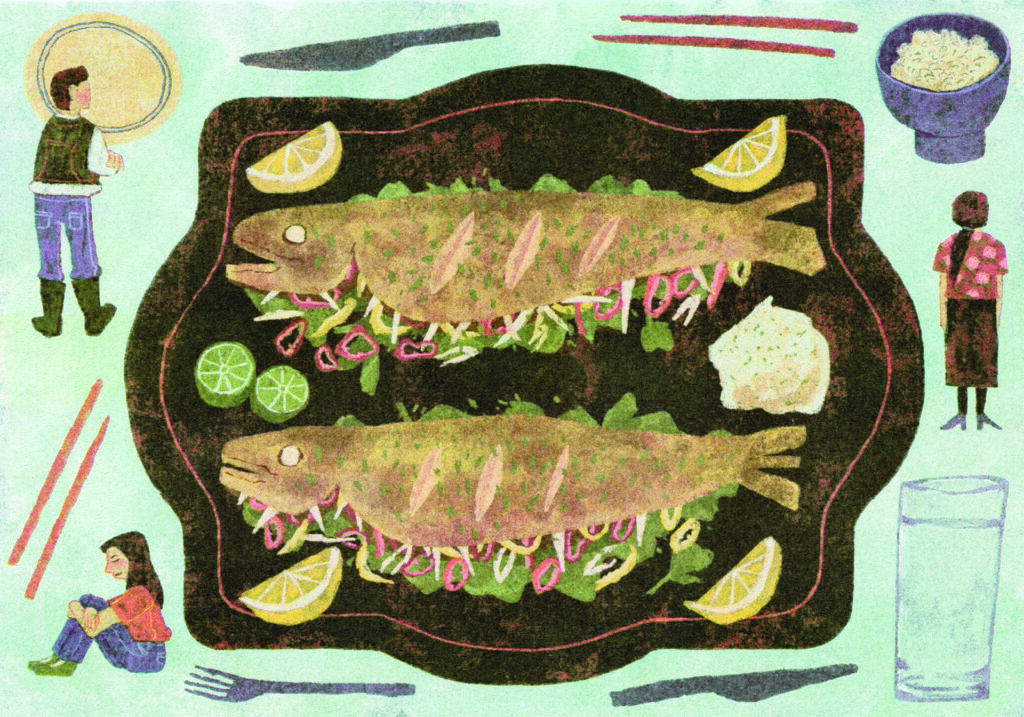
We didn’t have a lot of family dinners once I entered high school. Mostly, the three of us took our plates to our bedrooms, outdoors, or in front of the television. I think we imagined it safer that way: keeping our fangs out of reach. But eating fish is a communal activity; we couldn’t take a whole fish to our rooms. So there you’d be, splayed on a platter at the center of the dining room table, long and golden from the fryer. We’d lean forward to scoop pieces of you with our chopsticks, dropping them onto mounds of white rice in porcelain bowls purchased at the local Asian mart. Chewing slowly, careful of wayward bones that might jut into the soft flesh of our cheeks and draw blood.
With nowhere else to go, we’d have to talk: about my mom’s jealous coworkers; my shifts volunteering with Habitat for Humanity, where I’d mostly stand around with a hammer and peer at piles of lumber; my stepfather’s gardening clients, aging heiresses who’d waft onto their porches in Lilly Pulitzer caftans, offering him cold, too-sweet glasses of lemonade. Dinner was the detente we’d been waiting for. For a few minutes, I wasn’t thinking about my future escape to great cities with skyscrapers or to castles under the sea. I was eating seatrout with the people who raised me. That probably doesn’t seem momentous to you, who lived among schools of your own kind, but I’d always struggled to feel a part of something bigger, even a family, so this meant something to me. Sitting still with my people.
After dinner, my mother gathered your leftover flesh and formed it into patties to fry for her lunch at work, ignoring the rule about not microwaving fish in communal spaces. Even though I wasn’t hungry, I tore off a corner of a fried seatrout patty for myself, licking the oil off my fingers before slinking back to my room-cave.
If I bothered to look out my bedroom window, which gave a direct view of the overgrown garden out back, I would have seen how she dug a hole by her new orange tree, then emptied your remains into the hole. Bone, gills, guts, all covered with care, transformed into fertilizer. Sea to earth, down to the tentative roots that twisted into the soil.
My mother might have stood with her wrist against the divot of her waist, clicking her tongue at the darkening sky, like a secret language. A rat-a-tat eulogy for a day that would never return.
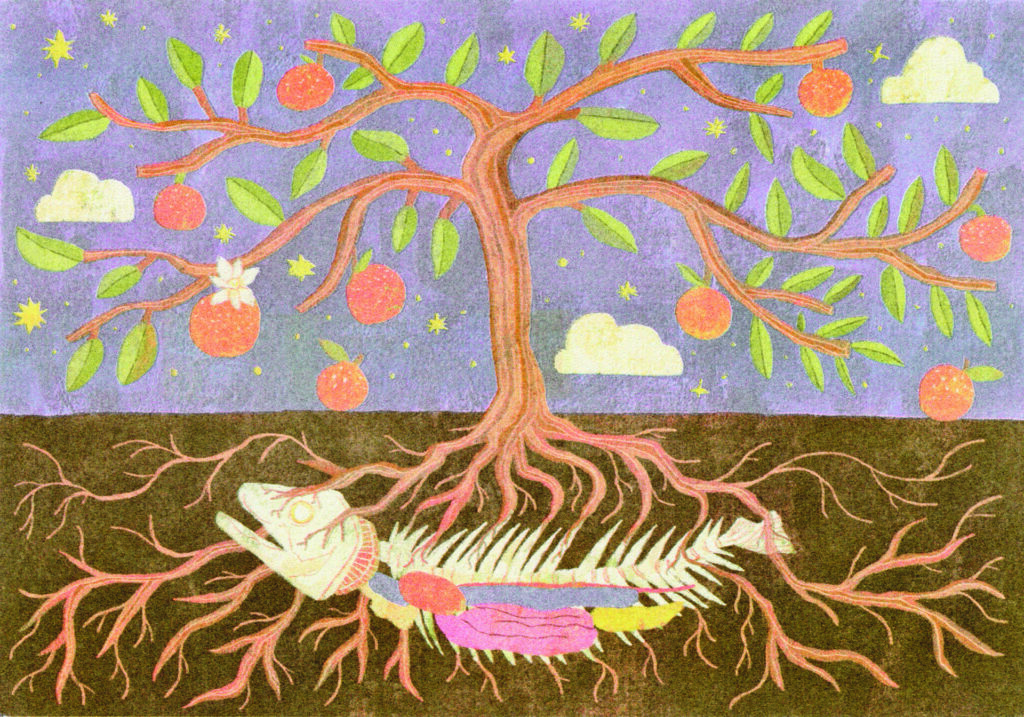
Years later, at my engagement party, she’ll carry a dozen oranges in a wooden crate from Florida to Georgia, where we’ll be celebrating. “They’re from my tree,” she’ll say proudly. “Do you remember?” I won’t think of you, of course. What were you but another meal somewhere in time, a forgotten taste in a moment too fuzzy to parse? But I will remember the orange tree silhouetted against a sherbet sky, blackish-green leaves speckling my vision. I will understand the sweep of years and the precarity of trying to hold onto a world that insists on rushing forward, like the currents that come to claim us all.
Did I escape my childhood home, like I once imagined? I did, at least temporarily. For college, I moved to Chicago, where the cold froze my breath into airy curdles that fell into Lake Michigan, home of the lake trout. As I graduated high school, a teacher said to me, “I can’t wait to hear what it’s like when you’re a small fish in a big pond.” Maybe he hoped being anonymous would teach me humility. But really, being small made me feel like great things were possible. I wonder if fish ever feel a capacity for grandness. Or was existing, even so briefly, enough of a gift for you?
After I first migrated northward, I came home to Florida often, during holidays and sometimes in the summers, when the sun roared its hot breath onto our necks. I remember one summer when I worked as a hostess at a fancy resort on a fancy island. I’d drive down the coastal highway in my clunky 1980s convertible, hair flailing like seaweed, the shushing lull of the ocean somewhere next to me, like a faithful passenger. The thing I love so much about the sea is that it promises infinitely more than what the eye can behold, what the mind can grasp. The surface is just the beginning. Sometimes, the surface is where it all ends.
All that time living near you, I wanted to go far away—as far as the horizon. But now, all I do is write about Florida. All I dream about is water.
In the end, I can’t talk about the life of a spotted seatrout—your life—without also talking about the perils your species faces. You have your natural predators, of course, the sharks and the barracudas and sharp-eyed pelicans, but the world is changing around you, too. Around us all. The sea warms. The ocean levels rise. We are sinking, and you fish are rising, and someday we will meet somewhere in the middle. Then we will find ourselves on the other side of sunlight, where home becomes a dream we’ll all swim toward.
Thao Thai’s writing has appeared in the Los Angeles Review of Books, WIRED, Catapult, Eater, and other publications. Her debut novel, Banyan Moon, was published by Harper Collins in June 2023.
SIGN UP FOR THE DIGEST TO RECEIVE GRAVY IN YOUR INBOX.