

Sorry, Texas Is Not Sorry for Barbecue Dominance How smoked brisket conquered the world
Story and photos by Daniel Vaughn
My family and I travel internationally as much as we can, and nowadays that means I’ll have a barbecue assignment or two. No matter if our destination is Mexico City, Brussels, or Melbourne, I know I’ll find some new restaurant serving Texas-style barbecue.
Cairo and Oslo are next on my list. In 2016, I traveled to Nyhamnsläge, Sweden, a tiny town on the country’s southwestern coast, to help teach a class on Texas barbecue at a local restaurant called Holy Smoke BBQ. In Lima, Peru, while stuck in the country during the initial Covid lockdowns, we could only leave our hotel room to go to the market once a day. All the restaurants were closed, but I daydreamed about trying the brisket from El Jefe Smoked BBQ, just a short walk away.
Before we took those international trips, Texas barbecue had already spread back in the States to both coasts and major cities in between. It didn’t take long for smoked brisket to dominate in the previously unconquered lands of Phoenix, Seattle, Denver, and Minneapolis. And in 2016, the unthinkable happened: John Lewis, the former pitmaster at La Barbecue in Austin, hauled his 1,000-gallon offset smokers to Charleston, South Carolina. There, in the heart of pork barbecue country, he serves smoked brisket with a bark as dark as night and Texas hot guts, a house-made spicy sausage. Lewis Barbecue convinced the sometimes-unruly Charleston customers that standing in line, waiting for your tray of barbecue to be prepared like we do in Texas, was OK. That watching as the meat is sliced in front of you means the freshest barbecue possible. Instead of just chopped pork on a plate or a bun, they got used to options like beef ribs, smoked turkey, and sausage with green chiles.
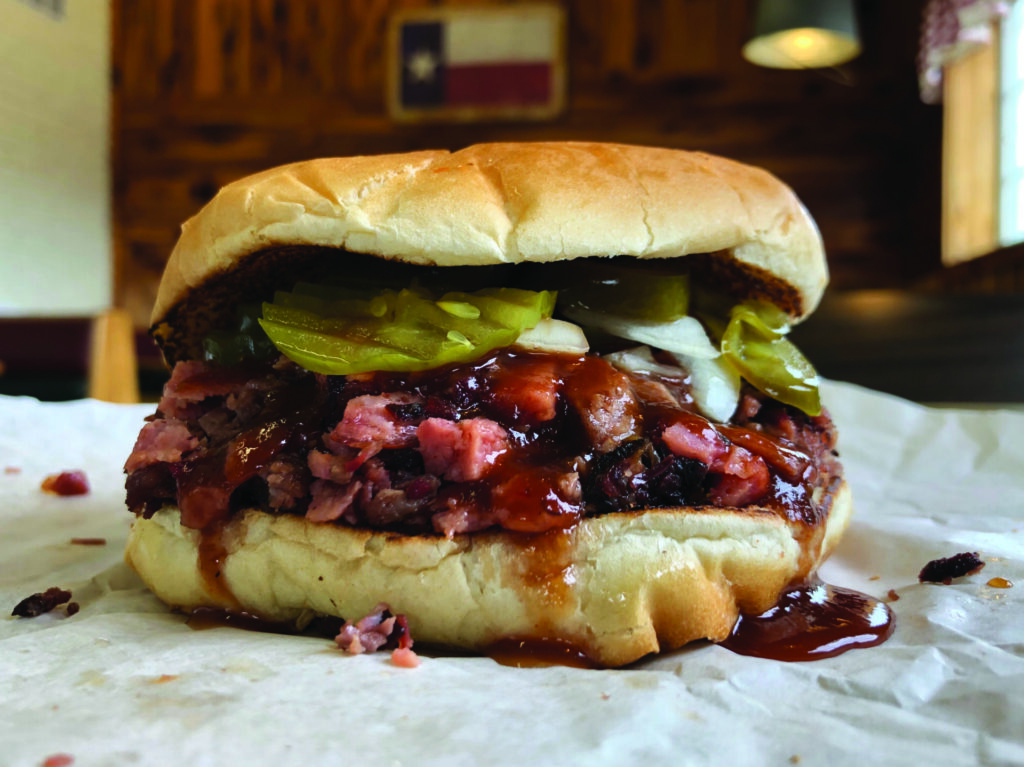
On a road trip through North Carolina last year, I got more than my fill of brisket. Prime Barbecue in Knightdale, a suburb of Raleigh; and Jon G’s Barbecue in Peachland, just east of Charlotte; both opened in 2020. The butcher paper–lined trays of brisket, spare ribs, and sliced sausage from Prime could have passed muster in Austin. Standing in line outside Jon G’s on a Saturday morning (the only day they’re open), drinking free beers from a cooler and talking with the locals about what to expect, had me feeling at home. If I had been blindfolded during the long drive there from Raleigh, I would have sworn we had crossed the Texas border, and that’s even before we got the food. It was right up there with some of the best smoked brisket you can get in the Lone Star State—even though owners Garren and Kelly Kirkman admitted that when they were growing up in North Carolina, “We didn’t really think of beef as barbecue.”
And that’s what used to make Texas the butt of Southern barbecue jokes. We were the odd ones who smoked beef and called it barbecue. Hogcentric Carolinians would have told you it was the equivalent of building a BLT with taffy. The brisket, from the chest of the steer, became our most popular cut. Slices of that brisket, sold by the pound, define Central Texas barbecue, along with simply seasoned pork ribs and homemade beef sausages, all wrapped in butcher paper.
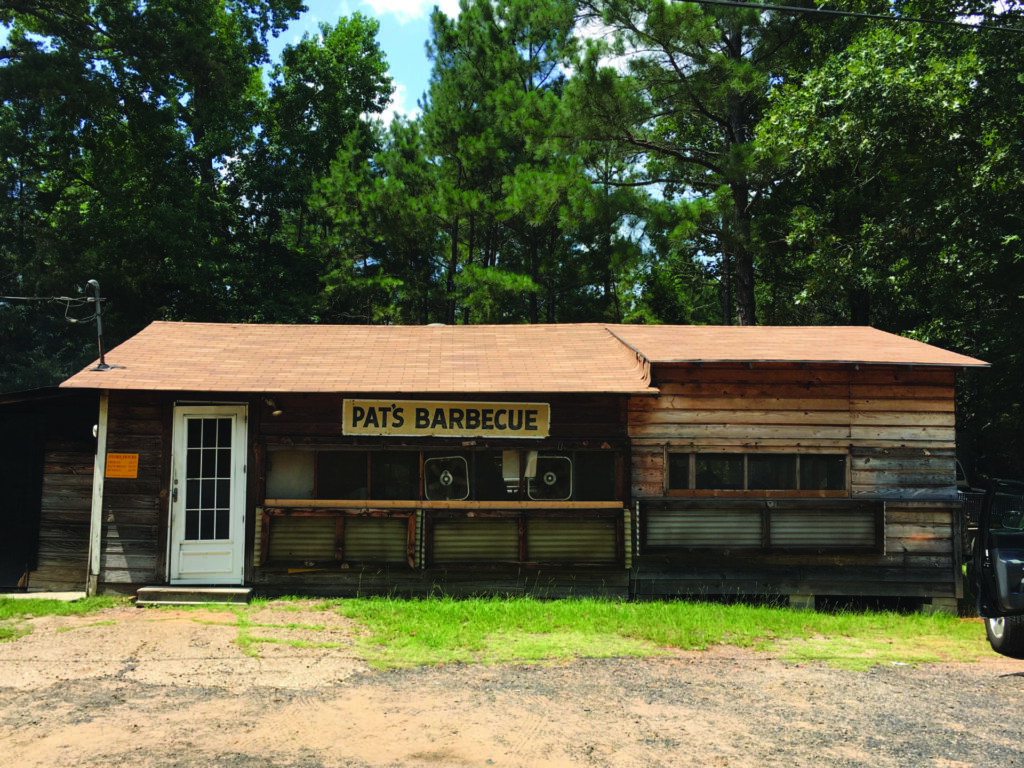
Central Texas barbecue was born in the meat markets of late-nineteenth-century Texas. Many market owners were of Czech and German heritage and brought their sausage-making traditions along. We call it Central Texas barbecue because the two oldest barbecue joints in Texas, Kreuz Market in Lockhart and Southside Market in Elgin, still serve that style, and they’re both in Central Texas. But meat markets serving barbecue were all over the state—at least in the parts settled by Europeans—prior to 1900. The first advertisement of barbecue for sale in America was from a butcher in Bastrop, Texas, in 1878. Meat markets and barbecue shacks followed their lead in the coming decades, laying the foundation for restaurant barbecue.
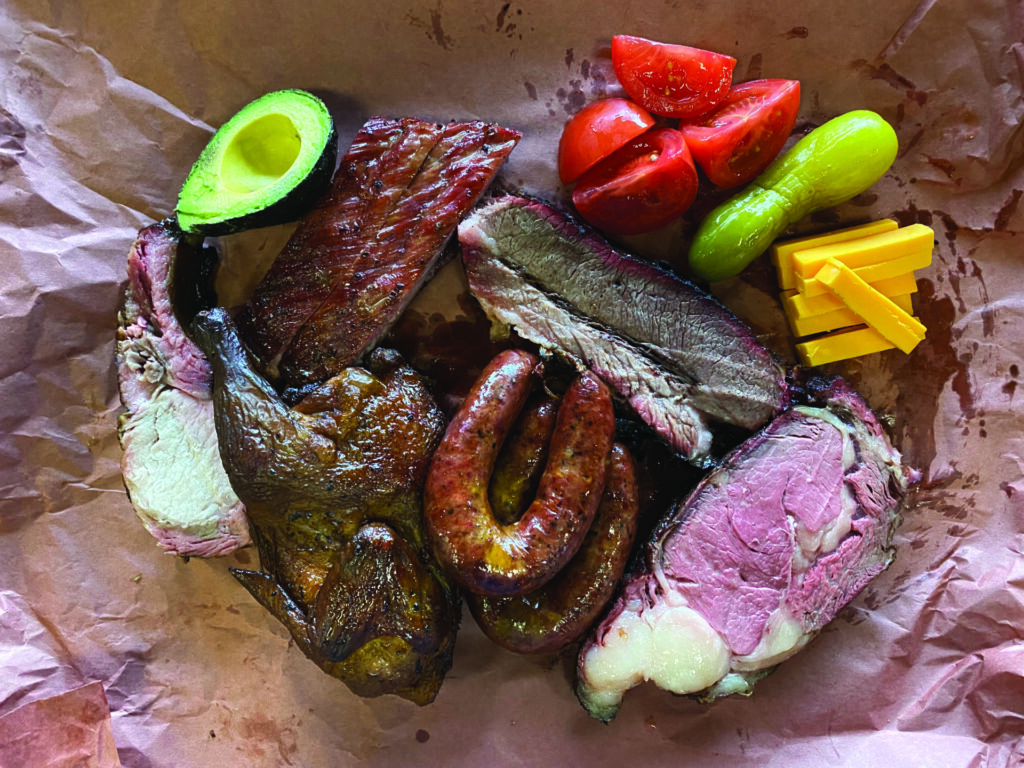
At a place like Kreuz Market, open since 1900, the important elements for producing Central Texas barbecue remain. Wood is the only fuel. The meat is seasoned simply with salt, black pepper, and a little cayenne and smoked with indirect heat. It’s cut on a wood block right in front of the customer and served by the pound on butcher paper. The preferred accompaniments are a hunk of cheese, an avocado, a tomato, some pickles, and a few slices of raw onion.
Slices of brisket, sold by the pound, define Central Texas barbecue, along with simply seasoned pork ribs and homemade beef sausages, all wrapped in butcher paper.
In 2009, Aaron and Stacy Franklin opened Franklin Barbecue in Austin, forty-five minutes north of Lockhart. It’s arguably the most famous barbecue joint in the country and is without a doubt the most influential. Franklin, whose parents operated a barbecue joint in Bryan in his teen years, built a menu based on those Central Texas principles of all-wood cooking in offset smokers. At first, Franklin seasoned his brisket with nothing more than salt and pepper. The unadorned slices of meat resting on butcher paper looked about the same as what you’d get at a Central Texas meat market, with a difference that became a game-changer: Franklin Barbecue smoked only all-natural, Prime-grade brisket.
Brisket quality hadn’t been a consideration of the old-school barbecue joints. Choice grade beef? Prime? That was for steakhouses. But Franklin’s brisket was different. His Prime-grade, antibiotic-free briskets were cooked until incredibly tender, a so-called “full-term brisket.” When a brisket hits the counter at Franklin, it ripples like a mini-meatquake. The fatty side of the brisket is, essentially, a beef aspic suspended in cow Jell-O. The fat is buttery, and—thanks to the higher grade of beef—even the lean side has enough intramuscular fat to remain juicy. Franklin’s brisket made him a star.
In 2011, Bon Appétit magazine called Franklin Barbecue the best barbecue in the country. At Texas Monthly, we named it the best joint in Texas—which really means the best in the world—in our 2013 Top Fifty Barbecue issue. Franklin had released a series of how-to barbecue videos a year earlier and went on to publish a barbecue cookbook in 2015. This went against what television shows always ingrained in viewers about barbecue’s secret recipes and the worn-out line of, “If I told you, I’d have to kill you.” If you were a pitmaster seeking fame, praise, and (less likely) fortune, why wouldn’t you copy what the new barbecue messiah was doing?
That was a turning point in Texas barbecue. The prevailing style began to veer away from old-school Central Texas barbecue, especially in Texas’s largest cities. Urban barbecue restaurants introduced sides like Brussels sprouts, elote, and carrot soufflé. They put kale in the coleslaw. They served desserts like ube cheesecake and chilled banoffee pie, all in an effort to differentiate themselves from the competition.
Thankfully, the wood-smoked meat persisted. So did the term “Central Texas barbecue.” It became ubiquitous in and outside Texas to describe this gussied-up version that featured premium meats and sides at a premium price. The name is supposed to carry a sense of tradition, but it’s usually a misnomer.
Salt and pepper have given way to seasoning salts like Lawry’s, an old pantry staple that has come back into fashion as a sort of ironic throwback in Texas pitrooms. Pitmasters mop rendered beef tallow onto finished briskets to keep them juicy—and glossy for the camera. Savory pork spare ribs are now doused with sweet glazes and finished in foil for tenderness. The overhead Instagram shot, made so easy with a paper-lined tray, has turned menu offerings into a colorful palette to be artfully plated. This is a different animal than Central Texas barbecue, and that’s what folks outside the state have been copying for the last decade or so.
I’ve struggled to find a good name for this style. Back in 2006, when Lamberts opened in downtown Austin, they were mocked for using the apparently unironic descriptor fancy barbecue on their menu. The admission got a laugh back then, but times change. Today’s Texas barbecue is fancy, but I can’t bring myself to call this new style “fancy barbecue” with a straight face. So I’ve taken to calling it “big city barbecue,” because it was introduced in Austin and quickly spread to Dallas, Fort Worth, Houston, and San Antonio. (It was, and still is, less common in rural Texas.)
Why was this version of barbecue adopted so quickly?
It’s because, in Texas, we make the best damn barbecue on earth.
I’ve been to over 2,000 different barbecue joints around the world and eaten across the barbecue regions of the continental United States. I’ve enjoyed incredible barbecue meals across the country and the world. Texas doesn’t have a monopoly on great barbecue. What it does have is an openness to creative innovation, especially from the state’s vibrant immigrant communities, paired with an uncompromising insistence on quality.

On a recent trip to Monterrey, Mexico, I ate at a Texas-style barbecue joint called Nōmada XXI. The owners, Jesús “Chuy” Rodríguez and Farid Foroughbakhch, told me about an epic barbecue research trip they’d taken to the United States in 2015. They looked for inspiration starting in Texas, then drove up to Kansas City and over to Memphis. They had planned to continue farther east, but the barbecue they’d eaten outside of Texas was so disappointing in comparison that they returned to Texas and dug even deeper before heading back home. Their incredible smoked sausages and the bark on the brisket were proof they’d paid attention.
Scrutiny from diners and critics fosters a competitive spirit among Texas barbecue restaurants. Making it onto Texas Monthly’s Top 50 Barbecue list (first published in 1997) is an achievement that both established and new barbecue joints strive for. They know it requires excellent barbecue served with consistency. I’ve been impressed by smoked meats in Kansas City, Memphis, Chicago, and the Carolinas, but I’ve also seen some of the legendary spots pass off leftover ribs that were still chilly from the night before, serve burnt ends that could bounce across the table, and sell literal burnt ends that weren’t meant to be. That kind of indifference isn’t as easily forgiven in Texas.
In Kansas City, the best barbecue I’ve had is from a trio of barbecue joints serving up Texas style barbecue. Harp Barbecue, Fox&Fire, and Chef J BBQ all proudly serve smoked brisket and house-made sausages. They’ve copied plenty from us when it comes to recipes, but the influence of Texas barbecue is most apparent in their consistent quality. There’s no indifference, from preparation to service. That level of care shows in the food; eventually, barbecue fiends in Kansas City will start to demand the same quality from the rest of their local joints—maybe even the legendary ones.
Nick Kindelsperger of the Chicago Tribune wrote in 2022 of a similar proliferation in Chicago, where the best barbecue joints in the area serve what they call Central Texas–style barbecue. Of course, it’s really the newer big city barbecue style. Chicago is a city that already has a well-developed barbecue culture thanks to the Great Migration of Black Southerners to the Midwest in the mid-twentieth century. I don’t want anything to threaten Chicago rib tips—or Kansas City burnt ends, for that matter.
Back in Texas, the spread of big city barbecue is still in its early stages, and it will take some patience to allow individuality to develop. The early signs are promising. I’ve had tatema, smoked beef cheeks similar to barbacoa, at Burnt Bean Co. in Seguin. A handful of Viet-Tex barbecue joints have brought a new energy to Houston’s barbecue scene in bowls of smoked brisket pho and sausage links with panang curry. Smoke’N Ash BBQ in Arlington is the only Ethiopian barbecue joint I’ve ever encountered. Owners Patrick and Fasicka Hicks add berbere spice to just about everything and serve their smoked meats with house-made injera, an Ethiopian flatbread. LaVaca BBQ in Port Lavaca smokes tamales in butcher paper rather than corn husks to allow more smoke flavor in. Places like these give me hope against the homogeneity.
Between big city-fication and hybrid innovation, where does that leave the generations-old Texas joints that John Shelton Reed defines as folk barbecue? I don’t know. I write about barbecue every week. I can tell a hundred different stories about a hundred different barbecue joints every year, but the highest praise I can give them is a spot on the Top Fifty Barbecue list we publish once every four years. With great power comes great responsibility, yet that damn list sometimes makes me feel powerless. The folk barbecue places are having a harder time competing, because it’s not a level playing field.
More expensive ingredients don’t automatically lead to a superior result, but the advantage is undeniable. There’s something to be said for getting the most out of inexpensive ingredients—that’s how brisket, spare ribs, and rib tips became part of the barbecue canon in the first place. But when you eat the best slice of cheaper-grade brisket next to a great version of the more expensive Prime stuff, the beef speaks for itself. Restaurant owners have to charge for those higher-quality ingredients, and they require a customer base who can pay the premium. That’s why big cities have been able to embrace this type of barbecue more easily than the small towns, where most folk barbecue joints in Texas do business.
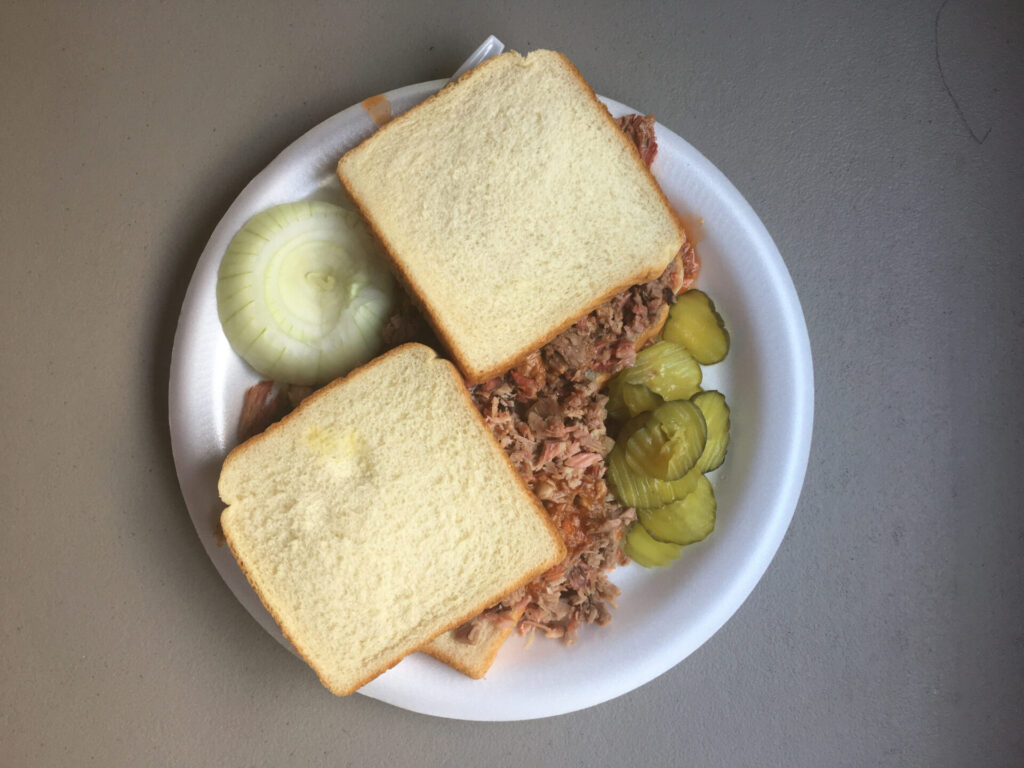
I find comfort in a humble chopped-brisket sandwich, especially one I don’t have to evaluate. It’s the same comfort offered by a plate of spaghetti and meatballs at an old-school, red-sauce Italian restaurant. But when it comes to choosing the best Italian restaurant in a city, how can a food critic dismiss the obvious difference between that plate of spaghetti and the housemade pasta at the newer spot across town?
If I could eat at one barbecue joint in Beaumont, I would order the links at Patillo’s Bar-B-Q, the oldest Black-owned barbecue restaurant in Texas. But when it’s time to evaluate how Patillo’s stacks up against 1701 Barbecue—a newer, big city barbecue–style spot in Beaumont, I can’t ignore the day-old ribs and parched brisket next to Patillo’s links. We’re not ranking the best atmosphere, the best service, or the best barbecue backstory for the Texas Monthly Top Fifty list. Consistency and quality are everything.
In a published conversation with Calvin Trillin in 2013, former Texas Monthly editor-in-chief Greg Curtis said, “Texas barbecue tends toward an ideal. There’s a Platonic brisket. It exists in the mind, and you can kind of sense how far away whatever you’re eating is from that ideal.” What that means for me, in my line of work, is that eating a slice of brisket in Texas is less about gratification than evaluation. Is the slice tender, juicy, adequately seasoned, and smoky? With so much great barbecue tending toward that ideal, I’m rarely giddy when I experience the good stuff. Comparison is the thief of joy, they say, but it does stave off mediocrity. Maybe my job would be more fun without all the comparing, but I think Texas barbecue fans are the beneficiaries, even if they’re enjoying their version of Texas-style barbecue outside of Texas. And when you combine that consistent dedication to quality with the generosity of Texas pitmasters in sharing their cooking knowledge (and the ease with which that information can be spread), a slice of barbecue inspired by Texas is closer than it’s ever been, no matter where in the world you are. I just hope you like brisket.
Daniel Vaughn is the author of The Prophets of Smoked Meat: A Journey Through Texas Barbecue, and the coauthor, with Sam Jones, of Whole Hog BBQ: The Gospel of Carolina Barbecue. He is the barbecue editor for Texas Monthly and has eaten at over 2,000 barbecue joints on four continents.
SIGN UP FOR THE DIGEST TO RECEIVE GRAVY IN YOUR INBOX.


