

When Brisket Met Injera Smoke’N Ash BBQ in Arlington offers Texas barbecue with a taste of Ethiopia.
by Hanna Raskin
Photos by Nitashia Johnson
To a Texas-born eater accustomed to barbecue served with a few slices of industrial white bread for sopping up beef fat, the spongy rolls of injera sidled up to Smoke’N Ash BBQ’s berbere-rubbed brisket might seem odd.
But any halfway decent student of Southern smoked meats would survey the Ethiopian flatbread, stewed lentils, and pork tibs that Patrick and Fasicka Hicks array on circular metal trays at their strip-mall restaurant in Arlington, Texas, and pronounce the spread traditional.
And with that conclusion out of the way, the scholar might order a cup of homemade ginger tea and teff sheet cake with spiced pecans for dessert.
As barbecue devotees over the last decade have sought out idiosyncratic riffs on barbecue standards, more and more pitmasters have borrowed techniques and ingredients from their families’ kitchen canons. In 2017, The Washington Post barbecue columnist Jim Shahin chronicled several of the nation’s birthright barbecue standouts, including Atlanta’s Heirloom Market BBQ, home of gochujang pork and kimchi slaw, and Austin’s Valentina’s Tex Mex BBQ, where the brisket comes with corn tortillas, guacamole, and salsa.
In Shahin’s telling, “Southern barbecue is being transformed by the immigrants of contemporary America,” who are either keen to put their stamp on the genre or reassert their citizenship by excelling at what Robin Wong of Houston’s Blood Bros. BBQ described as “straight Texas barbecue.”
That’s absolutely correct. But at Smoke’N Ash, the Hickses have something even bigger in mind.

Like the German immigrants in South Carolina who centuries ago sized up pork barbecue and decided it would benefit from a dollop of mustard sauce, or the Czech immigrants in early twentieth-century Texas who correctly guessed their butcher shop customers would enjoy garlicky pork sausage, the Hickses believe they’ve spotted an opportunity to improve upon how barbecue is practiced today.
“A lot of people…want vegan, they want gluten-free,” says Patrick Hicks, who grew up in Waco, Texas, on a style of barbecue that wouldn’t qualify as either.
His wife Fasicka, a native of Addis Ababa, Ethiopia, has a fix for that in the form of carrots, cabbage, and split peas.
“What’s appealing is the vegetable side of it,” she says, adding that it’s not uncommon for omnivorous Smoke’N Ash customers to ask for brisket with a vegan combo on the side.
Thus far, this column has examined the fame and financial profit that barbecue can yield, at least for its luckiest and hardest-working interpreters. Another outcome of the very best barbecue, though, is legacy: Foresighted pitmasters have the capacity to shape cuisine, in part because even radical-seeming barbecue innovations are generally comprehensible and replicable. Setting out a bottle of sauce with brisket, for example, once constituted sacrilege in Texas—but it sure was an easy upgrade to steal after new-school Texas barbecue chefs like John Lewis and Evan LeRoy helped normalize it.
Are barbecue joints across the country on the brink of jettisoning their cheap white bread and replacing it with injera fermented in-house? My professional opinion is “not a chance.” But could restaurants elsewhere ditch their meaty baked beans for lentils stewed with plenty of organic spices and no animal products? That seemed plausible enough for me to book a trip to Dallas, which is something I’d wanted to do since reading Daniel Vaughn’s December 2021 writeup of Smoke’N Ash in Texas Monthly.
After all, news value aside, buttery doro wot, a traditional slow-cooked stew, made with hickory-smoked chicken sounded exceedingly delicious.
That’s what the Hickses’ regular customers kept telling the couple in 2018, when they upgraded from their six-year-old barbecue trailer to a standalone store. Back then, there weren’t any Ethiopian references on their menu. “To tell you the truth, I didn’t know anything about the fusion idea,” Fasicka Hicks says. Still, friendly patrons were curious about her home cooking and wondered how East African sauces might taste on their baked potatoes.
While fusion was new to Hicks, she was well acquainted with the idea of keeping guests happy. When she moved to Arlington from Addis Ababa in 1996 to study information technology, she took a part-time job at a family-owned pizzeria. She didn’t yet speak any English, but quickly mastered the “pizza English” of sizes and toppings. “Every time I walk [into Smoke’N Ash], I always think about what I used to do there,” she says, remembering the praise she received for her hospitality and ease in the kitchen.
Fasicka’s other job was at a convenience store. Once Patrick Hicks noticed her behind the register, he kept coming back to the store, buying sodas and snacks so he’d have an excuse to spend a few minutes at the checkout counter. When that habit got too expensive, he switched to lottery tickets, even though the only number which interested him belonged to Fasicka.
They were married in 2003.
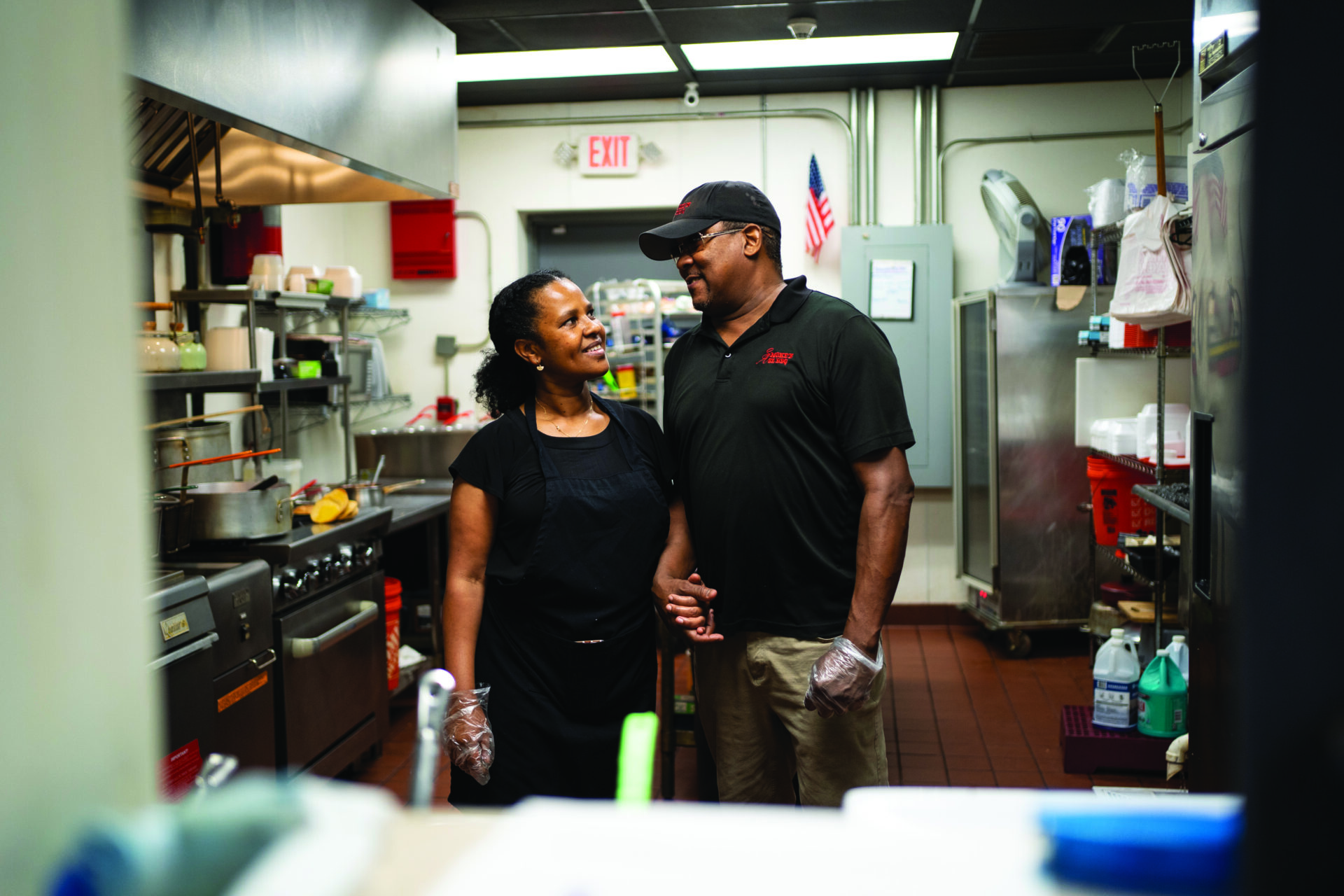
Before he met Fasicka, Patrick had never tasted Ethiopian food. “We started him with the spicy stuff to make fun of him,” Fasicka says of mitmita, a condiment that she and her sister playfully applied to his greens. “That was the intention, and it worked.”
Perhaps it was Patrick’s enthusiasm for the milder dishes that bolstered Fasicka’s resolve to bring Ethiopian food into a restaurant setting far from where most members of Dallas’ Ethiopian community live. Her biggest concern when she started offering Ethiopian-style dishes through an in-store popup called Cherkose, named after her late mother, and later, when she wedged those flavors directly into Smoke’N Ash’s barbecue plates, was that fellow immigrants would judge her hybrids harshly.
For instance, she didn’t know how they’d respond to items such as spareribs brushed with awaze, or liquified berbere, since pork is prohibited in both Islam and the Ethiopian Orthodox Church, the two primary religions of Ethiopia.
“Our fear was people [would] question how authentic this food is,” she says. “I can tell you one thing: I haven’t heard anything negative at all…Matter of fact, I remember [an Ethiopian customer] who had a couple of bites, and said, ‘This is genius.’ That was his exact words.”
Both Hickses hope to hear that phrase again when they open their next Smoke’N Ash in Ethiopia. One of Fasicka’s sisters spent the early summer months in Arlington, learning how to prepare their signature rubs and smoke meats to their specifications.
When she returns to Ethiopia to launch the restaurant’s second location, she’ll serve smoked chicken, macaroni and cheese dusted with berbere, and shiro wot, the beloved chickpea stew, abob with cubes of slow-cooked brisket and topped with clarified butter. And she’ll tell her patrons that that’s how they do it in Texas.
Hanna Raskin is a Gravy columnist. Her newsletter, The Food Section, is published on Substack.
SIGN UP FOR THE DIGEST TO RECEIVE GRAVY IN YOUR INBOX.