
In “What’s in Store for the Pawpaw Patch?” Gravy reporter Anya Groner examines the pawpaw, a long-overlooked fruit that’s now being domesticated, making its way into farmers’ markets, restaurants, and even beer.
What plant has leaves that smell like green pepper, fruit that can taste like pineapple or turpentine, and bark that can be woven into baskets? Enter the poor man’s banana, also known as the pawpaw. Two decades ago, you’d be hard-pressed to find a nursery with a pawpaw tree for sale, but these days the mid-sized tree and its fruit has a near cult following. Though indigenous to the eastern United States, pawpaw trees fell out of popular consciousness for almost a century. The reason is at least in part economic. The fruit ripens and rots so quickly that it’s never been commercially viable. But, in recent years the northern-most variety of “custard apple,” a family of trees that includes the soursop and cherimoya, has had a remarkable comeback.
Over two decades ago, horticulturalist Neal Peterson sparked a renewed interest in the fruit after patenting seven pawpaw cultivars, which he bred for flavor, low seed count, and perishability. Yet not everyone lauds the growing popularity of pawpaws. Dr. Troy Wiipongwii, Director of Innovation and Entrepreneurship in Conservation at the College of William and Mary, says this surge of interest could backfire, causing an overproduction of the fruit that ultimately hurts the ecosystem. And Sean Wilson, who uses pawpaws to flavor seasonal beers at FullSteam Brewery in Durham, North Carolina, worries that too much cultivation might result in a bland fruit.
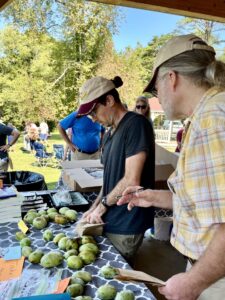
So what’s next? Will pawpaws become the next “it” fruit, destined to flavor everything from soap to cocktails? Or will oversupply collapse the market and leave us with a flavorless fruit? In this episode, Groner takes us to a festival in Paw Paw, West Virginia, to explore what we lose and what we gain as America’s largest indigenous fruit, the pawpaw, is bred for market.
***
Special thanks go to Andrew Moore. His 2015 book Pawpaw: In Search of America’s Forgotten Fruit, details over a century of cultivation efforts and is a wonderful read. Thanks also to Robbie Glen, the Morgan County Master Gardeners Association, and Nathan Eylands. Although they weren’t featured in the episode, their insights on growing and eating pawpaws were invaluable.
This episode was reported by Anya Groner. She is a journalist, fiction writer, and essayist, whose work has appeared in the New York Times, the Oxford American, and The Atlantic. Her audio reporting is featured in the Sea Change podcast and on Plot of Land, a podcast that explores land ownership and housing in the United States. Anya lives with her family in Richmond, Virginia, and works as a teacher and freelance journalist.