
In “Bala’s Bistro: Where Mali Meets Memphis,” Gravy reporters Marie Cascione and Joshua Carlucci profile Malian chefs, cousins, and business partners Bala Tounkara and Mady Magassa. Their story takes us from West Africa to the casinos of Tunica, Mississippi, and finally to South Memphis, where their restaurant, Bala’s Bistro, has become an emblem of success and belonging for African immigrants in the South.
Today, 21% of Black Americans are either immigrants themselves or children of immigrants. The vast majority of Black immigrants in America live in the South, and Tennessee is one of the fastest growing states for this community.
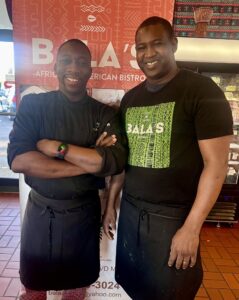
Bala and Mady both immigrated to Memphis by way of New York City in the early 2000s. Looking for some semblance of community, they landed in Whitehaven, a Black neighborhood that, at the time, had only a small enclave of West Africans. They started cooking in restaurants with no initial plans beyond making money to make ends meet. Over the years spent around fire and knives, Bala and Mady decided to dive into a business venture of their own: making food from home, as they saw it. They opened Bala’s Bistro in 2019 to answer the question: Where’s all the African food in Memphis?
Though Bala and Mady are from Mali, they make and serve food from all over West Africa. Fufu, egusi, maafe, and saka saga—just to name a few—all make star-studded appearances in the glass display case from which Bala’s customers can pick and choose to make their plates. The case looks like a buffet for a reason: Bala and Mady want you to ask about the food.
Bala used to be self-conscious of what he ate back home, but today he embraces it and encourages others to give it a shot. When Memphians wonder about some of the soupy, bubbling concoctions, he explains and gives them samples. He’s big on education; he wants curious eaters to satisfy their wonder, but even more, he wants Memphis to know that the soul food they know and love, and the rich and spicy cuisine of West Africa, were cut from the same cloth.
In this episode, Cascione and Carlucci talk to Bala Tounkara and Mady Magassa all about their journey to Memphis and the story of their restaurants. Gravy listeners will also hear from guests, some who come to Bala’s for a taste of something new and leave with a sense of community. Having just opened a second restaurant—Mande Dibi—Bala and Mady double down on the idea they hatched long ago. The pair place their bets on African food finding a widely-adored home, just as they did, in Memphis. At the same time, their restaurants have become a place of refuge and community for all who come to eat at their table, whether from Memphis, Mali, or all that in between.
This episode was reported and produced by Joshua Carlucci and Marie Cascione. Joshua is a food writer who splits his time between Memphis and New York, where journalist and anthropologist Marie is based. They’re old friends, but this Gravy episode is their first collaborative professional project.
Acknowledgments
Special thanks to Bala Tounkara and Mady Magassa for letting us take over a good chunk of their dining room for hours, for the great conversation, and for feeding us for many meals.
A huge thank you to editor-in-chief of Edible Memphis, Stacey Greenberg for her perspective on the changing Memphis food scene over the last two decades, and her important work through her magazine.
Many thanks to culinary historian Dr. Jessica B. Harris and her book, High on the Hog.
Thanks to Cassie Ippaso for keeping us grounded while we racked our brains over endless meals and a bad bout of food poisoning.
Top photo: Bala Tounkara explaining how the fufu is made back home by hand. Photo by Joshua Carlucci.