In “Cultivating Korean Greens in North Texas,” Gravy reporter Elizabeth Myong explores how Korean American communities are gardening in North Texas. She reflects on her upbringing in the Richardson suburbs, where she grew up eating Korean herbs and plants from her family’s backyard.
Those fresh greens were made into dishes with “son-mat,” which directly translates to “hand taste.” It’s the flavor of seasoned hands, usually of a mother or grandmother, making something especially for you. It’s the flavor of love and care mixed with earthen, locally-grown staples like kkaenip (sesame leaves), buchu (Korean garlic chives), and gochu (chili peppers).
In recent years, this intimate taste has been overshadowed by flashier, bolder flavors that have become popular with the commercialization of Korean food. But across North Texas, Myong shares the homemade food being made from backyard gardens and kitchens.
Heangjin Park is an assistant professor at the University of Wisconsin Madison who studies Korean diasporic communities and food. He explains that Korean gardening creates a sense of belonging.
“You are being transplanted and rooted in [this] new place. I think that there’s a symbolic or metaphorical dimension of Korean gardening.”
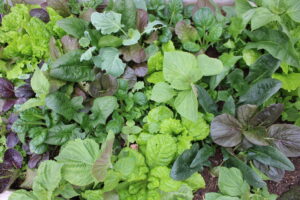
In the summer’s sweltering Texas heat, Myong’s mother Jan annually makes kkaenip-jangajji, pickled sesame leaves, with fresh leaves plucked from her garden. In the suburb of Carrollton, couple Sofia Kwak and Kenneth Jung grow their own bountiful garden filled with Korean lettuce, eggplant, bitter melon, zucchini, minari, jeok gat (Korean red mustard greens) and ah oh (cluster mallow.) In Irving, Duke Dukbong Yoon uses a homi, a traditional Korean hand plow, to harvest jujubes, mugwort, Korean peppers, corn and pumpkins.
Each month, Kwak and Jung join a Korean gardening club Dal-Nongbu, Dallas City Farmers, to talk about their gardens and trade tips, produce, and seeds. It’s been a way for members to build community and bond over their shared love of gardening Korean herbs and veggies.
North Texas boasts the largest Korean population in Texas and the ninth largest in the country. The region’s Korean dining scene has exploded over the decades along with a hunger for Korean home cooking. North Texas’ Korean food scene may not be as commercially visible as New York, L.A. or even Atlanta, but its rich history and quality food make it an important landmark of Korean diasporic communities in the South.
Acknowledgments
Special thanks to everyone who gave their time and expertise. Professor Heangjin Park, Stephanie Drenka with The Dallas Asian American Historical Society and the Dal-Nongbu Dallas City Farmers club. Elizabeth thanks her mother, Jan Myong, for sharing her insights, kkaenip recipe and lifelong love of Korean food. She also wants to thank her wesomo Linda for connecting her to the farmers’ club.
Elizabeth Myong is a reporter covering food systems and culture. She was raised in North Texas. Her work has been published by Civil Eats, NPR, and The Dallas Morning News, among other publications.