After the Storm: Up from the Rubble After Hurricane Michael, Mexico Beach’s food scene comes back “Cat 5 strong.”
by Jennifer L. Greer
Photos by Andrew Wardlow
On October 11, 2018, the morning after a Category 5 hurricane wiped out the tiny town of Mexico Beach, Florida, Michael Scoggins walked nine blocks from his waterlogged house to his business, Killer Seafood, on US 98, the coastal highway that runs through town. During the storm, he and his domestic partner escaped the crush of two falling pine trees by sheltering inside their garage, in a car, with their three cats and a litter box. Now the sun was up, and Scoggins needed to check on the restaurant that had been his life for fourteen years.
Killer Seafood lured repeat customers with its take on coastal classics: Baja California–inspired marinated and grilled tuna tacos (on warm corn or flour tortillas); baskets of fried or grilled Gulf shrimp with skin-on french fries, wasabi coleslaw, or hushpuppies; fresh catch of the day (such as flounder, grouper, or red snapper); and bread bowls full of shrimp or scallops cooked in Simmerin’ Sauce, an original, New Orleans-inspired tomato sauce stewed with beer, seafood stock, butter, and aromatics like rosemary, fennel, and thyme. Before leaving, patrons could buy a jar of Simmerin’ Sauce and a Killer Seafood T-shirt, with the chum and get it shark-jaws logo. They might even snap a selfie with the Captain, a life-size wooden statue with a flowing white beard and peg leg, who served as the restaurant’s mascot and front-door greeter.
On that October day, downed trees and power lines blocked the highway. Overturned boats and cars littered yards. Houses lay crumpled, reduced to piles of rebar and rubble. “I didn’t know exactly what I would see at the restaurant. There were no phone lines or communication, so nobody knew how bad the damage was,” recalls Scoggins, a Georgia native and former actor. A tall, wiry man, he pushes graying hair off his tanned forehead and frowns at the memory.
In 2004, Scoggins left the Los Angeles film scene to come back to the South and start Killer Seafood with a longtime friend, Kevin Crouse. Their sea-to-table approach bred success and took Scoggins to depths that perhaps few restaurateurs go. In 2018, a month before the Hurricane Michael hit, he went diving with the Mexico Beach Artificial Reef Association, a local conservation group, to spear invasive lionfish to serve at the restaurant.
My husband and I were in town that day, and I remember when Scoggins set down a whole fried lionfish in front of me. It was spiny and ferocious-looking, even with the venomous tips removed. My table companions stared. I grabbed the lemon wedged in the fish’s mouth, squeezed, and dug my fork into the golden skin. It was hot and crispy; a dusting of flour sealed in the juices. The meat tasted slightly sweet with a light, delicate texture like flounder. I worked my way slowly from fishtail to neck, nibbling a jalapeño-onion hushpuppy between bites as I savored the meal.
Scoggins boarded up Killer Seafood as Hurricane Michael churned across the Gulf of Mexico, its winds exceeding 160 miles per hour. But when he laid eyes on the restaurant in the clear morning after landfall, he knew it was history. The former cinderblock bakery he’d transformed into a “rustic boathouse” was now a huge mound of twisted metal, mangled plywood, and broken framing in a sea of sand. “I remember being in a state of shock,” says Scoggins, with a catch in his voice. “It took a few days for me to get past that.”
The wind and storm surge destroyed most of the town’s restaurants: Toucan’s on the Beach, the breakfast favorite Sharon’s Café, the surf-and-turf-style Fish House, the organic Caribbean Coffee & Cafe, Crazy Beach Pizza, old-Florida institution Shell Shack, and family pub Mango Marley’s. Mexico Beach’s only grocery store was obliterated, too. Gone were the locally owned, mom-and-pop businesses that nourished a town of 1,000 residents, which swelled to more than 10,000 people during the tourist season. With no chain restaurants, traffic lights, or high-rise buildings, Mexico Beach, a place of second- and third-generation residents, had resisted overdevelopment. Assessing the disaster, federal experts said the storm caused “severe damage” to more than 80 percent of Mexico Beach’s building structures.
Everyone wondered: Could the town even rebuild? If so, could it resist the kind of high-density developments that would change its small-town character?
Looking back, it is easy to see why Mexico Beach evolved from a seasonal fishing village into a dream beach town. Situated between Port St. Joe and Panama City, along a semirural stretch of highway known as the “forgotten coast,” the town has three miles of white sand beaches that curve around the Gulf of Mexico and frame a bottle-green sea. Spring and fall runs of migratory fish first attracted anglers here in the early 1900s. The newly constructed Route 98 brought visitors in the 1930s, and Tyndall Field (later renamed Tyndall Air Force Base) opened in 1941. In 1946, Southern businessmen Gordon Parker, W.T. McGowan and J.W. Wainwright formed the Mexico Beach Corporation and bought 1,850 acres of undeveloped property, mostly piney woods and cattle pastures, along the coast in eastern Bay County. In an act of prescience, early residents deeded one mile of unobstructed beach for conservation.
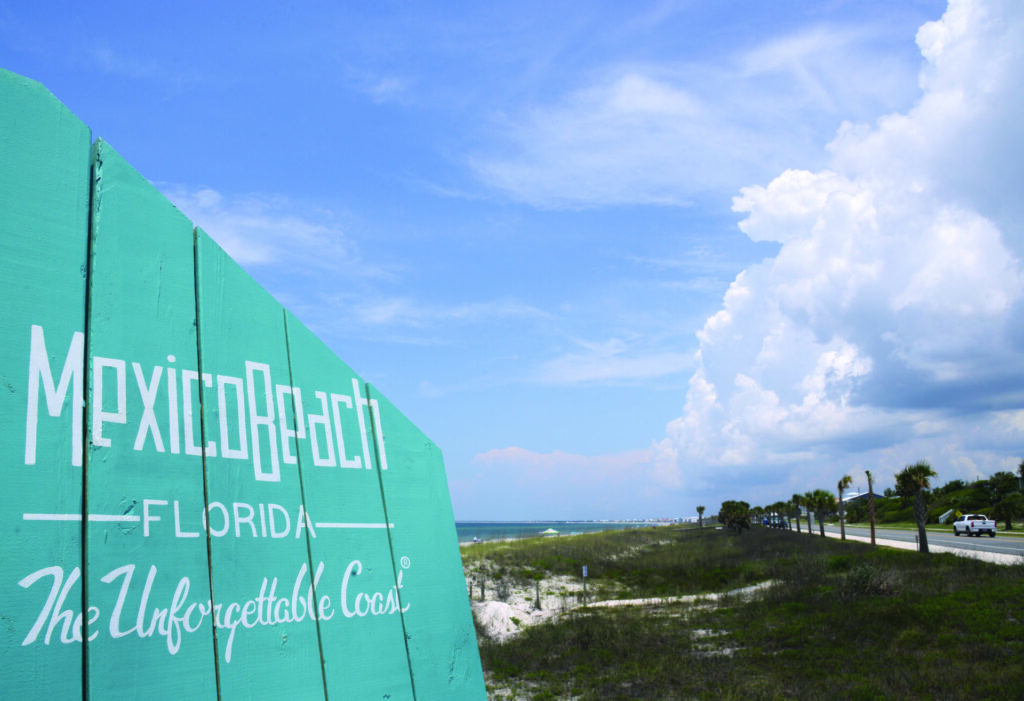
In 1975, Mexico Beach survived Hurricane Eloise, a Category 3 storm that made landfall at nearby Fort Walton Beach. It survived Hurricane Opal, a Category 4 storm that hit Pensacola in 1995. But in a sign of changing climate times, Mexico Beach was no match for a direct hit from Hurricane Michael’s ferocious winds and fourteen-foot storm surge. Four people died in Mexico Beach because of the storm. The Federal Emergency Management Agency’s chief administrator said the town was completely “wiped out.”
In the four-and-a-half years since the storm, with more than $100 million in state and federal disaster aid, the city has removed massive amounts of debris and restored essential infrastructure, such as roads, bridges, utilities, the public canal, and city hall, says Douglas Baber, the city’s administrator. Officials continue to work with federal and state agencies to rebuild the town’s much-loved public pier and jetties and to construct a new municipal complex with a police station, fire station, and civic center.
Though restaurants were essential to the town’s economic health, strategically, city officials prioritized restoration of beaches and parks popular with residents and tourists alike, including Sunset Park, Canal Park, Municipal Park, and the public boat ramp. But as amenities and basic infrastructure were replaced or repaired, Al Cathey, the former mayor who led Mexico Beach through Michael’s onslaught and aftermath, knew the local food scene was key to the town’s future: “It’s the lifeblood of the community. Our recovery as a town comes from our ability to bring back these local food businesses and encourage quality new ones. When people come to the beach, they don’t want to eat a bologna sandwich. They want to enjoy the Gulf and its bounty.”
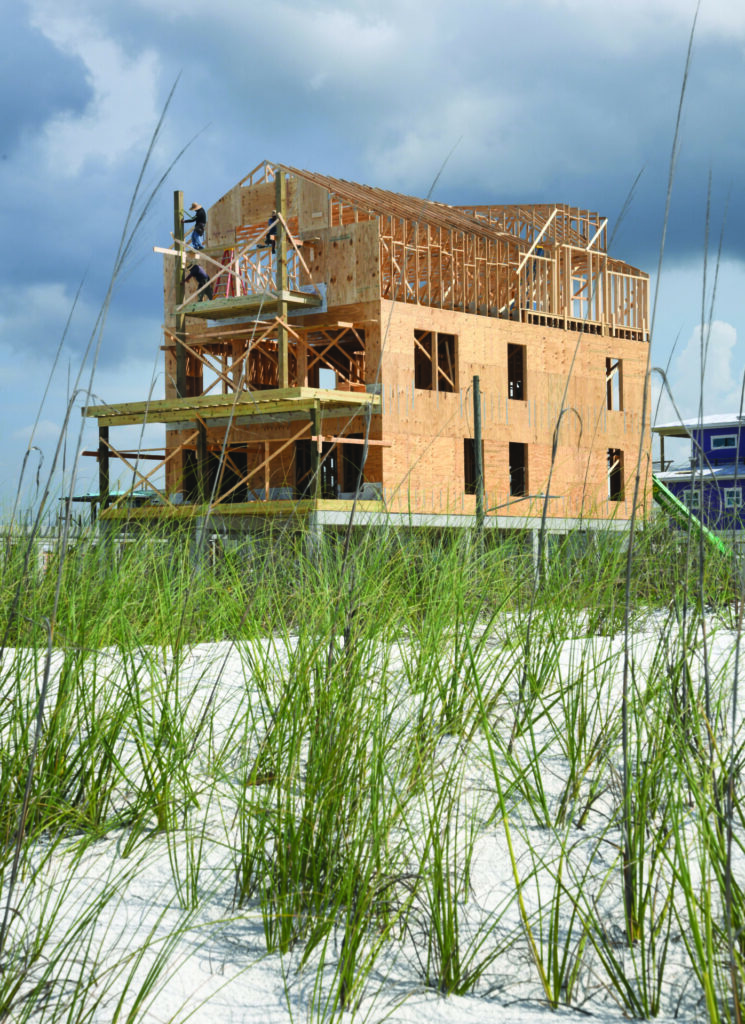
To that end, his town began planning how to defend itself against future storms and help its signature restaurants survive another mammoth storm. Starting in 2019, Mexico Beach adopted tougher building codes to qualify for federal recovery funds. Specifically, these codes call for increasing wind load to 140 miles per hour and elevating new structures to mitigate future flooding. Second, the town formed a “recovery and resiliency partnership” dedicated to stormwater management and greenspace development. In particular, the plan prioritizes flood mitigation, because the storm surge caused much of the damage.
None of this may matter to vacationing diners looking for locally sourced meals. But given accelerating climate change, scientists predict stronger, more volatile hurricanes. Gulf communities may be uniquely vulnerable to these storms, according to University of Florida historian Jack E. Davis, author of the Pulitzer Prize–winning history, The Gulf: The Making of an American Sea. Of the top twenty costliest hurricanes to hit the United States, seventeen have occurred since 2000 and fifteen passed through the Gulf, according to the National Oceanic and Atmospheric Administration. Restaurants along the coast will have to adjust, structurally and economically.
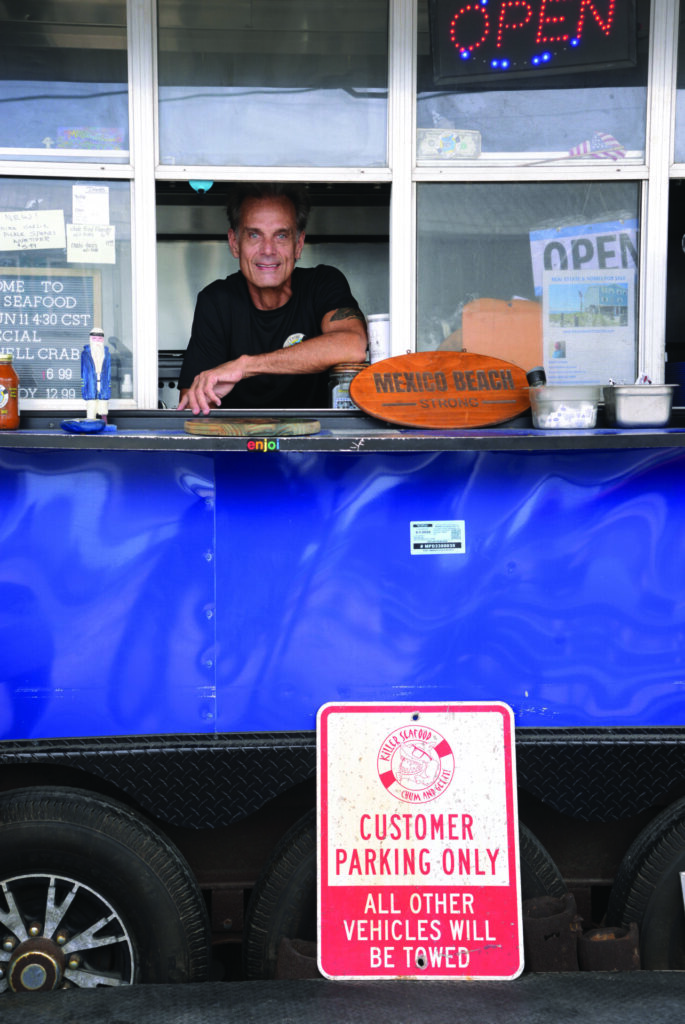
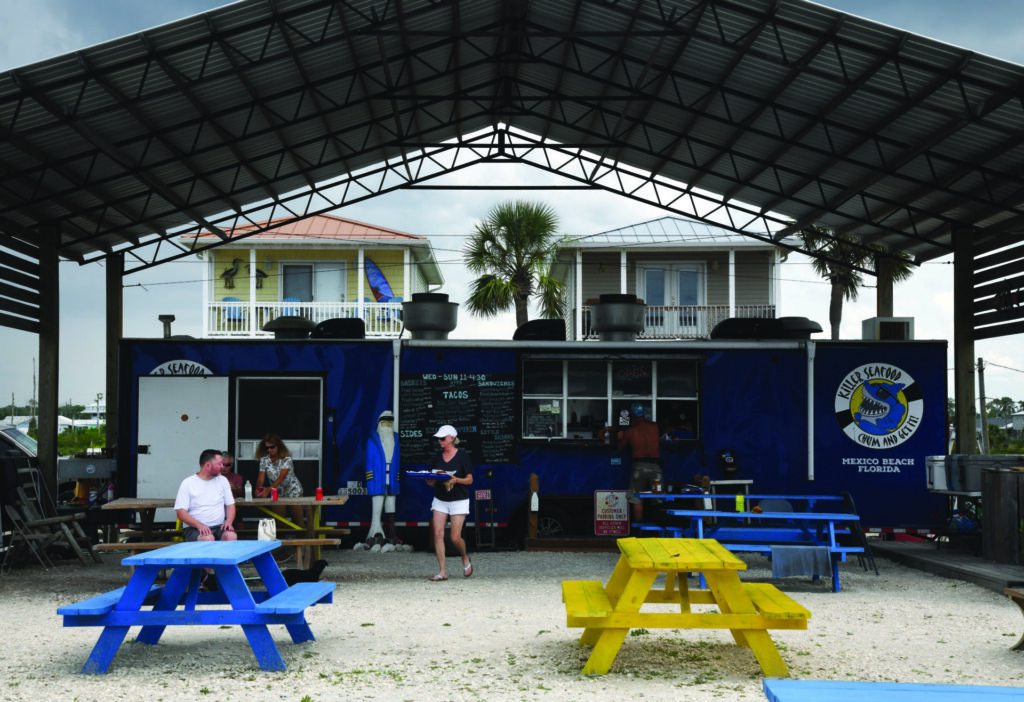
As Mexico Beach approaches the fifth anniversary of Hurricane Michael, five of the original food businesses have returned in their same locations: Killer Seafood as a mobile trailer and Shell Shack, Mango Marley’s, Caribbean Coffee & Cafe, and Crazy Beach Pizza as permanent structures. They’ve had to adapt their respective recoveries to their financial pictures, the risks of their sites, and their evolving business models. Killer Seafood, for example, chose a trailer it can move if another Category 5 storm threatens Mexico Beach. Shell Shack raised its foundation to better withstand flooding, and Mango Marley’s rebuilt with stronger, more hurricane-resistant materials.
Two beloved restaurants, Sharon’s Cafe and The Fish House, have not rebuilt. This spring, however, cheers erupted on social media when Toucan’s on the Beach, a fixture since the 1960s, received a permit to start construction at its old location near highway 98 and 8th Street. A three-level, indoor-outdoor, tiki-style restaurant, gift shop, and event space with a back door to the beach, Toucan’s once employed 130 people who served thousands daily.
A convenience grocery and a liquor store have opened in Mexico Beach post–Hurricane Michael. And although the Covid-19 pandemic slowed the economic recovery, tourists have returned. But some changes to the town’s laid-back, low-density, old-Florida past are proving inevitable. The St. Joe Company, developers of the luxury Pearl Hotel in nearby Rosemary Beach, have broken ground on a 554-acre “master-planned” community of townhomes, single-family homes, apartments, and a commercial village in Mexico Beach. Whether the development will include locally owned restaurants is unclear.
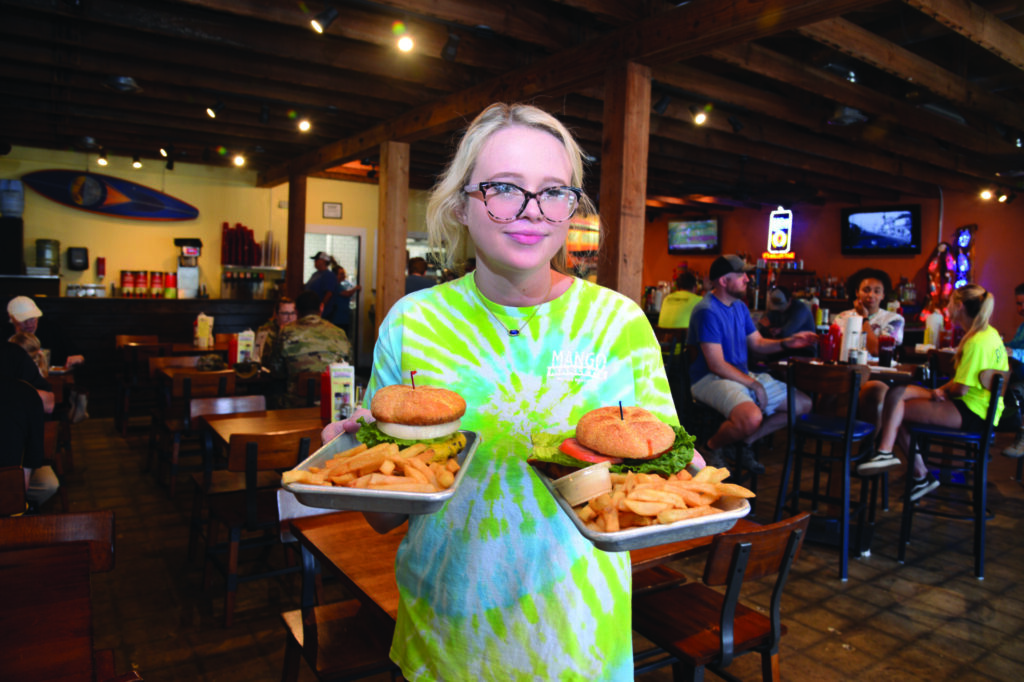
For now, three legacy establishments lead the way in the revival of the town’s food scene: Mango Marley’s, Shell Shack, and Killer Seafood. They are “Cat 5 strong,” as the locals say. Near the higher ground in the town center, people in shorts, flip-flops, and sundresses line up outside Mango Marley’s, a funky, family-friendly pub in a small shopping center on highway 98. Started in 2007 by Cathy and Steve Johnson of Valdosta, Georgia, the restaurant specializes in wings and burgers with sandwiches, seafood, and sides influenced by Caribbean and Southern cooking. When the storm hit, the building’s walls held their ground, but the roof peeled up, allowing rain to drench the interior, so the restaurant had to be gutted. The Johnsons’ Mexico Beach home also flooded. They spent weeks in a camper overseeing reconstruction at the restaurant. Yet the couple did not consider leaving. “Everyone came out to help us, and we realized how much we were a part of the community,” says Cathy Johnson.
Given how bleak the post-storm culinary scene was, the Johnsons quickly mustered a mobile kitchen, set out picnic tables, and accepted a customer’s gift of an army surplus tent. For two years, Mango Marley’s stayed afloat and fed the town, selling sandwiches, chips, and pasta salad to residents and construction workers alike. Staffing has been a challenge, with some employees moving on, but the Johnsons reopened in late 2020 for indoor, sit-down dining and broke sales records in 2022, says general manager Zac Emerson.
A family business built in 1965, Shell Shack was a classic Florida seafood and souvenir market that fronted highway 98 and backed up to the main canal. Hurricane Michael blew out its back wall, causing the building to collapse. Black muck coated what remained. “When I saw it, I thought my life was over. I’ve been working here since I was zero,” says Nick Hunter, who remembers standing on a stool to clean fish and help his grandmother, Bennie, run the market. The family got temporary jobs while the rebuild was underway. Today, a new shack-themed building mimics the old but rises several feet off the ground. A huge set of faux shark jaws still fills the front display window. “They made it through the storm, although we had to do a little dental work on them,” Hunter says, grinning.
The Hunters—Nick’s father, George; mother, Theresa; and uncle, Fred—catch shrimp and mullet locally. They buy other Gulf seafood, such as grouper, snapper, flounder, tuna, and crab, from wholesalers in Apalachicola. While we talk, Theresa chops celery for the smoked mullet dip she prepares for “Fish Dip Thursday.” Nearby, a white board lists the names of those who pre-order her dip, sometimes two weeks in advance. Did Shell Shack ever think about not coming back? No, says Theresa, a petite, energetic woman in jeans, sneakers and a backwards baseball cap. “I admit that recovering from this storm was a lot harder than anything I have ever done. But we built back stronger and better.”
At Killer Seafood, Scoggins is making a video to promote “Flatfish Friday.” The picnic tables in front of the thirty-six-foot-long trailer are filling up with lunch customers. Inside, coworkers take orders, flip grouper fillets, and load deep fryers. Scoggins and Crouse’s new business model requires half of the former staffing and includes four former employees and three new employees. They wanted to keep the business in Mexico Beach, but construction costs were too high to build a new flood-proof building on the current site. Nearing retirement age, they didn’t want to take out a big loan and opted for a less expensive, portable structure. The new setup means they are open fewer hours and serve no alcohol. Yet loyal customers have returned, and with smaller overhead, profits add up about “the same as before,” says Scoggins. The Captain statue is back, too. After the hurricane, he was found under a boat six blocks away on 15th Street.
On another morning, Scoggins makes five gallons of Simmerin’ Sauce. That afternoon, he speaks via Zoom to the 2023 National Hurricane Conference. The conference is hosted by a Tallahassee-based nonprofit that provides a national forum for education and training in hurricane preparedness. His talk is about “how small businesses can pivot and recover post hurricane or other natural disaster,” he tells me. Is he worried about future hurricanes? “The climate is changing, but it’s changing everywhere, not just here. It will take more than a storm to get me to quit.”
It’s hard to argue with him. From wildfires and droughts to tornadoes and flash floods, we are in the climate crisis together, no matter where we live. If we draw lessons from Hurricane Michael and Mexico Beach, maybe one of them is this: The local restauranteurs took the worst day the Gulf has given them, and they gave back their best.
Jennifer L. Greer, PhD, is a freelance journalist who worked in newspapers and magazines for twenty-five years. She also taught research writing at the University of Alabama at Birmingham (UAB). In 2018, Jennifer and her husband suffered severe damage from Hurricane Michael to their fish camp on Wetappo Creek, six miles north of Mexico Beach.
SIGN UP FOR THE DIGEST TO RECEIVE GRAVY IN YOUR INBOX.