To the Marrow In the 99th Issue of Gravy, poems show up hungry
by Sandra Beasley
Poems are the unruly guests of magazines. These strange linebreaks! This casual overruling of house style! A poem shows up hungry and isn’t afraid to ask for third helpings. A great poem can bless and celebrate but may also cackle, ache, and complicate. The music of one poem might be found in muscular, grinding bursts of sound-play, while another poem conducts using silences of breath and white space. Like all intergenerational craft, poems thrive when knowledge of form and recipe is punctuated by a willingness to experiment and evolve.
Poems are deeply particular things, and to write one is almost always an act of bravery. We need all the bravery we can get.
The Southern Foodways Alliance “baked poetry into our aesthetic,” as founding director John T. Edge wrote in his welcome to Vinegar & Char: Verse from the Southern Foodways Alliance (2018). This took form as invocations and benedictions delivered at symposia from 2002 onward; editioned broadsides; poems featured in all seven installments of the anthology Cornbread Nation; and the Vinegar & Char anthology, which I edited. In my Mississippi travels, I have found it to be a state that loves poetry to its marrow. It’s a place where telling someone that you’re a poet is met with enthusiasm, not an awkward pause—something I’ve only found in one other place, which was Cork, Ireland.
It’s wild to realize that over a decade has passed since I stood onstage at the Lyric Oxford for an SFA Symposium in fall 2015. My relationship with food is complex. I write about food allergy as often as I write about food, and I understand how eating is a mechanism for exclusion as well as invitation. I couldn’t eat a single meal at that 2015 symposium (something that John Currence’s crew, amazingly, worked to fix when I was back in 2018).
Yet when I felt at a total loss to begin working on my fourth collection, which became Made to Explode (2021), it was cooking and the poetry of food that rescued me. The topic of culinary tradition was not my cozy refuge. The lens of writing about food focused a hard, bright beam on my identity and inheritance, as a Virginia-born girl who had chosen to make a home in Washington, D.C., and as a disabled writer. But you don’t get to second-guess the topic that chooses you. What you do is show up and write the poems.
While giving a reading recently, W. Ralph Eubanks said something that has kept echoing in my head: “We’re all living with one foot in the South, whether we want to admit it or not.” He was speaking, in part, of reckoning with generations of infrastructural iniquity and economic turmoil as unpacked in his new book, When It’s Darkness on the Delta. But he was also speaking to the phenomenon that there are no geographic boundaries on where one might find a meaningful, unique discussion of what it means to be of the South. People carry that lived experience to every corner of America and beyond. Which means I try to be alert, always listening and learning, always ready to acquire as an editor.
In the case of this portfolio, I was lucky enough to cast a net that caught the stars, many of whom are first-time contributors to Gravy. Tomás Q. Morín’s “Magical Realism” is a bold, self-aware ode to lifting experience beyond the commodification of the everyday and into the sincerity of the sublime. (Plus, pan dulce. Plus, a dog.)
Noreen Ocampo’s lush instincts for litany and lineation bring intimacy to small but nourishing gestures, while Jason McCall’s poem extends a broad wingspan over the landscape and history of Pensacola, Florida. Julie Hensley’s poems operate on the stage of a marriage story. C.T. Salazar’s poem composes a promise, phrase by phrase, while Kwoya Fagin Maples’s poem channels Gullah Geechee ancestors. Rodrick Minor’s sequence, riffing on a sonnet crown, examines the life of enslaved chef James Hemings. Adrienne Su weighs the legacy of Teflon, and Hailey Leithauser relishes a sweet corn varietal. Kevin Young bring us home with brilliant epistolary poems that invite two more Southern poets to the table—Sean Hill and Jake Adam York, both featured in Vinegar & Char. York (1972–2012) delivered a Barbecue Benediction at the fifth SFA Symposium in 2002.
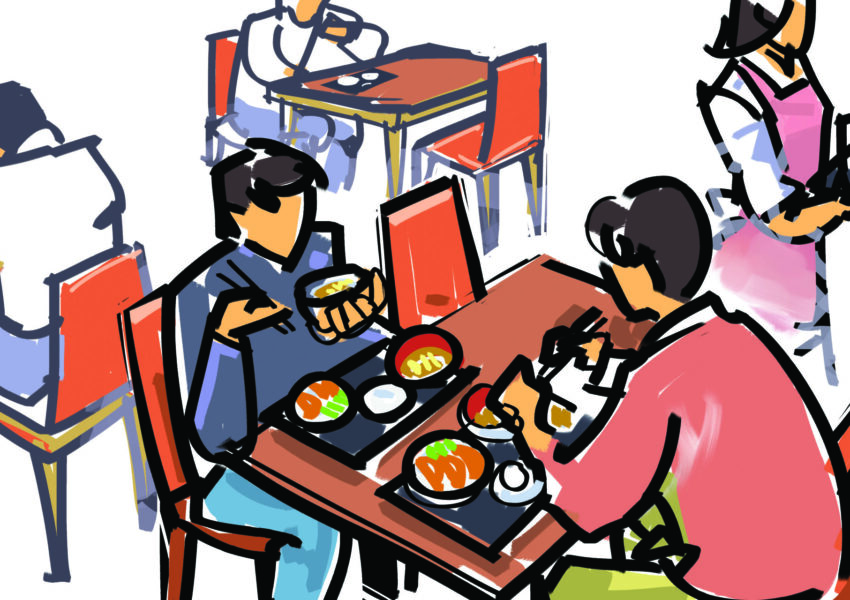
These powerful poems are paired with illustrations that bring extraordinary energy to the page. I am deeply grateful to these artistic collaborators, as I am to Sara Camp and Rosalind and the whole SFA team. Read these poets who, in sharing their new work, teach me what it means to show up in this impossible time and keep going.
Sandra Beasley is Gravy’s poetry editor. She is the author of four collections of poetry and a memoir. She lives in Washington, DC, and guest-edited the spring 2026 issue (#99) of Gravy quarterly.
SIGN UP FOR THE DIGEST TO RECEIVE GRAVY IN YOUR INBOX.