
Rise and Shine? As it expands into the Midwest, Bojangles risks losing something in translation.
by Hanna Raskin

Korrie Gorman heard the news from her friends. Then she shared the intel with her eight-year-old daughter.
Bojangles was coming to Columbus, Ohio.
“We love it so much,” said Gorman, who lives about thirty minutes west of the new-construction nexus where the Charlotte chain situated its fourth Midwestern location. Previously, she could only get her Bojangles fix on road trips. “We always stop at Bojangles for a chicken biscuit on the way to Florida.”
In much the way that a changing climate has dislocated weather events—with snow falling on Los Angeles and heat waves enveloping Portland, Maine—recent economic and demographic shifts have scrambled the fast-food restaurant map. Now eaters in a hurry can order a Torchy’s Tacos’ beef burrito in Raleigh or a Culver’s root beer float in Rogers, Arkansas.
At the time of this writing, it wasn’t yet possible to score a Bojangles’ biscuit in the Buckeye state. Following a January groundbreaking, construction on the restaurant—the first of fifteen Bojangles planned in central Ohio—was delayed repeatedly by uncommonly wintry conditions. Blame the aforementioned climate change.
I paid a visit to the unoccupied building this summer anyhow, curious about what culinary philosophies or breakfast practices Bojangles might bring beyond the South as it presses ahead with expansion to Chicago, Baltimore, New York City, and Las Vegas, a city where twenty new locations are in the works.
Obviously, cultural diplomacy isn’t Bojangles’ calling. It’s been a privately held company since a pair of New York investment firms acquired it for $593 million in 2019, which means its purpose is profit. Presumably, that’s why the chain announced this year that all new locations henceforth will serve boneless tenders, rather than chicken by the piece, and sell blueberry milkshakes.
Still, I wondered: Could a chain identified so definitively with the South nudge the region’s boundaries outward a bit? Might its menu help establish havens of Southerndom in unexpected places?
That wasn’t what was on Gorman’s mind when I met the interior decorator in a parking lot adjacent to the forthcoming Bojangles. As she surveyed the boxy beige structure, emblazoned with the slogan next level southern flavor since 1977, she thought back on those road trip sandwiches.
She was sure she’d never tasted anything like them in her hometown.
“Maybe Chick-fil-A is similar,” she said tentatively, seeming reluctant to offer an answer that could be construed as not-nice. “But they don’t have those biscuits.”
Might Bojangles’ menu help establish havens of Southerndom in unexpected places?
Even though Columbus, Ohio, is proud of its status as a doughnut town, it’s not devoid of biscuitry. Local versions may not possess the otherworldly powers attributed to the pastry by smitten Southern eaters and upbeat Bojangles execs, but there isn’t much involving flour that Midwesterners haven’t mastered.
At least until Bojangles opens, the best-known biscuit in the Columbus area is the one on the menu at Bob Evans. The 437-location casual dining chain and freezer-aisle favorite is headquartered just north of the city. Developed to accompany gravy made from Evans’ sausage, the Bob Evans biscuit is famously six-sided. “Bob did it that way because it created less waste,” said Casey Stevens of Plain City, Ohio, who worked in the company’s test kitchen for seven years before losing her job in a round of pandemic layoffs. She launched her Biscuit Boss food truck in 2021.
“It took me about six months to perfect the recipe, but we’ve found a niche,” Stevens told me on a Sunday morning, when her truck was parked at a plant nursery. “Biscuits are very versatile.”
At Biscuit Boss, if customers are wondering what to order, Stevens is likely to suggest the French toast bites, made from chopped-up biscuits tossed in sugar and glazed.
Almost a century earlier, another Ohioan had an idea about how to reconfigure biscuits. Henry D. Perky invented the slim shredded wheat biscuit, promoted in 1922 as “delicious” when mounded in a bowl with hot milk. “It is the only cereal food made in biscuit form,” a print ad promised.
It’s not a rap on Columbus’ biscuits to say their producers always seem to be on the lookout for something else to do with them. When I stopped by a café called Basic Biscuits, Kindness, and Coffee, the woman who took my order told me proudly that the bakery’s biscuits made an excellent quiche crust.
Regardless of why Midwesterners value their biscuits, it’s getting harder to find the homemade kind there, as Bojangles’ strategists may have noticed.
“I’m a spoiled sunnabitch,” Mark Van Hook, a fifty-six-year-old auto mechanic told me when I asked how he liked the biscuits and gravy he was eating at a Bojangles in Normal, Illinois. “I get up on Sunday and make my own biscuits and gravy.”
Even though Van Hook learned biscuit secrets from his mother as a kid in nearby Bloomington, he agreed to meet his friend Rich Jones for breakfast at Bojangles because they both wanted sausage gravy. Jones, an auto body technician, explained, “They’ve got the market cornered now, because the only one that does biscuits and gravy anymore is—”
Van Hook interrupted, “Hardee’s.”
Nodding, Jones continued, “McDonald’s doesn’t do it. Burger King’s never done it. When I worked at Dairy Queen, we used to make biscuits from scratch every morning, but Dairy Queen dropped breakfast all together. It’s just Hardee’s, but they want [six dollars] for it.”
Unlike Van Hook and Jones, I don’t have to look far for a superlative fast-food biscuit. There is a Bojangles nine blocks north of my house in South Carolina that serves a biscuit with boundless loft and a buttermilk twang. But on a recent Saturday, I went another 898 miles to try the biscuits—and test my theory of cultural seepage—at the northernmost Bojangles in the country.
In 2019, Bojangles partnered with Love’s Travel Stops to open locations in states where it previously didn’t have a presence. The outpost in Normal, one of three now operating in Illinois, opened in December 2022.
Since the restaurant is relatively new, I’m compelled to forgive the biscuit I was served, which bore an uncanny resemblance to a hamburger bun. When I posted a picture of my breakfast on Instagram, meaning no mockery, Southerners rose up in disgust.
“That looks awful,” Davidson, North Carolina restaurateur Katy Kindred weighed in.
I didn’t bother telling Kindred that it tasted as dense as it looked.
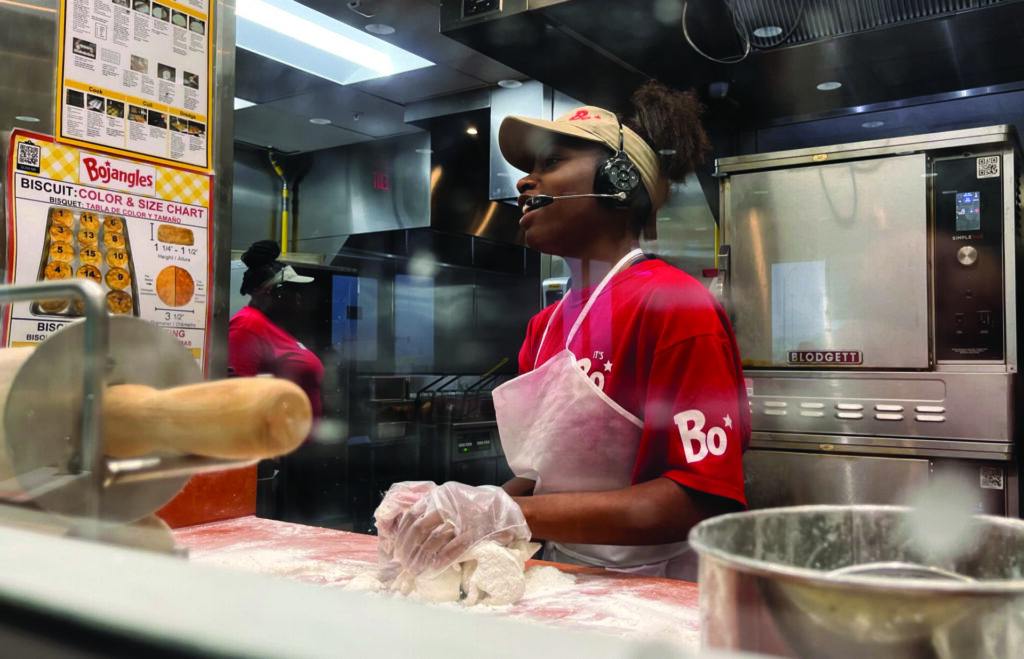
For Korrie Gorman’s sake, I hope the Bojangles employees in Columbus have greater biscuit facility. Maybe, like the workers at the Bojangles near my house, they’ll tease each other about the broad contours of that morning’s biscuits or ask customers if they wouldn’t mind waiting a few minutes for the next batch.
Then again, maybe they won’t. As a Normal employee who goes by the name Jay Dog has concluded, it’s an attitude toward biscuits that determines the Southern feel of Bojangles, more so than the recipe for them, or even the intensive training that Bojangles offers.
Jay Dog is a big fan of the Southeastern United States. He was skeptical when a boss at another job sent him on a work trip to Huntsville, Alabama, but he came home to Illinois with dreams of going back. “I’ve been all over the United States, and I know where I would live and I would not live,” he told me. “Alabama is in my top four.”
According to Jay Dog, there is nothing Southern about the Bojangles in Normal, Illinois.
“Sorry, no,” he said, pinning the difference on the people. In the South, “there’s more of a folksy feel,” he continued, describing the conversations he’d expect to overhear in a Southern Bojangles as, “‘We’re all here, and then after our time here, you’re going to get the [utility] trailer, and we’re going to do this [and] that.’”
Jay Dog was generalizing, of course. But I think what he meant is that Southerners are apt to think of food as part of life, rather than an interruption of it. As someone who grew up in Michigan, that read rings true. My family’s 5 p.m. dinner often consisted of a dish romantically referred to as “meat-and-string beans,” served with a glass bottle of pop that had been opened a few days prior and preserved with a plastic stopper. For years, I was baffled by people saying they liked macaroni and cheese because our household’s version was boiled Creamettes studded with cubes of unmelted Kraft cheddar.
The enthusiasm that Jay Dog described is familiar to Shafkat Anowar, a Dallas Morning News photographer. In June 2023, he covered the opening of one of the first Bojangles in Texas—and the North Carolina transplants who eagerly flocked to it.
“We live so that we can cherish food, that is like the core part of the culture,” Anowar, who was born in Bangladesh, said of his countrymen. “So, when I saw the excitement [at Bojangles], that made sense.”
By contrast, Bob Evans’ preference for culinary efficiency remains prevalent in the Midwest. When I asked a desk clerk at the McLean County Museum of History if she could suggest somewhere distinctive for lunch, she instructed me to take a left on Washington, a right on Main, and another left on Front Street. The walk wouldn’t take more than a minute or two, she promised, without providing the restaurant’s name.
I looked at her blankly. “But what do they serve?” I asked.
“Oh,” she said. “Salad.”
Restaurant chains aren’t in the business of shifting cultural values
Bojangles isn’t likely to budge that utilitarian approach to food, even if the names of North Carolina cities are printed on the restaurant’s to-go cups, and a story about the company’s founding is displayed prominently near the entryway to the dining area.
After all, restaurant chains aren’t in the business of shifting cultural values, which is a risky proposition from a financial standpoint. Big food companies can amplify trends and perfect systems, but there’s little money to be made in pioneering new ways of thinking. Americans liked getting pizza delivered before Domino’s sped up the process. They enjoyed sugar in their coffee long before Starbucks rolled out Frappuccino drinks.
What fast food companies such as Bojangles do well is meet existing demands, such as central Illinois’ desire for a freshly made biscuit, built to bear sausage gravy, rather than the cultural weight it carries in the South.
At Bojangles, Jones said, “I’ve never gotten a hard biscuit.”
“That’s what I hate about going to McDonald’s sometimes,” he continued. “I told them, I feel like I’m getting your leftover biscuit from yesterday. Like, I have to go back through the drive-through and say, ‘Hey, can I get a soft biscuit?’ …Ain’t nothing more frustrating, especially if you’re traveling on the highway.”
In good capitalist fashion, Bojangles may have solved that problem. Under its deal with Love’s, the chain is supposed to open forty locations at interstate exits across the country. So, like the Ohioans who associate Bojangles with long hauls, Southerners will soon be able to land a chicken biscuit after logging many miles on the open road—they just shouldn’t expect to feel any closer to home.
Hanna Raskin is a Gravy columnist. Her newsletter, The Food Section, is published on Substack.
SIGN UP FOR THE DIGEST TO RECEIVE GRAVY IN YOUR INBOX.