
A Plate Full of Plains Home cooking in the Carter White House
by Adrian Miller
I’ve had a couple of Georgians on my mind of late.
In February 2023, Jimmy Carter, the thirty-ninth president of the United States, announced that he had entered hospice care. At the time of this article, he’s still with us at age ninety-eight, and he’s the longest-living president in United States history. In August 2023, former First Lady Rosalynn Carter celebrated her ninety-sixth birthday amidst her own health challenges. These two remarkable and resilient people have come to epitomize what a good life, guided by faith and marked by love and service, can be. Going from berated to beloved has been quite a star turn for a president who left office with low approval ratings. The Carters’ successful and very public post-presidency “second act” has made the twilight of their lives so meaningful to us today. Since leaving the White House, President Carter continued to champion human rights, mediate international disputes, build houses with Habitat for Humanity International, author several books, and teach Sunday School at Maranatha Baptist Church in Plains, Georgia.
I was a child during President Carter’s tenure, but I still have vivid memories of his infectious smile, the slight drawl of his Southern accent, and a sense that he was trying to do the right thing. I also remember the serious headwinds he faced: inflation, long gas lines, and the Iran hostage crisis. Decades later, a visit to the Jimmy Carter Library and Museum in Atlanta, Georgia, renewed my interest in his administration. I was there to research African American presidential cooks. I wasn’t interested in how President Carter met the policy challenges of his term; I just wanted to know what he ate. I fully expected to review the same information that I’d found in other presidential archives, namely state dinner menus and maybe a few recipes. I was delighted to find much more: a treasure trove of hundreds of private dinner menus in the executive residence. It’s a food nerd’s dream, and one that rarely comes true—whether for privacy reasons or perceptions of historical insignificance, such menus are seldom archived.
The American public tends to demand the impossible from its presidents. We want them to be exceptional people, but we also want them to be a lot like us. During campaigns, voters crave ways to connect with the person who might lead the nation, and food has often proved to be an effective window into the presidential soul. A politician who is knowledgeable about, and prefers, so-called “traditional” American foods makes a strong case for having “the common touch.” Of course, there are nearly as many American diets as there are Americans. Even so, an elected official’s choice to eat foods generally regarded to be old-fashioned, patriotic, or humble tends to instill confidence that the nation is in good hands.
Carter tapped into this sentiment by playing up his roots as a peanut farmer and a country-food-loving family man. In a widely syndicated March 1976 column, then-candidate Carter told The Washington Post’s Sally Quinn that, at home in Plains, Georgia, he and Rosalynn shared cooking duties. “We divide the responsibility,” Carter said. “I’m a fairly good cook. I like Southern foods, corn on the cob, collard greens and turnips, grits, fried chicken. I like plain food.” Those sentiments certainly work on the campaign trail.

First Lady Rosalynn Carter and President Jimmy Carter have lunch on the White House patio, August 4, 1977.
Just as the Nixons and Fords had done, the Carters put White House Executive Chef Henry Haller in charge of all family and guest meals in the executive residence. Swiss-born Chef Haller cooked for President Johnson for a few years, but the family dinners were prepared by an African American cook from the Johnsons’ native Texas named Zephyr Wright. Some suspected the Carters would bring a family cook to ensure the consistency of the Southern specialties they loved. That never happened. When the First Family traveled away from the White House, such as to Camp David, the culinary team in the US Navy–run White House Mess handled food operations.
The Carters entered the White House amid a swirl of food trends. In the 1970s, salad as a first course or entrée was in vogue as a healthy and economical choice. First Lady Rosalynn Carter was in step with this trend by writing a salad-centric memo for the culinary staff on stationery with an aboard air force one header:
“M—
There are several salads that Jimmy prefers. Please tell Ron [Jackson]
(Also Henry Haller)
* Spinach and mushroom
1. Tossed salad & bleu cheese dressing
2. Avocado & grapefruit
3. Caesar salad
4. Pear salad & grated cheese & a dash of mayonnaise
5. Congealed salad with mayonnaise
6. Cole slaw
7. Carrot & raisin
RBC doesn’t like heart of palm
JC does not like cranberries
JC does not like thousand island [dressing]”
We may be turned off today by some of those favorites, but copious amounts of congealed salad and mounds of mayonnaise were midcentury staples that survived into the Carter era and beyond.
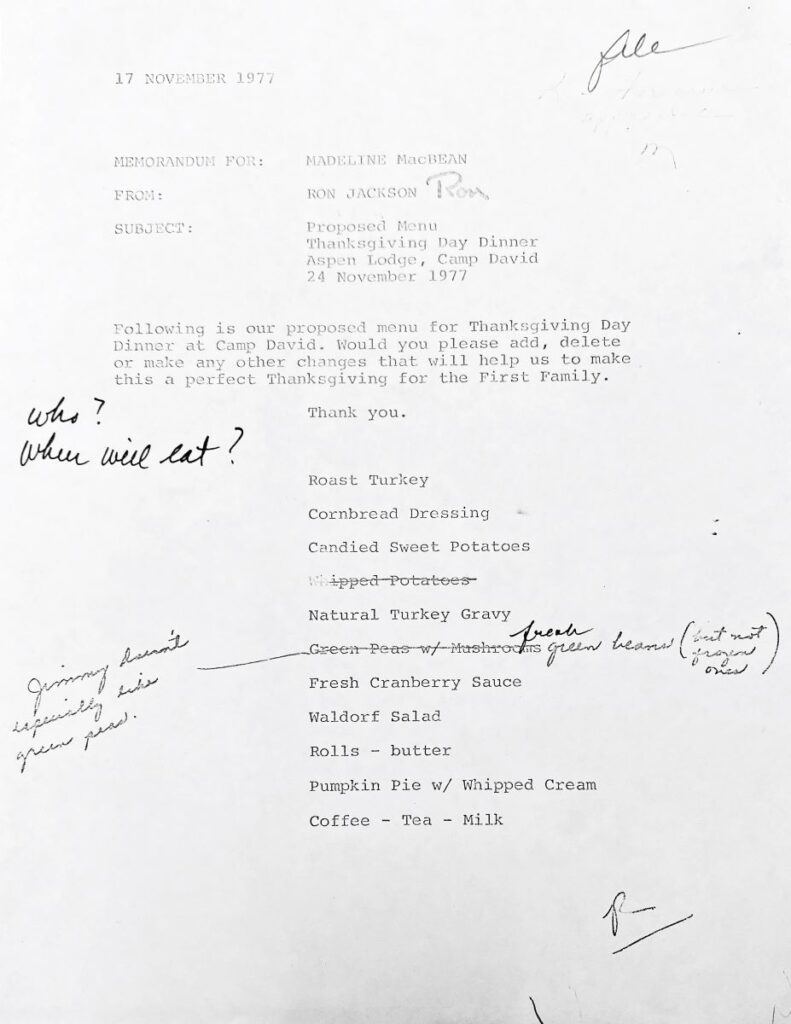
The Carters’ very first presidential Thanksgiving on November 24, 1977, had a bit of Southern influence. Ron Jackson, the White House Mess food-service coordinator, proposed a classic Thanksgiving menu that included turkey, cornbread dressing, sweet potatoes, cranberry sauce, and more, and invited the First Lady’s feedback. She crossed out “Whipped Potatoes” and “Green Peas w/ Mushrooms,” suggesting fresh (not frozen) green beans in their place. “Jimmy doesn’t especially like green peas,” she wrote.
After the Immigration and Nationality Act of 1965, the United States opened its borders to waves of immigrants. Many opened restaurants that introduced the cuisines of their homelands to their new neighbors. In time, Americans patronized these restaurants and embraced their fare. As Americans of many backgrounds became more comfortable with newly arrived cuisines—Chinese, in particular—cookbooks and television cooking shows encouraged them to try making some of those dishes at home. On April 11, 1978, the Carters’ dinner menu reflected how ubiquitous certain dishes had become: chicken chop suey, egg rolls with shrimp, and steamed rice. Egg foo yong and chow mein weren’t on the list that night, but they popped up on other menus.
Even as the first family’s diet reflected a national trend toward palate-broadening, Southern staples were ever-present on their White House table. The Carters incorporated dishes such as ambrosia, cheese straws, and spoonbread, believed to be derived from an Indigenous American dish. Then there was the Friday-night fish dinner, a tradition in many pockets of the South. It’s usually a humble meal, but by being prepared and served at 1600 Pennsylvania Avenue on White House china, even a simple cornmeal- or flour-dusted fish must have felt elevated. The Friday, September 26, 1977, menu was a classic: “Southern Fried Fish, French Fries, Hush Puppies, Coleslaw.” Sometimes White House chefs varied the preparation and type of fish. For example, on Friday, July 4, 1980, the Carters dined on: “Broiled Filet of Trout, Fried Eggplants, Broccoli Spears, Mixed Green Salad w/ Bleucheese (sic) Dressing.” Even though barbecue is a Fourth of July mainstay, the Carters’ devotion to fish was unwavering. An avid fly fisherman, Carter loved to catch trout, though there’s no evidence he supplied the catch for that Independence Day dinner.
Weekend barbecues were also a fixture of the Carter White House. The standard menu included pork spareribs, potato salad, and coleslaw. Other times, the barbecue was chicken or chopped pork. On Saturday, March 11, 1978, things got a little weird when it came to the barbecue side dishes. Next to the ribs were pearl onions, boiled green cabbage, cornbread, and fresh pear salad.
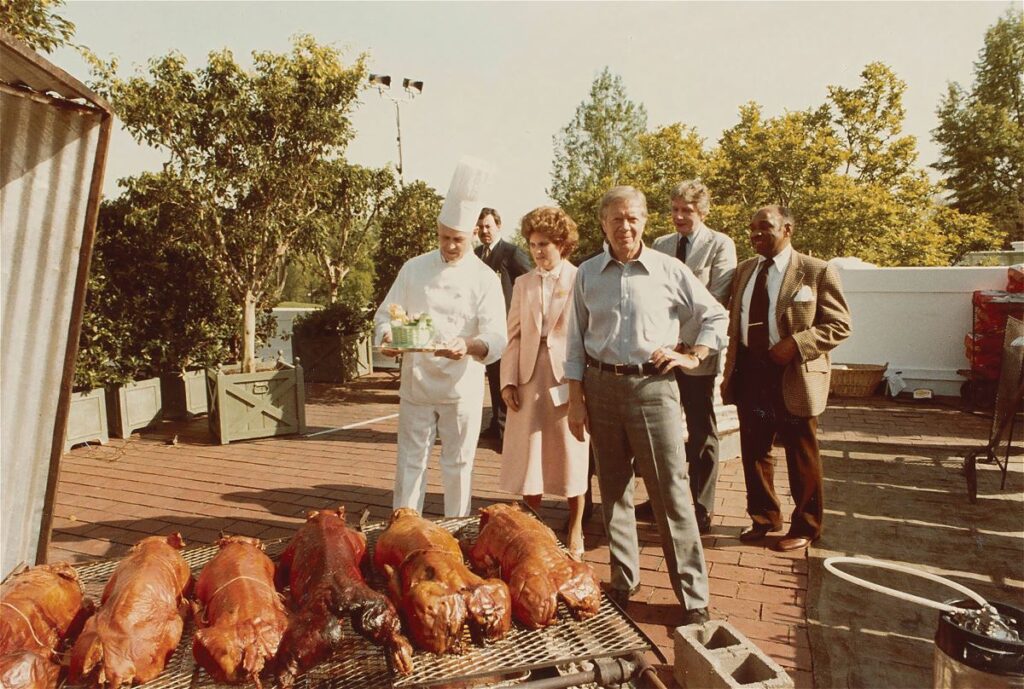
Courtesy Henry & Carole Haller and family via the White House Historical Association.
The ritual of smoking and grilling meat also played a tiny role in diplomacy. According to a Washington Post story that carried the headline “Barbecue Diplomacy,” after trade negotiations broke down with Japan, the Carters hosted an elaborate West Terrace barbecue for Japanese Prime Minister Masayoshi Ōhira on May 2, 1979. The menu consisted of barbecue chicken, suckling pig, and—wait for it—buffalo. Passersby could smell the wafting smoke for blocks. Carter is quoted as toasting Ōhira that evening, saying the day was “one of the most productive days in my whole diplomatic life.” Ōhira was quoted as saying the buffalo was “a little coarse.”
Additional menus offer a sense of how the Carters were nourished during the administration’s other big moments. Though I did not see menus from the summit between Egyptian and Israeli leaders that led to the Camp David Accords, I did find clues as to what President Carter ate in the early days of his biggest challenge: the Iran hostage crisis. On November 4, 1979, militants seized the United States Embassy in Tehran and took fifty-two people hostage. That week, the Carters ate dinners featuring broiled tenderloin tips, coquille of crabmeat, stuffed saddle of lamb, and egg foo yong with Shrimp. An eclectic mix for sure, but the meal served on Wednesday, November 7, is noteworthy. The menu included fried chicken, hot biscuits, butternut squash, braised lettuce, Waldorf salad, and dessert by request.
I’m guessing that this taste of home brought much-needed comfort to the Carters and sustained them during an extremely stressful situation.

Chef Hans Raffert, Amy Carter, and Rosalynn Carter in the White House kitchen, January 24, 1980.
Fish fries and barbecues have long been political campaign mainstays. On August 7, 1980, just a week before President Carter accepted his second nomination for president at the Democratic National Convention in New York, the First Couple hosted a barbecue at the White House. The event was intended as a thank-you to Carter’s supporters, but in retrospect it served as an unintentional farewell. Traditional pits were dug on the White House South Lawn, and tables groaned with smoked pork, Brunswick stew, potato salad, rolls, sweet pickles, and strawberry cobbler. As election day drew near and campaigning more intense, the comfort of familiar foods is suggested in the menu for Thursday, September 4, 1980: “Soft Fried Country Ham, Red Eye Gravy, Grits, Collard Greens, Cornbread, Lettuce and Tomato Salad.”
Two months later, Carter would lose his re-election bid to Ronald Reagan. With the inauguration of the fortieth president three weeks away, and the Carters’ time in the White House virtually at an end, on Wednesday, December 31, 1980, menu spoke lovingly of Plains, where it all began: fried chicken, hot biscuits, mustard greens, yellow turnips, and coleslaw. Desserts were served on request; perhaps they included pecan pie or even pound cake, stars of the Southern larder at that time of year.
This is just a taste of the Carters’ White House diet. It does make me wonder what the former first couple is eating now; if the same foods that sustained them all those years are nourishing them now in the twilight of their lives. And if, every now and then on a Friday, someone fries up a tray of fish for them and their loved ones.
Adrian Miller is a former White House staffer and author of The President’s Kitchen Cabinet: The Story of the African Americans Who Have Fed Our First Families from the Washingtons to the Obamas.
SIGN UP FOR THE DIGEST TO RECEIVE GRAVY IN YOUR INBOX.