
Where Your People From?

In memory of Celestine Chaney, Roberta Drury, Andre Mackniel, Katherine Massey, Margus Morrison, Heyward Patterson, Aaron Salter Jr., Geraldine Talley, Ruth Whitfield, and Pearl Young, murdered at the Tops Friendly Markets in Buffalo, New York, on May 14, 2022.
By Audrey Petty
There is nothing new under the sun, but there are new suns. —Octavia Butler
I grew up on the South Side of Chicago; first in the black, working- and middle-class neighborhood of Chatham, and then in Hyde Park-Kenwood, a relatively well-to-do, racially integrated community and home of the University of Chicago. As a kid in the 1970s and 1980s, I experienced my coming-of-age in the city in fundamentally similar ways to Isabel Wilkerson, author of The Warmth of Other Suns.
In a 2021 TED talk, Wilkerson recollected, “…growing up in Washington, DC, surrounded by people whose parents or grandparents had all come up from the South, it was something that was just part of the atmosphere. It was in the food. It was in the accents. It was in the culture. It was the language. It was the music. It was everywhere. But no one was speaking directly about [it]—no one was giving it a name.”
My mother, Naomi Elizabeth (Jackson) Petty, was born and raised in El Dorado, an oil town in southeastern Arkansas. My father, Joe Louis Petty, grew up in two places: a coal mining camp in Parrish, Alabama (about an hour north of Birmingham, in the northwestern part of the state), and a farm on the outskirts of Columbus, Mississippi. My parents met and fell in love as students at Talladega College in the late 1950s. After they married, they moved to Chicago, where they raised me and my two sisters. My grandfathers died before I was born, my grandmothers passed when I was very young, and my parents’ siblings were spread out all over. Unlike many of my childhood classmates and friends, who spent long stretches and seasons down South with grandparents and extended family, my travels to Parrish, Little Rock (where two of my mother’s siblings settled), and other parts of the South were special occasions rather than routines. It took over forty years for my mother to return to El Dorado. My sisters and I made a Christmas gift of it—all expenses paid. She took us with her, and she talked about that trip for the rest of her life. It was more than a homecoming for my mother. It was a pilgrimage.
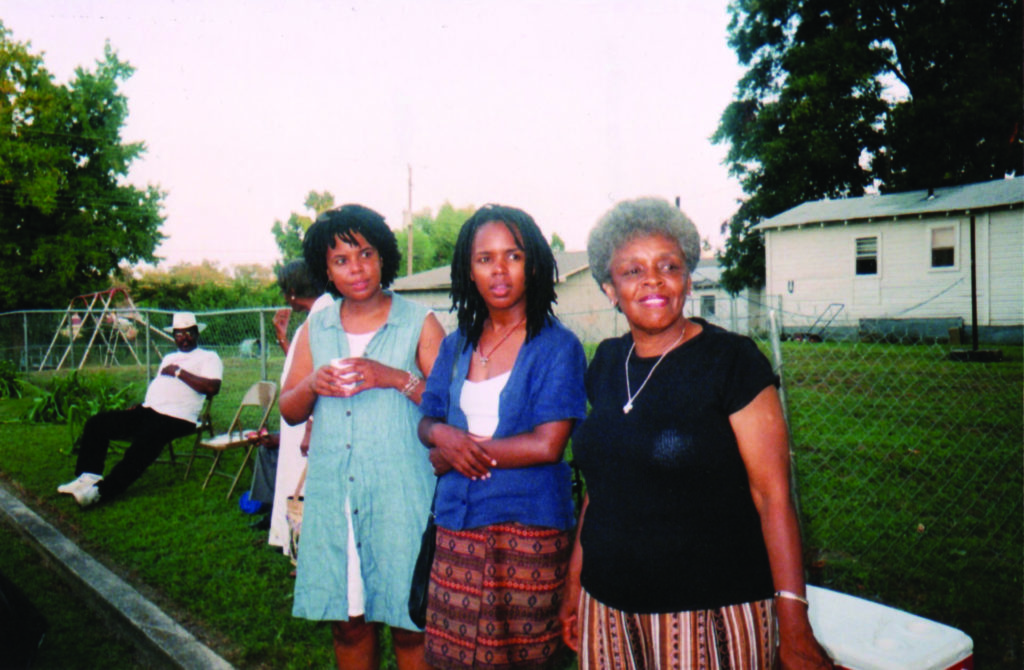
As I now parent a teenager myself, I think about the many ways love, silence, and protection were conveyed in the household my parents created. There was so much that they didn’t directly pass on to my sisters and me about the finer details of their home communities, nor about the horrors of Jim Crow that they’d known and survived. When I ask my father why he became a scientist, he tells me he was always interested in history as he was coming up—more than anything, he wanted to learn about the past. But so much of what he was given to read in school, he knew to be racist and untrue. And so he came to have more confidence in the integrity of the periodic table.
Reading about the Great Migration in college made Chicago—and the United States—sharply visible to me. And each time I returned to the South as an adult, it felt like a strange, powerful reunion. I started to grapple with the South that had been shared with me through custom, mores, and memory. And I began to deeply appreciate all that had been shared by heart, and to realize that my education in the Great Migration has been lifelong.
There was so much that my parents didn’t directly pass on to my sisters and me about the finer details of their home communities, nor about the horrors of Jim Crow that they’d known and survived.
This issue of Gravy explores Great Migration legacies in the Midwest. The authors write from and of their homeplaces in Illinois, Indiana, Michigan, Minnesota, Missouri, Nebraska, Ohio, and Wisconsin. They write from and of kitchen tables—complicated sites of storytelling and instruction. They ponder silences and mysteries. They invite us to sit with the act of migration itself. At the very least, it is some kind of leap; an act of seeking. These Gravy authors document leaps and arrivals and narrate how worlds were remade along the way.
Any primer to the Great Migration must explore the push and pull factors that informed Black peoples’ decisions to depart the South. These are explored here as well, most notably in Lyletta Robinson’s “Come Here and Watch” and Emily Lansana’s “Of Chitlins and Care.” And any true introduction to this mass movement of seven million Americans, between 1910 and 1970, must also begin to reckon with all that the migrants brought with them. As this entire issue of Gravy evinces, the migrants’ bounty is impossible to fully document, whether measured in material or metaphysical terms.
When my father moved to Chicago as a young man, in the early 1960s, he didn’t carry many physical keepsakes from Alabama or Mississippi, where so many of his family members still lived. One of the few items he brought with him was a sturdy, worn back brace that my grandfather John wrapped himself into after long, grueling days working in coal mines. It was something my father wore for support rather than recovery, as he managed heavy lifting and building projects around the house. And although he wasn’t very religious, he brought one of Grandma Mattie Will’s Bibles with him. Huge and leather-bound, it held our family tree, with birthdates recorded in cursive in the back. My mother didn’t carry many physical things either, though I do recall elegant-looking sheet music from Grandma Ruth’s library, and the ancestor photos our mother framed and cherished that my sisters and I now share.
When we moved from our walk-up in Chatham to more space in Hyde Park, our mom filled our backyard with bee balms and impatiens—bright, happy flowers remembered from her childhood in Arkansas. My mother was also an excellent cook. And on special occasions, she would prepare dishes that did not have appended recipes, working from memory alone. One of my favorites was shrimp Creole, a light, tomato-based stew with celery, tomatoes, bell peppers, and fresh or frozen shrimp. My sisters and I were her assistants, deveining shrimp and chopping all the veggies just so. When my mother served this dish over white rice, she’d make a small song of ta-da, unveiling it at the long buffet table, set with our nicest plates and linen napkins. Like black-eyed peas, shrimp Creole was New Year’s food, and for us, it was a dish infused with good fortune.
SIGN UP FOR THE DIGEST TO RECEIVE GRAVY IN YOUR INBOX.